This month in AI: How organizations can scale convergent technology
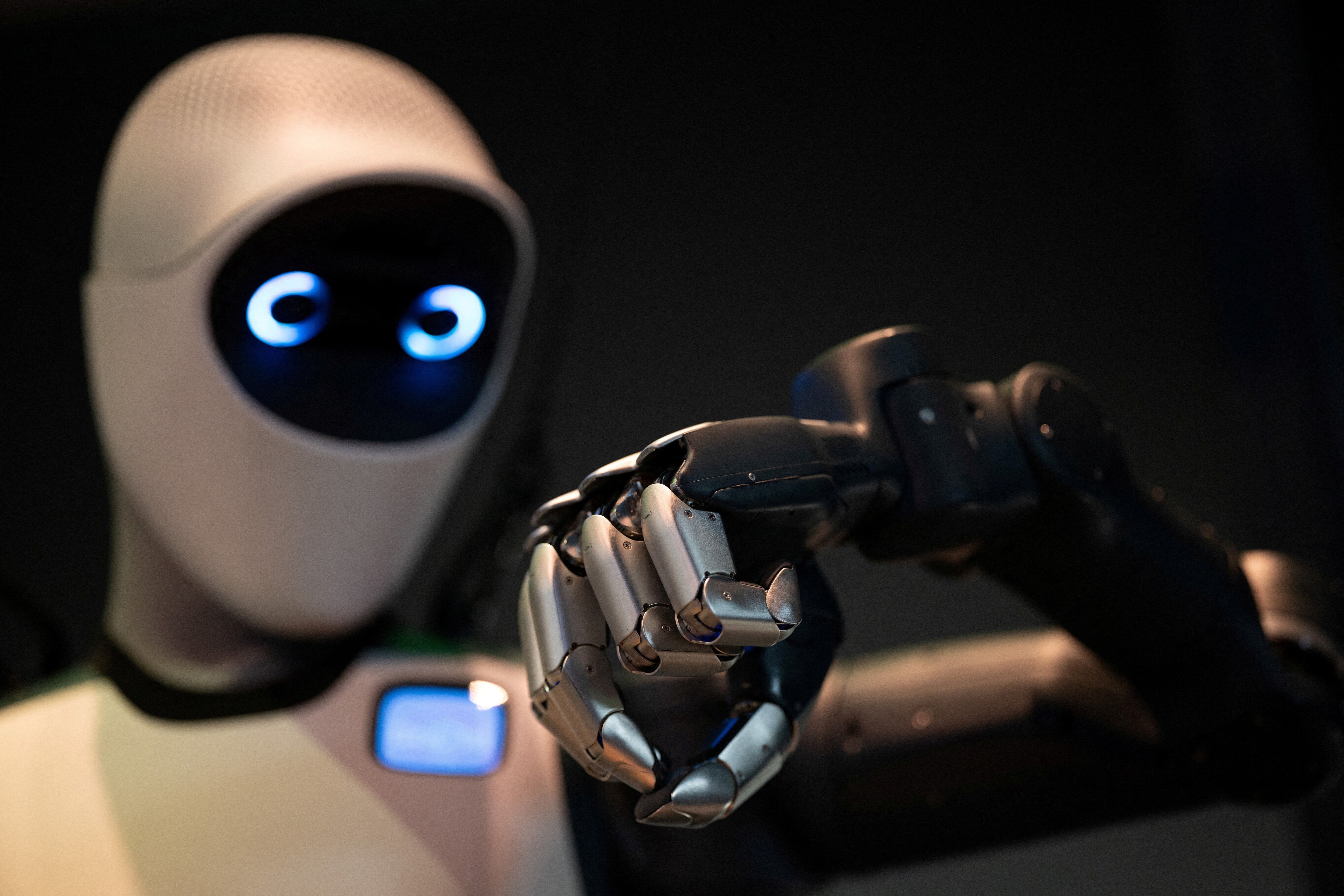
Cognitive AI robotic systems are being propelled to maturity as part of a technology convergence. Image: REUTERS/Carlos Barria TPX IMAGES OF THE DAY
- This month in AI: The Forum's latest Technology Convergence report explores how innovations like AI can be brought together to scale effectively.
- Leading AI CEOs appear together at NVIDA GTC 2026 to back open-proprietary models.
- The EU's code of practice on AI-generated content has been simplified and streamlined ahead of implementation this summer.
1. Big picture: Scaling convergent technologies
How can organizations scale convergent technology, such as AI, into widespread adoption and impact? That is the key question explored in the Technology Convergence: The New Logic for Competitive Advantage report from the World Economic Forum.
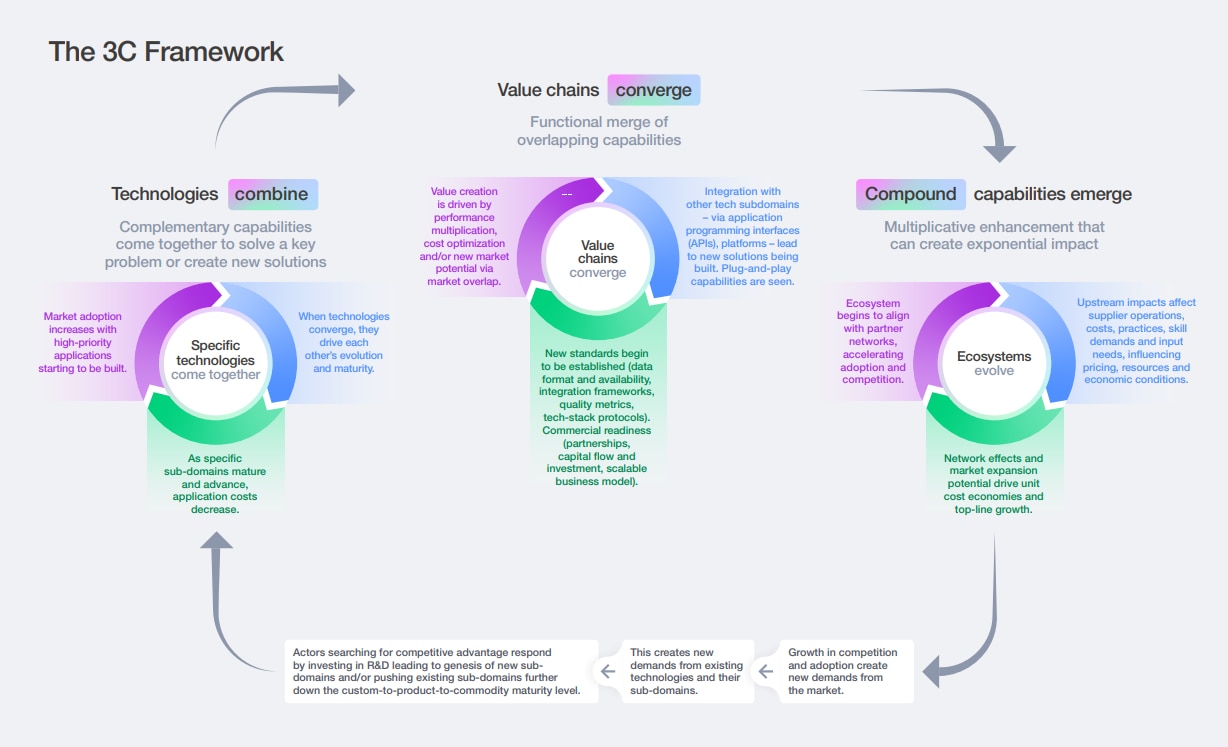
Last year, the report introduced the 3C Framework. The first C, Combination, considers how complementary capabilities can be brought together to solve problems or create new solutions. The second, Convergence, looks at the functional merging of overlapping capabilities within value chains. The third C, Compounding, considers how new capabilities emerge, creating exponential impact.
This year's edition recognizes how the 3Cs operate as an interconnected system, rather than a linear sequence, where compounding of capabilities leads back to technologies combining. "Convergent innovation does not unfold on a predictable schedule," the report states. "It rewards those who stay the course."
In addition, deep dives from key industries show how AI and other technologies are being brought together to advance promising solutions and ensure they have a durable impact. In healthcare, for example, cognitive robotic systems are being propelled to maturity as AI systems, such as object detection, small/efficient models and multimodal models, combine with other sectors, including advanced alloys in advanced materials and adaptive and intelligent controls in robotics.
And in intelligent energy grid systems, predictive modelling and reinforcement learning are being utilized alongside solid-state battery advancements and real-time 3D syncing.
You can read the full report here to find out more about how technologies can be effectively converged to create lasting value and unlock new capabilities.
2. Market moves: AI power consumption, ecosystem models and new EU guidance
Power use in the US will hit record highs in 2026 and 2027, with AI and cryptocurrency data centres playing a large role in surging demand, the Energy Information Administration has said. Projections in the latest Short-Term Energy Outlook indicate demand will rise from a record 4,195 billion kilowatt-hours (kWh) in 2025 to 4,244 billion kWh in 2026 and 4,381 billion kWh the following year. The data follows calls from experts to improve energy system flexibility and utilization to support AI growth. Writing for the Forum, Amit Narayan and Shaneez Mohinani, respectively the CEO and Head of Strategy & Operations at GridCARE, suggest that a 1% improvement in system flexibility could unlock 100 GW in the US alone, equivalent to $500 billion in avoided infrastructure costs.
CEOs from some of the world’s leading AI organizations have backed an open-proprietary ecosystem model. The leaders of Mistral, Perplexity, Cursor, Reflection AI and other businesses joined NVIDIA CEO Jensen Huang at the company’s GTC 2026 event in San Jose, California, to announce the Nemotron Coalition. The collaboration hopes "to advance open, frontier-level foundation models through shared expertise, data and compute". Participants are seeking to advance systems of models, where individual specialized systems work together to solve business problems. “What you want is a multimodal, multi-model and multi-cloud orchestra," said Perplexity CEO Aravind Srinivas. "All you’ve got to do is delegate your task. You don’t have to worry about which model is good at what - it’s for the orchestration system to figure it out."
The European Commission has released a second draft of its Code of Practice on Marking and Labelling of AI-generated Content. The code intends to support providers and deployers of generative AI systems in demonstrating compliance of obligations in the EU AI Act. Following feedback from participants and observers from industry, academia, civil society and beyond, the Commission says that the latest version is simplified and streamlined, providing more flexibility and reducing compliance burdens. The final code is expected to publish in early June, with rules taking effect on 2 August, 2026.
3. AI insight in a chart
4. More AI news on Forum Stories
While AI has offered many positives, it has also brought challenges. New figures from INTERPOL suggest AI-enhanced fraud is 4.5 times more profitable than traditional cybercrime methods. Tal Goldstein, Head of Strategy and Growth, and Giulia Moschetta, Initiatives Lead, Centre for Cybersecurity, at the Forum, have considered how private-public collaboration can bring new solutions and deploy new safeguards. Read the article here.
When considering adoption of new technology, conversations in businesses often centre around ‘winners and losers’, ‘disrupt or be disrupted’. But is this the right way to think about things? In this piece, Nezar Banabeela, CEO of Etihad Etisalat Company (Mobily) discusses why AI must instead be considered a cultural discussion, building a shared understanding of what different tools can and should achieve.
Yoshua Bengio, Professor of Computer Science at the University of Montreal, is widely considered one of the ‘Godfathers of AI’. Earlier this year at the Forum's Annual Meeting, he spoke to Radio Davos to discuss solutions to correct unwanted AI behaviours. You can read more about his conversation here or listen to it below.
License and Republishing
World Economic Forum articles may be republished in accordance with the Creative Commons Attribution-NonCommercial-NoDerivatives 4.0 International Public License, and in accordance with our Terms of Use.
The views expressed in this article are those of the author alone and not the World Economic Forum.

Forum Stories newsletter
Bringing you weekly curated insights and analysis on the global issues that matter.
More on Artificial IntelligenceSee all

Charlotte Edmond
September 16, 2026


