With industrial clusters, South Africa is moving up the manufacturing value chain
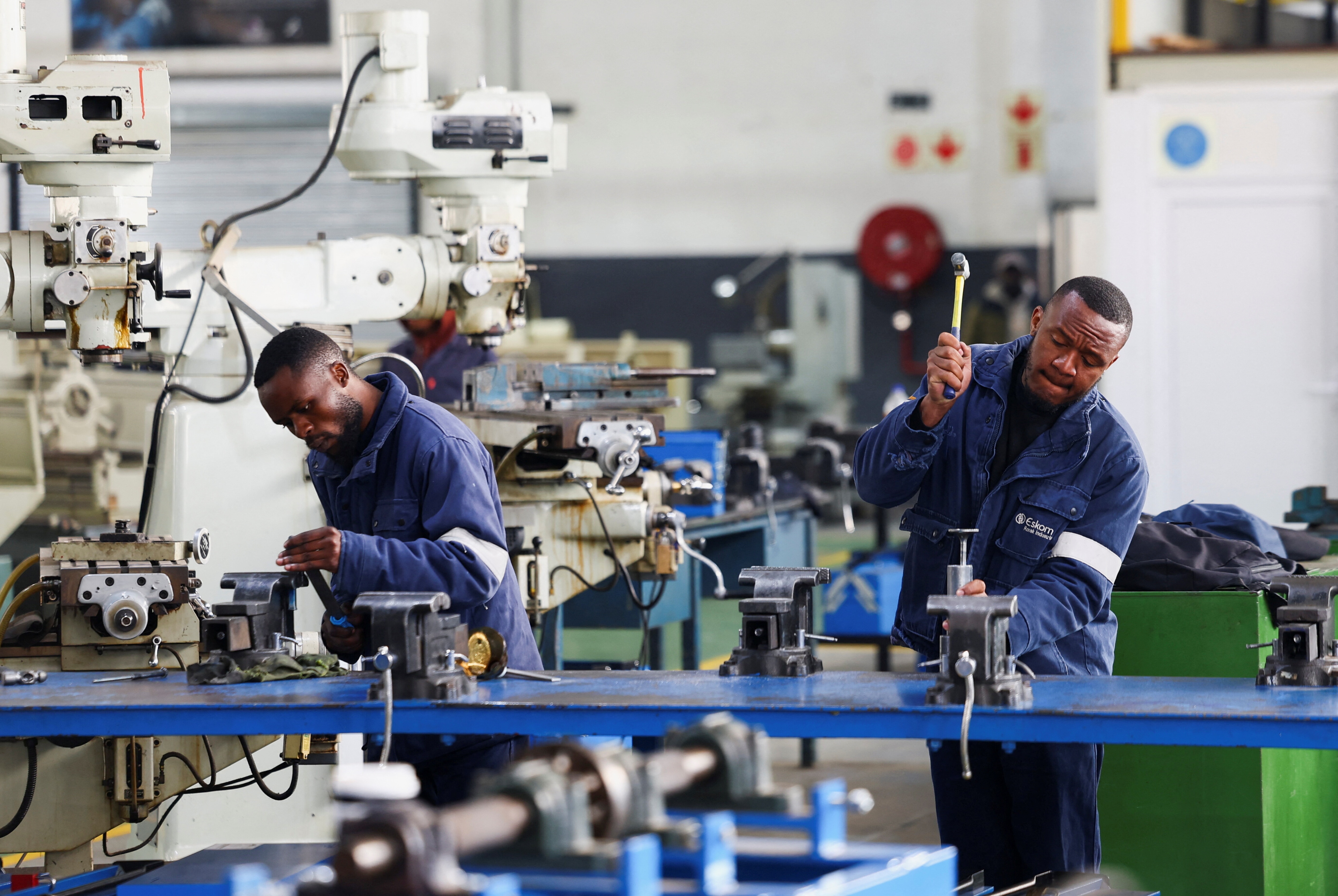
South Africa is embracing industrial clusters as part of its wider industrial strategy. Image: REUTERS/Siphiwe Sibeko
Mchenge Nyoka
National Project Coordinator, United Nations Industrial Development Organization (UNIDO)Lee-Hendor Ruiters
Strategy and Innovation Manager, Council for Scientific and Industrial Research (CSIR)- South Africa’s industrial clusters are proving that clean industrialization can attract investments boosting competitiveness and regional growth.
- With industrial clusters, South Africa is adding value to its mineral wealth and scaling clean-tech manufacturing.
- Two leading South African clusters have joined the World Economic Forum's Transitioning Industrial Clusters initiative.
Across the world, industrial clusters are at the heart of modern economies. They produce the materials, energy and goods that sustain daily lives. By concentrating production, consumption, infrastructure and talent in defined geographic areas, clusters enable industries to innovate faster, de-risk large-scale investments and remain competitive in a rapidly changing global economy.
This pivotal role is recognized by the World Economic Forum’s Transitioning Industrial Clusters initiative — a global network of 40 leading hubs advancing inclusive growth, employment and industrial decarbonization — as well as by the South African Centre for Industry and Technology (SACIT), which supports industrial transformation nationally. By linking local economies to global value chains, industrial clusters can attract investment, foster inclusive growth and accelerate decarbonization of industrial operations.
In emerging economies like South Africa, industrial clusters can also serve as critical engines for economic diversification, helping regions transition from single-sector dependency (such as mining or logistics) toward integrated value chains that include clean manufacturing, renewable energy systems and green export corridors. The cluster-based approach ensures that industrial transformation is not isolated within individual companies but embedded across entire regional ecosystems, allowing for far greater economic multiplier effects.
South Africa's leading industrial clusters
Two South African members have recently joined the World Economic Forum's Transitioning Industrial Clusters initiative: the Coega Development Corporation Industrial Cluster and the West Coast Industrial Hub. They are the first African clusters to join the platform.
The Coega Development Corporation (CDC) Industrial Cluster, anchored in South Africa’s Eastern Cape, is one of Africa’s largest and most diversified special economic zones. The cluster hosts a diverse portfolio of sectors, including automotive manufacturing, energy and renewables, maritime, metals and metallurgy, agro-processing and chemicals among others.
The CDC’s long-term strategy emphasises industrial diversification, infrastructure-led growth and socio-economic impact – and green projects are a major part of this. For example, the Coega Green Ammonia Project integrates large-scale wind and solar deployment, water desalination, green ammonia production and export infrastructure. The project represents an estimated ZAR 105 billion ($6.4 billion) investment and is expected to create more than 20,000 direct and indirect jobs.
The West Coast Industrial Hub, located in South Africa’s Western Cape, brings together the Saldanha Bay Industrial Development Zone, Wesgro, and the Atlantis Special Economic Zone. Anchored by South Africa’s largest natural deep-water port, the hub integrates maritime industries, steel and green-technology manufacturing and port-linked logistics.
The cluster aims to become a strategic hub for green maritime logistics. To support this ambition, the cluster has developed a Phase 1 master plan identifying the key strategic, technical and regulatory considerations required for the sustainable rollout of green hydrogen and Power-to-X development across the West Coast region. It is undertaking feasibility assessments for green hydrogen and green ammonia production projects with a combined investment value exceeding ZAR 100 billion ($6.1 billion).
How South Africa is embracing industrial clusters
The importance of clusters and the strategic advantage they offer is increasingly reflected in national and multilateral leadership agendas. In October 2025, South Africa’s G20 leadership supported the launch of the Sustainable Industrialization Hubs Coalition – an effort to localize clean-technology value chains, create quality jobs and advance industrial decarbonization at scale leveraging industrial hubs.
In South Africa, the Sustainable Energy Systems for Urban-Industrial Development (SESID) project launched in 2023 with a four-year duration, supports selected clusters through technical assistance, pilot low-carbon projects and de-risking strategies to build pipelines of bankable, investment-ready projects. Led by the United Nations Industrial Development Organization (UNIDO), the initiative is supported by approximately $1.3 million in direct funding from the Global Environment Facility and more than $13 million in co-financing from local partners.
Complementing this, South Africa’s Low-Carbon and Energy-Positive Industrial Spaces project, launched in April 2025 and funded by the Government of Flanders, promotes energy efficiency and distributed renewable energy in industrial spaces. Through energy and economic assessments, the creation of low-carbon energy guidelines, and the piloting of revenue-generating sustainable energy assets, the project aims to create self-sustaining, low-carbon industrial ecosystems.
Through these initiatives, selected clusters – including Coega – will pilot scalable decarbonization models that reduce emissions while enhancing competitiveness. This will position South Africa’s clusters as living laboratories for industrial transformation, where policy, innovation and investment converge, while demonstrating that sustainability and performance can go hand in hand.
What Africa and the world can learn from South Africa
Africa’s transition is emerging as a strategic pillar of global energy security and supply-chain resilience. The continent holds nearly 30% of the world’s known mineral reserves, essential for batteries, fuel cells and renewable technologies.
Industrial clusters provide the platforms to optimize energy demand, coordinate infrastructure, mobilize investment and accelerate technology deployment at scale, helping the continent move up the value chain into processing, component manufacturing and clean-tech assembly.
Rather than repeat the extractive models of the past, by harnessing industrial clusters, Africa can build value-added clean industrial ecosystems, from green hydrogen to critical-mineral beneficiation.
To do so, five strategic levers are essential.
1. Cluster finance and blended de-risking: Use concessional capital, performance-based grants and offtake-backed structures to aggregate bankable projects within industrial parks and corridors.
2. Traceability and disclosure: Align with G20-endorsed just-transition principles and nature-positive disclosures to build trust in green supply chains. Embed digital product passports for minerals and low-carbon materials.
3. Skills and knowledge transfer: Scale Energy Management System and systems-optimization training through South–South platforms modelled on UNIDO pathways. Tie skills pipelines to local supplier development.
4. Local value addition and regional integration: Anchor beneficiation and component manufacturing within strategic regional corridors such as the African Continental Free Trade Area corridors, so more value is created locally rather than exporting raw resources. Link green hydrogen hubs to heavy industry decarbonization (steel, chemicals, cement).
5. Reporting: Standardize metrics for cluster performance (energy, water, materials, jobs) to guide incentives, procurement and carbon border compliance.
Industrial clusters will be pivotal to ensuring that Africa plays a defining role in the world’s clean industrial future. As global value chains reshape around low-carbon competitiveness, Africa’s industrial clusters are proving that climate-aligned development is not a burden but a strategic opportunity.
Countries like South Africa are demonstrating how the Global South can contribute to global decarbonization in ways that advance domestic industrialization, create employment and strengthen economic sovereignty.
Don't miss any update on this topic
Create a free account and access your personalized content collection with our latest publications and analyses.
License and Republishing
World Economic Forum articles may be republished in accordance with the Creative Commons Attribution-NonCommercial-NoDerivatives 4.0 International Public License, and in accordance with our Terms of Use.
The views expressed in this article are those of the author alone and not the World Economic Forum.
Stay up to date:
Industrial Solutions and Manufacturing

Forum Stories newsletter
Bringing you weekly curated insights and analysis on the global issues that matter.
More on Manufacturing and Value ChainsSee all

Kiva Allgood and Kristine Renker
September 17, 2026


