The AI-first operating system: 5 building blocks for enterprises to rebuild around intelligence

Leading organizations can unlock potential for industry as an AI-first enterprise Image: Unsplash/Imagine Buddy
- Leading enterprises are redesigning workflows, decision-making and business models around intelligence instead of layering AI onto existing processes.
- AI-first organizations build intelligence engines, adaptive technology stacks and redesigned operations that continuously improve through feedback and data.
- The most successful organizations combine AI-powered workflows, new talent models and customer-centric products to unlock both productivity and new sources of growth.
Global investment in artificial intelligence (AI) is estimated at more than $250 billion, yet only 25% say it is having a transformative effect. Many enterprises are still adding AI to the top of existing workflows. That helps the margins but it does not fundamentally change how the business operates.
Change, in the AI era, must come from within the organization and move beyond tech stacks. In recent times, a new phrase has entered boardrooms and offices: AI-first, the systematic redesign of workflows, roles and decision rights, so that AI becomes the strategic lever for creating and delivering value at scale.
The early signs are already visible. In commercial insurance, workflows that once took 28 days now complete in under three hours. A new generation of software companies is reaching $100 million in annual recurring revenue in months, compared to the four to eight years it took their predecessors.
In healthcare, AI-first platforms are transcribing doctor visits into structured medical notes in real time. In biotech, generative AI models are simulating biology, designing new antibiotics, and mapping proteins at a speed and scale that was not possible before.
As Mark Gorenberg, chair of the MIT Corporation, Massachusetts Institute of Technology says, “A strong AI-native company builds and controls its own inference stack: orchestration, fine-tuned models, vector databases, data pipelines and feedback loops.
“That ownership creates a self-reinforcing, compounding, cycle of lower costs, better performance, and faster learning, creating a structural advantage over AI-enabled competitors.”
The gap between AI investment and AI impact is not a failure of the technology or change management; it is a failure of systems design. Introduced first in the playbook, The AI-First Operating System: A Blueprint for Operating and Business Model Innovation, five fundamental building blocks define how leading AI-first organizations design for that change.
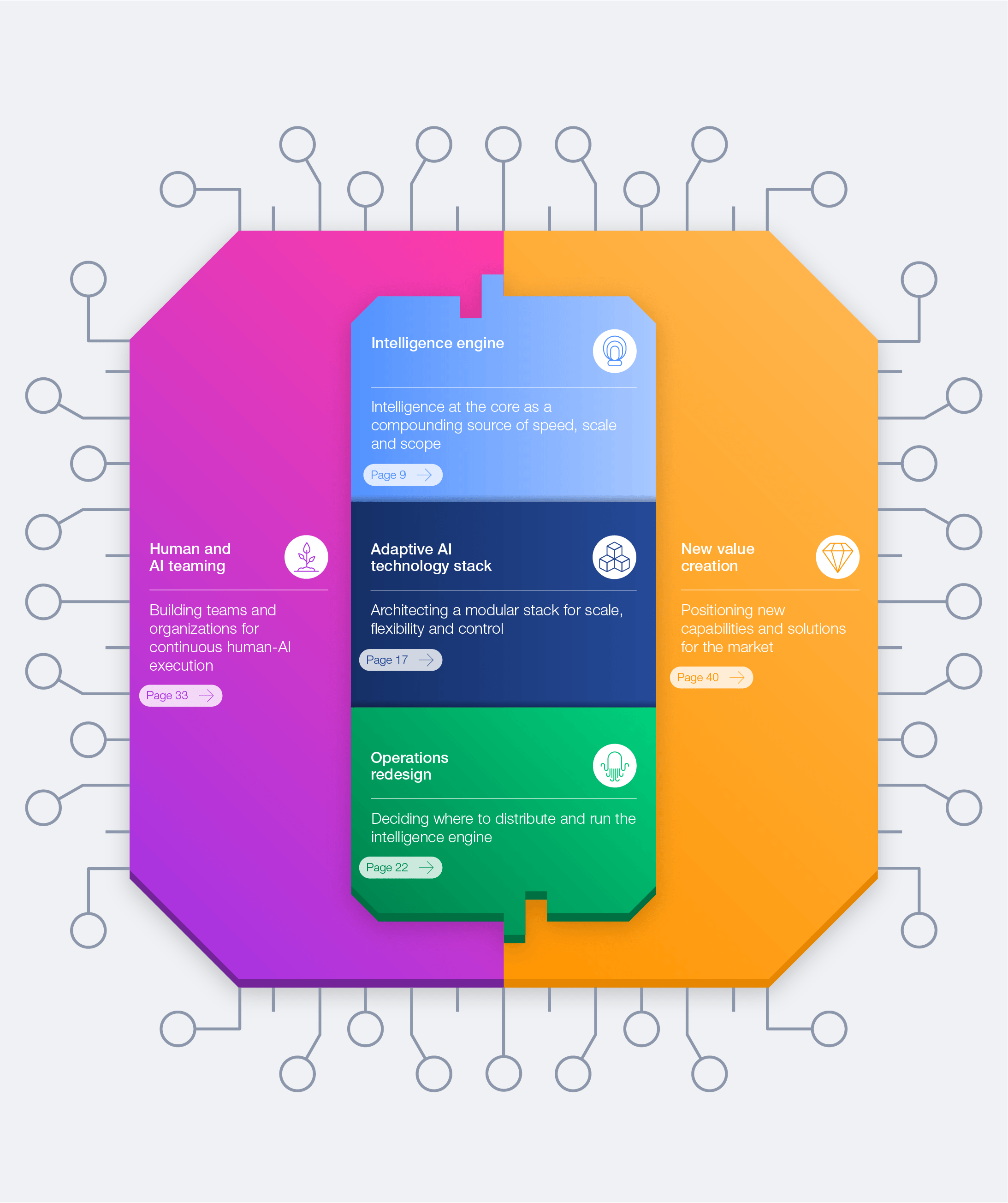
1. Intelligence engine
The starting point is to identify the business’s unique learning loops: repeated decisions, feedback, user signals or operational data that can make an AI system better each time it runs.
These inform the first step for successful AI-first organizations, building the intelligence engine. These are self-reinforcing, data-driven flywheels that learn from every interaction, grow smarter with use and connect performance back to business outcomes.
They operate across three dimensions: speed, through rapid hypothesis generation; scale, through platform operationalization; and scope, through the recomposition of proven capabilities into new ones. The result is a structural advantage that compounds: every cycle improves the next.
Osmo shows this pattern with its olfactory-intelligence platform, trained on more than 3 billion molecules and 5 million fragrance classifications, enabling one platform to support many formulations rather than building per-product models.
2. Adaptive AI technology stack
For an intelligence engine to work, it cannot sit alongside the business as just another tool. It has to connect into the systems where work already happens, while allowing the organization to adapt as models, vendors and applications change.
This is the role of the second building block: a modular tech stack that lets the intelligence engine evolve with the frontier while keeping core operations stable.
AI-first organizations do this four ways: they turn every interaction into a training signal, capturing overrides, feedback and edge cases; they own the control layers, keeping orchestration and routing inside the enterprise so vendors can change without rebuilding workflows; they build model-agnostic portfolios, routing tasks by cost, accuracy and risk; and they make context dynamic, pulling live data rather than relying on static prompts.
3. Operations redesign
Eighty-four percent of companies have not redesigned jobs around AI capabilities, while AI high performers are nearly three times as likely as others to fundamentally redesign workflows.
AI-first organizations treat intelligence like capital: identifying the outcomes that matter most, then working backwards into the workflows where AI can create the greatest operating leverage.
Workflows are digitized and connected to the intelligence engine end to end, codifying rules, matching models to tasks, building observability and defining where human judgment is required. When this works, operations stop being static processes and become learning systems.
“I think the imaginative mindset of AI-first companies is they start with, if we had access to unlimited intelligence, what would we build and they're obviously not held back by having organizations and preexisting workflows,” said Ravi Mhatre, partner and co-founder of Lightspeed Venture Partners, when speaking on the “Enterprises with a Neural Spine” panel at the Forum's 2026 Annual Meeting in Davos, Switzerland.
“Everyone is chasing the efficiency of AI; the bigger unlock is effectiveness.
—Sarah Franklin, CEO, Lattice
”4. Human-AI teaming
Even as intelligence moves into the operating model, the talent gap remains significant: one report found that the top 10% of organizations spend on average about $611 per employee per month on AI, while another found that only 33% feel confident they have the right mix of talent to execute their AI strategy.
Yet the productivity upside is becoming clear: in a controlled field experiment, humans in human-AI teams achieved 73% greater productivity per worker.
AI-first organizations are responding by hiring and developing new talent profiles: design engineers, forward-deployment engineers, evaluation specialists and AI safety engineers. The most effective AI-first teams are small, flat and cross-functional, often fewer than 10 people and organized around one product, workflow or customer problem.
“Everyone is chasing the efficiency of AI; the bigger unlock is effectiveness. Give every employee a personalized coach and you change the quality of how an organization works, not just its speed,” says Sarah Franklin, CEO of Lattice.
“AI lets us redefine work around human skills rather than tasks. Once the routine work is handled, what's left and what we now build careers and measure success around is curiosity, judgment and the human skills machines don't have," she adds.
5. New value creation
As intelligence moves from internal operations into products, services and customer experiences, every AI-first organization has to decide how it will create and capture value in the market. Intelligence can show up as a feature, the product itself, a workflow platform, invisible infrastructure or a new interface entirely.
That choice matters because it shapes what customers pay for, where value accrues and how feedback flows back into the intelligence engine. The market signal is clear: newly funded AI companies grew 70% between 2024 and 2025 but AI novelty alone is not enough.
AI-first organizations are responding by designing products around the customer’s actual workflow or problem. They ask where intelligence should appear, what modality fits the task and how much autonomy the user is ready to trust.
Contextere shows this in practice. Its voice-first factory-floor troubleshooting system replaced a 47-minute information-gathering process with near-instant context assembly, cutting troubleshooting time by up to 80%. The value was that intelligence was packaged into the way frontline workers already operate.
The starting point throughout this entire process is to decide how intelligence should be positioned in the market: as an enhancement to an existing product, a standalone AI product, a workflow platform, infrastructure or an invisible layer behind a better customer experience.
Today, as many organizations adopt AI, the ones that look likely to succeed are those that design systems for intelligence and people to work as one.
The World Economic Forum’s AI-First Enterprises workstream continues to convene global AI-first leaders from leading industry and technology companies, AI-native startups, venture investors and academics in innovation management.
Together, they work to achieve our mission of unlocking the next leap in what enterprises can do for industry, global ecosystems and society by exploring the business and operating model breakthroughs AI is making possible.
Don't miss any update on this topic
Create a free account and access your personalized content collection with our latest publications and analyses.
License and Republishing
World Economic Forum articles may be republished in accordance with the Creative Commons Attribution-NonCommercial-NoDerivatives 4.0 International Public License, and in accordance with our Terms of Use.
The views expressed in this article are those of the author alone and not the World Economic Forum.
Stay up to date:
Artificial Intelligence
Related topics:


Forum Stories newsletter
Bringing you weekly curated insights and analysis on the global issues that matter.
More on Artificial IntelligenceSee all

Krishna Kumar
September 21, 2026