The 2026 G7 Summit will take place in Évian-les-Bains, France.
Alongside member states Canada, France, Germany, Italy, Japan, the UK and the US, middle powers are expected to play a key role.
Canadian Prime Minister Mark Carney told delegates in Davos this year that middle powers “must act together” amid a shifting global order.
“The rules-based order is fading,” Mark Carney told delegates in Davos in January this year.
The Canadian prime minister was speaking not long after his country had passed the Group of Seven (G7) Presidency to France. Six months on, as the G7 is set to meet in Évian-les-Bains, the future looks increasingly uncertain for the international order.
In the words of France as it assumed the presidency: “The international economy is no longer a terrain of cooperation or even one of fierce competition: it has become a space for confrontation, where strength and domination are sought through power struggles and constraint.” This has a direct impact on the ability of all countries to grow and develop, it says.
Carney told Davos that middle powers must work together to counter this shift and build a more cooperative, resilient world. France echoes that sentiment, stating that this G7 will work to reduce global imbalances by creating dialogue between “major emerging or committed countries and willing stakeholders”.
So could the summit prove to be a defining moment for middle powers and their influence on global affairs?
What will be discussed at the 2026 G7 Summit?
Every year, the G7 Summit convenes leaders of the world’s seven largest economies to discuss economic and political issues.
These annual events are attended by member states Canada, France, Germany, Italy, Japan, the UK and the US – with the EU as an observer – and are organized and hosted by a different member each time.
France says it wants to use its G7 presidency to rekindle the “original spirit” of the group: making it a forum for dialogue among major powers to address today’s economic challenges.
Its presidency will be organized around foreign affairs, development, trade, finance, the digital sector, the environment and home affairs, which the country says will enable work on issues including:
Resolving major geopolitical crises;
Establishing a shared understanding of the causes of the excessive macroeconomic imbalances;
Overhauling the international solidarity system to form fairer and more effective global partnerships;
Securing value chains;
Developing reliable digital tools accessible to all;
Combating illegal flows and organized crime.
Alongside the main summit, dozens of working groups meet regularly throughout the year to tackle these issues.
Is the influence of middle powers growing?
At Davos, Carney said: “In a world of great power rivalry, the countries in between have a choice – compete with each other for favour, or to combine to create a third path with impact.
“Middle powers must act together, because if we’re not at the table, we’re on the menu.”
There is no exact or agreed-upon definition of what a middle power is. But they are often defined as states with extensive diplomatic, economic, multilateral, and sometimes military clout. These powers sit below those with a permanent seat on the United Nations Security Council – China, France, Russia, the United Kingdom and the US – but still exert influence over global politics.
They comprise Global North countries including Australia, Canada and South Korea, and Global South nations including Argentina, Brazil and Indonesia.
Some commentators question whether middle powers can really prosper in a world dominated by two competing superpowers.
But many foreign policy analysts say middle powers have the potential to help stabilize global order and advance cooperation. They can do this both within formal organizations, including the United Nations, and through groups that advance cooperation on specific issues, according to the Carnegie Endowment for International Peace.
How the Forum helps leaders make sense of regional, trade and geopolitical shifts
The Centre for Regions, Trade and Geopolitics provides a trusted space for leaders to understand evolving trade dynamics, regional developments and geopolitical fragmentation.
By fostering dialogue across sectors and regions, the Centre helps partners navigate uncertainty and explore cooperative approaches to shared challenges.
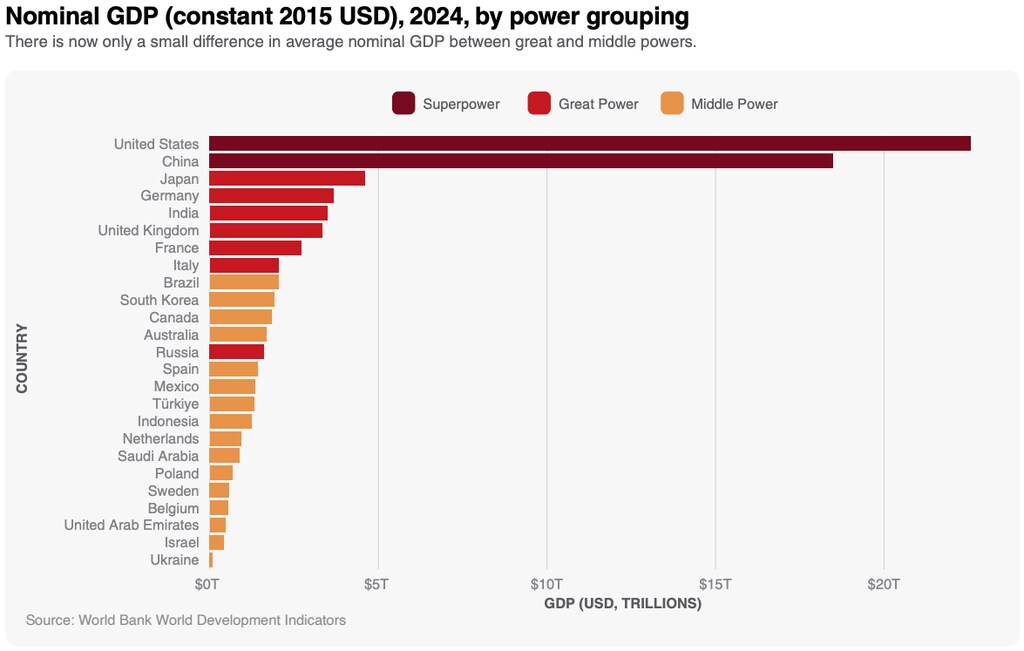
There is now just a small difference in average nominal GDP between great and middle powers, according to research from the Institute for Economics & Peace. It says countries including the Gulf states, Brazil, Indonesia and more are "gaining significant leverage through rising economic power, control of critical resources, and flexible coalition building".
Writing for the World Economic Forum, Robert Muggah, founder of the Igarapé Institute, says: “States that were never fully accommodated by the old order now have the weight to demand a bigger role in shaping what comes next.”
Cooperation will increasingly be organized through overlapping coalitions of values and interests rather than a single universal consensus, Muggah says. Larger powers will still “matter most” – but middle powers “matter more than before”.
It has even been suggested that like-minded middle powers could form an “M10” group to build consensus around issues including sustainability and equality.
What role could middle powers have at the G7 Summit?
Outside of the seven members of the G7, other middle powers participate in the group’s work and discussions.
During the 2025 Canadian presidency, for example, Australia, Brazil, the United Arab Emirates, India, Mexico, South Korea, Saudi Arabia, South Africa and Ukraine were invited to the Summit.
Researchers have shown that coalitions of like-minded states working together on specific interests can provide a mechanism for middle powers to shape international agreements. With France signalling that it intends to bring a wider group of nations into key discussions, middle powers can help bridge the gap between the G7 and the rest of the world if they align on issues including trade, development, supply chains, digital governance and more.
They may not replace the great powers in a fragmented system – but they are set to play an increasingly important role.