5 experts on the future of investment in frontier markets
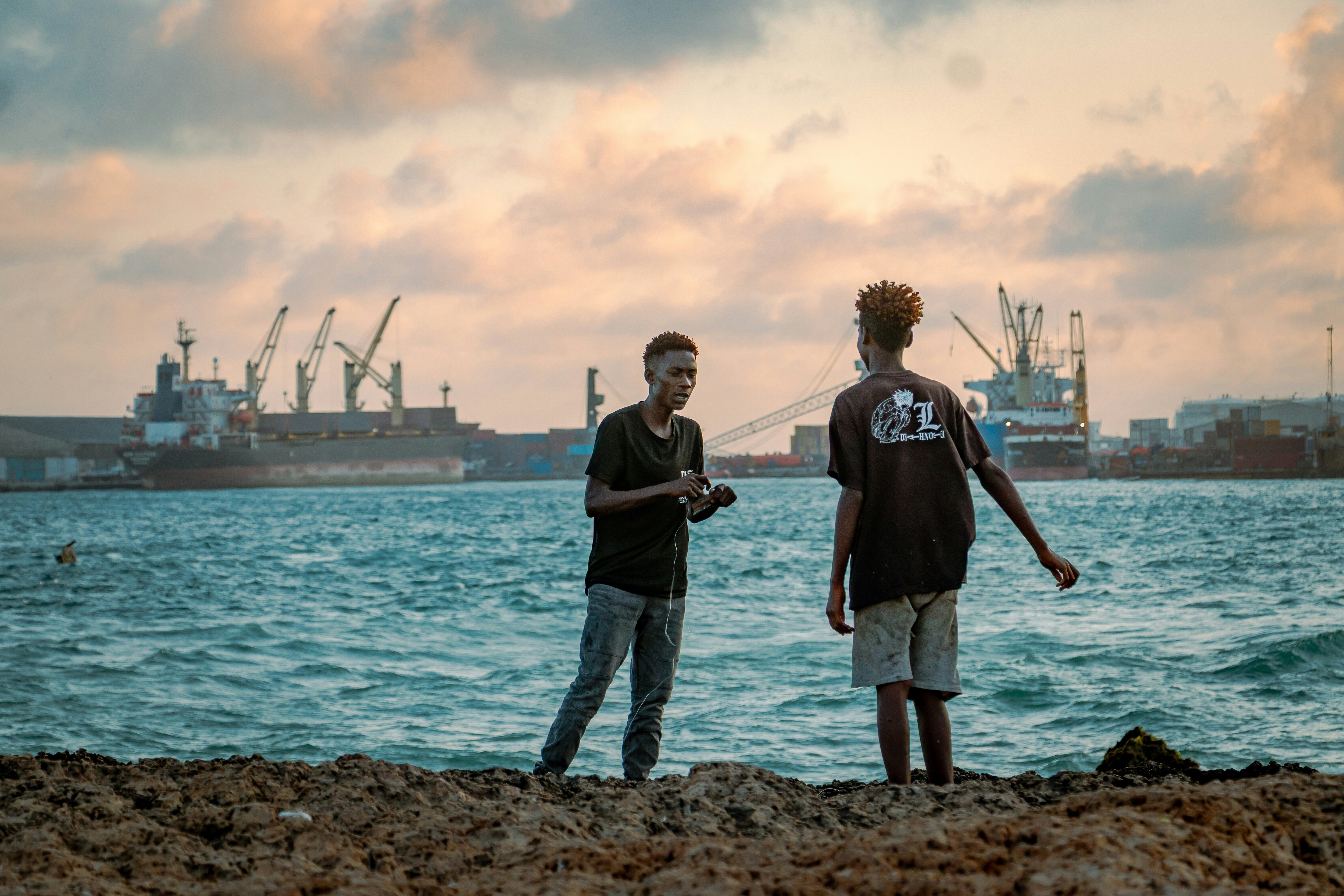
Mogadishu's 3,300 kilometre coastline could support a global tuna industry, says Hodan Osman. Image: Photo by Abdalla Emiir on Unsplash
- Risk in frontier and fragile markets is often a matter of perception rather than fact and changing that story will unlock private capital.
- We asked five experts working across African markets, development finance and peacebuilding what it will take.
- The World Economic Forum is working with the European Commission to unlock new forms of public-private-philanthropic collaboration that will drive growth and shared prosperity in fragile and frontier markets through a new platform called InvestFrontier.
When people picture Mogadishu, Hodan Osman explains, they picture something that no longer exists.
"It's always surprising, especially when I tell people I work in Mogadishu," says Osman, president of the Somali Development and Reconstruction Bank, "because they don't see the Mogadishu of today.
“What's in their minds is a narrative from the past." The city they're picturing is one of ruin and war. The city she works in has high-rises, a banking sector that has quadrupled its assets in three years, and a 3,300 kilometre coastline that could support a global tuna industry.
The gap between those two stories is one of perception and it has real consequences for the country’s investment prospects.
Official development assistance has fallen for two straight years, and there was consensus among the five experts we spoke to at a frontier investment meeting last week in Geneva, that it’s not coming back.
What replaces it is beginning to take shape. For those working in Somali finance, in Kenya's refugee settlements, in agricultural markets from Lagos to Nairobi, the common thread is that the risk, although evident, isn’t the problem. The real challenge is how to change the story to be about opportunity.
Africa holds 19% of the world's population and is widely recognized for its competitive investment returns, yet foreign direct investment to the continent made up only around 6% of global flows in 2024.
The Forum's Humanitarian and Resilience Investing (HRI) Roadmap for Africa, developed with the African Development Bank, sets out a framework to close that gap, building on a 2023 call to action to mobilize $10 billion in commercial and catalytic capital to help 1,000 businesses scale in frontier markets by 2030.
What these five leaders describe, from different corners of the same problem, is what closing that gap actually requires: institutions that can catch capital locally, data that replaces inherited assumptions, and leaders willing to tell a more accurate story about risk than the one that's been repeated for decades.
Rewriting the risk narrative: Hodan Osman, President, Somali Development and Reconstruction Bank
“The risk is not just on Somalia — there's kind of a joke about the Africa risk premium in general. Interestingly, the former African Development Bank president commissioned Moody's Analytics to study infrastructure investments over 14 years, across multiple regions. What they found was that the loss rate in Africa was less than 1.7%, where losses in Latin America were between 10% and 13%. That really goes to show you the gap between perception and reality, and what perceived risk is actually based on. I think it's being based more on narrative than on actual track record and data.
“And this drives a multiplier effect: an inflated risk premium leads to more expensive debt for governments, which overvalues the project, which pushes up the rates banks then set. I think how you fight against that is through data — proper information about bankable projects, and evidence that allows investors to do real risk analysis rather than relying on headlines.”
Peacebuilding as a form of de-risking: Itonde Kakoma, President and CEO, Interpeace
“The European Union itself is a peace project by design. The Nobel Peace Prize awarded to the European Union was precisely in recognition of a mechanism to maintain peaceable relations between not just states, but peoples who experienced considerable periods of unrest. Undergirding that peace project was coal and steel — infrastructure investment that created the interconnectedness, economically and from an energy point of view, that enables states to understand cooperation is better for their own longevity, viability and profitability.
“The second example, tied to discussions here at the World Economic Forum, is this whole notion of de-risking. What is clear to us, and to many in the development finance world, is that peacebuilding in and of itself is a primary form of de-risking, because fundamentally undergirding it is the notion that societal resilience — rooted in inclusion and ownership — creates conditions for durable peace, and in doing so, for quality investment. This is where we need to be smarter as a peacebuilding community in making the case for how investing in peace is also good for business. It's good for security, for the state, and in particular for human security.”
Data-driven risk and financial inclusion: Jehiel Oliver, Founder and CEO, Hello Tractor
“Lending in Africa is constrained because there are real information asymmetries. For a bank to finance an individual in a rural community — because they don't know much about who that customer is, their repayment ability — they tend to require exorbitant amounts of collateral to de-risk. As a technology platform, we collect nine billion data packets from our tractors every year. That data guides our decision-making to identify strong credits: who should receive financing, who's more likely to pay, based on the strength of their book of business. It's allowed us to manage risk at a rate that's much greater than a commercial bank.
“These are farmers who traditionally would not have had access to mechanisation, relying on household labour to get their fields planted in time. Through this intervention, they have affordable, timely, reliable access to machinery — and on average, we're seeing a 227% income increase when these farmers gain access to mechanisation.”
Bridging the local and global development conversation: Bright Simons, President mPedigree
“If I go to Kenya, and go to the ground — and if I go to Malawi, and go to the ground — the conversations they're having about what they call development, what the politicians are beating each other over the head with during election campaigns, is very different from when I come to Geneva, or go to London, or Paris, and what we call development there. They are definitely not having conversations about blended finance. You're not going to hear that phrase on Kenyan television, in any conversation with Kenyan actors of any shape or size.
“When they talk about schools, and why school inspection isn't working, and why a particular school feeding programme hasn't linked with local farmers — that is the conversation about development they're having. So long as we have this parallel world, where development is discussed so differently at the local level than in this so-called development ecosystem — which is becoming an echo chamber — we're going to have problems.”
Community-led blended finance: Victoria Sabula, CEO, Africa Enterprise Challenge Fund (AECF)
“We work in very difficult places — refugee settings in northern Kenya, Sudan, Somalia, Burkina Faso. In Kakuma, there's a refugee community and a host community that has been so generous in welcoming people from elsewhere. That host community won't feel great if they're continually excluded from the initiatives coming into their own villages.
“So we built a Local Enterprise Development window into the Kakuma-Kalobeyei Challenge Fund — funding set aside specifically for host-community businesses alongside refugee businesses. But what really mattered was the participation of local leaders. It wasn't us going directly to the community; it was their own leaders presenting the initiative, explaining its purpose and design. That gave us legitimacy. A small community will resist a large new operation unless its own leaders have explained why it's there.”
License and Republishing
World Economic Forum articles may be republished in accordance with the Creative Commons Attribution-NonCommercial-NoDerivatives 4.0 International Public License, and in accordance with our Terms of Use.
The views expressed in this article are those of the author alone and not the World Economic Forum.
Related topics:
Contents
Rewriting the risk narrative: Hodan Osman, President, Somali Development and Reconstruction BankPeacebuilding as a form of de-risking: Itonde Kakoma, President and CEO, InterpeaceData-driven risk and financial inclusion: Jehiel Oliver, Founder and CEO, Hello TractorBridging the local and global development conversation: Bright Simons, President mPedigreeCommunity-led blended finance: Victoria Sabula, CEO, Africa Enterprise Challenge Fund (AECF)
Forum Stories newsletter
Bringing you weekly curated insights and analysis on the global issues that matter.
More on Global RisksSee all

Reese Wong
October 6, 2026


