Informal economies don’t need fixing. Their solutions need recognition
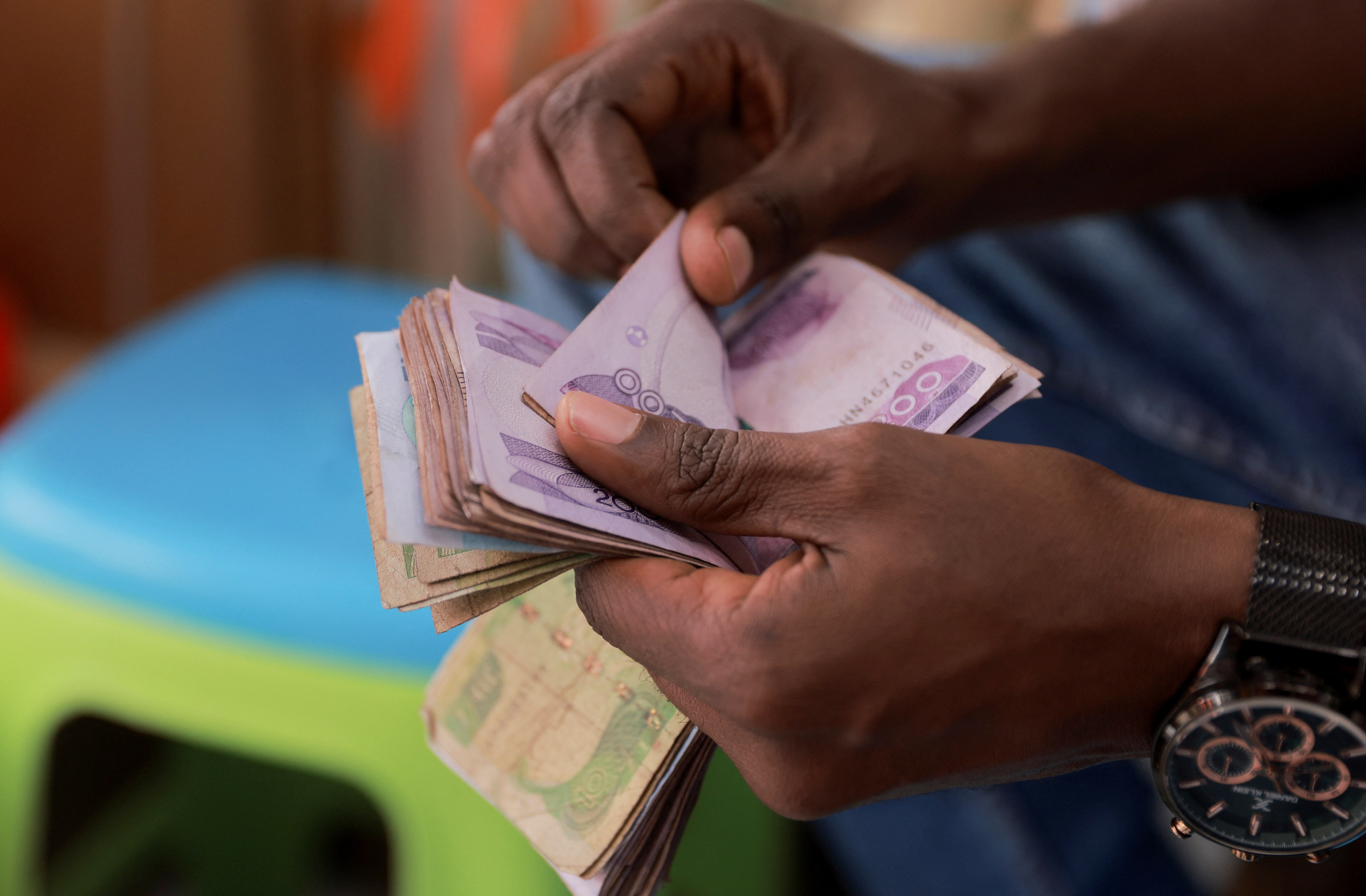
500 million people worldwide already participate in informal savings groups, but financial institutions rarely recognize this when assessing creditworthiness. Image: REUTERS/Tiksa Negeri
- 500 million people worldwide already participate in informal savings groups, but many of them are nonetheless locked out of access to institutional credit.
- Pilot programmes in Uganda digitizing savings group transaction data have produced non-performing loan rates below 2%.
- These savings groups in CARE's network generated almost $1.4 billion in member savings last year.
The largest overlooked credit market in emerging economies is sitting in the open. In sub-Saharan Africa, nearly nine in 10 workers earn their livelihoods in the informal economy. In countries ranging from Tanzania to Nigeria, informal activity generates close to half of GDP. These are not marginal populations on the edges of a formal system. In most of the developing world, the informal economy is the economy.
Much of the financial activity that sustains this economy, however, also happens outside formal banking systems. Among the most widespread of these are community-based financial systems in which members meet regularly to pool savings, issue loans, enforce repayment and manage risks through trust, transparency and social accountability. Some have operated for generations. Across three continents, approximately 500 million people participate. Studies of group-based lending consistently show repayment rates above 95%. The members are not simply savers, but are often entrepreneurs running small businesses that sustain families and local economies today. They could drive broader economic growth with access to greater capital.
Yet the International Finance Corporation estimates the finance gap for micro, small and medium enterprises (MSMEs) in emerging markets at $5.7 trillion, a figure that has grown faster than GDP. Forty percent of MSMEs are credit-constrained. Not because they lack financial discipline, but because formal systems cannot see how that discipline plays out.
This is a problem of legibility, not behaviour.
Two systems that cannot read each other
In high-income economies, credit is invisible infrastructure. Use a credit card, pay a utility bill, take out a lease and the system quietly builds a profile of reliability. Creditworthiness is an automated byproduct of participation.
In informal economies, credit runs on different infrastructure entirely. Borrowing and lending happen through relationships. Risk is managed through social accountability. Repayment is enforced by community trust. A member who defaults in a savings group does not just lose access to capital. She risks her standing in her community. Her financial behavior is consistent with that reality. It simply does not produce the documentation that formal lenders know how to read.
Savings groups have not merely filled the vacuum left by formal finance, they’ve persisted alongside formal finance options because of what they offer: voluntary membership, social solidarity, transparent governance and returns that stay in the community. They were designed around the realities of how people actually live and manage money. For millions of women who have been historically excluded, these are not just substitutes for a bank. They are the foundation of economic life. That foundation is solid. What’s missing is the bridge.
The result is mutual blindness: savings group members see formal institutions as risky, shaped by years of exclusion through high barriers, documentation requirements and financial products designed without them in mind, while institutions see these borrowers as risky because they lack the data to assess them. These perceptions reinforce one another. Closing the gap requires movement on both sides.
The World Bank’s Global Findex 2025 found that in low- and middle-income economies, twice as many adults borrowed from informal sources (family, friends, community savings groups, local moneylenders) than from banks. In sub-Saharan Africa, mobile money transactions reached $1.4 trillion in 2025, representing two-thirds of the global total. And yet, even in the region’s most advanced markets, more than half of all borrowing still runs through informal channels, according to a 2026 BCG report. Africa’s first fintech wave solved payments. The second must solve credit, or the economy risks remaining high-volume but low-value. The behavioral data exists at an enormous scale. Almost none of it is used to assess creditworthiness.
Building the bridge from both sides
In Uganda, CARE International is working with fintech partner Ensibuuko and credit bureau GnuGrid to test precisely this model: digitized savings group transaction data, fed into a credit-scoring algorithm, used to qualify women for formal loans of $300 to $5,000 through a licensed financial institution. Early results from pilot programmes show non-performing loan rates below 2%. That is a fraction of the 50–56% delinquency rates CGAP documented in East African markets where most borrowers were accessing formal credit for the first time, with no savings history or accountability structure behind them.
Earlier models, such as India’s self-help group–bank linkage programme, demonstrated the potential of collective financial histories; newer approaches are now extending this logic using digital data.
The lesson is not simply that new data sources can improve lending. It is that the sequence matters. Where systems build on existing financial behavior and trust, both adoption and repayment improve. Where they bypass those foundations, uptake stalls and risk increases.
Scaling this requires digitalizing records, building accurate behavioral credit-scoring models, partnering with governments for a supportive policy environment and connecting to formal institutions, but the foundation is trust, not just technology. That trust, once made legible, represents an enormous untapped market.
The capital is already there
The market case for getting this right is substantial, and the capital to unlock it is already there. The MSME finance gap is equivalent to 19% of GDP across 119 emerging economies. Yet the money moving through savings groups is not aid, donor capital or external investment. Last year alone, savings groups in CARE's network generated almost $1.4 billion in member savings. That is capital that’s already circulating locally to finance businesses, smooth shocks and sustain livelihoods. That is just what CARE can track. The question is not whether the capital exists. It is whether formal finance will learn to connect to it.
CARE modeling suggests that if even 10% of savings group members accessed formal financial services and took out small business loans, this could unlock on the order of $1.6 billion in additional capital. For financial institutions, this is an untapped customer segment with demonstrated repayment discipline, low default risk and a built-in accountability structure that reduces the cost of lending. For entrepreneurs, it is the capital to stock inventory, survive slow seasons and grow businesses that already sustain families and local economies. For the broader financial system, it begins to close a gap that suppresses productivity and constrains growth across the developing world.
The infrastructure already exists. The trust, the habits and the track records are already built. More than 500 million people are saving, borrowing and repaying at scale, every week, in systems that work. That’s why the next frontier in financial inclusion is not reaching new borrowers. It is translating trust into credit.
Don't miss any update on this topic
Create a free account and access your personalized content collection with our latest publications and analyses.
License and Republishing
World Economic Forum articles may be republished in accordance with the Creative Commons Attribution-NonCommercial-NoDerivatives 4.0 International Public License, and in accordance with our Terms of Use.
The views expressed in this article are those of the author alone and not the World Economic Forum.
Stay up to date:
Informality


Forum Stories newsletter
Bringing you weekly curated insights and analysis on the global issues that matter.
More on Financial and Monetary SystemsSee all

Mehrad Yaghmai and Judith Ketelslegers
September 21, 2026


