Which nature investments pay off? Here's what a decade of data says

Nature investment is becoming more diverse as institutional investors expand beyond traditional sustainable agriculture. Image: Shutterstock/Singkham
- Private capital investments in nature projects have increased roughly five-fold over the last decade, reaching $14 billion in 2025.
- Recent research shows institutional investors are backing a broader range of nature investments as the market matures.
- Four investment trends show how institutional investors' approach to nature has evolved over the past decade.
A decade ago, $2.8 billion in private capital flowed into nature management and restoration projects annually, according to a 2016 benchmark report published by Forest Trends and The Nature Conservancy. These investments financed better management of working lands like forestry, agriculture and aquaculture, or the restoration of wildlands and natural habitat.
In 2025, that figure topped $14 billion – a roughly five-fold increase. That raw growth is good news for nature, but it’s actually the less interesting number compared to what the figures say about the nature of these investments.
Nature investment has diversified
Over the course of 10 years, capital has started flowing to a new set of opportunities.
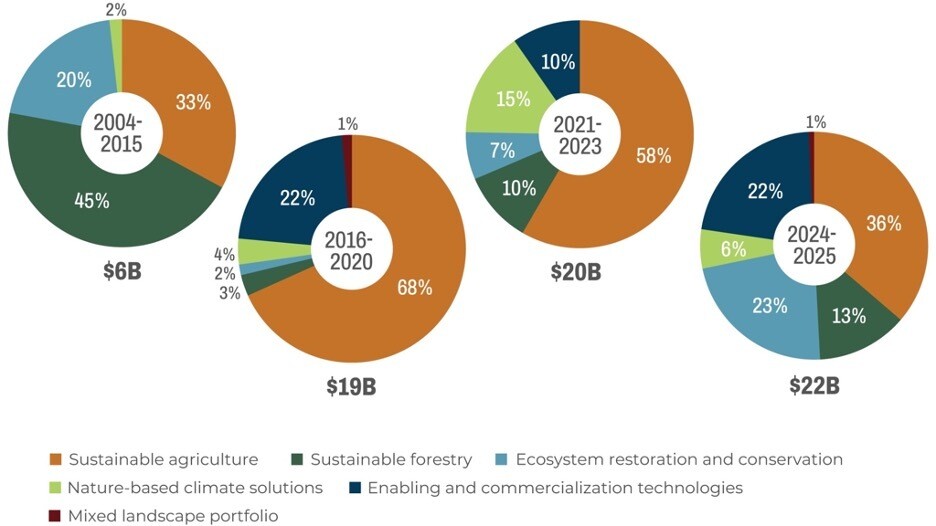
During 2016-2020, sustainable agriculture accounted for 68% of all investment allocations to nature-based projects. By 2024–2025 it was 36%, according to the latest report from Forest Trends and The Nature Conservancy, which is a follow-up to the 2016 baseline study.
Agriculture didn’t shrink; its allocations kept growing. But the pie around it grew faster, driven by nature investment categories that were barely on the radar in 2016.
This diversification reflects four new bets that investors are now taking on nature:
1. Ecological restoration in the US is boring enough to be a pension-fund asset
In 2016, there was just one instance of a US-domiciled public pension investing in ecological restoration – a $30 million commitment from the New Mexico Educational Retirement Board to Ecosystem Investment Partners’ (EIP) EIP II fund. It focused on delivering wetland and stream habitat mitigation credits for US Clean Water Act-regulated buyers.
Today, EIP has at least 10 pensions engaged across five funds. Other large restoration companies like Resource Environmental Solutions and Westervelt have also secured institutional commitments.
Why the investor interest? There is a stable market for wetland and stream credits backed by clear rules set by US regulators. The presence of pension money is telling: because it's not impact-motivated, it signals that this has become a safe – or “boring” – investment.
Whether this pattern – of a clear regulatory driver leading to institutional comfort with ecological restoration deals – is repeatable elsewhere is currently being tested. The UK's biodiversity net gain (BNG) system, which requires development to produce positive measurable improvements for nature, is one to watch.
2. Ecological restoration in Latin America can be financed at a scale previously only seen for pure commodity plays
In April 2026, BTG Pactual’s Timberland Investment Group (TIG) closed a $1.24 billion fund focused on Latin America. That’s an uncommonly large fund for this asset class.
TIG’s strategy focuses on degraded lands, including Brazil’s biodiversity-rich and currently severely drought-stricken Cerrado region. Only half of the land will be planted for commercial harvesting. The other half (roughly 133,500 hectares) is slated for reforestation with native species and protection.
While a half-and-half split between harvesting and conservation isn’t unheard-of for a boutique fund, it is unusual at a billion-dollar scale. The capital assembled includes catalytic and concessional capital up front and expected revenue streams from Forest Stewardship Council-certified timber production, as well as carbon credits and other ecosystem services.
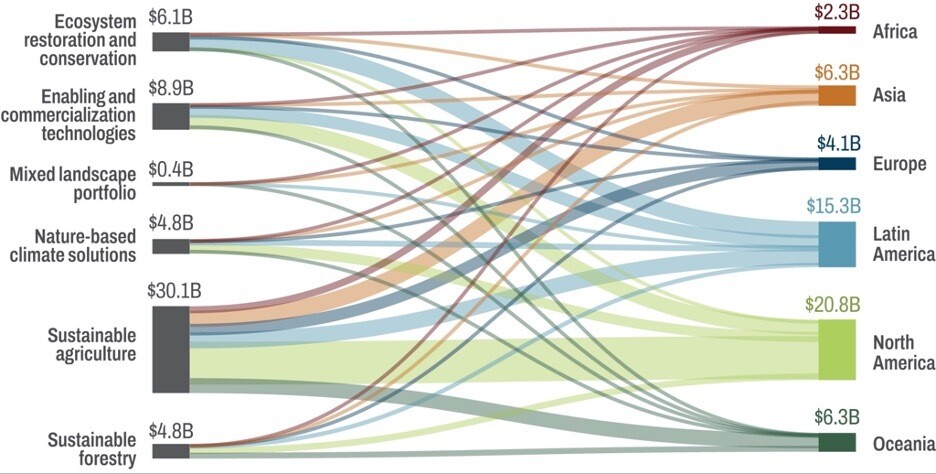
Nature and capital are coming together in a variety of new arrangements in Latin America, which has attracted 28% of global nature capital deployment in the last 10 years.
Belize, Barbados, the Bahamas and Ecuador have all recently signed innovative debt-for-nature conversions to refinance external debt at a discount and direct savings to conservation. Meanwhile the continent’s commodity supply chains are being re-engineered at massive scale to create a traceable, deforestation-free bioeconomy.
3. Regenerative agriculture is the next edge in an asset class investors already like
Farmland in established markets has a good investment record. Low correlation with the market and inflation-hedging properties make farmland an appealing investment in a high-inflation, high-volatility, geopolitically uncertain time. Sustainable agriculture deal volume more than tripled after 2020 versus the previous five years, while investment doubled from $10.8 billion to $22.2 billion.
Now, regenerative agriculture may be able to beat that already-strong baseline. Regenerative farmland delivers a 2–3% income rate premium above benchmark levels, even before regenerative premiums are layered on top, according to US-based sustainable agriculture equity financing company Fractal Agriculture. There’s emerging evidence that regenerative methods can increase the productivity of farmland and grazing land, lower input costs over the medium to long term, and outperform conventional methods of farming during drought and extreme-weather years.
Unlike carbon markets or mitigation banking, the economics don't depend on policy or market infrastructure catching up. They work today – and maybe even better tomorrow as climate stress and a shrinking land base reward resilience. The right investment vehicles are needed, however, to give farmers the incentive and security to invest in long-term regenerative practices.
4. Investors can hold a carbon position while market infrastructure and governance catch up
Over 10 years, investments in nature-based carbon businesses have ebbed and flowed. They've gone from 4% of overall allocations pre-2020 to 15% around 2021’s banner year of $2 billion in carbon transactions, before falling back to around 6% at present. Deal count tells a steadier story, growing from seven deals in 2016 to 41 in 2025, at a median of $52 million.
Today, the demand outlook is more assured. The global Carbon Offsetting and Reduction Scheme for International Aviation initiative (CORSIA) is set to enter its mandatory phase in 2027, which will increase demand for carbon credits. Alongside this, various domestic carbon policies are starting up and Science Based Targets Initiative (SBTI) signatories are required to purchase carbon credits starting in 2035 to neutralize residual emissions.
Meanwhile, the supply pipeline of high-quality credits looks comparatively thin, providing an opportunity for investors. Still, high-quality market governance and infrastructure work is required quickly to meet forthcoming demand for carbon credits and shore up confidence in these volatile markets.
Charting nature investments
Will these investor bets on nature projects pay off? Only time will tell.
But the scale of work to date is vast. Nature investments now cover at least 105 million hectares – twice the area of Spain – with another $183.5 billion slated for allocation by 2028.
Institutional capital's entry into this space may be the single biggest story in this data. EIP’s journey from one pension to 10 isn’t an isolated example: institutional deal counts have tripled across our dataset and average ticket sizes have grown from $70 million in 2017 to $167 million in 2025.
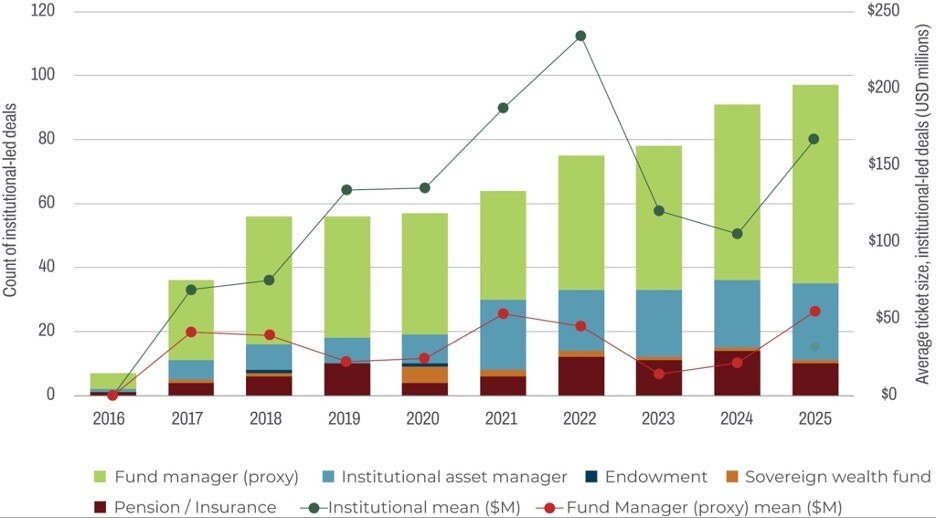
This isn't a mature market. Institutional participation remains concentrated in particular asset classes, managers and geographies. But nature as an investment theme is unmistakably becoming mainstream enough – and big enough – for many of the world's largest asset allocators to take it seriously.
Don't miss any update on this topic
Create a free account and access your personalized content collection with our latest publications and analyses.
License and Republishing
World Economic Forum articles may be republished in accordance with the Creative Commons Attribution-NonCommercial-NoDerivatives 4.0 International Public License, and in accordance with our Terms of Use.
The views expressed in this article are those of the author alone and not the World Economic Forum.
Stay up to date:
Future of the Environment
Related topics:


Forum Stories newsletter
Bringing you weekly curated insights and analysis on the global issues that matter.