Why companies without geopolitical muscle risk falling behind
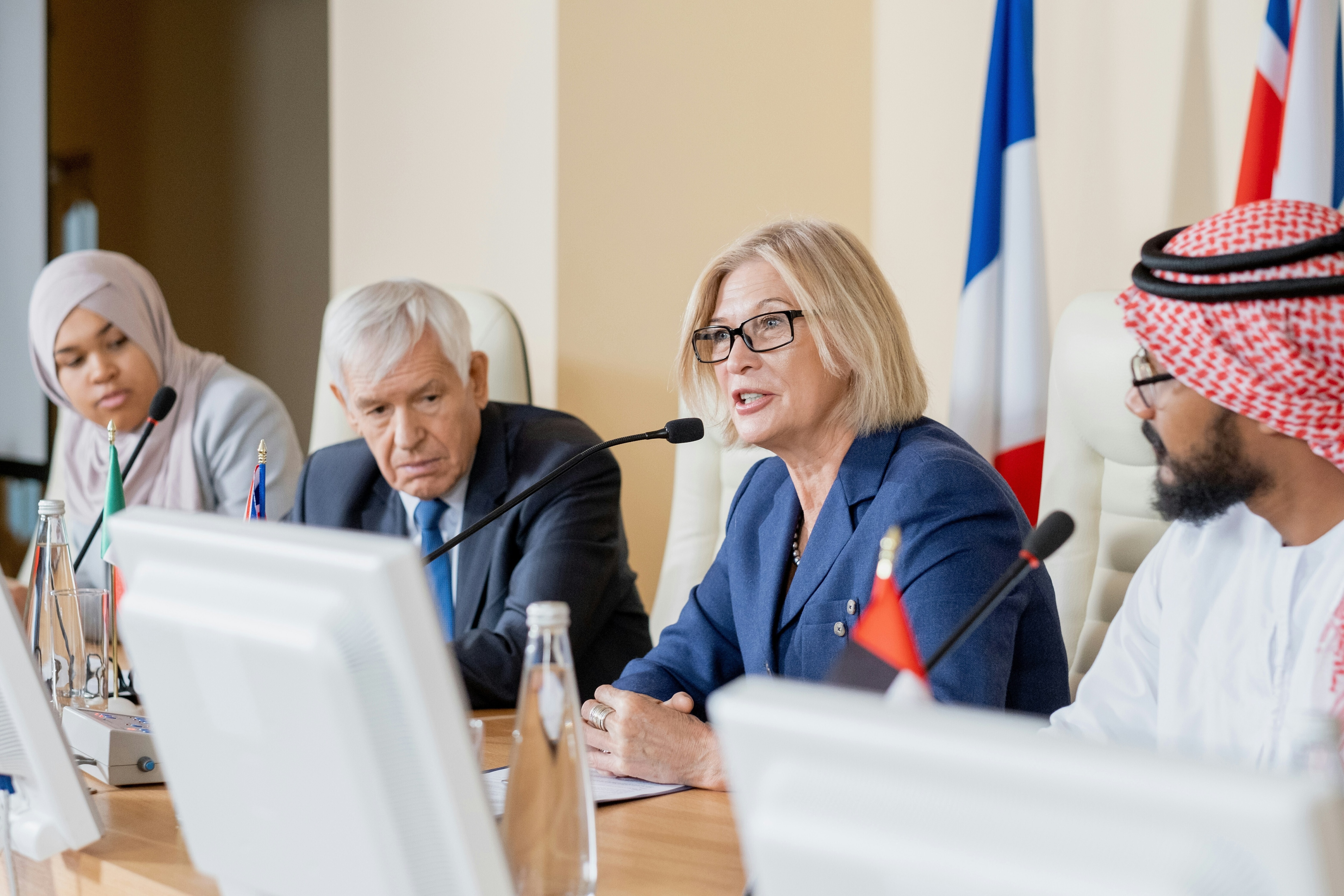
Geopolitical muscle gives companies a competitive edge Image: Unsplash+/Getty Images
Aparna Bharadwaj
Global Leader, Global Advantage Practice; Managing Director and Senior Partner, Boston Consulting Group- Geopolitical muscle refers to the capabilities, expertise, processes and tools that help organizations understand how geopolitical events affect business outcomes and act on that understanding quickly.
- While many businesses have strengthened their geopolitical capabilities, relatively few have institutionalized them or incorporated them into core strategic decisions.
- Companies are increasingly shifting from reactive measures like crisis response to forward-looking actions like long-term strategic planning and design.
Geopolitical forces already shape fundamental business decisions for global companies: where to operate, what to build, whom to partner with, how to access capital and more.
In a 2026 survey of 176 senior business leaders, BCG found that 80% of businesses globally report significant geopolitical exposure. Among the companies with revenues of $20 billion or more, this percentage rises to 93%.
The geopolitical topics that require the most attention from leaders are trade and investment flows, mission-critical sectors (such as semiconductors and critical minerals) and ongoing conflicts.
In Asia, while three-quarters of businesses reported significant geopolitical exposure, the effects are likely to be even higher now, as the survey was conducted before the ongoing conflict in the Middle East.
Many countries in Asia depend heavily on the Strait of Hormuz for imports, leaving the region especially vulnerable to the shipping disruptions facing that route.
What is ‘geopolitical muscle’?
Geopolitical muscle is a combination of capabilities, expertise and tools focused on geopolitical issues and developments. Businesses with a strong geopolitical muscle are likely to have a competitive advantage in an increasingly fragmented world shaped by multiple geopolitical forces.
This requires the ability to trace the effect of a geopolitical development on specific business outcomes. How does a shift in trade policy affect procurement costs? What does escalation at a critical chokepoint mean for the financial assumptions underpinning a capital investment? How do changes in regulations improve or restrict market access?
Geopolitical muscle means having processes and people in place to answer these questions and act quickly on those findings.
Research from the World Economic Forum, IMD Business School, and BCG provides a toolkit of five practical building blocks for geopolitical muscle, beginning with a clear mandate from the CEO and the board and a mission that goes beyond crisis management.
Companies need tools and sources to detect and interpret signals; people who can translate geopolitical analysis into commercial judgment; an appropriate operating model; and decision processes that bring it all together.
Geopolitical muscle will look different for every company, as the playbook will depend on a business’s sector, scale and strategic exposure.
How to move from resilience to advancement
Resilience has been the focus for many companies over the past several years: diversifying supply chains, building inventory buffers and stress-testing operations.
Resilience is necessary but it is not enough. Geopolitical muscle is the approach that allows companies to move from reaction to anticipation. In BCG’s survey, almost half of businesses said they would like to spend less time on crisis management in the coming year.
Geopolitical muscle in practice would enable companies to anticipate the potential effects of shifting geopolitical dynamics, i.e. identifying new corridors as old ones close, repositioning capital as changing policies create new investment opportunities or barriers, and building partnerships in markets whose strategic importance is just beginning to emerge.
Senior business leaders are largely aware of the impact of geopolitical dynamics but are not fully incorporating this awareness into their planning, investment and operations.
In Asia, nearly all surveyed companies strengthened their geopolitical capabilities in the past year, yet only about half have established or institutionalized them (regularized, cross-functional processes rather than ad hoc responses).
Most notably, only one in five companies in Asia has embedded geopolitics systemically into its core business decisions.
Why this is the right moment for companies to build geopolitical muscle
For companies across Asia and those with significant exposure to the region, the imperative is clear: move from crisis response to long-term strategic planning and design. The companies that build geopolitical muscle to sense, plan and act ahead of disruption are likely to be better positioned to turn insights into execution.
Geopolitical muscle, like other forms of operational capability, takes time and effort to build. Companies that invest in building mandates, creating processes and attracting talent to turn geopolitical insight into decisions will be better positioned to grow and thrive.
Don't miss any update on this topic
Create a free account and access your personalized content collection with our latest publications and analyses.
License and Republishing
World Economic Forum articles may be republished in accordance with the Creative Commons Attribution-NonCommercial-NoDerivatives 4.0 International Public License, and in accordance with our Terms of Use.
The views expressed in this article are those of the author alone and not the World Economic Forum.
Stay up to date:
Geopolitics
Related topics:


Forum Stories newsletter
Bringing you weekly curated insights and analysis on the global issues that matter.
More on Geo-Economics and PoliticsSee all

World Economic Forum
June 15, 2026


