Why human roles matter for Asia's AI transformation

Over three-quarters of organizations in Asia have adopted advanced AI, yet many have yet to see sustained value from it. Image: Getty Images/Unsplash
Na Na
Manager, Industrial and Tech Transformation Content and Programming, Greater China, World Economic Forum- 77% of organizations in Asia have adopted advanced artificial intelligence, yet less than one-third report achieving sustained value from it, and closing this gap requires redesigning human systems to keep pace with AI.
- The World Economic Forum’s Asia's Human-led AI Opportunity: A Framework for Transformation report offers a practical framework for organizations translating AI adoption into system-wide value.
- How promising ideas become scalable impact is a key focus at the World Economic Forum’s Annual Meeting of the New Champions, also known as Summer Davos, in China from 23–25 June.
Artificial intelligence (AI) is no longer confined to experimentation. It is now moving beyond pilots and isolated productivity gains into the core systems through which organizations can design products, manage risk, plan production, serve customers and run operations.
The question is no longer whether AI can work, as in many organizations, it already does. But as deployment accelerates, a harder question is coming into view: why does wider AI adoption still so often fail to translate into sustainable value?
This gap is acutely visible in Asia, where 77% of organizations have adopted advanced AI, yet fewer than one-third report achieving widespread and sustained value from it. Furthermore, only 20% have reconfigured end-to-end processes around AI, and just 8% have adjusted job roles or decision responsibilities accordingly. The pace of deployment is fundamentally running ahead of organizational redesign.
Few regions illustrate this gap more clearly than Asia. The region combines industrial scale, demographic variation, large digital user bases and strong policy momentum. It is a region where the practical conditions for scaling AI are being tested under real economic, organizational and institutional pressure.
This diversity is reflected in the different pathways that economies across Asia are taking towards AI transformation.
China is advancing quickly, leveraging its deep industrial ecosystems and the “AI+” initiative in its 15th Five-Year Plan to move artificial intelligence beyond isolated application and toward broader economic transformation. Japan is moving more gradually, with greater emphasis on reliability and institutional assurance, while Singapore is pairing AI investment with governance innovation, and India is building momentum through digital public infrastructure and sector-led application.
These pathways differ in pace and sequence, but they converge on a common challenge: whether people, organizations and institutions can adapt quickly enough for AI deployment to translate into durable value.
Why scaling AI is a human systems problem
The World Economic Forum’s new white paper, Asia’s Human-led AI Opportunity: A Framework for Transformation, addresses this challenge directly. The report identifies three human responsibilities that remain essential as AI scales: setting direction, exercising judgement and holding accountability.
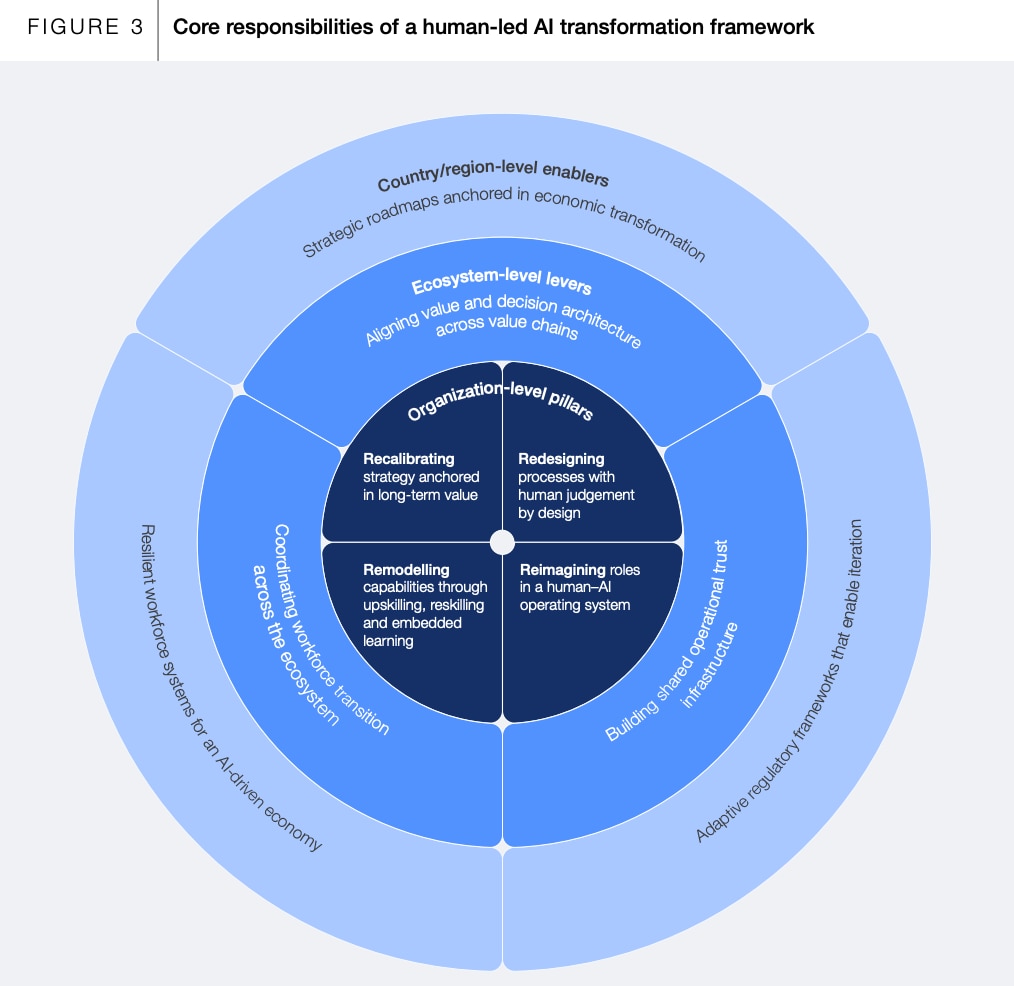
These responsibilities are operational, not philosophical. They determine what AI is used for, where its boundaries are set and how outcomes are governed. The framework traces how these responsibilities are exercised across three levels, where the bottlenecks differ.
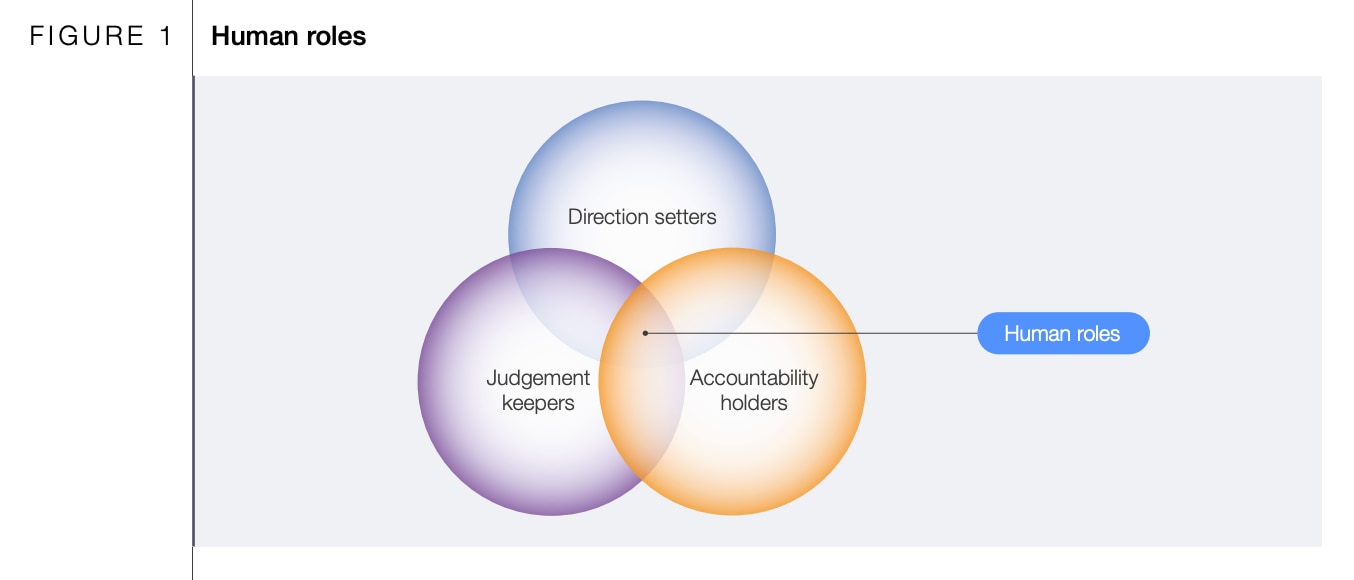
Within organizations, the constraint is structural. AI is layered onto existing processes without redesigning decision-making, role definition or accountability. This produces activity without coherence: more use cases, limited operating change.
Across ecosystems, the constraint is coordination. As AI-enabled decisions move across firms, differences in objectives, unclear interfaces and uneven capability limit how far systems can scale. Progress is bounded by the weakest node rather than the strongest.
At the country and regional level, the constraint is institutional. Workforce systems, regulatory frameworks and coordination mechanisms evolve more slowly than AI capability. This creates a persistent gap between deployment and the conditions required to sustain it.
Across all three levels, the same pattern emerges. The limiting factor is no longer what AI can do. It is whether human systems can reorganize fast enough, and coherently enough, to make use of it.
What this means for Asia’s AI transition
These constraints translate directly into a more concrete set of priorities for leaders across organizations, ecosystems and institutions.
For organizational leaders, the immediate task is to shift focus from expanding AI use cases to redesigning how work is structured. This means explicit choices about which decisions should improve, where human judgement remains essential, and how roles and accountability need to evolve once AI becomes part of execution. Without this shift, organizations risk accumulating AI capability without changing their core performance.
This constraint does not stop at the firm boundary. For ecosystem actors, the priority is coordination across the value chain – grounded in shared standards, clearer decision interfaces and mechanisms for trust, traceability and intervention. Getting there requires extending capability-building beyond the firm to suppliers, partners and smaller actors that ultimately determine how far transformation can scale.
For policy-makers and institutional leaders, the task is to strengthen the conditions for transformation at scale. This includes workforce systems that can move people into redesigned roles, regulatory frameworks that make accountability workable as systems become more autonomous, and coordination mechanisms that enable transformation to travel across sectors and borders. When these conditions hold, the gains from AI deployment become broader, more durable and more evenly shared.
The message for leaders is clear. Scaling AI requires treating human system redesign as a primary agenda, not a secondary effect.
In Asia, where artificial intelligence adoption is already accelerating at scale, the gap between deployment and redesign is becoming visible earlier and more sharply. How this gap is addressed will determine not only the region’s trajectory, but also how AI transformation unfolds globally.
The Forum is spotlighting how innovation moves from breakthrough to scale to impact ahead of Summer Davos in China, 23–25 June 2026. Follow the latest.
Don't miss any update on this topic
Create a free account and access your personalized content collection with our latest publications and analyses.
License and Republishing
World Economic Forum articles may be republished in accordance with the Creative Commons Attribution-NonCommercial-NoDerivatives 4.0 International Public License, and in accordance with our Terms of Use.
The views expressed in this article are those of the author alone and not the World Economic Forum.
Stay up to date:
Artificial Intelligence


Forum Stories newsletter
Bringing you weekly curated insights and analysis on the global issues that matter.
More on Artificial IntelligenceSee all

Ariel Kastner, Miriam Schive, Sannan Pervaiz and Jessica Margolis
October 2, 2026


