Net zero planning needs an AI update. COP31 is the right moment to do that
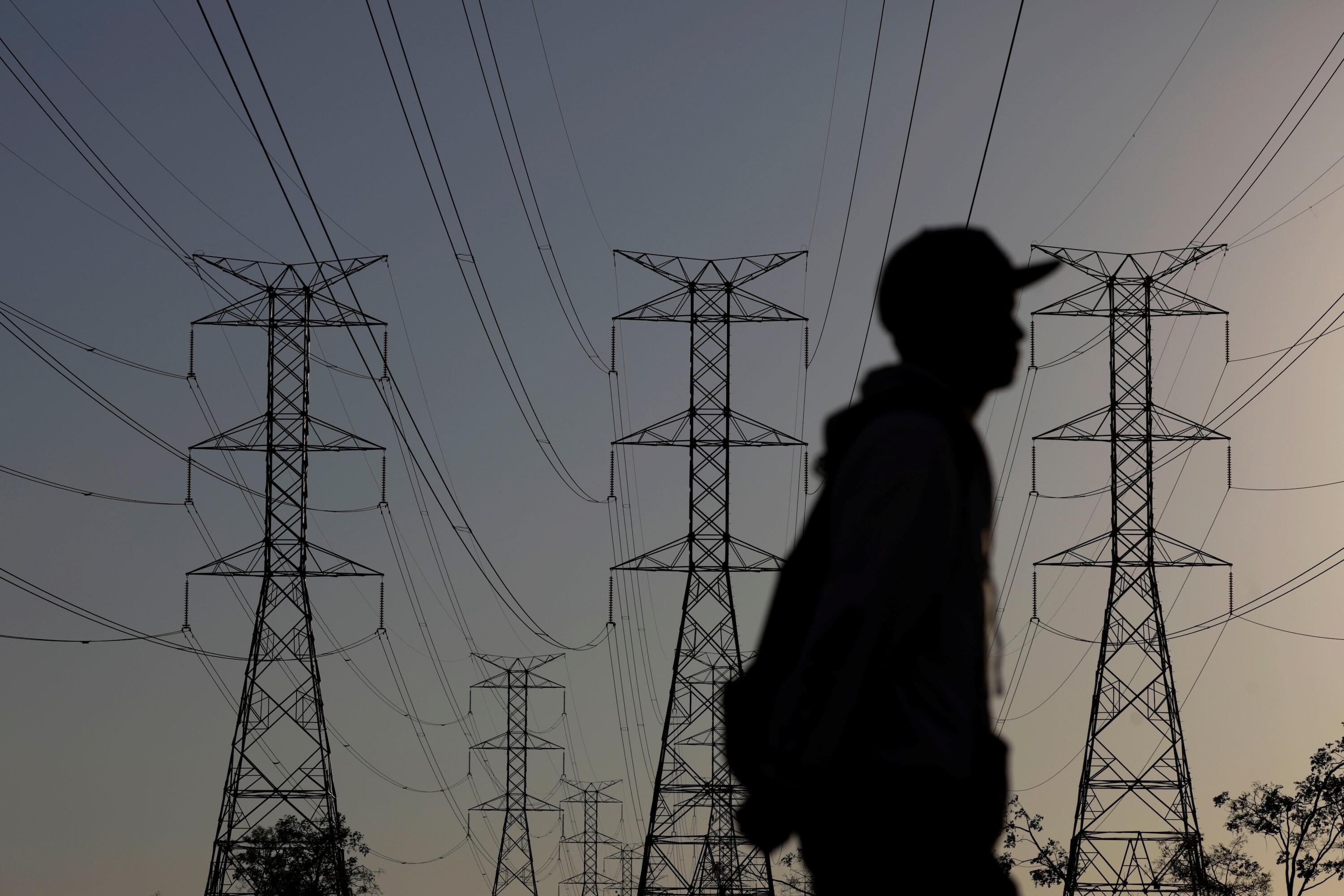
Global net zero goals were agreed before AI existed in any meaningful way – now, with COP31 approaching, it is time climate goals were updated to account for AI. Image: REUTERS/Ueslei Marcelino
Andrei Covatariu
Co-Chair of the Task Force on Digitalization in Energy, United Nations Economic Commission for Europe (UNECE)- The COP31 Presidency has proposed raising electricity’s share of global final energy demand, yet AI is largely missing from climate and energy planning.
- Two trends now dominate and compete with each other in the long-term planning on AI: massive efficiency gains combined with a sharp expected rise in demand.
- At COP31 in Antalya this November, we have the opportunity to put down on paper a shared plan for long-term climate scenarios – whether demand or efficiency eventually wins out in the end.
Artificial intelligence was not in the room when the world designed its net zero targets. At COP31 in Antalya this November, that needs to change.
In June, the incoming COP31 Presidency made electrification the flagship of its Action Agenda, proposing a collective goal to raise electricity’s share of final energy demand from just over 20% today to 35% by 2035. It is the right priority. But electrification is also a demand story: what will use the additional electricity, where will that demand appear and how will it be supplied?
AI and data centres now belong at the centre of that discussion.
AI and energy: Two trends, moving in opposite directions
To understand why the electrification agenda cannot be separated from AI and data centres, it’s crucial to understand two key trends: improved efficiency and rising demand.
The first trend is extraordinary efficiency improvement. Power consumption per AI task is declining by at least an order of magnitude annually, an unprecedented rate in energy history. Google reports that a median Gemini text prompt now uses about 0.24 watt-hours, after a 33-fold reduction in one year. One 2026 study estimates a median of 0.31 watt-hours for frontier-model inference.
The second trend is rising total demand. Data centre electricity consumption grew 17% in 2025, while consumption by AI-focused data centres rose 50%. The IEA’s central projection sees global data centre demand roughly doubling from 485 terawatt-hours (TWh) in 2025 to 950 TWh by 2030 (about 3% of global electricity).
AI is becoming dramatically more efficient per task, while the number, complexity and frequency of tasks grow even faster. Which curve proves steeper will shape the energy system for decades.
Why the projections stop at 2030
Almost every credible forecast ends this decade, and the reticence to predict further ahead is understandable: the IEA notes that uncertainties widen sharply after 2030. A technology whose unit economics improve tenfold a year makes a mockery of point forecasts. Extrapolate the efficiency curve and AI’s footprint dwindles to a rounding error; extrapolate the adoption curve and it swallows entire national power systems.
The first structured attempt to model data centre demand to 2050 within established climate-scenario frameworks finds a range of 1,800 to 5,000 TWh, a nearly threefold spread. But the limits of forecasting are precisely why the exercise matters.
The energy system does not have the luxury of a five-year horizon. A gas turbine ordered today will run into the 2050s; a transmission line permitted now, after four to eight years of development, will shape siting for decades; nuclear plants brought forward by tech sector procurement will still be generating in 2070. Every siting approval, grid connection and power-purchase agreement embeds a view of AI’s long-term electricity appetite, whether anyone writes the number down or not.
Are we heading for an AI decoupling or rebound?
The long-term question reduces to a structural fork. Down one path, the efficiency curve wins. Order-of-magnitude annual gains compound, AI’s share of global electricity stabilizes at a manageable 3-5%, and its efficiency dividend (the more than 13 exajoules of potential savings the IEA has documented across industry, buildings and transport) makes it a net asset on the world’s energy balance.
Down the other, Jevons prevails. The 19th-century economist William Stanley Jevons observed that more efficient steam engines increased, rather than reduced, Britain’s coal consumption, because efficiency made the service cheap enough to use everywhere. Cheap inference does not merely serve today’s queries more frugally; it unlocks demand that barely exists yet (always-on agents, AI embedded in every appliance and vehicle, embodied robotics, scientific simulation at scale). Long reasoning queries already consume roughly 13 times more energy than a standard prompt. Efficiency per task is improving, but the number of tasks per human is exploding.
Nobody knows which branch we are on. But the branches lead to profoundly different worlds: in one, AI is a footnote in the 2050 energy balance; in the other it is a defining driver of demand that competes with electrified transport, heating and cooling, and industry for every clean electron.
COP31 can fix net zero's AI blind spot
The 2015 Paris Agreement invited countries to prepare long-term low-emission development strategies. Eighty have been submitted. They commonly model the electrification of transport, buildings and industry, but the framework largely predates generative AI, and data centres are not consistently represented as a distinct end-use sector.
The omission cuts both ways. On the demand side, an invisible assumption stands where an explicit range should be. On the mitigation side, an opportunity goes unbooked: less than half of global energy demand is covered by policy frameworks promoting AI uptake in the energy sector, and only 10% of electricity consumption is covered by open-electricity-data policies.
None of this requires COP31 in Antalya to settle a number; it requires making the question visible. The 35% electrification goal could carry an explicit, regularly updated range for AI and data centre demand, with the assumptions on efficiency, uptake and geographic concentration stated rather than implied. National plans could treat data centres as a distinct end-use sector, rather than a residual buried inside commercial demand, as governments cannot manage what they cannot see. AI-enabled savings deserve a place in mitigation accounting, but on evidence: measured against clear baselines, disclosed consistently and tested against rebound. And flexibility (siting where clean power and grid capacity exist, shifting non-urgent computing across time and geography, participating in demand response) can turn a fast-growing load into a source of system resilience.
The Belém Mission to 1.5, stewarded by the COP29, COP30 and COP31 Presidencies and reporting ahead of Antalya, is a natural vehicle for exactly this kind of gap: a fast-growing demand source paired with a major but underused mitigation tool.
The energy sector already knows how to plan under uncertainty; that is what scenarios are for. What it cannot afford is to leave AI outside the climate planning frame because the error bars are wide. Antalya will not settle AI’s electricity demand to 2050. But it can ensure the question is finally measured and governed, before another generation of infrastructure is locked in, one siting decision, one turbine order and one silent strategy at a time.
Don't miss any update on this topic
Create a free account and access your personalized content collection with our latest publications and analyses.
License and Republishing
World Economic Forum articles may be republished in accordance with the Creative Commons Attribution-NonCommercial-NoDerivatives 4.0 International Public License, and in accordance with our Terms of Use.
The views expressed in this article are those of the author alone and not the World Economic Forum.
Stay up to date:
Artificial Intelligence
Related topics:


Forum Stories newsletter
Bringing you weekly curated insights and analysis on the global issues that matter.
More on Artificial IntelligenceSee all

Ben Colman
October 8, 2026


