The AI productivity trap: Why efficiency doesn’t always equal measurable value

Turning AI efficiency gains into measurable enterprise value requires strategic workforce planning and deliberate work redesign. Image: Compagnons/Unsplash
- Flexible AI tools boost task speed but fail to deliver bottom-line returns without job redesign.
- Unmanaged productivity creates workforce overcapacity alongside persistent skill shortages.
- Leaders must prioritize redeploying saved employee capacity towards high-value strategic growth.
In 2026, artificial intelligence is helping workers complete tasks faster than ever – yet many organizations are struggling to turn those time savings into actual financial returns. BearingPoint’s survey of 1,050 C-suite executives and senior leaders across 13 countries finds that 27% of organizations that have implemented AI report productivity gains without any measurable impact on their bottom line. Furthermore, only 13% have scaled their AI initiatives fully in line with the original business plan.
The gap between productivity gains and actual financial returns matters because AI has moved from experimentation into day-to-day operations. The stakes are rising with the shift towards agentic systems that can coordinate tasks and execute parts of workflows. If organizations automate faster without redesigning work or realigning accountability and resources, technical productivity could rise while enterprise value stalls.
The result is an emerging AI productivity trap: technology creates capacity, but management decisions determine whether that capacity becomes growth, cost savings or simply unused potential.
Why time saved doesn’t automatically mean money saved
Many AI business cases begin with operational measures: minutes saved, tasks automated, response times reduced. These measures are useful, but they are not enterprise value. A process can become more efficient while the organization’s cost base, staffing structure and complexity remain unchanged.
Consider a customer-service team that uses AI to resolve inquiries more quickly. If faster resolution does not allow the organization to serve more customers, improve retention, redeploy employees, lower supplier costs or reduce recruitment needs, the time saved may never translate into actual financial savings. The same applies in finance, procurement, software development and other functions dominated by repeatable information-processing work.
That is why leaders need a clear value chain for each major AI investment: what task-level improvement will change a customer, workforce or operational outcome, and how will that outcome affect revenue, cost, margin or another strategic objective?
Without that connection, organizations risk celebrating activity rather than impact.
AI-induced overcapacity is creating a new workforce challenge
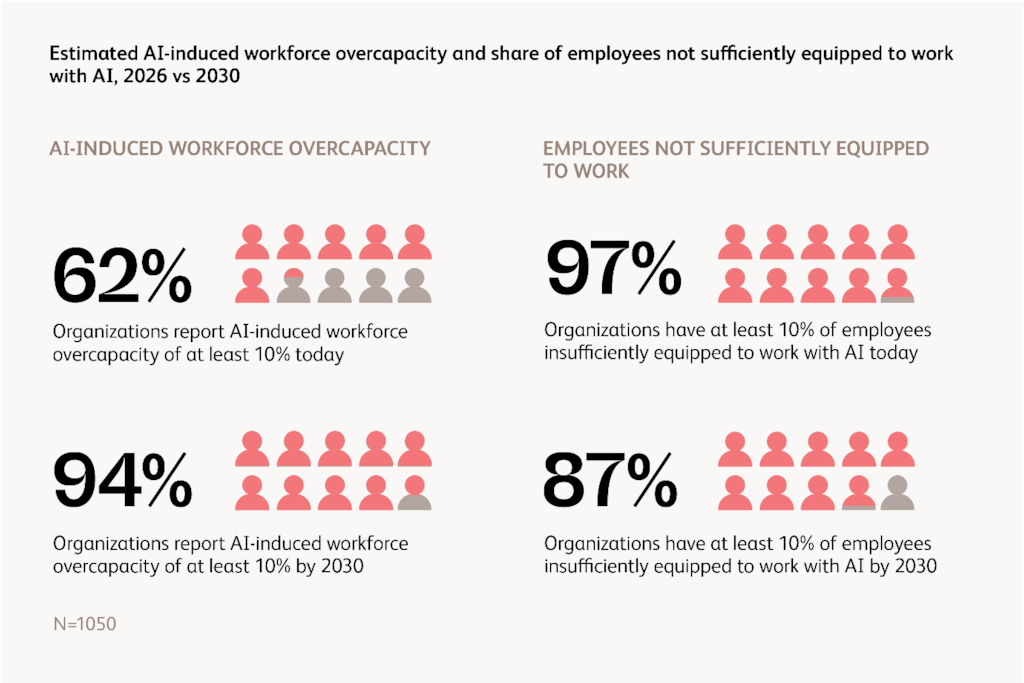
The productivity trap is most visible in the workforce. In the same survey, 62% of organizations estimate that AI has already created workforce overcapacity of at least 10%, while 94% expect overcapacity at that level by 2030. At the same time, organizations face critical skills shortages in AI governance, agent orchestration, data science, risk management and human-machine workflow design. This deficit is likely to persist: 97% of organizations say at least 10% of their workforce is insufficiently equipped to work alongside AI today, and 87% expect these skill shortages to remain through 2030.
Workforce planning also needs to start earlier. Although 69% of organizations regularly assess skills gaps, only 48% embed strategic workforce planning in their AI transformation roadmaps. Technology, business and HR teams cannot develop separate plans and expect the economics to add up after implementation.
Redeploying staff is the fastest way to capture value from AI
Organizations have more options than absorbing unused capacity or launching large restructuring programmes. In the survey, 66% report using upskilling and reskilling, 44% internal mobility, and 38% strategic hiring freezes or controlled recruitment.
These levers can work together. Employees can be redeployed to improve customer engagement, strengthen sales, support innovation, supervise AI-enabled processes or fill emerging governance and risk roles. Natural attrition and recruitment controls can gradually align capacity with demand, while contractor use can be adjusted, where appropriate. Where workforce changes are constrained by regulation, industrial relations or social considerations, organizations can prioritize AI initiatives that support growth and service improvement, absorbing higher demand without proportional headcount growth.
This is a more responsible and economically useful approach than treating productivity as a synonym for workforce reduction. The objective is to move capacity towards higher-value work and measurable outcomes.
Commerzbank illustrates how this can work in practice. From 2030 onward, the bank expects its AI initiatives to generate around €500 million in additional value annually and free up around 10% of its capacity, partially redeploying it to give employees in sales more time for high-quality customer advisory services. Its wider transformation includes a group-wide reduction of around 3,000 positions, partially offset by targeted hiring in selected growth and future areas and supported by established retirement programmes, natural attrition and demographic effects.
Test scalability and workforce readiness together
Even a strong local use case creates limited enterprise value if it cannot scale. Regulatory complexity, legacy-system integration and fragmented data often emerge only after a pilot succeeds. Fewer than one-third of organizations formally assess scalability before launching an AI initiative, even though 54% identify high-quality, trusted data as critical to scaling.
Before approving a major AI investment, leaders should ask three questions. Can the solution scale across relevant processes, business units and markets? Can its operational benefits be connected to measurable customer and financial outcomes? And can the organization adapt roles, skills and resource allocation to capture the capacity created?
Escaping the AI productivity trap ultimately requires leaders to make deliberate choices about where that capacity should go and how it will generate measurable value.
Don't miss any update on this topic
Create a free account and access your personalized content collection with our latest publications and analyses.
License and Republishing
World Economic Forum articles may be republished in accordance with the Creative Commons Attribution-NonCommercial-NoDerivatives 4.0 International Public License, and in accordance with our Terms of Use.
The views expressed in this article are those of the author alone and not the World Economic Forum.
Stay up to date:
Artificial Intelligence


Forum Stories newsletter
Bringing you weekly curated insights and analysis on the global issues that matter.
More on Artificial IntelligenceSee all

Etay Maor
October 15, 2026


