How ageing consumers are reshaping the global economy

Of the $70 trillion consumers will spend in 2026, $19 trillion will be controlled by people aged 60 and over. Image: Mark Timberlake/Unsplash
- People aged 60 and over make up only 15% of the world’s population, but account for 27% of global consumer spending, roughly $19 trillion.
- That figure is projected to nearly double to $34 trillion by 2036, when close to one in three consumer dollars worldwide will be spent by someone over 60.
- The “silver economy” markets – products and services designed for ageing populations – are already worth $4.5 trillion and growing at 7% per year.
The world’s population is ageing at an unprecedented pace. Global life expectancy has risen by more than 25 years since 1960, from around 48 to 74, while the total fertility rate has fallen from 4.7 to 2.2. Longer lives and smaller families are producing an older world.
According to the UN, the population aged 60 and above numbered 196 million in 1950, accounting for 8% of the world population. By 2025, it had reached 1.2 billion, or 15%. By 2050, it is expected to reach 2.1 billion, more than one in five people on Earth. This cohort is currently growing at more than three times the rate of the global population.
Many of our societal stories about ageing center around its liabilities: crises of care, shrinking workforces and pensions. However, the fact that we’re living longer lives is also creating a huge demand engine, something we call the silver economy.
What is the silver economy
Of the $70 trillion consumers will spend in 2026, $19 trillion will be controlled by people aged 60 and over. This means that only 15% of the population controls 27% of spending. According to World Data Lab’s forecasts, by 2036, that will grow to $34 trillion, at which point nearly a third of every consumer dollar worldwide will be spent by someone aged 60 or older.
Beyond this general high spend, there is a specialized market for goods and services designed for ageing populations. This silver economy encompasses senior living and care, longevity health, longevity finance and senior tourism, as well as other adjacent categories, and is already worth about $4.5 trillion and expanding at 7% a year, compared with roughly 3% for consumer spending overall.
Where is the growth coming from?
The silver opportunity is global, but still regionally concentrated. North America, led by the United States, is the largest market today and for the immediate future, with 60+ spending projected to rise from $7.4 trillion to $11.7 trillion by 2036. However, Asia-Pacific is the fastest-growing region, since 60+ spending there is projected to more than double from $4.9 trillion to $10.2 trillion (overtaking Europe, which is projected to grow from $5.4 trillion to $8.6 trillion) by 2036. Japan, South Korea, China and Southeast Asia’s ageing populations are driving this growth, and demand is concentrated in senior tourism and healthy-ageing products. Latin America and Africa are starting from a small base but are also growing quickly, with Africa’s older-adult spending set to double by 2036.
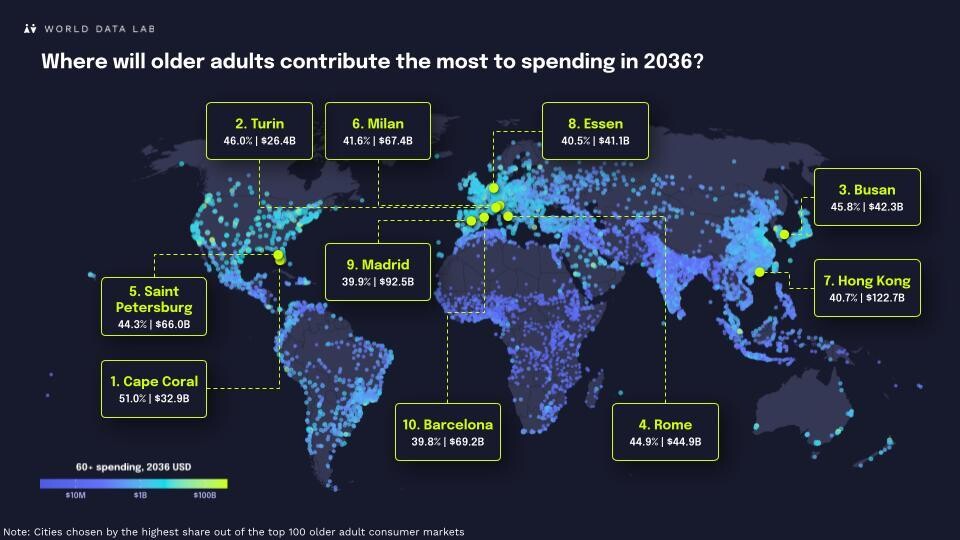
The US as a preview
The US is the clearest example of an economy already in this transition. Its 86 million adults aged 60 and over spend around $6.7 trillion a year, which, if it were a country, would be the world’s third-largest consumer market, behind only the US as a whole and China. Silver spenders make up 30% of national consumer spending today, rising to a projected 33% by 2036.
As consumers age, the data shows a pattern of spending reallocation, with increases in social protection (+29%), medical products (+21%), hospital services (+19%), insurance (+14%) and home ownership (+13%), and falls in spending on restaurants (-21%), clothing (-14%), transport and vehicle purchases ( -13%). This illustrates that older consumers are spending differently, but not less.
Who is the over-60 consumer?
Unlocking this growth requires dismantling outdated stereotypes about older adults. Far from being passive or digitally averse, today’s 60+ consumers are optimistic, tech-literate and value-driven. NielsenIQ’s Consumer Life survey reveals that 81% of older Americans hope to age better than their parents did, while 51% report feeling younger than their chronological age.
They are also active digital adopters: adults aged 55 and over account for 34.5% of health and beauty buyers on TikTok Shop – a larger share than the 35-54 demographic. While willing to pay a premium when quality and efficacy are clear, they remain value-conscious and largely unmoved by empty aspirational branding.
This blend of digital fluency and a desire for healthy, independent ageing is fueling explosive demand for technology-enabled solutions. Within the silver economy, “age tech” categories are growing at two to three times the market average, despite many barely existing five years ago. Driven by consumers who want to age in place, smart-home and ambient assisted-living systems are expanding at 17% annually, while fraud protection grows at 15%. Similarly, wearables and health-monitoring devices (14%) and eldercare robotics and AI companions (12%) reflect a consumer base actively using technology to maintain autonomy and vitality.
Capturing the silver opportunity
Capitalizing on this demographic shift requires more than minor product adjustments; it demands a fundamental shift in corporate strategy.
First, businesses must embrace universal design. Rather than retrofitting products for an ageing audience, companies need to design for older consumers from the outset. Brands that remain fixated solely on younger demographics risk ignoring nearly a third of all global spending.
Second, health is becoming a central organizing principle across every sector. Longevity and well-being are no longer confined to healthcare; they now shape consumer choices in food, travel, finance and everyday technology.
Finally, organizations must radically rethink how they talk about ageing. Effective messaging for the silver consumer emphasizes vitality, capability and active life engagement, treating the 60+ market as aspirational participants rather than passive patients.
The 60+ consumer today is wealthier per capita than the working-age population, growing faster than any other group, digitally fluent, and actively investing in living longer and better. The brands that win the next decade will be those that recognize this shift first.
This article draws on Spending Longer and Living More: Why Ageing Consumers Will Shape Global Spending Through 2036, a joint research report by World Data Lab, NielsenIQ and Silver Economy (June 2026).
Don't miss any update on this topic
Create a free account and access your personalized content collection with our latest publications and analyses.
License and Republishing
World Economic Forum articles may be republished in accordance with the Creative Commons Attribution-NonCommercial-NoDerivatives 4.0 International Public License, and in accordance with our Terms of Use.
The views expressed in this article are those of the author alone and not the World Economic Forum.
Stay up to date:
Longevity Economy


Forum Stories newsletter
Bringing you weekly curated insights and analysis on the global issues that matter.
More on Economic GrowthSee all

John Letzing
October 13, 2026


