Opinion
What Pakistan reveals about administrative reform for fast-growing populations

As Pakistan's population continues to grow, administrative reform becomes an ongoing concern. Image: REUTERS/Mohsin Raza
Miroslav Zafirov
Advisor to the Director General, The Anwar Gargash Diplomatic Academy; Non-resident Senior Fellow, The Atlantic Council, The Anwar Gargash Diplomatic Academy- Fast-growing populations can outgrow the administrative systems built to govern them, making institutional scale necessary for development.
- Pakistan shows why decentralization must go beyond provincial capitals – authority, funding and accountability need to move closer to citizens if services are to improve.
- Boundary reform is not a cure-all and works only when paired with fiscal capacity, clear mandates, reliable transfers and measurable performance.
Across many emerging economies, populations are outgrowing the institutions designed to govern them, creating a governance challenge as demographics change.
When administrative systems built for smaller societies are asked to serve vastly larger, more urban and more unequal populations, decision-making can become too distant from the citizens they are meant to serve.
Pakistan illustrates why reform here is necessary and what it should look like. Its population has grown more than sevenfold since 1951. Its approximately 260 million people live within the same four main administrative provinces but disparities exist. Punjab alone, for example, has about 128 million people. Balochistan, by contrast, has fewer than 15 million people in a larger land area.
Administrative maps shape how governments raise revenue, allocate public funds, plan infrastructure, respond to shocks and measure performance. When these maps no longer reflect demographic and economic realities, governance challenges intensify.
This is further compounded when provincial capitals become increasingly remote from peripheral districts, leaving citizens with a weak sense of connection and threatening socio-economic stability. As Pakistan’s population continues to grow, potentially reaching 265 million by 2030, administrative reform becomes an ongoing concern.
Keeping pace with demographic change
To address this, consecutive governments have taken major steps in recent years to decentralize the country.
The 18th Constitutional Amendment and the 7th National Finance Commission Award, for instance, devolved major responsibilities for services such as health and education to the provinces, while giving them a much larger share of federal taxes – from 47.5 to 57.5%.
While promising, many decisions remain far from the communities most affected by them. Lahore district has around 13 million people, while Harnai district in Balochistan has just 128,000. A policy designed in a provincial capital must therefore serve vastly different realities.
The education sectors further outline these variations. The Planning Commission’s District Education Performance Index, for instance, found that none of the 134 assessed districts reached the “very high” performance category. Recent household survey reporting also shows that 28% of children aged five to 16 are out of school nationally, with provincial rates ranging from 21% in Punjab to 45% in Balochistan.
These gaps reflect distance: between policymakers and districts, budgets and outcomes, authority and accountability.
Moving closer to citizens
Pakistan is far from unique. Other large and diverse countries have repeatedly adjusted their administrative geography as their populations and economies evolved. Nigeria, for example, repeatedly redrew its internal administrative map, replacing its three-region structure at independence with 12 states in 1967 and eventually 36 states by 1996.
Indonesia, too, grew from 27 provinces in 1991 to 38 today. Kenya replaced its eight provinces with 47 elected county governments in 2013. In Indonesia, Nigeria and Brazil, average first-tier populations are around 6-8 million, far below Pakistan’s current average of 60 million and these countries arguably have more complex administrative systems.
More units can produce better government but more importantly, institutional geography should evolve when the scale of governance no longer matches the scale of society.
Here, Kenya is instructive. The country changed its fiscal and political machinery alongside its map. Counties were not just new boundaries; they were elected governments with constitutionally protected responsibilities and a formula-based share of national revenue, weighted for factors including population and poverty.
Lebanon, however, offers a cautionary contrast: fragmentation without fiscal and institutional capacity can be as debilitating as over-centralization. Despite having more than 1,000 municipalities, many remain too small and financially weak to deliver services effectively.
Changing institutions and fiscal systems, too
Boundaries, funding and mandates must move together. Smaller units without predictable transfers, credible taxing powers and clear service responsibilities can simply reproduce centralization at a lower level.
For Pakistan, the debate should not be framed as a contest over one “correct” map because it presents a set of governance scenarios.
A modest reform could divide each existing province into four, creating 16 first-tier governments and reducing the average population per unit from about 60 million to roughly 15 million.
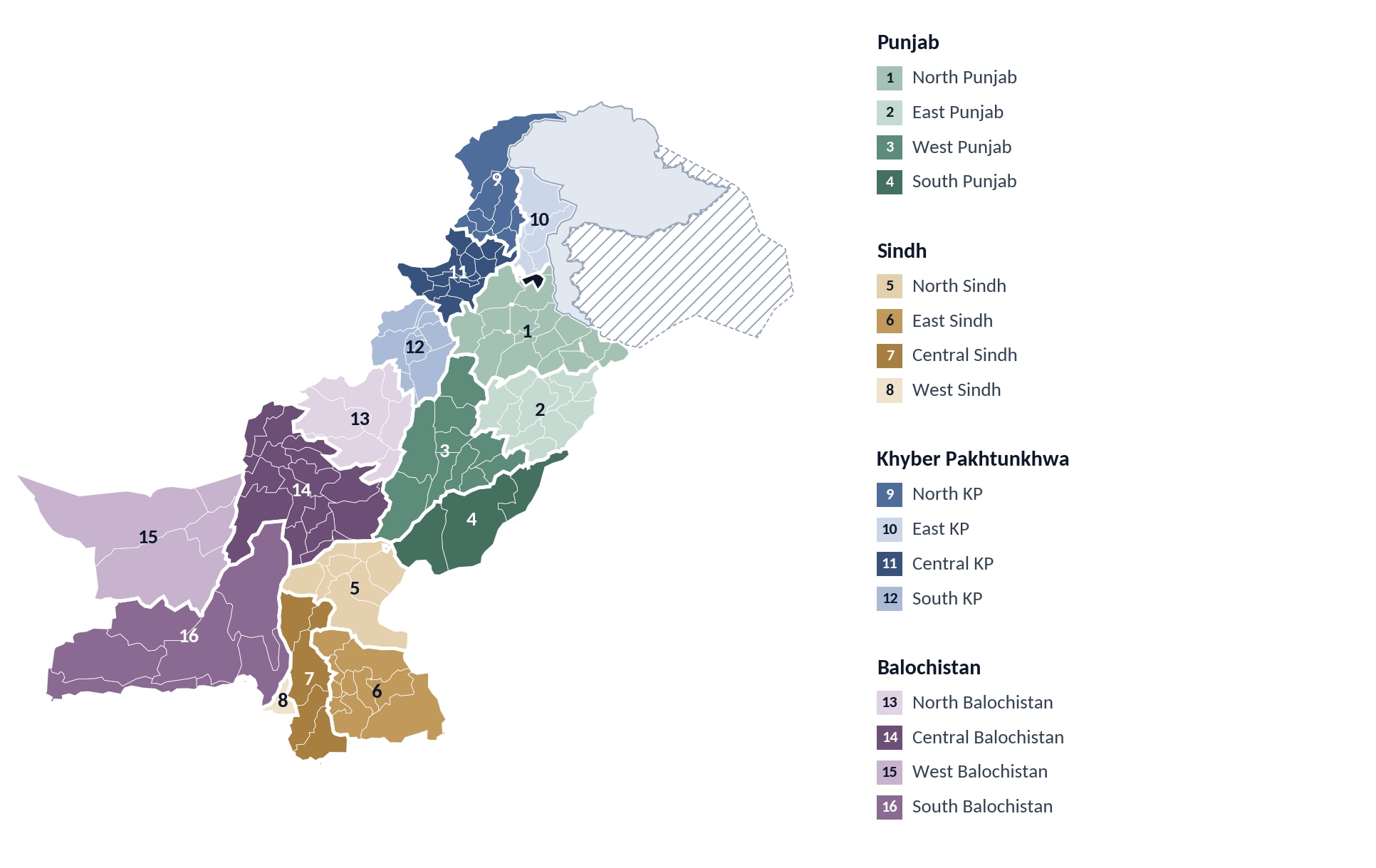
More ambitious models could create 23 to 25 units based on population balance or geographic coherence. Another approach could build on existing civil divisions, creating more than 30 units with average populations closer to those seen in other large federations.
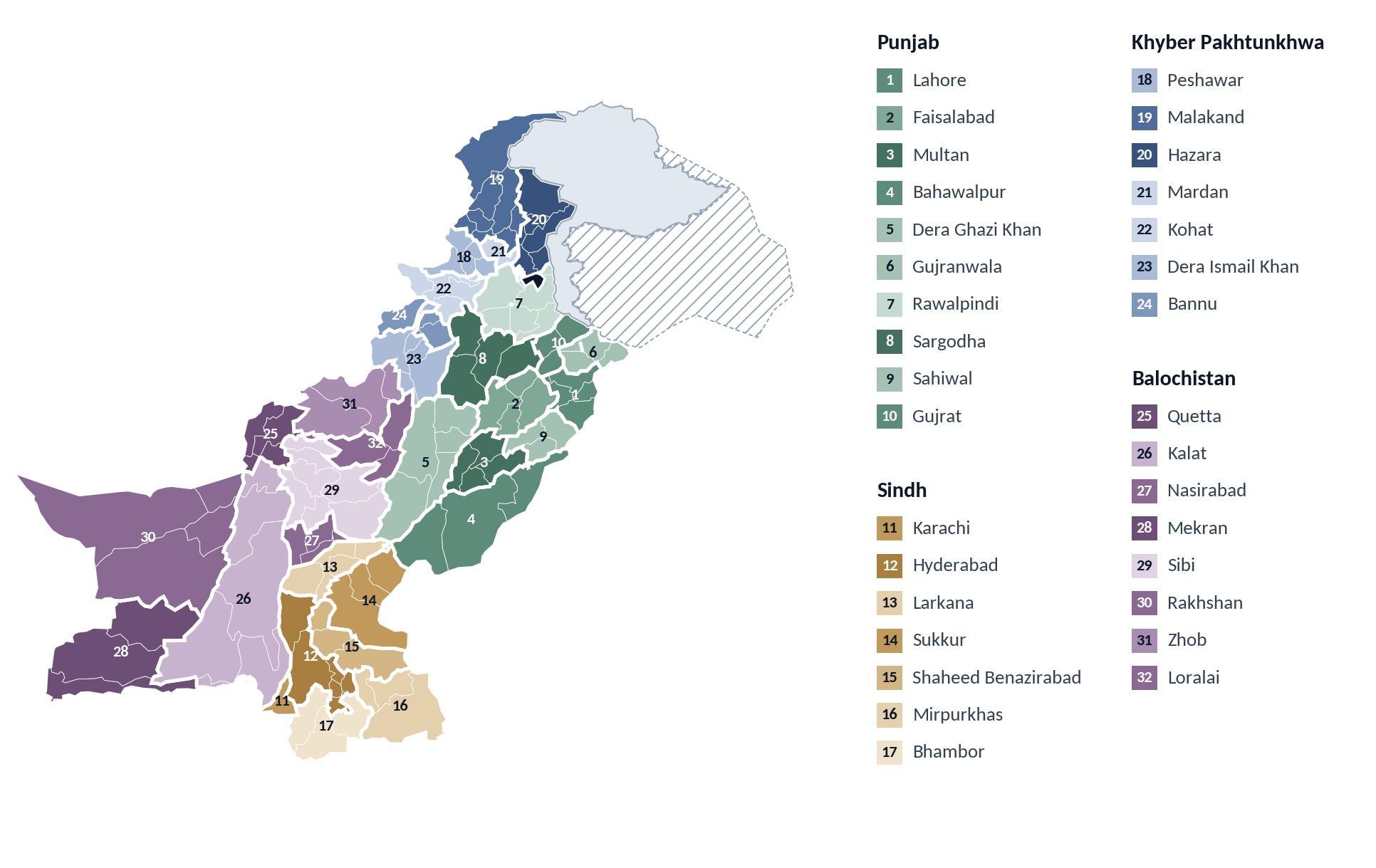
Each scenario involves trade-offs. Fewer, larger units may be easier to legislate and finance. More numerous units could bring capitals, budgets and political authority closer to citizens but would raise transition costs and require stronger administrative capacity. Evidence from other countries also cautions against treating boundary reform as a cure-all.
New administrative units can improve responsiveness but only when paired with capable institutions, transparent transfers, comparable performance data and incentives for local revenue mobilization.
Better governance, not simply more administrative units
To illustrate, Pakistan’s provinces now carry major service delivery responsibilities, yet provincial own-source revenue remains limited. In 2024-2025, provincial taxes brought in just PKR 983 billion, equivalent to less than 0.9% of gross domestic product.
Meanwhile, agriculture accounts for 24% of value added but agricultural income taxation has historically yielded very little relative to the size of the sector.
The International Monetary Fund estimates agriculture’s effective tax rate at just 0.3%, while agricultural income tax revenues have remained below expectations even after rates increased in 2025.
For decades, provincial tax authorities have struggled with limited administrative capacity, weak enforcement and inadequate information, making it difficult to identify and collect tax on agricultural income.
The recent reforms aim to address some of these weaknesses but their success will depend on better data sharing with the Federal Board of Revenue, greater automation and stronger provincial capacity to enforce the rules.
Weak local revenue systems also undermine accountability because citizens are less able to connect what they pay with what they receive. Greater fiscal proximity, if designed carefully, could strengthen that link.
Stronger local revenue systems
A political economy argument also applies. Smaller, better-resourced administrative units can widen the pipeline of political and administrative leadership. They can make it easier to plan around local economic strengths, manage climate shocks, respond to urban growth and tailor services to district-level needs.
For a country exposed to floods, water stress, rapid urbanization and youth employment pressures, proximity is not a luxury; it is part of resilience.
The caution is that redesign must not become fragmentation for its own sake. Some countries face the opposite risk: too many weak local bodies, without adequate fiscal or institutional capacity, can leave governments fragmented but ineffective.
The goal is not simply to multiply administrative units but to align scale, authority, resources and accountability.
Pakistan therefore raises a question many fast-growing economies will increasingly face: when does administrative scale itself become a constraint on development?
There is no universal answer and no ideal number of provinces, states or counties. However, the principle is broader than any boundary: when populations grow faster than institutions, governments must be willing to redesign those institutions so decisions, resources and accountability can be brought close enough to the people who live with the consequences.
Don't miss any update on this topic
Create a free account and access your personalized content collection with our latest publications and analyses.
License and Republishing
World Economic Forum articles may be republished in accordance with the Creative Commons Attribution-NonCommercial-NoDerivatives 4.0 International Public License, and in accordance with our Terms of Use.
The views expressed in this article are those of the author alone and not the World Economic Forum.
Stay up to date:
Agile Governance


Forum Stories newsletter
Bringing you weekly curated insights and analysis on the global issues that matter.
More on Geographies in DepthSee all

Karikari Achireko
October 2, 2026


