Emerging technologies: 3 signals show where innovation is headed
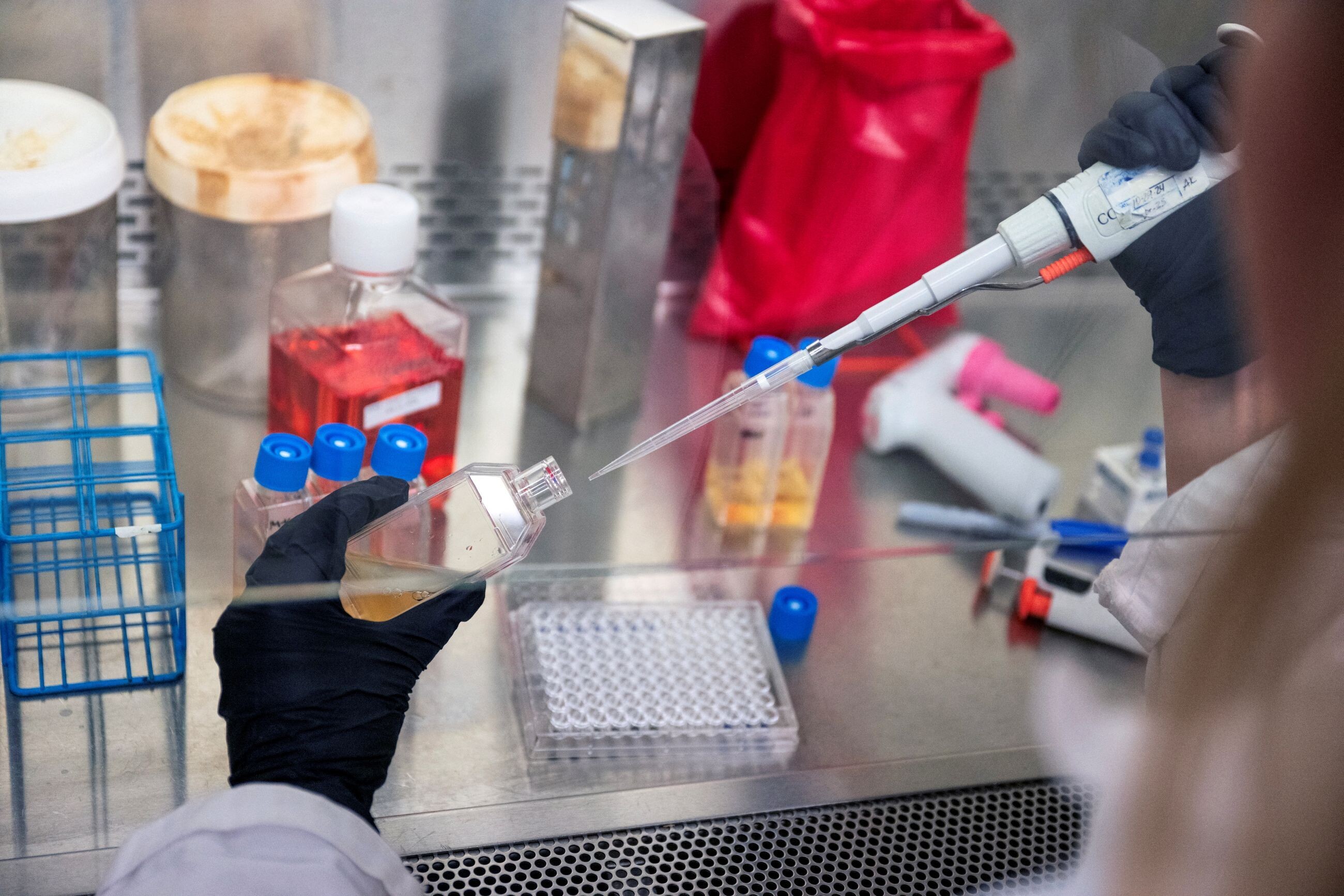
Key developments across different fields show that innovation is becoming more personal, more local and more resource-efficient. Image: REUTERS
Akshay Joshi
Head of the Centre for Cybersecurity, Member of the Executive Committee, World Economic Forum- The Forum's Top 10 Emerging Technologies of 2026 report identifies scientific advances on the cusp of changing the world.
- What it also reveals is the shift in how innovation happens - moving from experimentation to digital modelling, compressing the distance between discovery and deployment.
- Key developments across different fields show that innovation is becoming more personal, more local and more resource-efficient.
It’s said that one fine day does not make a summer. The same is true when considering innovation.
While seeing how individual technologies are making an impact can provide insight, lone developments and deployments rarely indicate societal change.
To truly understand the direction of travel innovation is taking, it’s instead important to look at the broader shifts being experienced across economies, industries and communities as a whole.
The Top 10 Emerging Technologies of 2026 report from the World Economic Forum identifies scientific advances that are approaching the moment when they are ready to change the world.
Looking at the developments that made the cut this year – selected by world-leading scientists, technologists and innovation leaders for their novelty, development progress and potential impact – a clearer picture of change emerges.
From experimentation to modelling
Perhaps the most significant shift is in how innovation happens.
Where previously experimentation was needed in order to test scientific breakthroughs, digital modelling is changing how funding is directed and compressing the distance between discovery and deployment.
Advances in AI, simulation and computational design mean more capabilities can be tested, with researchers able to model and optimize solutions before physically building them.
This overarching change in approach is accelerating discovery and can also reduce costs.
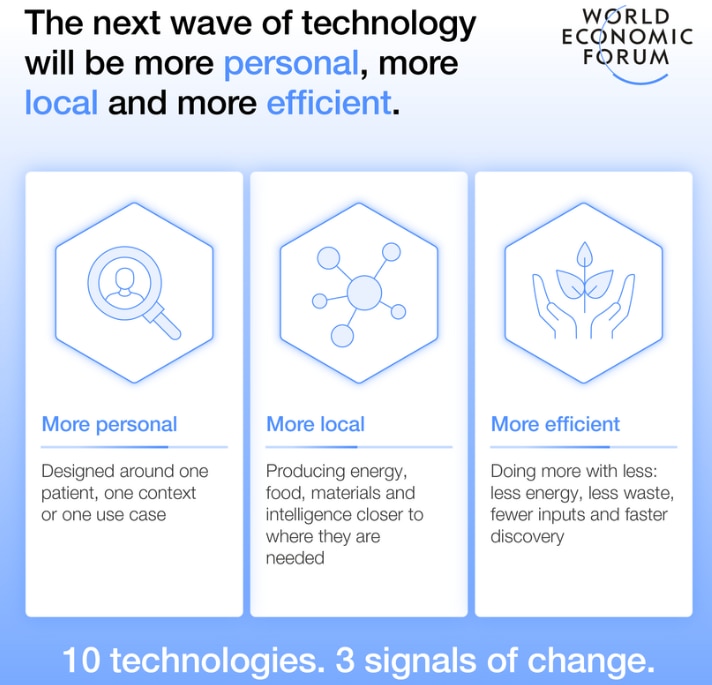
Three signals of change
Aside from this broad shift, clear markers are also emerging to indicate the path innovation is taking. Different examples from across the report suggest that personalization, localization and resource efficiency will be major themes over the coming years.
1. Innovation is becoming more personal
The first key signal centres on personalization. Technologies are being designed to support individual people, specific contexts and to solve unique problems. This is perhaps most clear in the field of medicine.
When treating cancer, mRNA vaccines can now be built to the specifications of individual tumours. By sequencing genetic mutations in extracted cells and identifying antigens, vaccines can be synthesized to a specific profile, "carrying instructions that prime the immune system to recognize and respond to cells bearing those markers".
Developments in drug delivery mean medicine can be delivered using parts of a patient's own body, reducing risks of rejection. Exosomes can be loaded with therapeutic cargo and reprogrammed to find a specific diseased cell. As the report says, “the body accepts the delivery because it recognizes the courier”.
In AI, world models are changing how the technology learns, allowing it to provide more tailored solutions. Unlike Large Language Models, which are trained only on text, these models can ingest data from video, depth sensors, pressure readings, motion capture and more. By analysing patterns from across different sources, world models can predict outcomes in specific contexts, giving them the potential to inform decisions in unique real-world physical settings.
Meanwhile, quantum simulation means researchers have the potential to cure diseases or target particular molecules that were previously too complex, risky or expensive. Researchers can map drug candidates atom by atom, allowing them to see how they will “fold, bind and behave” before being brought into lab-based testing.
2. Innovation is becoming more local
The second signal shows how innovations are allowing for a more evenly distributed, localized approach. Many breakthroughs are changing where goods can be produced, reducing the need for particular geographic or physical conditions to succeed. In these instances, competitive advantage can be gained by installing the right infrastructure, nurturing technical capability, and increasing deployment capacity.
The extraction of lithium is a case in point. Previously, evaporation ponds were set up in places such as the Atacama Desert in Chile, evaporating over months to refine the chemical, with the full process taking up to two years. Direct extraction methods can now process the same material without the need for evaporation, enabling production in new locations.
And in energy, everything-to-grid systems mean buildings, vehicles and more can become both consumers and suppliers of power. By connecting stored energy from a wide range of sources to the grid, spikes in demand can be managed more effectively.
3. Innovation is becoming more resource-efficient
The third signal indicates that many promising technologies are doing more with less, reducing the amount of resources needed for certain processes, while improving performance and resilience.
Passive radiative cooling materials, for example, allow surfaces to cool without using electricity and can be embedded in many building materials. By using them, building temperatures can be reduced without the need for cooling systems.
Precision fermentation can produce proteins using fewer natural resources. A key antimalarial drug relied on a particular crop, making it vulnerable to poor harvests and price collapses. Now its genetic makeup is transferred to a microbial host, cultivated in large fermentation tanks and the identical molecule is produced reliably at scale.
Have you read?
The path forward
While these signals indicate a clear direction of travel, one in which innovations become more personalized, localized and resource-efficient, long-term success requires more than just novel solutions.
Ecosystem thinking is fundamental to the success of many of the emerging technologies outlined in the report.
The technologies emerging today are arriving at a moment of growing pressure on our critical systems - healthcare, energy grids and production, supply chains and natural resources.
If businesses, institutions and governments can work together to deliver infrastructure readiness, regulation, investment, standards and public trust, promising advances can grow into transformative systems.
License and Republishing
World Economic Forum articles may be republished in accordance with the Creative Commons Attribution-NonCommercial-NoDerivatives 4.0 International Public License, and in accordance with our Terms of Use.
The views expressed in this article are those of the author alone and not the World Economic Forum.
Related topics:

Forum Stories newsletter
Bringing you weekly curated insights and analysis on the global issues that matter.