The art of enhancing human-technology connection
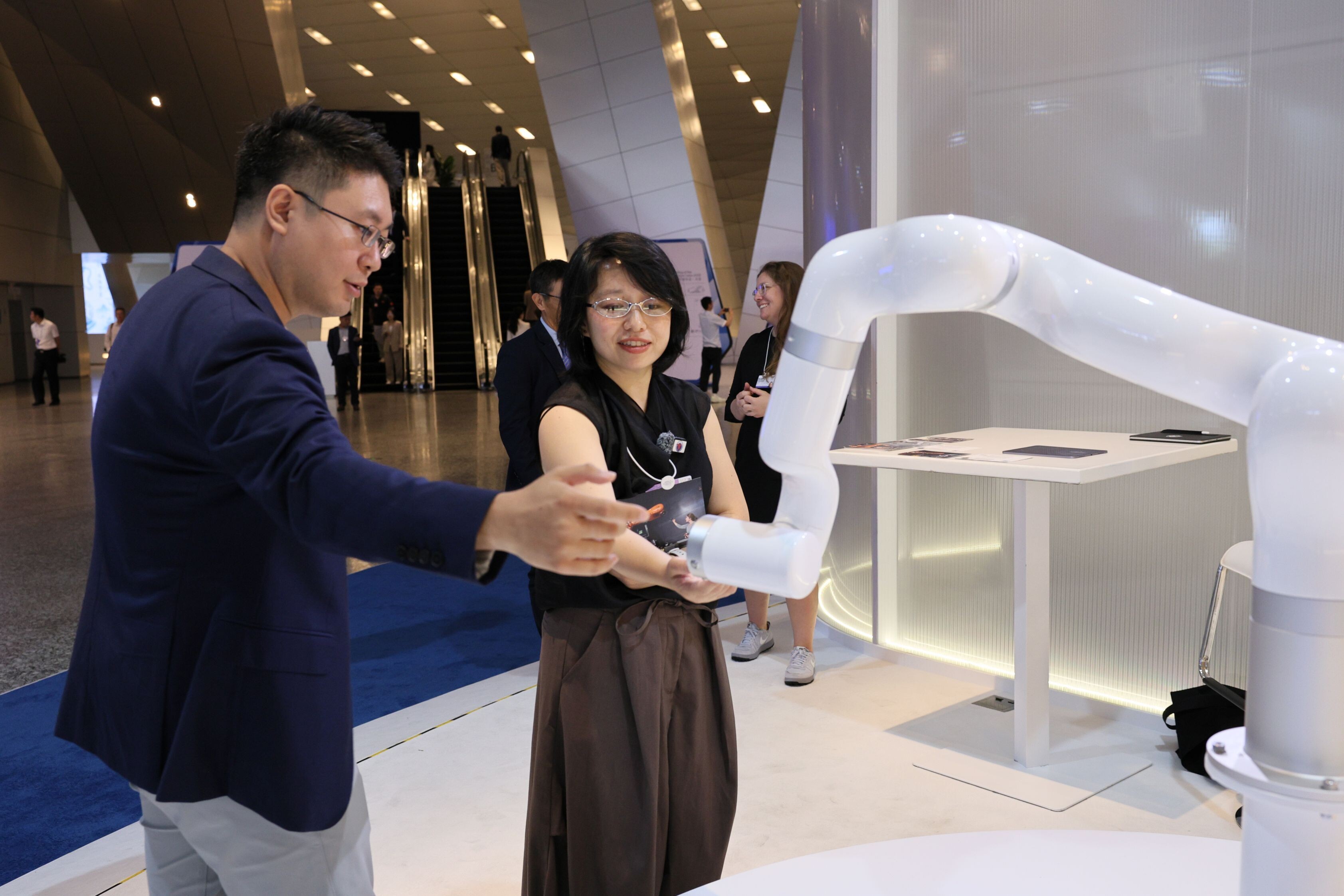
Visitors to the Annual Meeting of the New Champions 2026 interact with Madeleine Gannon's exhibit. Image: World Economic Forum
- As emerging technologies become more central to our lives, questions are being raised about how deeper connections can be forged between people, systems and hardware.
- From altering the movement of robots to using new tools to tell stories, artists Madeliene Gannon and Victoria Fard are exploring different ways to bring humans and technology closer together.
- They shared their thoughts at the Annual Meeting of New Champions 2026 in Dalian, People's Republic of China.
Technology deployment success metrics often centre on productivity, efficiency and cost savings.
But as AI, robotics and more become increasingly embedded in our lives, should we put greater focus on the sense of connection we feel with them?
This question surfaced in more than one session at the Annual Meeting of the New Champions 2026 in Dalian, China.
Here are some of the approaches different experts are taking to humanize technology.
Robots with warmth
Madeleine Gannon is an artist-roboticist. In her session Robots in Rhythm With Us, she shared why she believes it’s so important to ensure that the human experience of machines becomes more deeply embedded in the development process.
“Robots hold a lot of our deep anxieties about our future with technology,” she explained. “Automation reminds us of our own potential for obsolescence. What I want us to think about, though, is how automation is not inevitable; it's intentional. It's the result of our collective choices as a society, and at any moment we can decide to choose differently.”
In her work, she has explored how changes to the movement of robots, even those usually used in industrial settings, can be altered to capture people's imaginations and make it easier to build a connection. One example, Mimus, started life as an Autoline robot in Birmingham, UK. By altering its programming, it was transformed into an interactive exhibit at the Design Museum in London.
“What I think we're missing in the robotics world and in the technology world in general is that the future is really not going to be about function, what the robots do,” she said. “It's really going to be about feeling – the experience of these machines.”
She explained how she looks for ‘shortcuts’ that structure their movement in a way that elicits emotion. In some instances, this means making them move more like animals rather than people.
“The magic behind all of this, just by changing how these machines move, is that we automatically begin to project our life force onto this machine and reflect it back onto us," Gannon explained. “The human in the loop is what brings this machine to life.”
The human in the loop is what brings this machine to life.
—Madeleine Gannon”Storytelling through new mediums
Elsewhere at the event, speakers considered how technology is impacting the way we communicate with one another.
Multidisciplinary artist Victoria Fard hosted a session titled Algorithmic Storytelling, which she began by reflecting on the importance storytelling has always held for humans.
“Long before stories were written down, they were shared through gatherings, around circles, around tables,” she said. “They lived in people's voices, in the atmosphere, in gestures, and in shared attention.
“And people weren't just listening to the storyteller. They were listening together. Over centuries and across cultures, storytelling was used to exchange ideas and to share different ways of seeing the world.
“Now today, the tools have changed, but that human impulse of sharing stories has not.”
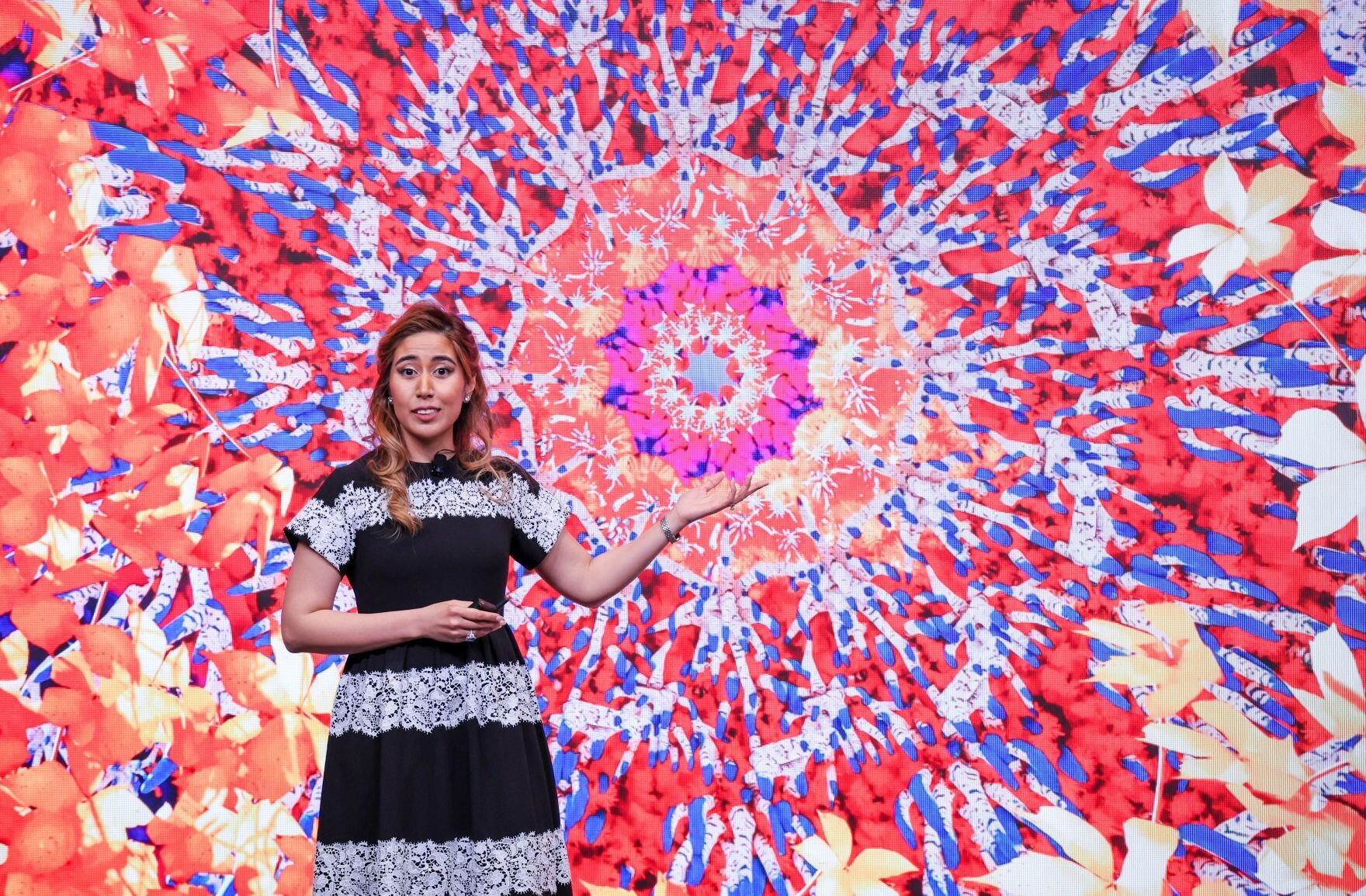
In her work, Fard creates immersive digital spaces using algorithmic design, advanced visualization and emerging technologies. The tools she uses allow her to create works in 16K resolution, enabling them to be displayed on screens more than four storeys high, such as those in Times Square and Outernet London.
While technology may be creating new ways for art and stories to reach broader audiences, Fard maintained that it is the human choices she makes that allow others to truly connect with her work.
“What fascinates me is the dialogue between the artist and the system. Because the system does not recognize why one choice matters more than the other,” she explained.
“The tools helped me build the worlds, but I decide what matters."
License and Republishing
World Economic Forum articles may be republished in accordance with the Creative Commons Attribution-NonCommercial-NoDerivatives 4.0 International Public License, and in accordance with our Terms of Use.
The views expressed in this article are those of the author alone and not the World Economic Forum.

Forum Stories newsletter
Bringing you weekly curated insights and analysis on the global issues that matter.
More on Emerging TechnologiesSee all

Rohail Iqbal
October 12, 2026