Debt, yields and AI: The chief economists' view, and other finance news to know

The AI build-out is increasingly being financed through debt markets. Image: REUTERS/Audrey Richardson
- Catch up on the key stories and developments shaping the financial world.
- Top stories: Chief economists on debt, yields and AI; IMF on hedge fund leverage; Africa launches its own rating agency.
- For more on the World Economic Forum's work in finance, visit the Centre for Financial and Monetary Systems.
1. Key finance takeaways from the latest Chief Economists' Outlook
The headline economic outlook may be stabilizing, but underlying market dynamics tell a much more complex story.
The September 2026 Chief Economists’ Outlook from the World Economic Forum reveals an environment marked by elevated public debt, diverging monetary policy expectations and a tech capex boom increasingly reliant on debt financing. With fiscal buffers constrained and long-term yields high in the US and Japan, the outlook points to growing risks around stretched valuations, AI financing and investment returns.
Core financial takeaways:
1. Valuation frictions & the AI credit engine
Market enthusiasm for tech infrastructure is running into credit market realities and capacity constraints.
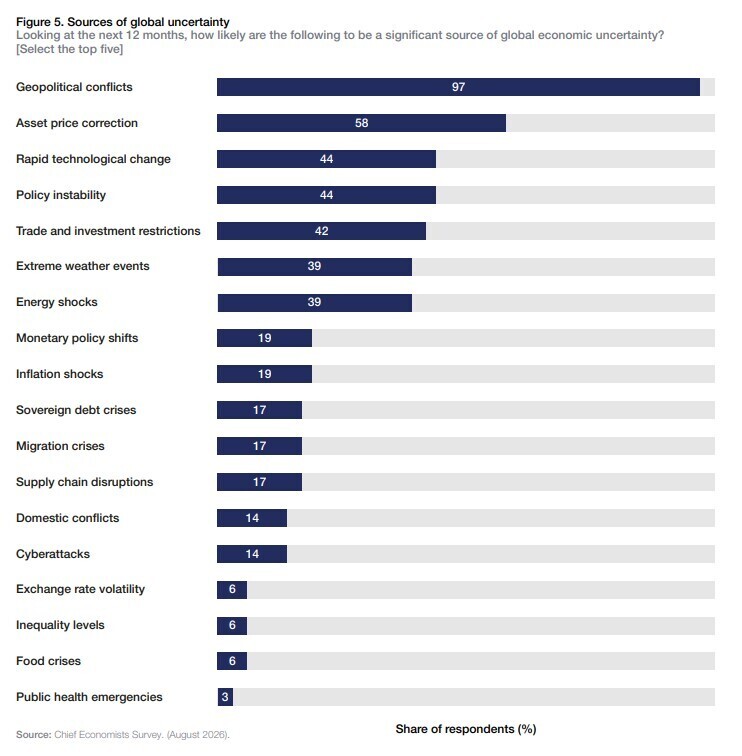
- Market correction exposure: 58% of surveyed chief economists identify asset price corrections as a top-five source of global economic uncertainty, second only to geopolitical conflicts. The report also highlights BIS warnings about compressed risk premia and stretched equity valuations.
- Heavy debt issuance: AI companies absorbed close to two-thirds of US venture capital and about one-quarter of investment-grade debt issuance in the preceding 12 months. Hyperscaler bond spreads have widened by around 30 basis points this year as of August, compared with 2 basis points for the broader investment-grade market, according to JP Morgan Asset Management.
- Potential ROIC bottlenecks: 79% of respondents expect significant local community pushback against data centre expansion, with higher electricity and water prices among the concerns cited. Such opposition could threaten project timelines and delay returns on invested capital.
2. Private capital & dealmaking realignment
Investment in strategic sectors is becoming more concentrated, while private equity allocations in Asia are shifting.
- Mega-cap capex concentration: Tech giants (Google, Meta, Microsoft, Amazon) are expected to spend over $725 billion combined in 2026, as the US widens its AI-driven investment gap with Europe.
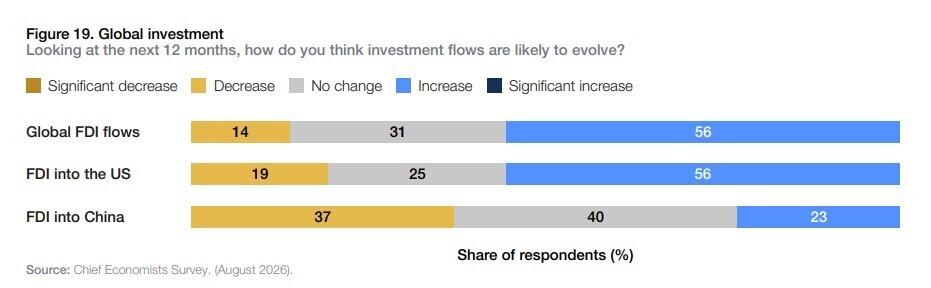
- Private equity rotation: Ten of the largest global private equity groups announced no mainland China deals in the first seven months of 2026, with several redirecting Asian allocations towards Japan, India and Australia.
- Multinationals' top markets: The US ranks as the most attractive business environment for multinational companies over the next 12 months (77% top-three selection), followed by Southeast Asia (57%) and Europe (49%), while India slipped to fourth (40%).
3. Sovereign supply & yield curve pressures
Heavy public debt and diverging rate expectations are the backdrop to rising long-term yields in the US and Japan.
- Sovereign debt pressures: US public debt reached a record $40 trillion, while elevated debt across other key markets is constraining governments’ capacity to respond to further shocks.
- Diverging rate paths: Respondents expect monetary policy tightening over the next 12 months in Japan (70%), the euro area (53%) and the US (42%), while 49% expect easing in China.
- Borrowing costs climb: The 10-year US Treasury yield stood at 5.28% on 5 October 2026, up from 5.01% in mid-September, while the 10-year Japanese government bond yield reached 3.1%, above its August level, already its highest in three decades.
4. Energy & infrastructure investment
Power-hungry digital infrastructure and energy security needs are driving demand for additional capacity and investment.
- Energy investment set to rise: Most respondents expect investment to increase across nuclear power (83%), renewables (80%) and fossil fuels (70%) over the next 12 months.
- Power infrastructure capex: Data centres account for 55% of forecast growth in US electricity demand over the next five years, highlighting the need for investment in generation and grid capacity alongside the AI build-out.
The survey points to a more balanced outlook. On the upside, a stabilizing global economy and continued investment in AI and energy are creating opportunities. On the downside, stretched valuations and constrained public finances pose investment risks.
Whether investment in AI and energy can translate into sustainable returns remains one of the central questions for the year ahead.
2. Hedge funds: Market support or stress amplifier?
As chief economists flag the risk of asset price corrections, new International Monetary Fund (IMF) analysis examines how hedge funds could affect market stability under stress.
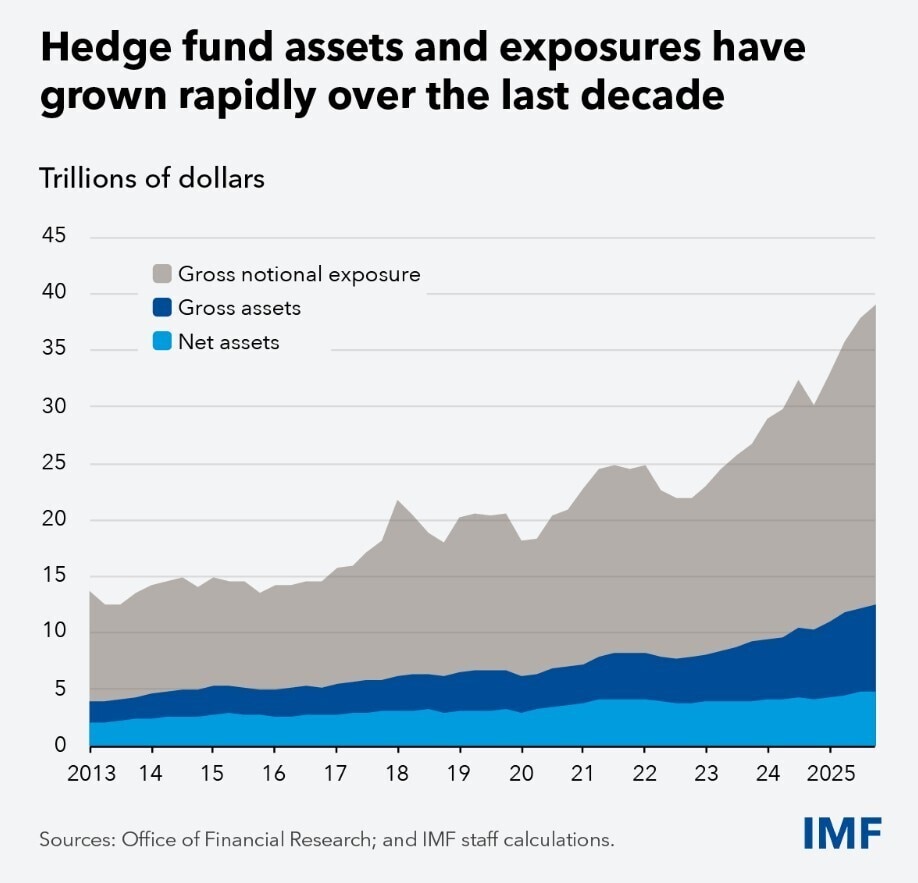
Since 2013, hedge funds' gross assets under management have tripled to $13 trillion, with gross notional exposures of about $40 trillion, according to the IMF’s latest Global Financial Stability Report. And the industry is still growing: global industry capital reached a record $5.6 trillion in the second quarter of 2026, HFR reports.
In normal times, that scale can support liquidity and price discovery. But leverage, crowded positions and rapid investor withdrawals can turn hedge funds into "amplifiers of market stress", the IMF warns.
A bigger footprint in sovereign debt
Hedge funds hold about 9% of the US Treasury market, up from 4% in 2022, according to Reuters. Meanwhile, the Federal Reserve says that US hedge funds' repo borrowing reached $3 trillion as of September 2025, with the 50 largest hedge funds accounting for about 90% of gross Treasury exposures.
A key strategy, the basis trade, uses borrowed money to profit from small price gaps between Treasury bonds and futures. The IMF notes it supports liquidity when funding is cheap, but hedge funds may be forced to unwind positions quickly when borrowing costs rise. The trade has now shrunk to its smallest size in over two years.
Leverage and crowding
Hedge fund leverage is rising. Equity prime brokerage balances are at record levels, up around 40% globally in the past year, with positions concentrated in sectors such as semiconductors as AI-linked share prices climb, the Bank of England says.
That concentration carries a cost. In periods of stress, the stocks most widely held by hedge funds are 10 percentage points more volatile and fall 4 percentage points further from peak to trough than the least crowded stocks, the IMF finds. Losses can also weigh on prime brokers, and stress can spread across borders, particularly to less liquid markets.
Tighter oversight ahead
Mandatory central clearing of US Treasury cash trades begins on 31 December 2026, with repo trades following on 30 June 2027, bringing more of hedge funds’ Treasury activity under margin requirements. Beyond this, the IMF calls for:
- Better data on leverage, derivatives and prime broker exposures.
- Market-wide tools, such as minimum margins and haircuts, where many funds deleverage at once.
- Targeted measures, including leverage limits and capital add-ons, where risk sits with particular firms.
As a Bank of England official put it, the question is "where that leverage resides, how concentrated it is, how it is financed, and how it interacts with the rest of the financial system".
How the Forum helps leaders understand change in global financial systems
3. More finance news to know
Rates top wealthy investors' worries: Family offices and high-net-worth individuals see rising interest rates and yields as the biggest threat to global economic growth, a Deutsche Bank survey found. Asia was seen as the most stable geopolitical region over the next 12 months, with 73% of respondents choosing it, ahead of the US at 14%.
Fed supervision shake-up: The Fed will create five new geographic regions for bank supervision, each led by a regional leader accountable to Washington. The move is part of a broader push to strengthen accountability and streamline oversight, following a review of the Fed's supervision of Silicon Valley Bank.
Japan raises the bar for TOPIX: 683 companies are at risk of removal from Japan's benchmark stock index under stricter inclusion criteria. The changes aim to improve the index's quality and encourage companies to deliver stronger returns to shareholders. Rolling out through July 2028, they could affect nearly $1 trillion in assets tracking the index, according to the Financial Times.
Africa's own rating agency: The African Union has launched a homegrown credit rating agency to provide an alternative to the major international ratings firms. Endorsed by African leaders in 2018 amid concerns over how the continent is assessed and the borrowing costs that can result, the Africa Credit Rating Agency must now establish credibility with investors, with its methodology likely to face close scrutiny, writes Bloomberg.
How AI could cost banks: AI agents that move customers' idle cash into higher-yielding accounts and investments could squeeze banks' deposit profits. The FT estimates that US banks could ultimately lose about $500 billion in equity value if their $20 trillion deposit base were to earn market-like returns, though cost savings and other efficiency gains from AI could offset some of the hit.
4. Read more on Forum Stories
Why do so many hard-tech innovations struggle to move from pilot to commercial scale? This article reveals how financing, insurance and procurement can determine whether promising technologies make it beyond the pilot phase, highlighting three shifts that could help close the gap.
Infrastructure finance is often framed around one question: how can we mobilize more capital? But the bigger challenge may be designing financing around the very different starting points and needs of individual economies. Cheukai Makari of the Forum's Centre for Financial and Monetary Systems, Sustainable Finance, explores why a one-size-fits-all approach can hold back real economy transformation and what a more tailored model could look like.
License and Republishing
World Economic Forum articles may be republished in accordance with the Creative Commons Attribution-NonCommercial-NoDerivatives 4.0 International Public License, and in accordance with our Terms of Use.
The views expressed in this article are those of the author alone and not the World Economic Forum.

Forum Stories newsletter
Bringing you weekly curated insights and analysis on the global issues that matter.
More on Financial and Monetary SystemsSee all

Farooq Malik
October 12, 2026


