Why a one-size-fits-all approach to infrastructure finance is holding back real economy transformation
A new approach to global infrastructure finance. Image: Shutterstock/Sculpies
Cheukai Makari
ECP Spring 2026 – Centre for Financial and Monetary Systems, Sustainable Finance, World Economic Forum- As countries pursue energy security, industrial competitiveness and climate goals, the global conversation around infrastructure finance often focuses on how to mobilize more capital.
- But every country is navigating real economy transformation differently – often on a separate trajectory and with a unique end-point in mind.
- Accepting that asymmetric paths exist across the global infrastructure finance landscape could help some economies to accelerate real economy transformations.
As countries pursue energy security and industrial competitiveness while maintaining climate goals, global conversations about infrastructure finance often circle back to a single question: how do we mobilize more capital for the system transformations that are happening simultaneously?
While this is a good question, it may not be the most important one. A bigger constraint than the amount of capital available may be the assumption that every economy is navigating the same energy transition, on the same trajectory and towards the same end state.
Clean technologies are improving. Global climate investment continues to grow. But the places with some of the greatest infrastructure needs continue to receive only a small share of investment. For example, emerging markets and developing economies (EMDEs) outside China receive only around 15% of an expected $2 trillion of annual global clean energy investment, according to the International Energy Agency (IEA), despite representing a large share of future infrastructure demand.
This gap highlights that even journeys towards the same goal are inherently asymmetric. This truth needs to be addressed in the broader infrastructure finance landscape, particularly since it could create opportunities for certain economies to leapfrog their real economy transformations.
Different starting points, different finance needs
Some economies are financing the modernization of mature infrastructure and industrial systems – replacing what exists with cleaner, more efficient versions. Others are building those systems for the first time, with no legacy infrastructure to retrofit and no incumbent technology to displace. These different starting points create different infrastructure finance needs, different risk profiles and, in many cases, entirely different opportunities.
Conventional finance often struggles to find a foothold in the markets that need it most because this asymmetry is seen as a footnote to a universal transition story. But when it’s reframed as a starting condition rather than a constraint, it becomes a source of design discipline – a reason to create financing structures that fit the system being built, not the system that finance was originally built for. The Forum’s MICEE initiative surfaced several of these barriers for clean energy.
The same logic holds across other sectors:
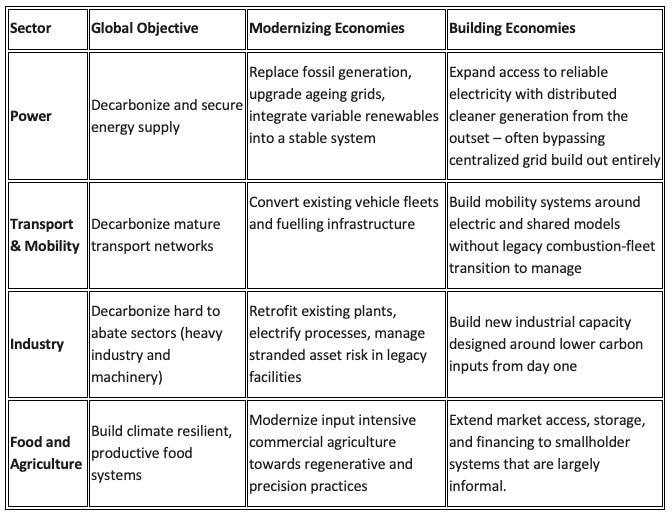
The pattern repeats across sectors: modernizing economies often finance conversion by swapping one system for a better version, against a backdrop of established utilities, balance sheets and regulatory frameworks. On the other hand, building economies have an opportunity to learn from their mistakes, such as assembling systems where credit history, offtake certainty and asset security are often thin or entirely absent.
A financing structure built for the first case – long tenor project finance against a known utility counterpart, for instance – frequently fails in the second. This is not because the underlying economics are worse, but because the risks the structure was designed to price don’t match the risks that are actually present in a building economy.
How infrastructure finance can shape growth
In emerging markets, finance is often treated as a downstream input, whereby development can only happen if finance is there to fund it. But in economies building systems from the ground up, the sequence often runs in the other direction. The financing structure available – its tenor, currency, risk allocation and the collateral it accepts – shapes which technologies get built, at what scale and for whom.
A financing model built around aggregating small distributed cash flows into an investable pool makes distributed energy access the more financeable path relative to centralized grid extension – a common route for building economies that don’t have fully developed grid systems.
A local currency structure doesn’t just reduce currency risk for one deal, it changes what kind of infrastructure looks attractive to investors in a market where dollar denominated debt taken out against local currency revenue has historically been the default.
In building economies especially, research shows that financing is not a neutral pipe for capital, it’s an active variable in what gets built and how fast.
This is where the innovation frontier in real economy transformation actually sits – in designing structures, not finding more capital. These economies need securitization of small ticket receivables, blended concessional-commercial layering, local-currency instruments and portfolio guarantees that align both with the risk being financed and the investors being asked to hold it.
Lessons in infrastructure finance from Africa
In a building economy, the financing sequence can become part of the growth strategy, as illustrated by an ODI Case study of the Freetown Waste Transformers (FWT), a waste management firm in Sierra Leone, Africa.
FWT initially combined founder funding with grants totalling just under £500,000, including support from the GSMA Innovation Fund, to prove its waste-to-energy model and develop an app called DortiBox. This helped secure a consistent supply of organic waste for its biodigesters, which was one of the venture’s central risks.
Once the pilot and digital platform strengthened the company’s investment-readiness signals, Climate Fund Managers committed $3.9 million to the development phase. The investment was explicitly designed to test the feasibility of scaling, with no commercial return expected at that stage. A further $20.3 million investment opportunity is linked to the success of this phase.
The financing structure used concessional and catalytic capital to de-risk an asset class with little established track record, allowing commercial capital to follow once risks had been demonstrated rather than assumed.
The mechanism is different from the approach used in larger infrastructure deals in Africa, such as JPMorgan’s 2025 financing of African communications provider Axian Telecom, but the underlying principle is similar. JPMorgan acted as global coordinator and development finance structuring agent for Axian’s $600 million bond issuance, which was supported by $60 million in anchor investments from development finance institutions.
For Axian, development finance helped aggregate and support repayment capacity by an established telecommunications provider. FWT represents the same broader logic from an earlier starting point. Rather than helping finance a company with an existing operating and repayment history, concessional capital helped create the operational evidence and infrastructure needed for an investable asset class to emerge.
Different paths to real economy transformation
Accelerating the global real economy transformation requires more capital, but capital alone will not resolve the mismatch at the centre of the asymmetry problem affecting infrastructure finance.
In addition to mobilizing money, financing frameworks must reflect where an economy is actually starting from, the system it is trying to build and the pathways by which that will happen. This is the harder and more consequential task.
Infrastructure finance that insists on a single template will keep missing the markets that need it most. But finance that follows economies' asymmetric paths will unlock investment where conventional approaches have fallen short.
Don't miss any update on this topic
Create a free account and access your personalized content collection with our latest publications and analyses.
License and Republishing
World Economic Forum articles may be republished in accordance with the Creative Commons Attribution-NonCommercial-NoDerivatives 4.0 International Public License, and in accordance with our Terms of Use.
The views expressed in this article are those of the author alone and not the World Economic Forum.
Stay up to date:
Infrastructure
Related topics:


Forum Stories newsletter
Bringing you weekly curated insights and analysis on the global issues that matter.
More on Built Environment and InfrastructureSee all

Liz Dennett
September 14, 2026


