The Law of Inaction: How doing nothing can impact our future, multiple times over

The Law of Inaction – every decision, including not to decide, has costs and opportunities Image: Unsplash/Bradyn Trollip
- Inaction is never neutral, as every act of silence is a decision with costs and missed opportunities that compound over time.
- The Law of Inaction sets out eight interconnected principles outlining how deferred choices expire, accumulate invisibly and foreclose futures for individuals, organizations and civilizations.
- Diagnostic questions and challenging assumptions turn those principles into practice, helping leaders surface what their silences are already deciding before the cost becomes irreversible or breakthroughs lost.
Strategic thinking has long rested on assumptions that served well in more stable times.
Professor Philip Bobbitt, the constitutional scholar and strategist, identified the Parmenides Fallacy in the early 2000s, named for the ancient Greek philosopher who argued that reality is static and change is an illusion.
The fallacy occurs when we evaluate the future according to the present status quo, rather than against other possible futures. In a complex, nonlinear and deeply uncertain world, that option has expired.
Sir Isaac Newton’s first law of motion reinforces the intuition – objects at rest stay at rest unless acted upon. In Newton’s world, waiting costs nothing. In ours, the world moves while we stand still and the gap between us compounds.
Omission bias, documented in behavioural economics, describes our tendency to judge harmful actions more harshly than equally harmful inactions. We fear the visible mistake more than the invisible accumulation.
Cicero captured something real when he called indecision the thief of opportunity. These concepts originated in stable environments. They treated inaction as neutral stillness that could preserve options.
They did not account for today’s metaruptions – cascading, self-reinforcing systemic shifts where technology, geopolitics, ecology and economics amplify one another. Standing still is, therefore, a decision with compounding consequences.
The intuition that inaction carries costs recurs in different guises across philosophy, behavioural economics and management writing; the "Eight Laws of Inaction" formalize it into a framework.
The future is open but not indefinitely – you shape it through your choices and silences. Each unclaimed choice expires but its cost compounds and the futures closed off to you can be claimed by others.
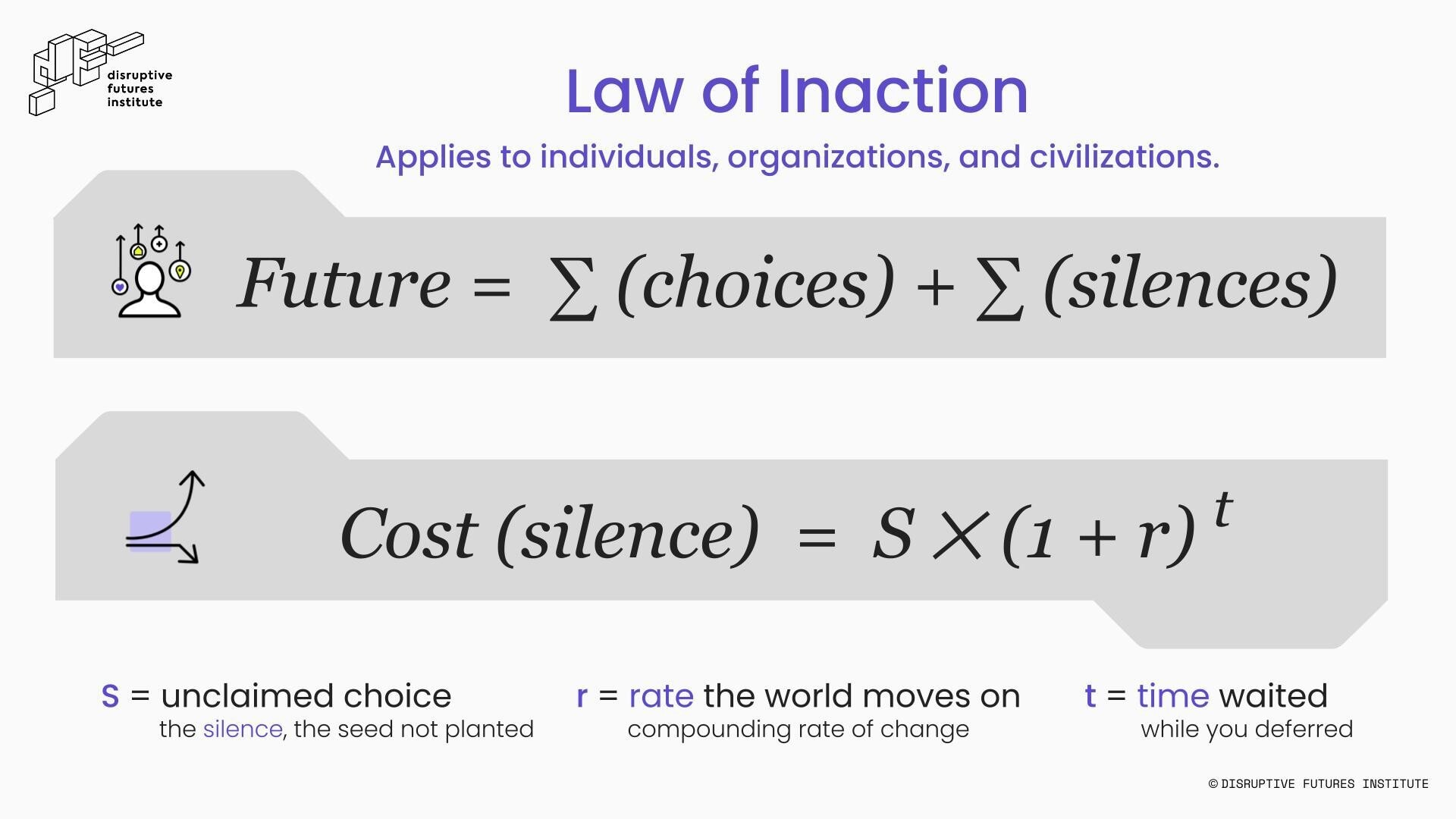
The 8 Laws of Inaction
The Law of Inaction is a system of eight interconnected principles describing how inaction operates, compounds and forecloses futures, at every scale from individual to civilizational:
- Always deciding: Inaction is a choice and not deciding in itself is a decision.
- Agency expires: When you fail to exercise a choice, your options expire and others act for you.
- Compounds: The compounding gap drives breakdown or breakthrough; deferral compounds as risk, action as opportunity.
- Invisible until too late: Unlike failure, inaction rarely signals its consequence.
- Tipping point: The threshold between high costs of inaction and permanent consequences.
- Collapsing cost: As it is now cheaper than ever to experiment, waiting is now costlier.
- Determining: Your pattern of silences defines you as surely as your actions.
- Existential: At the extreme end, inertia becomes existential for risks and opportunities.
Four warrant particular attention here.
Always deciding
Inaction is a choice and not deciding is itself a decision, with consequences as real and as identity-defining as any deliberate act. As Sartre observed, existence precedes essence: we define ourselves through our choices, including the ones we decline. The comfortable fiction of a neutral holding position can be the most expensive assumption.
Agency expires
Agency works like a financial option. If it is not exercised, it expires and others act in your place. A window that closes on a risk unaddressed closes equally on a breakthrough unclaimed.
Cybercrime is projected to cost the global economy more than $10 trillion a year but the damage often begins before the attack itself. When Jaguar Land Rover’s production was halted for five weeks in 2025, cyber insurance negotiations had not been finalized and the disruption was later estimated to have cost the UK economy £1.9 billion.
The attack was the trigger. The loss was compounded by decisions not taken in time.
Invisible until too late
Unlike a failed initiative, which announces itself, the cost of not acting accumulates quietly, below the threshold of awareness. By the time the damage is obvious, the window to respond is often already closing.
On AI, organizations that treated adoption as a future consideration are now discovering that the capability gap compounds faster than their ability to close it.
On climate, a 2024 study in Nature Climate Change estimated that limiting warming to 1.5 degrees Celsius instead of 3 degrees Celsius could cut projected global economic losses by two-thirds, with losses reaching up to 10% under higher-warming scenarios.
The window does not close dramatically. It narrows until the crossing has already happened. On energy’s deferred transition, repeated shocks are exposing the fragility of dependence on imported fossil fuels.
Collapsing cost
The cost of experimentation has collapsed and with it the traditional justification for inaction. From generative AI to on-demand manufacturing, what once required teams, budgets and weeks of iteration can now be prototyped and tested in minutes or hours.
This is the inversion the Law of Inaction demands that we confront: as the barriers to experimentation collapse, the cost of deferral compounds, forfeiting the learning curve that earlier action would have built.
The other laws trace a similar mechanism across scales and time horizons.
At the extreme end, when inaction is simultaneously invisible, compounding, irreversible and collective, the consequence for risks and opportunities can be existential, with the foreclosure of sustainable futures altogether. The cures not developed, the transitions not led, the possibilities not seized at the moment they were within reach.
Diagnostic questions taking laws to practice
Applying the Laws of Inaction begins with a diagnostic built around three clusters of questions, each translating a law into a critical evaluation of what your silences are already deciding.
The first cluster surfaces the inaction: what decisions are we avoiding and what are those avoidances already choosing for us? What is compounding silently if we do nothing? What small experiment have we been meaning to start but keep deferring?
The second stress-tests the consequences: what is already charging at us that we are choosing not to face? How do our unclaimed choices interact and what cascades when they collide? Given that the cost of experimentation has collapsed, what are we still not trying and why have we not yet started?
The third commits to agency: what would we do right now if we knew that waiting would cost us everything and what is stopping us?
The gap between what an honest answer reveals and what an organization is currently doing is the measure of its inaction profile and its compounding exposure.
How to close the gap caused by inertia
The framework describes the compounding dynamics of passive deferral in a nonlinear world, not a case against deliberation, foresight or the anticipatory governance that complex and consequential decisions require.
The Parmenides Fallacy assumes the world waits. The Law of Inaction reveals what happens when it does not. Newton’s object at rest is not stationary – in an exponential world, it is falling behind – and the gap compounds.
Omission bias is not merely psychological; it is a structural vulnerability in every organization that has ever confused the absence of a bad decision with the presence of a good one.
The same logic operates for inflection points at scale. Research shows that when around 25% of a population commits to a new behaviour or belief, the entire system can shift. Collective action can ignite transformation; collective inaction can permanently foreclose it.
The futures are open. The Law of Inaction is the instrument for calibrating that window before it closes.
Don't miss any update on this topic
Create a free account and access your personalized content collection with our latest publications and analyses.
License and Republishing
World Economic Forum articles may be republished in accordance with the Creative Commons Attribution-NonCommercial-NoDerivatives 4.0 International Public License, and in accordance with our Terms of Use.
The views expressed in this article are those of the author alone and not the World Economic Forum.
Stay up to date:
Justice and Law


Forum Stories newsletter
Bringing you weekly curated insights and analysis on the global issues that matter.
More on LeadershipSee all

Marlen Heide and Houssam Al Wazzan
September 7, 2026


