Opinion
Should governments act like start-ups?

Start-up principles have enabled Ukraine to serve the public efficiently and effectively under extraordinary circumstances. Image: REUTERS/Dado Ruvic/Illustration
Valeriya Ionan
Advisor on Innovation, Digitalization and Global Partnerships to the First Deputy Prime Minister of Ukraine, Ministry of Digital Transformation of Ukraine- When Russia launched its full-scale invasion in February 2022, Ukraine's digital response became crucial for national survival.
- From ensuring access to government services to digital identification for internally displaced persons, none of the challenges faced could wait for years-long planning cycles.
- Start-up principles have enabled Ukraine to serve the public efficiently and effectively under extraordinary circumstances.
In times of crisis and growing global challenges, the way governments operate must evolve. Can – and should – governments adopt start-up-like qualities to meet the urgent needs of their citizens?
This presents a false dichotomy. The question isn't whether governments should transform into businesses, but rather how they can adopt certain start-up principles while maintaining their core public mission.
As Ukraine's digital transformation journey demonstrates, governments don't need to choose between institutional resilience and innovative approaches – they can and should pursue both simultaneously.
Crisis response and innovation
When Russia launched its full-scale invasion in February 2022, Ukraine's digital response became crucial for national survival. Our ability to quickly launch and iterate digital services wasn't simply a matter of efficiency: it was existential.
We needed to:
● Provide digital identification for internally displaced persons
● Ensure continuous access to government services despite infrastructure attacks
● Facilitate rapid rebuilding efforts
● Solve many other emerging needs
None of these challenges could wait for years-long planning cycles. These solutions had to be deployed in days or weeks, not months. This would have been impossible under traditional bureaucratic timelines.
We needed to ensure access to information for citizens during first missile attacks, help internally displaced people who left their houses with just smartphones and no documents, deliver support payments to millions of displaced citizens and maintain critical government functions.
A great example is our remarkable cooperation with the private sector and the creation of the Air Alert app. For millions of Ukrainians, this app became a lifesaver. The old Soviet-era municipal air raid sirens were often inaudible in many areas. The Air Alert app solved this critical problem by delivering instant notifications to smartphones, allowing citizens to seek shelter before incoming attacks.

Within days of the invasion, Ajax Systems, a home security company, together with IT company STFalcon, developed the app in collaboration with the Ministry of Digital Transformation. This would not be possible through traditional long-term bureaucratic cycles and processes. The Air Alert app went from concept to nationwide deployment in just a few weeks – something that would take months or years in conventional government timelines.
At the Ministry of Digital Transformation, we didn't blindly copy start-ups, but we did embrace three crucial principles:
● Agile development through rapid iteration: Launching minimum viable products (MVPs) that could be improved based on real user feedback.
● User-centric design: Building services around citizens' needs rather than administrative convenience.
● Data-driven decision-making: Using metrics and feedback to rapidly evaluate what works and what doesn't.
These approaches weren't about treating citizens as “customers” in a commercial sense; they were about fulfilling our fundamental duty to serve the public efficiently and effectively under extraordinary circumstances. Not every initiative succeeds, but in rapidly changing circumstances, the greatest risk is inaction.
Governments everywhere are operating in emergency conditions. During the COVID-19 pandemic, the governments that could rapidly develop and deploy digital services managed the crisis far more effectively than those stuck in traditional bureaucratic models.
Public innovation and the Ukrainian Diia system
Our e-government Diia system exemplifies how start-up methodologies can enhance – not detract from – public service. With more than 22 million users, the Diia app has transformed how citizens interact with the government.
Diia wasn't developed as a monolithic system with years of planning. We started with digital driving licences and ID cards, then rapidly expanded digital documents and services based on user needs and regular feedback. Each new service was launched as an MVP that was continuously improved through iteration.
This approach wasn't about “disruption” for its own sake or seeking financial returns. It was about creating what we call “the most convenient digital state in the world” – a vision fundamentally rooted in public service.
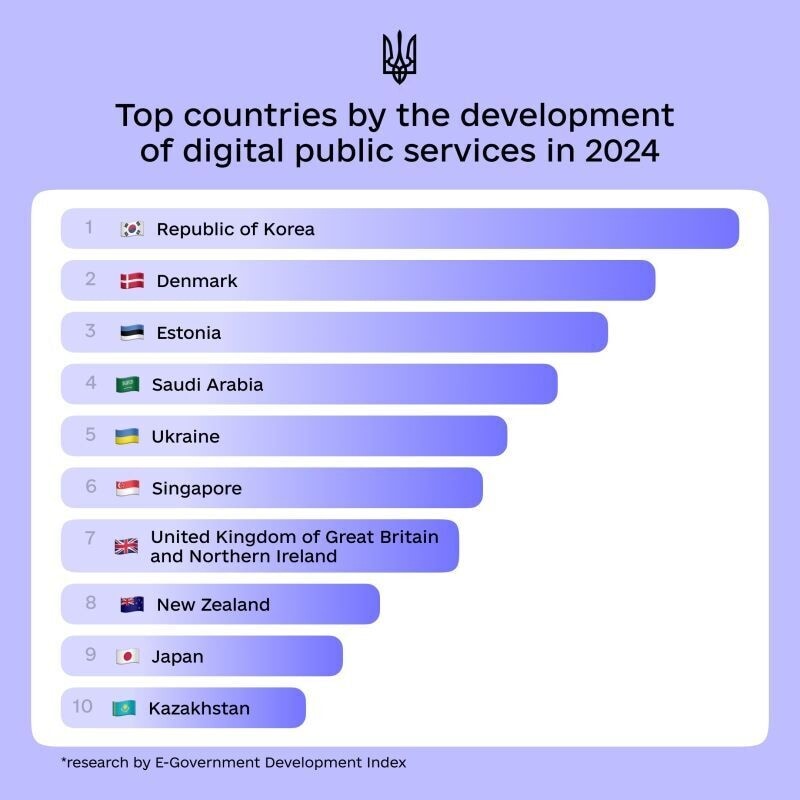
Competition does exist in government
We've learned that you cannot improve fundamentally broken systems – you need to transform them entirely or replace them with something new and effective. Digital transformation requires a bold reimagining of government services from the ground up.
In Ukraine, long before our digital transformation efforts, citizens had extremely low trust in government services. They would pay intermediaries, navigate complex bureaucracy or simply avoid engaging with public administration whenever possible.
By creating services that matched or exceeded the user experience of the private sector, we reclaimed citizens' trust and participation. We are not, nor have we ever been, fighting for abstract “market share”; we are competing against deeply ingrained cynicism and accumulated disappointment.
Our digital transformation wasn't about announcing grand “improvements” but demonstrating tangible change that citizens could experience directly. This is not about “winning a market” – to borrow language from start-ups – rather about fulfilling our democratic obligation to serve citizens effectively and rebuilding trust through action.
Institutional innovation as evolution, not revolution
Experts warn against undermining institutional capacity through disruptive approaches. However, innovation and institutional strength aren't mutually exclusive.
In Ukraine, our digital transformation has strengthened public institutions by making them more responsive, transparent and efficient. Modern governments face challenges that traditional bureaucratic structures weren't designed to address: climate change, pandemic response, cybersecurity threats, and, in our case, war.
Adapting to these challenges requires new operational models. This isn't about dismantling institutions, but evolving them to better fulfil their mission in a changing world.
The European paradox and implementation
Europe has strength in research and invention but comparative weakness in turning innovations into widespread, real-world applications. This challenge extends to the public sector, where government innovations often struggle to scale or achieve widespread adoption as well.
I believe that if more governments embraced certain start-up principles – agility, experimentation and outcome-focused thinking – they would be better positioned to implement solutions at scale. There’s a lack of mechanisms to bridge the gap between concept and implementation.
Innovation shouldn't end at pilot projects or policy papers. It shouldn’t take years and years (though, there might be exceptions). Governments must develop the capacity to move from ideas to scalable, tangible impact. This requires breaking down silos between policy-making and implementation.
Complementary strengths
Rather than seeing government and start-up approaches as opposing models, we should view them as complementary. Governments provide legitimacy, scale and long-term thinking; start-ups offer speed, user focus, and adaptability.
In Ukraine, we've learned that these strengths can be combined to create responsive, effective public services, even under the most challenging circumstances. This doesn't mean abandoning the core mission and values of government; it means enhancing our ability to fulfil that mission in a rapidly changing world.
An extended version of this article is available on the GovTech Intelligence Hub website. The GovTech Intelligence Hub is a pioneering initiative by the Global Government Technology Centre Berlin, the Global Government Technology Centre Kyiv and the World Economic Forum. It serves as a global platform for governments, tech providers, academia and GovTech experts, sharing insights, best practices and strategic guidance in the GovTech space.
Don't miss any update on this topic
Create a free account and access your personalized content collection with our latest publications and analyses.
License and Republishing
World Economic Forum articles may be republished in accordance with the Creative Commons Attribution-NonCommercial-NoDerivatives 4.0 International Public License, and in accordance with our Terms of Use.
The views expressed in this article are those of the author alone and not the World Economic Forum.
Stay up to date:
Cybersecurity
Related topics:


Forum Stories newsletter
Bringing you weekly curated insights and analysis on the global issues that matter.
More on Emerging TechnologiesSee all

Justin Cyrus
September 15, 2026