How the US-Mexico-Canada Agreement review could impact North America's auto industry
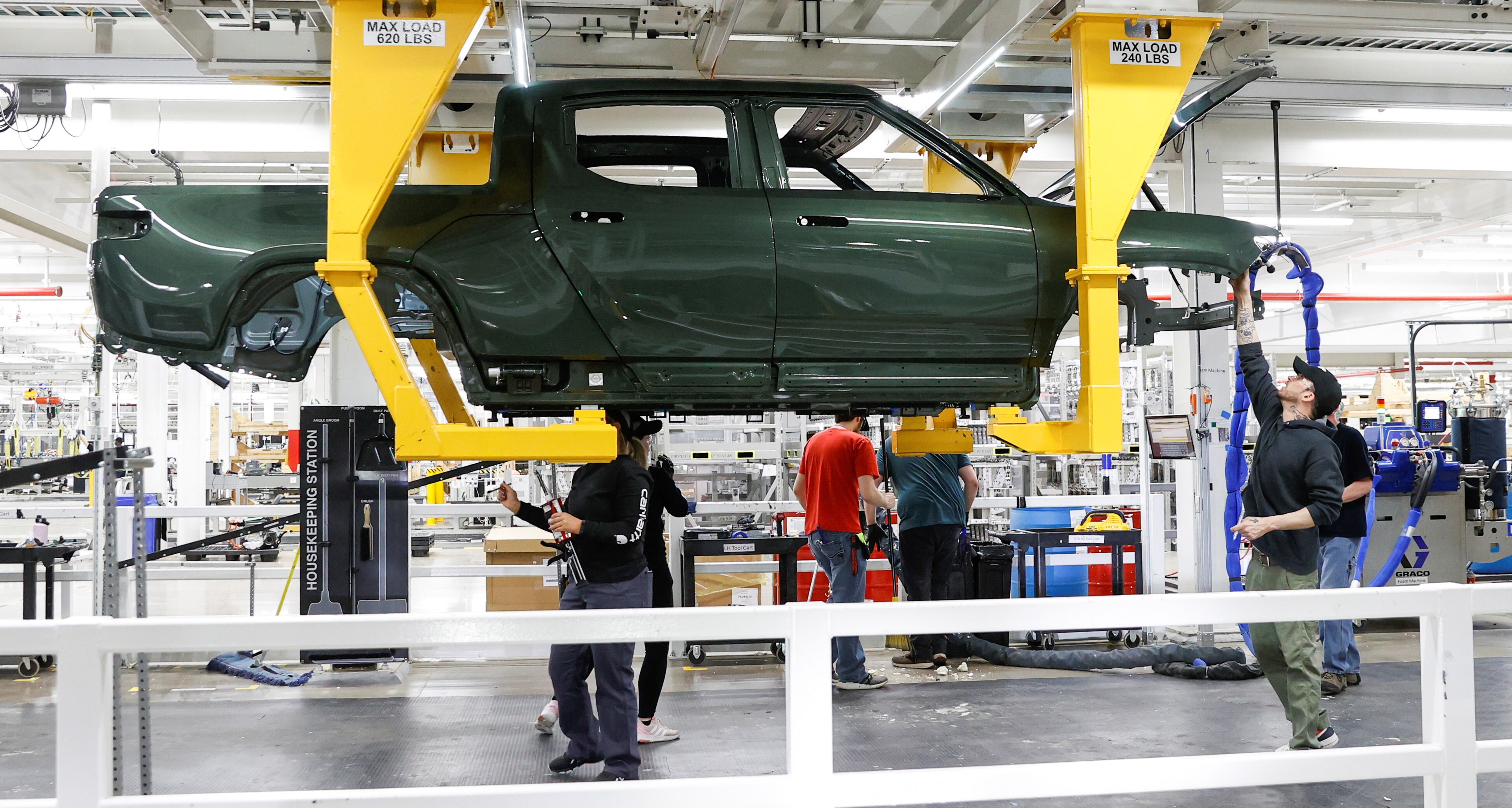
Stability will be key for the North American automotive industry as the USMCA is reviewed yearly. Image: Reuters/Kamil Krzaczynski
- The United States recently declined to automatically renew the trilateral US-Mexico-Canada Agreement (USMCA).
- As we enter a more open-ended review phase, the main goal is to keep the trade deal credible, stable and clearly oriented towards the future.
- Stability will be required for North America's automotive sector as a pre-condition for long-term investment, innovation and job creation.
Until recently, the central question about the United States-Mexico-Canada Agreement (USMCA) review was whether the three countries would agree to extend their free trade deal for another 16 years under the existing framework. Expectations have now shifted.
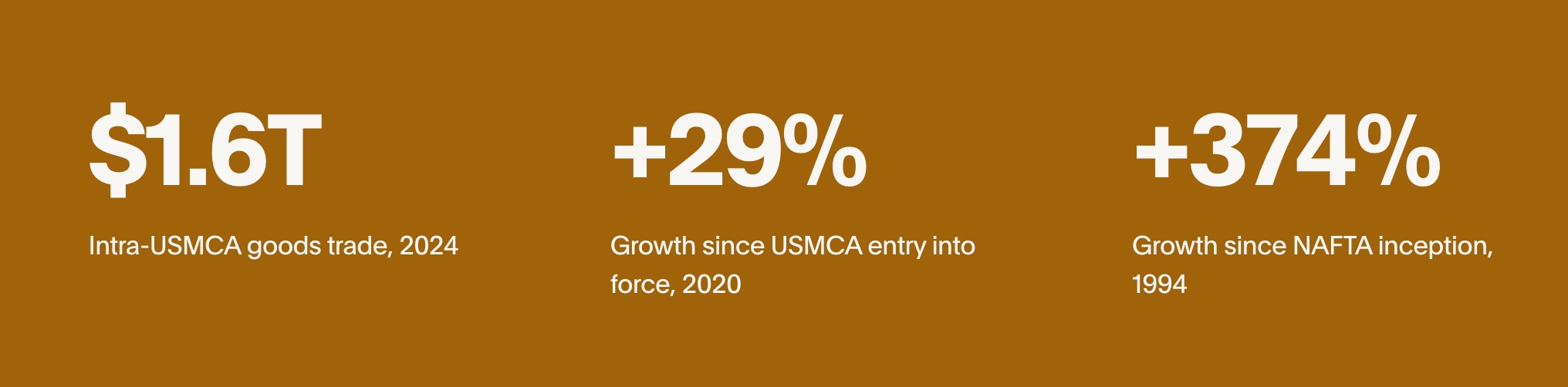
Since the implementation of USMCA's predecessor, the North American Free Trade Agreement (NAFTA), total US bilateral goods trade with Canada and Mexico has grown from roughly $343 billion to over $1.6 trillion – a 374% increase. However, the US has now declined to automatically renew the USMCA, which replaced NAFTA in 2020 and will now undergo a yearly review from July until 2036.
While the USMCA remains in force, this shift changes the political economy of the agreement from a relatively predictable review cycle into a prolonged period of uncertainty.
The implications are significant for North America’s automotive sector, which is one of the most deeply integrated manufacturing systems in the world. Its $280 billion yearly automotive intra-USMCA trade volume represents a 38% increase in automotive trade flows since 2021. This depends on deeply integrated supply chains, and a high degree of interdependence among the three countries.
Components cross borders multiple times before a vehicle is assembled, reflecting decades of specialization across the US, Mexico and Canada even before NAFTA was established.
The question is not whether the USMCA has delivered (on most measures of industrial integration and trade facilitation, it has). It is whether introducing uncertainty now risks undermining the very investment and supply chain resilience the agreement was designed to create.
Investment, jobs and the power of policy certainty
Since coming into force in 2020, the USMCA has been associated with a significant surge in investment across the region, particularly in the US. Industry estimates point to roughly $200 billion in automotive investment across North America between 2020 and 2025, with most directed towards US-based production. This has translated into tens of thousands of new jobs and the expansion or creation of manufacturing facilities.
The employment impact is substantial. In the US, the auto industry supports about 10.9 million jobs and accounts for roughly 5.4% of GDP. In Canada, the sector generates more than 500,000 direct and indirect jobs and close to 10% of manufacturing GDP. In Mexico, it represents about 4.7% of GDP, more than one‑fifth of manufacturing GDP, and roughly 22% of manufacturing jobs. These figures underline why long‑term certainty over the USMCA’s future is a core economic priority.
Automotive industry investment decisions are made over decades, not electoral cycles. What had been framed as a technical review has now become a structural question about whether the policy environment can continue to support long-term capital allocation, cross-border production networks and industrial transformation at scale.
Assembly plants, battery gigafactories and supplier ecosystems require predictable rules for market access, as well as regulatory compliance, rules of origin and cross-border logistics. In this context, policy stability is key to competitiveness.
According to Sarah Stephan, Regional Officer, North America at Volkswagen Group, "By providing certainty for long-term investment and fostering cross-border industrial cooperation, the USMCA agreement has helped strengthen North America's economic resilience, competitiveness and capacity for innovation."
For global manufacturers with deeply embedded regional production systems, this stability directly determines where and how capital is deployed across North America.
Stephan added: "As policy-makers consider the future evolution of the agreement, preserving these foundations will be essential to ensuring that the region continues to attract investment, advance industrial transformation and create lasting economic opportunity."
In other words, the value of the USMCA is not only in tariff preferences, but in the predictability it provides for industrial planning across borders. This is not just speculation; uncertainty around the 2017 NAFTA renegotiations led to Ford’s cancellation of a planned $1.6 billion assembly plant in San Luis Potosi, for example.
Rules of origin drive competitiveness
One of the defining features of the USMCA is its stringent rules of origin for the automotive sector. Vehicles must now contain at least 75% regional value content (up from 62.5% under NAFTA), a minimum share of steel and aluminum must be sourced regionally, and a portion of production must meet specified wage thresholds under labour value content requirements.
These rules are designed to both determine where a car “comes from” and steer investment and employment. Early evidence suggests they are doing so. Companies have reconfigured supply chains, increased local sourcing and reassessed sourcing strategies in response.
Yet, compliance remains challenging. Some vehicles still enter markets using most‑favoured‑nation tariffs rather than USMCA preferences, indicating that thresholds are already close to the operational frontier for part of the industry. The US administration now reportedly wants to increase the regional value content to 82%, with 50% of that value coming from the US.
Full implementation timelines of the current USMCA extend into mid‑2027, meaning firms are still optimizing production lines, supplier relationships and data systems. This raises a key concern: is it too soon to revisit or tighten these rules further?
Nina Köbernik, Head of Trade Policy at Volkswagen Group, said, "The automotive rules of origin under the current USMCA agreement are among the most stringent of any free trade agreement." This stringency is paired with something equally important: a structured, rules-based framework that enables integration rather than fragmentation.
Köbernik added, "The agreement highlights the enduring value of a rules-based, trilateral framework in a highly integrated manufacturing region. It plays a pivotal role in ensuring the legal certainty and stability required for long-term economic growth in both North America and the automotive sector." In practice, this means that while compliance costs may be higher, the predictability of common rules across three economies reduces systemic risk.
For globally integrated industries like automotive, the USMCA’s value extends beyond preferential tariffs. Common rules on origin, transparent customs procedures and regulatory coherence enable just-in-time production systems to function across borders. Maintaining the current rules of origin and the predictability they provide is particularly important in a global environment increasingly shaped by industrial policy, trade restrictions and geopolitical fragmentation.
Geopolitics: from trade flows to ownership
Supply chain vulnerabilities, the pandemic, semiconductor shortages, geopolitical tensions and the race to secure critical minerals and battery supply chains have all demonstrated that resilience can no longer be determined solely by geography when it comes to sourcing. Increasingly, governments are asking not only where a product is made, but also who owns, controls and finances its production networks.
This marks an important evolution in trade policy. Traditional rules of origin remain fundamental, but they are now complemented by a growing focus on ownership structures, trusted suppliers, investment screening, supply chain transparency and economic security. For highly integrated industries such as automotive, these emerging policy priorities will shape competitiveness just as much as tariff preferences or market access.
This is particularly relevant as USMCA partners are taking different approaches when it comes to their trade relations with China. While Mexico to US automotive flows have increased 69% from 2024 to 2025, the growth of Chinese automotive exports to Mexico has increased 156%.
Consequences would be far reaching if ownership considerations are incorporated into USMCA renegotiations. Trade treatment rooted in corporate control, rather than location of substantial transformation – or, in basic terms, where value addition happens – would complicate compliance even further, fragmenting global production systems along geopolitical lines and questioning the purpose of traditional rules of origin that, many times, are intended to attract foreign direct investment.
Automotive supply chains of the future
The next frontier for the USMCA lies in emerging automotive inputs, including batteries, semiconductors, critical minerals and advanced electronics.
China dominates the midstream and downstream of the supply chain of materials, from material processing and refining to EV production. While the USMCA encourages regional sourcing, overly rigid requirements could hinder the development of next-generation supply chains.
Here, flexibility becomes essential. Enabling transitional arrangements, longer phase-in periods or targeted exceptions could help balance two competing objectives – reducing dependence on external suppliers and ensuring that North American producers remain globally competitive – without adding a layer of complexity around compliance.
Getting this balance right will be central to the agreement’s future relevance.
Preserving stability in a more turbulent world
The USMCA is one of the few recent trade agreements that explicitly tries to shape industrial outcomes rather than simply liberalize trade. In the automotive sector, it has already nudged sourcing and investment patterns while preserving a high level of regional integration.
Higher tariffs, diverging standards or fragmented negotiations would not strengthen any single partner. It would instead dilute the region’s collective ability to compete in a rapidly changing global market increasingly shaped by industry policy, supply chain security concerns and technological competition.
The emerging debate is no longer limited to tariffs or market access alone. It increasingly extends to the structure of production itself, including questions of ownership, control of strategic supply chains and the resilience of cross-border investment networks, making the predictability of the framework even more critical, not less.
As governments enter what is now a more open-ended review and negotiation phase, the central task is to keep the agreement credible, stable and clearly oriented toward the future – even as it is updated.
That points to a pragmatic agenda: strengthening regulatory cooperation, improving and digitalizing compliance systems, reinforcing trusted supply chain frameworks, and deepening trilateral coordination on external economic and geopolitical risks.
In the automotive sector in particular, stability is not a secondary consideration. It is the precondition for the long-term investment, innovation and employment creation that will define North America’s position in the next era of mobility.
Don't miss any update on this topic
Create a free account and access your personalized content collection with our latest publications and analyses.
License and Republishing
World Economic Forum articles may be republished in accordance with the Creative Commons Attribution-NonCommercial-NoDerivatives 4.0 International Public License, and in accordance with our Terms of Use.
The views expressed in this article are those of the author alone and not the World Economic Forum.
Stay up to date:
Automotive Industry


Forum Stories newsletter
Bringing you weekly curated insights and analysis on the global issues that matter.
More on Trade and InvestmentSee all

Linda Lacina, Pooja Chhabria and Spencer Feingold
October 13, 2026