


Podcast transcript
This transcript has been generated using speech recognition software and may contain errors. Please check its accuracy against the audio.
Niall Ferguson, Senior Fellow, Hoover Institution, Stanford University: This looks quite like a Cold War between the United States and China. It has some resemblances to the Cold War between the US and the Soviet Union, except that the economic relationship is much, much more developed, much larger than the economic relationship ever was with the pretty much closed Soviet economy.
Robin Pomeroy, host, Radio Davos: Welcome to Radio Davos, the podcast from the World Economic Forum that looks at the biggest challenges and how we might solve them. This week historian Niall Ferguson says we’re in Cold War Two, with similarities and differences from the last one.
Niall Ferguson: The technologies of Cold War I are still around, we still have nuclear weapons, but we have new technologies, of which artificial intelligence is probably the most important, that make this Cold War in some ways a more dangerous and unpredictable one than the first one.
Robin Pomeroy: Niall Ferguson explains what's making our societies increasingly polarised, but why, despite that, fears about Western countries potentially descending into civil war are overblown.
Niall Ferguson: Most families have kind of their Trump supporter and their Trump hater and at Thanksgiving they have a huge fight at the dinner table, but that's not the basis for a civil war. That's the basis of a fight at Thanksgiving.
Robin Pomeroy: And as the Forum’s Global Risks Report concluded we are living in a new 'age of competition', this historian says why that’s not always a bad thing.
Niall Ferguson: I like competition because there are winners and losers. Where a competition can be dangerous is when empires or states compete. Competition is good, but try to make it nonviolent. That seems like a pretty good lesson of history.
Robin Pomeroy: I’m Robin Pomeroy at the World Economic Forum, and with this historian’s view of the here and now…
Niall Ferguson: Isn't that a reason to be optimistic? I think it is.
Robin Pomeroy: This is Radio Davos.
Welcome to Radio Davos. On this show, one of the many great interviews we did with some of the sharpest minds at the World Economic Forum's Annual Meeting in Davos last month. To tell us about it, I'm joined by my colleague, Gayle Markovitz. Hi Gayle, how are you?
Gayle Markovitz, Head, Written and Audio Content, World Economic Forum: Hi Robin, I'm good.
Robin Pomeroy: You've done this wonderful interview. You're going to tell us who it is, but first tell us, who you are, what you do at the Forum.
Gayle Markovitz: I am part of the content team at the forum, so we produce all that content that you see on our website, on our social media, podcasts, videos and articles on all the different things that happen and all of our events.
Robin Pomeroy: So you and I and many other people had a busy time in Davos at the Annual Meeting, covering all the sessions, doing lots and lots of interviews, and this is one of them. And we're putting these out on Radio Davos, also on Meet the Leader, and on our third podcast, which is Agenda Dialogues, that's where we're put out some of the great sessions that were live streamed there, we're putting out the audio, so please follow us, if you're not already doing so, wherever you're getting podcasts, follow those three podcasts.
But let's get back to this one, Radio Davos today is an interview you did in Davos, tell us who it was.
Gayle Markovitz: It's Niall Ferguson who is a historian first and foremost and big thinker on all the things that we're seeing now and learning from history and giving us precedents and putting it all into perspective.
Robin Pomeroy: Really interesting figure. He's often around in the pod sphere. I've heard him interviewed many times. Always an interesting listen. Even if you don't agree, he often has quite strong opinions about things. Even if don't you agree, always worth a listen. Why particularly did you want to interview him in Davos?
Gayle Markovitz: I feel like it's a very tough moment, where we're looking at quite depressing things potentially happening in the very near future. Our Global Risks Report looks at what's on the horizon, and it's not a great picture. It's not particularly optimistic. So I was hoping for some comfort, to be honest. I was hoping he would make me feel better about things and tell me that oh we've seen this all before and it all ended fine it's a big overreaction, don't worry about it. I didn't quite get the comfort. I was on a bit of an emotional rollercoaster, so on some things he was very optimistic and allayed all my fears, on others I came crashing down.
Robin Pomeroy: Interesting a historian's perspective on the here and now, because history can't tell us what's about to happen next. No historian's going to pretend that. And I think in this interview, the comfort he might give is, look how bad the world's been throughout the centuries anyway, and count your blessings. So in a way it's, look at the glass half full, rather than, no, actually things are going to be great. I think he's saying, things are going to be tough, things are tough, they're going to tough, but they've always been tough if you look at history.
Gayle Markovitz: And in fact they've been tougher. So he also doesn't think that we are necessarily at the precipice of a new era. He thinks to talk about new eras, you need a little bit more than what we're currently seeing. So jury's out on that.
He also made a comparison to the Cold War, which I thought was very interesting. So he kind of calls this, well, I can't call it an era, he calls this time a bit more like Cold War Two where we're seeing rivalry between the US and China in particular, very different to Cold War One and this is where I came crashing down on my emotional roller coaster actually because he said that in some ways it's worse, AI is making it even more disruptive and potentially more dangerous.
Robin Pomeroy: Yeah, I mean, I grew up at the, I don't know, what was the height of the Cold War? I don't know, but certainly let's say in the 80s, early 80s I think my generation were convinced we were all going for a nuclear Armageddon. And I suppose with the fall of the Berlin Wall and the end of the Cold War, that catastrophic potential, well we've thought about it less, but like he says we've still got all those nuclear weapons but now we've got AI as well so yeah, i joined you on the emotional roller coaster.
I like his, do i like it, I'm interested in his total rejection of you try to coax him into saying are we in an age of x y or z and he says no as you just said he doesn't like to defining these ages. But one thing you did put to him which was interesting was from that Global Risks Report which listeners should go back and listen to the podcast you co-hosted earlier this year on that, one of the conclusions from that was we were in a new age of competition And I think he did grapple with this idea of competition could just remind us What what did you mean by that phrase what came out of the Risks Report that gave us that?
Gayle Markovitz: Yeah, so the Risks Report, the context to the Risks Report was that we were looking at things like the age of chaos or the age disorder. And in the end, I think there was a rethink that actually it's not chaos what we're seeing. It's much more this age of competition, which I think in the report is framed as potentially a dangerous thing, whereas, what was surprising with the conversation with Niall is that he is all for competition. He thinks it's a great thing, for the most part, not always.
He spoke about Europe pulling ahead of the rest of the world after around 1600 through technological innovation and how competition really propelled it forward and how that led to many brilliant things. But he did caveat it that when it involves violence, it's not such a good thing. So if we're talking about competition descending into war, clearly it's not great. But otherwise, otherwise he's all for it.
And that was quite uplifting, actually, because it makes you feel like, well, it's a tough moment that we're seeing, but maybe it's not as bad as we think. And maybe this sort of this AI race that we are seeing is not as bad as you think.
Robin Pomeroy: Okay, let's hear it, shall we? This was recorded at the World Economic Forum's Annual Meeting in Davos a few weeks ago. This is historian and author, Niall Ferguson.
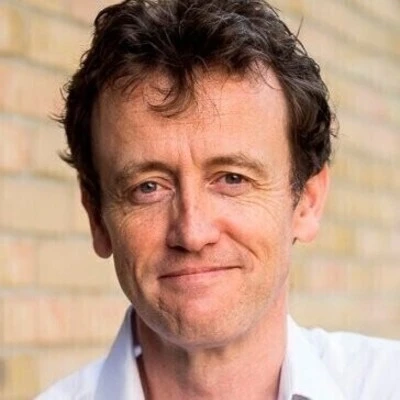
Niall Ferguson: Hello. My name is Niall Ferguson. I'm the Milbank Family Senior Fellow at the Hoover Institution at Stanford and I'm a historian.
Gayle Markovitz: Welcome, Niall. We are entering a new era. I keep reading about it. It's the number of times I've seen the fact that we're at an inflection point, a pivot point, something new, something unprecedented. It is endless. Do you agree? And if so, what do you think characterizes this new era?
Niall Ferguson: I think journalists tend to over-name eras, and there are way too many eras and only a very few of them make it into the history books.
It's a particular mistake to associate an era with an individual. It's tempting at the moment to talk about the Trump era, but I'm not sure that's how future historians will think of it.
Eras tend to be defined by empires and by technologies. So you could say that the 19th century was the British era or the age of steam power. And certainly the 20th century became a very American century over time. And that was associated with oil and then silicon.
I think it's much too early to say if we're in a new era, I'm not sure that American era is even over or even close to over.
So I think we probably have too many eras in our conversations and not a sufficient recognition of how hard it is to achieve an era, you need an empire and you need a technology.
Gayle Markovitz: Is there anything in history that we could use to interpret the present? Have you seen these kinds of cycles before that could help us navigate forward? Or do you feel that this really is unprecedented?
Niall Ferguson: Well, I'm very weary of the idea of cycles, because I don't think there are cycles in history. That would make it quite easy to predict.
But in reality, there's so much chaos, so many random shocks, that any kind of cycle is very hard to discern without hugely distorting the data.
My approach is to say, this looks quite like a Cold War now between the United States and China, two superpowers. In technology, there really are only two. Ideologically, they're clearly very different. It has some resemblances to the Cold War between the US and the Soviet Union, except that the economic relationship between the U.S. And China is much, much more developed, much larger than the economic relationship ever was with pretty much closed Soviet economy.
That's for me been a very useful way of thinking about the last six, seven, eight years, because I think this has been true since about 2018.
But it's only a rough approximation.
There are obviously very important differences between Cold War II and Cold War I, just there were differences between World War II and World War I.
But it seems like that's the best way of thinking about the world today. You just have to remember that the technologies of Cold War I are still around, we still have nuclear weapons, but we have new technologies of which artificial intelligence is probably the most important that make this Cold War in some ways a more dangerous and unpredictable one than the first one.
Gayle Markovitz: Well, I mean, speaking of wars, our Global Risks Report, which came out just last week, there is a chapter in it called Values at War. And essentially, it's a deep dive into cultural polarization, which has been amplified by technology. How do you interpret that trend? Do you think it's fundamentally new or a resurgence of older fault lines?
Niall Ferguson: I don't think it's entirely new to see ideological polarization because, after all, the United States had a civil war back in the 19th century. And if you look at American politics in the 1950s, at the time of McCarthy, or in the 1960s and the late 60s, when assassination almost became a too familiar feature of American politics. Those were very polarized times, too.
I think I've argued since The Square and the Tower, which was published back in 2017, that the advent of network platforms as the dominant organizing forces on the internet was bound to lead to more polarization because of the business model. If you're selling ads to generate cash flow, whether you're Facebook or Google or YouTube, you are going to to promote more inflammatory content and the centere is going to just get hollowed out because there aren't that many eyeballs drawn towards centrist narratives.
So I think that's playing out in a way that was quite predictable some years ago.
A couple of points that are interesting to me. One is we've seen something like this before, long ago, when the printing press radically altered the public sphere in Europe. In the late 15th and 16th century and that produced a period of tremendous polarization and wars of religion. Religion was the domain of division rather than politics. So I think in some ways we're replaying wars of religions only today instead of saying I'm a Catholic and you're a Protestant we say I'm Republican and you are a Democrat. These political allegiances in America are becoming more and more confessional, they're becoming more almost like political religions.
The other point is that If you look at the extremes, they too fragment. It's not as if we have just two blocks, left and right. On the extremes of the political spectrum, you can see fragmentation. Think of the new phenomenon of a woke right, which is overtly anti-Semitic and even pro-Nazi. And then on the left, you have radical trans activists who seem to be at war with feminists and gay rights activists. So I think the fragmentation is actually in many ways a little bit like one of those fractal geometries that you find in nature. So polarization leads to more polarization and then further polarization in a sort of fractal geometry of political religion.
Gayle Markovitz: I mean the religious polarization never seemed to end very well. Do you see a similar trajectory or do you think we can get ourselves out of this mess?
Niall Ferguson: I grew up in Glasgow which was very divided between Catholics and Protestants and it was as if the history of the 17th century had never really ended. Communities that barely spoke certainly didn't intermarry and often engaged in violence. It was even worse in Northern Ireland. So I recollect how this works.
And if you see political communities becoming as separate from one another as that, with the same kinds of antagonism, it would be sort of surprising if there wasn't at least some political violence too. And I hope we can avoid that.
Comforting thing is that there are still a significant number of voters who in fact don't occupy either the Republican or the Democratic camp. They may describe themselves and even register as independents, but that's actually quite a big part of the US electorate. If you look at politics in Europe, and that includes the UK despite Brexit, what you see is multiple parties.
You don't get polarization in European politics at all. What you get is fragmentation so that you end up in the Netherlands with so many parties that it's kind of a crapshoot who ends up forming a government. That's a very different story from the standard one of polarization that one reads about.
I actually think what happens in democracy is that it is hard to maintain two-party systems. They barely exist anywhere else outside the United States and even in the United States there's a secret third party, the independents, who aren't really a party but they account for about a third of the electorate.
So that's the picture that I see and that makes it quite hard to sustain narratives of extraordinary polarization tending towards civil war. I actually think that's highly unlikely because the polarization is so fractal.
I mean the polarization in the United States today runs through families. And counties, towns. It's not that there are parts of the country that are all red and parts of country that all blue and they're one day going to have a civil war. It's not like that at all.
Most families have kind of their Trump supporter and their Trump hater and at Thanksgiving they have a huge fight at the dinner table, but that's not the basis for a civil war. That's the basis of a fight at Thanksgiving.
Gayle Markovitz: Interestingly, going back to our Global Risk Report, we do talk about an age and we often do in the Global Risk report, we have the age of the polycrisis a couple of years ago. And what we
Niall Ferguson: I hated the polycrisis. I thought that was one of the worst words ever to infect this discourse at Davos
Gayle Markovitz: Oh, go on, tell us why.
Niall Ferguson: Well, because every year has a polycrisis, it's just one of these preposterous, pretentious words to describe the fact that in any given year, there'll be some combination of economic volatility and some political division and there'll a war somewhere and probably a famine somewhere else. That's just history. Calling it a poly risis is absurd. Show me a year without a polycrisis.
Gayle Markovitz: So what we've come up with this year is an age of competition. We specifically didn't go with something like chaos or disorder. Do you think that characterizes it well?
Niall Ferguson: It's quite good to think of it that way. Mind you, I don't think that's particularly new because you could argue that at the heart of Western history, going all the way back almost to the break-up of the Roman Empire, has been competition between rival polities. There's a whole school of history that says the reason Europe ends up pulling ahead of the rest of the world after around 1600 is that there's just so much competition that it propels technological innovation forward.
I think what's interesting about competition today is that it exists within countries and it exists between countries and that's very obvious if you look at new sectors of the economy, not only artificial intelligence but take automobiles.
There's an enormous number of companies frantically raising money and competing to build large language models. I mean, the leaderboard is like looking at the Premier League. That's a lot of companies raising capital and competing to build models that replicate neural networks.
And then you look at electric vehicles. The first time I even heard about Chinese automobile companies was, oh, I don't know, 15 years ago. And now they're the dominant manufacturers of automobiles in the world. And there are lots of those. And they're all ferociously competing with one another.
So, I think there are parts of the world economy that are very competitive today in a way that we haven't really seen since oh I don't know the 19th century competition between railroad companies and banks.
In that sense I think it is a very competitive period in some sectors of the economy but in other sectors there's a woeful lack of competition and all those public sector entities that are supposed to deliver public services are noteworthy for the lack of competition. There just isn't much competition in those areas which is why productivity doesn't grow at all and the quality of service tends to stagnate. I wish there could be more competition.
I wrote a book called Civilization in which I said competition is one of the six killer applications of western civilization. The frustrating thing is that there are big parts of western economies that don't have much competition. And that, of course, is one of the reasons why those are the disappointing parts of the economy, whereas if you're into AI, the competition's delivering a better model almost every month, if not every week.
Gayle Markovitz: But with the better model every month or week, do you not feel that there are winners and losers? So in that sense, is competition really good for everyone?
Adam Smith 250 years ago this year wrote The Wealth of Nations explaining how competition could work to improve the efficiency of the economy. So I'm for competition. And I'm against the things that reduce it. I'm again some monopolies, which obviously reduce competition, and I am against state interventions that reduce competition.
Where a competition can be dangerous is when empires or states compete.
Now, clearly the competition between the United States and China is in some measure a competition about military technology. There's an arms race going on in the Indo-Pacific region. That's the kind of competition historically has produced war.
When you're competing in the battlefield, it's generally not a good thing. There's a competition going on in Ukraine right now of that sort. It's bloody. It's extraordinarily nasty, this war, because the weapons are really, thanks to drone technology, very lethal. And that kind of competition, we don't want to see more of that.
We don't to see that kind competition in the Middle East. We already saw quite a bit of it. And we certainly don't want to see that kind of competition in the Far East.
So competition is good, but try to make it nonviolent. That seems like a pretty good lesson of history.
Gayle Markovitz: If you were to bet on a Black Swan event over the next decade, what do you think it would be?
Niall Ferguson: Black swans, by definition, are supposed to be unpredictable. If I predicted it and then it happened, it would kind of not be a black swan.
But I think what one can say we underestimate is the probability of a very big geological disruptive event. Because we've forgotten that the Earth can play these tricks on us, very nasty tricks, like big volcanic eruptions or big earthquakes.
And those happen very infrequently on a large scale. And that leads us to think that they're going to not happen. But there's absolutely no reason to think that the world has become less volcanically active than it was in the 12th century, when huge numbers of very big volcanic eruptions fundamentally altered the climate and led to global cooling, which had very bad effects. Or think back to 1906, the great Californian earthquake. 120 years is the time between then and now, but if you had a really big quake that size in California today, it would be very economically disruptive because of the importance of Silicon Valley.
And I think we tend to underestimate the geological risks because we talk a lot at Davos about climate. Now what's interesting is that climate disasters are generally much less lethal than geological disasters. The big flooding events tend to be an order of magnitude less destructive than big geological disasters. So that's the thing that people tend to underestimate and then it comes along and literally shakes their world.
Gayle Markovitz: So if there's something that we're not paying enough attention to, you might put it on that. But I mean, what could we do to become more resilient?
Niall Ferguson: One of the odder things about the human race is we are drawn by some extraordinary force to build large cities near fault lines. And those cities are bigger than they have ever been.
The most volcanically volatile part of the world is in the neighborhood of Indonesia. There are some very big cities there now, much bigger than any that were built there in the past. And I think our tendency is to talk about the vulnerability of big cities to say flooding or rising ocean levels. That's not the big risk to big cities. The really big risk big cities is a geological shock.
Japanese understand this quite well because they're so much more exposed than say West Europeans or Americans on the East Coast.
But as I said, at some point you get the big one in California. I can't tell you when. I'll be quite surprised if I get through my life without seeing another really big geological event. It's been 200 years since there was a volcanic eruption big enough to affect the world's climate.
It would really take us by surprise if one of those happened, but there's no reason that it shouldn't happen this year. It could.
Gayle Markovitz: It's a fairly gloomy moment geopolitically, geoeconomically.
Is there anything that we should be hopeful for in the future? Is there something that we could feel happy about and optimistic about?
Niall Ferguson: Well, I'd say two things. The first is we shouldn't suffer from a tremendous myopia about the past. By comparison with, I don't know, the world in 1926 or 36 or 46, the geopolitical problems of 2026 are really quite minor.
People get tremendously excited about President Trump's more outrageous claims. One that people are almost certainly going to spend a lot of World Economic Forum 2026 discussing is bid to take control of Greenland. But at some level there's a comic opera quality to this by comparison with, oh, I don't know, World War II. Or even the high points or low points of the first Cold War when we came very close to blowing the world up over Cuba. So let's just keep this in perspective.
It is, of course, a topic of conversation like no other. Talking about Trump at Davos, I feel like I've now been doing it for a decade. But it's really pretty minor by comparison with, I don't know, talking about Hitler in the late 1930s or talking about Stalin in the late 1940s. Those were much, much bigger threats to global stability.
The thing I'm most optimistic about is that, in the end, when you step back and think about what the great technological revolutions of our time represent, collectively they do represent an empowerment of the individual, unlike anything we've ever seen.
Individuals, no matter where they are born, have access to knowledge in a way that simply wasn't possible before. And that is, I think the principal reason for optimism.
We can wring our hands about young people on social media, on their smartphones, all we like. But the really important thing is that entrepreneurial talented people, even if they happen to be unlucky in being born in the bottom quintile of the income distribution in the most impoverished part of a country, if they have access to the internet, and even a fairly basic bit of technology, then they effectively have access to the Widener Library or the Bodleian Library.
And that's amazing. I think that that will unleash extraordinary possibilities, unlike anything we've ever seen. And the individual liberty will be the winner over totalitarianism or even minor league threats like populism.
That's why I'm an optimist. This is an individualist world, where the clever kid, wherever the clever kid is, has a better shot at fulfilling her or his potential. Much better shot than in any previous era in human history.
Isn't that a reason to be optimistic? I think it is.
Robin Pomeroy: Niall Ferguson is a Senior Fellow at the Hoover Institution at Stanford University. He was talking to Gayle Markovitz.
Do listen back to Gayle’s podcast about the World Economic Forum’s Global Risks Report 2026 which was published just before the Annual Meeting in Davos. And you can read the report on our website - links to the report and the podcast in the show notes.
We have lots more great interviews from Davos coming soon here on Radio Davos, and on our sister podcast Meet the Leader - to get those when they drop please follow both shows wherever you get podcasts or visit wef.ch/podcasts.
This episode of Radio Davos was presented by me, Robin Pomeroy. Editing was by Jere Johansson. Studio production was by Taz Kelleher.
Radio Davos will be back next week, but for now thanks to you for listening and goodbye.
Are we living in the Second Cold War? And if so, what can we learn from the last one that might help us through it?
Historian and author Niall Ferguson sets out his view of global affairs right now and says why, compared to many times in the past, there is lot to make us optimistic.

Bringing you weekly curated insights and analysis on the global issues that matter.

Saia Ma’u Piukala
April 5, 2026


