Drought fuelling food insecurity, and other nature and climate news

The agricultural sector has faced many challenges this year due to heatwaves and drought. Image: REUTERS/Florence Lo
- This round-up contains some of the key nature and climate news from the past week.
- Top stories: The global impact of drought; Outcomes from the UN's development summit; BRICS leaders demand wealthy nations cover climate costs.
1. Droughts affecting millions of people around the world
More than 90 million people across eastern and southern Africa are facing extreme hunger as a result of widespread drought, a report from the National Drought Mitigation Center (NDMC) and the United Nations Convention to Combat Desertification (UNCCD) has found.
The situation is particularly dire in Somalia, where approximately one-quarter of the population is facing crisis-level food insecurity, with 1.7 million children under five experiencing acute malnutrition.
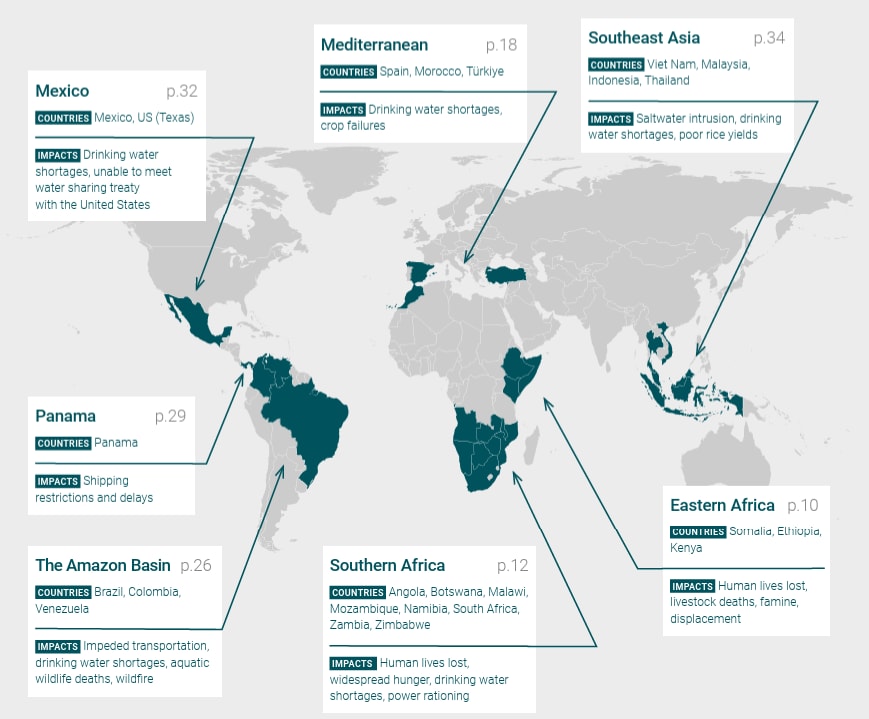
The report outlines the impacts of drought beyond food security as well, exploring the disruption for healthcare and energy systems as a result of the persistent dry weather.
Illustrating the depth and severity of the problem, Paula Guastello, lead author shares: "Girls pulled from school and forced into marriage, hospitals going dark, and families digging holes in dry riverbeds just to find contaminated water — these are signs of severe crisis."
The authors emphasized the need for investments into water-efficient infrastructure and nature-based solutions, as well as implementing policy changes regarding water use and human rights, particularly for the most vulnerable.
The nations of the world have the resources and the knowledge to prevent a lot of suffering. The question is, do we have the will?
—Dr Kelly Helm Smith, NDMC Assistant Director
”2. What happened at the UN development summit?
The Fourth International Conference on Financing for Development was held in Seville, Spain, from 30 June to 3 July. The conference brought together over 15,000 participants, including nearly 50 heads of state and government.
The event was expected to achieve higher levels of participation, but the US and many major developed nations pulled out altogether, Reuters reports.
Here's a short summary of the progress that was made towards boosting investment in sustainable development:
- The Sevilla Commitment was signed, laying out a path to close the $4 trillion annual SDG financing gap in developing countries.
- A Debt-for-Development Swap Programme by Italy that will convert €230 million ($270m) of debt obligations of African countries into investments in development projects.
- A Debt “Pause Clause” Alliance where a coalition of countries and multilateral development banks commit to including “pause clauses” in their lending, to suspend debt service payments during crises.
- A blended finance platform, SCALED, to scale up blended financing, led by a coalition of countries and financial institutions to support efforts to create effective and replicable, scalable blended finance instruments and funds with development impact.
3. News in brief: Other top nature and climate stories this week
Flash floods have killed more than 100 people in Texas after heavy rain and thunderstorms caused water levels to rise rapidly. Some parts of central Texas, including Kerr County, experienced several months' worth of rain in a few hours on Friday, the BBC reports.
Leaders of the BRICS group of developing nations have demanded that wealthy nations fund the global mitigation of greenhouse emissions, Reuters reports. In their joint statement, BRICS leaders stated that providing climate finance "is a responsibility of developed countries towards developing countries".
The world's biggest multilateral climate fund has announced it will make its largest-ever series of investments, as it plans to release about $1.2 billion for 17 projects, mostly in Asia and Africa. "At a time when collective climate action is more needed than ever, GCF is stepping up to deliver on its mandate," Green Climate Fund Co-Chair Seyni Nafo said in a statement.
An $88m pollution-tracking satellite has gone missing in space after losing communication with the Environment Defense Fund on 20 June. The MethaneSat satellite is designed to detect and track releases of the planet-warming gas methane from oil and gas production, to hold offenders to account.
Japan's matcha production has been curbed by heatwaves and drought. The Kyoto region, which accounts for about a quarter of Japan's production of tencha - the stemmed leaves dried and ground into matcha - was hit by severe heatwaves last summer during Japan's hottest year on record, Reuters reports.
How the Forum helps leaders align climate action with nature-positive growth
4. More on the nature and climate crisis from Forum Stories
Positive tipping points are helping to restore degraded ecosystems and shift human behaviour towards sustainability. Understanding how these feedback loops work could help reverse ecosystem collapse, restore biodiversity and build a nature-positive future, write Tim Lenton and Steve Smith in this article. Dive into examples from Yellowstone in the United States to Rajasthan in India.
Acidity in the sea has reached hazardous levels. Even more worryingly, scientists have discovered it crossed this critical threshold five years ago, much faster than they had anticipated. Learn more in this video:
This new satellite is using radar to map the world's forests, measuring how much carbon is stored within these ecosystems. Watch the video below:
License and Republishing
World Economic Forum articles may be republished in accordance with the Creative Commons Attribution-NonCommercial-NoDerivatives 4.0 International Public License, and in accordance with our Terms of Use.
The views expressed in this article are those of the author alone and not the World Economic Forum.

Forum Stories newsletter
Bringing you weekly curated insights and analysis on the global issues that matter.
More on Climate Action and Waste Reduction See all

Temidayo Akenroye and Hushneara Begum
April 10, 2026


