How stronger laws and institutions can help close the global gender gap and boost the economy

The global gender gap can be closed, but it requires actions on multiple fronts Image: Getty Images/iStockphoto
- Gender parity isn't just a moral imperative, it’s a smart economic strategy.
- Closing these gaps isn’t just fair – it’s necessary for any country that wants to stay competitive and achieve its full economic potential.
- To close the global gender gap, progress must happen on three fronts: stronger laws, stronger institutions and stronger outcomes.
Gender parity isn't just a moral imperative – it’s a smart economic strategy. When laws and policies prevent women from working and starting businesses, countries forfeit the talents and contributions of half their population. This leads to slower growth, fewer jobs and less innovation. Closing these gender gaps isn’t just fair, it’s also necessary for any country that wants to stay competitive and achieve its full economic potential.
To unlock that potential, we need reliable data to inform smart decisions and track progress.
When lawmakers have clear evidence of what works, they can take action. Ministers, private sector leaders, philanthropies and civil society groups can use this data to push for — and help implement — evidence-based reforms. With the right legal changes, countries can take significant leaps towards stronger economies, expanding access to jobs and business opportunities. But without reliable data, policymakers are navigating in the dark.
To meet this challenge head-on, the World Bank’s Women, Business and the Law project joined forces with the World Economic Forum for the 2025 Global Gender Gap Report. Together, we bring both sides of the gender equality equation into focus: the laws that shape opportunity and the outcomes that reveal whether those opportunities are being realized. By combining legal data with real-world performance indicators, we deliver the comprehensive evidence leaders need to identify barriers, craft smarter policies and drive meaningful reform. This is the data that turns good intentions into action and potential into progress.
Gender parity reaps economic rewards
The economic upside of gender parity is clear. Estimates show that achieving gender equality in the labour force could boost long-run GDP per capita by 20% on average across countries. In entrepreneurship alone, gender parity could add between $5–6 trillion to the global economy. From a macroeconomic perspective, legal gender equality could also help foster cross-country income convergence over time.
Yet, legal and policy barriers remain stubbornly entrenched. Of the 190 economies analyzed by Women, Business and the Law, 96 still don’t prohibit gender-based discrimination in access to credit. Ninety-two don’t require equal pay for equal work and 77 still bar women from certain jobs — often the better-paying roles shaping the future. Alarmingly, 18 countries still have laws requiring a wife to obey her husband. These restrictions don’t just limit women’s agency, they shrink labour pools, constrain entrepreneurship and hold back growth for entire economies. These laws are often portrayed as protective measures, but as history shows, they can serve to entrench exclusion, disguising economic barriers as concern for women’s welfare.
The tools that highlight where the global gender gap is greatest
Analyzing these gaps, the World Economic Forum’s Global Gender Gap Index tracks four arenas – economic participation, educational attainment, health and survival and political empowerment – to show the remaining path to gender parity across 148 economies. In addition to this, the World Bank’s Women, Business and the Law report analyzes legal and policy frameworks in 190 economies to reveal what helps or hinders women’s access to work and entrepreneurship throughout their lives. Together, these tools equip leaders with the insights needed to close gaps and unlock shared prosperity.
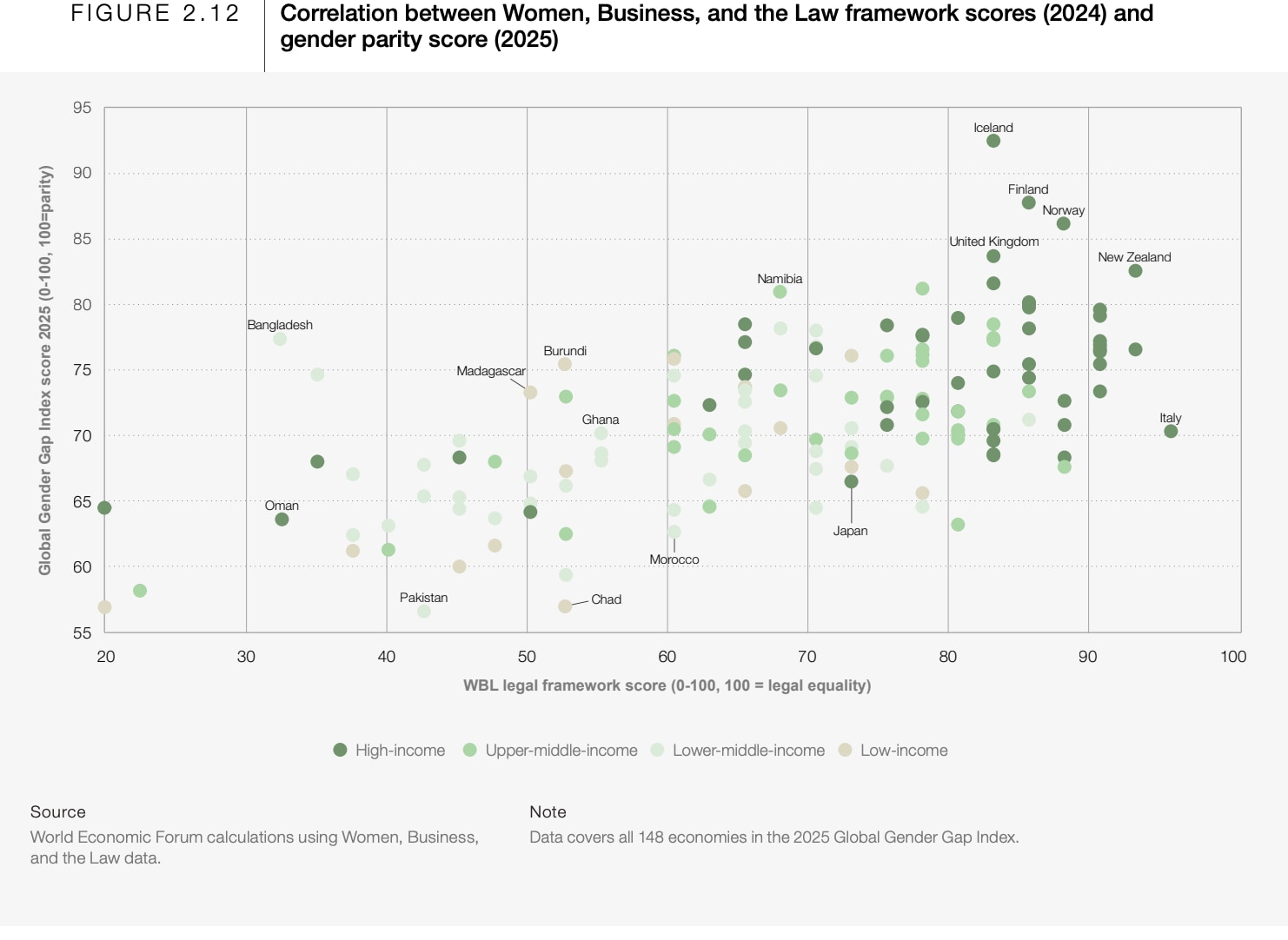
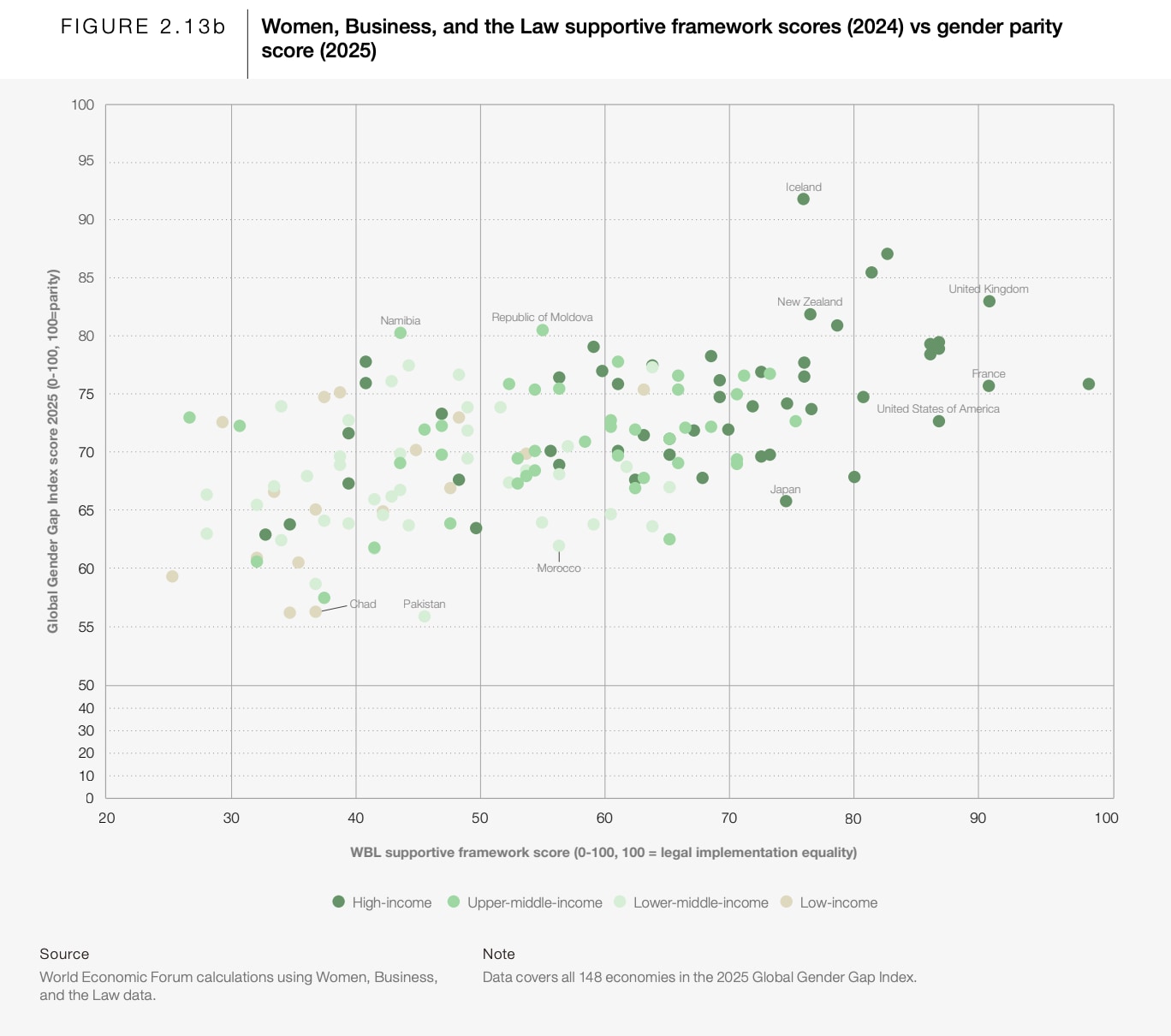
The charts above highlight the strong, statistically significant correlations between the Women, Business and the Law Legal Framework Index, the Supportive Frameworks Index and countries’ performance on the Global Gender Gap Index. Panel A shows that countries with stronger legal frameworks tend to achieve better gender parity outcomes. Panel B displays a similar, though slightly weaker, positive association with supportive frameworks, such as policies, programmes and institutions.
Together, these three indexes help capture the full picture of what drives gender equality: legal intent, institutional capacity and measurable outcomes. The Legal Framework Index reflects what’s on the books; the Supportive Frameworks Index assesses how those laws are implemented; and the Global Gender Gap Index reveals what women experience in practice across economic participation, education, health and political empowerment.
The data show that countries with strong legal frameworks and robust implementation systems tend to achieve better real-world outcomes, such as higher female labour force participation, improved access to education and healthcare, more equitable pay and stronger political representation. While institutional capacity is critical, strong, gender-equal laws remain the foundation for measurable, meaningful progress.
The 2025 Global Gender Gap Index finds progress is real but slow
The 2025 Global Gender Gap Index confirms that progress is real, but slow. The global gender gap now stands at 68.8% closed, with full parity still 123 years away at the current pace. Gaps in health (96.2% closed) and education (95.1% closed) are nearly closed, but economic participation (61.0% closed) and political empowerment (22.9% closed) remain far behind. These disparities underscore a vital truth: laws and policies alone are not enough. They must be backed by strong systems and embedded in supportive social norms.
At the same time, laws and implementation frameworks have been advancing to address these disparities, but implementation still lags behind. Only five countries — Bangladesh, Belize, Canada, Jordan and the United Kingdom — have higher implementation scores than legal ones. This doesn’t mean their laws are stronger, but that enforcement efforts are more developed. In contrast, 143 economies show a clear implementation gap: laws exist on paper but lack institutional support to be effective.
The consequences are tangible. For example, while most countries legally ban sexual harassment in the workplace, few offer such protections in public spaces, affecting women’s safety and limiting their access to work. Women, Business and the Law data shows that women enjoy 64% of the legal rights men do and fewer than 40% of enforcement systems are in place. For example, 98 economies have enacted legislation mandating equal pay for women for work of equal value. Yet, only 35 economies — fewer than one out of every five — have adopted pay-transparency measures or enforcement mechanisms to address the pay gap. To close gender gaps, progress must happen on all three fronts: stronger laws, stronger institutions and stronger outcomes. No single effort is enough. Lasting change depends on aligning all three.
Don't miss any update on this topic
Create a free account and access your personalized content collection with our latest publications and analyses.
License and Republishing
World Economic Forum articles may be republished in accordance with the Creative Commons Attribution-NonCommercial-NoDerivatives 4.0 International Public License, and in accordance with our Terms of Use.
The views expressed in this article are those of the author alone and not the World Economic Forum.
Stay up to date:
Gender Parity


Forum Stories newsletter
Bringing you weekly curated insights and analysis on the global issues that matter.
More on Jobs and the Future of WorkSee all

Keith E. Ferrazzi and Wendy Smith
April 9, 2026


