UN court issues landmark climate decision and other nature and climate news

Climate activists and campaigners demonstrated outside the International Court of Justice during the ruling. Image: REUTERS/Marta Fiorin
- This round-up contains some of the key nature and climate news from the past week.
- Top stories: UN Court confirms countries can be held accountable for their environmental impact; Fossil fuels are "running out of road" as renewables grow cheaper; EU looks to simplify sustainability laws.
1. World Court issues landmark opinion
A landmark decision by the International Court of Justice (ICJ), the United Nations' (UN) judicial body and highest court, outlines that countries have a duty to limit environmental harm. The ruling strengthens the case for those most vulnerable to climate change, such as developing nations or indigenous people, in suits against countries over historic emissions of greenhouse gases or failure to meet climate commitments.
The President of the ICJ, Judge Iwasawa Yuji, said that if countries do not implement ambitious plans to tackle the climate crisis and their nations' emissions, then this would constitute a breach of their Paris Agreement promises.
Countries not part of the Paris agreement would still be obligated to protect the climate, notes Reuters, as a matter of human rights law and customary international law.
Although just an advisory ruling from the court, many consider this is a big step in the right direction for climate policy: "I didn't expect it to be this good," Vanuatu's Climate Minister Ralph Regenvanu told reporters.
This advisory opinion is a tool for climate justice. And boy, has the ICJ given us a strong tool to carry on the fight for climate justice.
—Vishal Prasad, Law Student, as reported by Reuters
”2. Fossil fuels ‘running out of road’, UN chief says
A just transition away from fossil fuels to renewable energy is inevitable, as "fossil fuels are running out of road", the UN Secretary-General António Guterres has stated in an address.
Guterres urged countries to approach tackling energy security by investing in low-carbon energy sources, which will help to boost grid resilience and lower costs for consumers simultaneously.
The cost of renewables has declined steadily in recent years, with the cost of solar, which was "not so long ago four times the cost of fossil fuels – is now 41% cheaper".
A new report from the International Renewable Energy Agency analyzes the cost of renewable power generation, finding that more than nine in ten renewable power projects globally are now cheaper than fossil fuel alternatives.
Guterres also called on big tech companies to commit to sourcing 100% of their electricity from low-carbon power sources by 2030.
You can watch the full address below:
3. News in brief: Other top nature and climate stories this week
The European Union (EU) has begun discussions to further simplify its set of sustainability laws, aiming to reduce the administrative burden on companies and governments, Reuters reports. The consultation seeks "not to lower the EU's environmental objectives or the protection of human health granted by EU environmental laws, but to attain them more effectively without causing avoidable costs".
Just as wildfire season peaks in the US, the nation is facing a shortage of firefighters, with more than a quarter of firefighting positions at the United States Forest Service remaining vacant, The Guardian reports.
The ancient city of Alexandria is under threat from coastal erosion, with 40 structures collapsing every year and beaches being swallowed up by the rising seas. Watch the video below from Reuters for more:
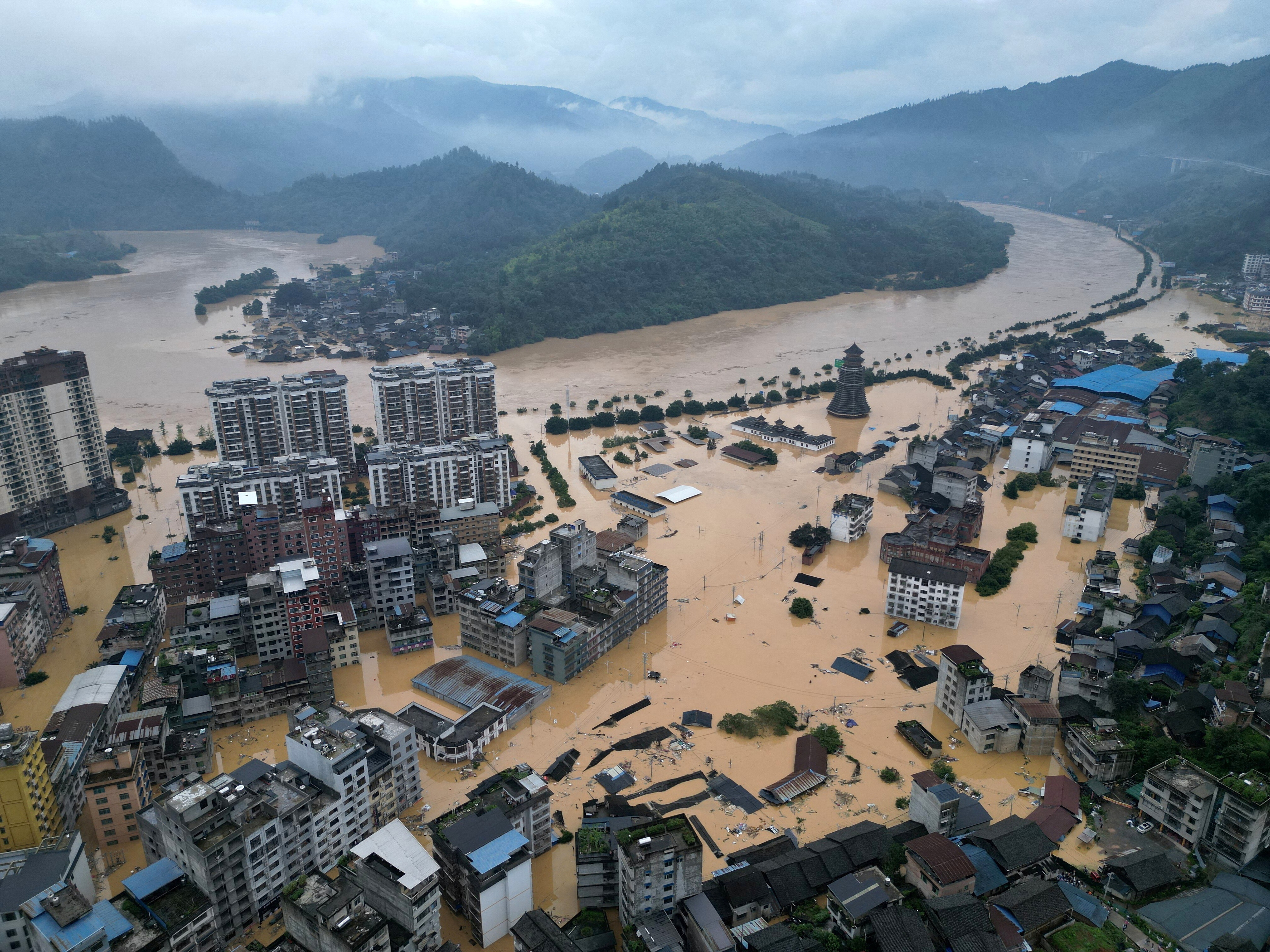
An entire year's worth of rain has fallen on Northern China in just 24 hours. As much as 448.7 mm (17.7 inches) of rain fell throughout 24 July into early 25 July in Yi, an area in western Baoding, leading to flash floods, power outages and damage to local infrastructure.
Scientists have sounded the alarm on declining populations of seabirds, as the number of Peru's guano coastal birds has dropped by more than three-quarters in the past three years to around 500,000, down from a population of 4 million in 2022. "We are very alarmed by this sharp decline," said Susana Cardenas, director of the Environmental Sustainability Center at Peru's Cayetano Heredia University, in an interview with Reuters.
How the Forum helps leaders align climate action with nature-positive growth
4. More on the nature and climate crisis from Forum Stories
Traditional approaches to water risk management are no longer adequate, write Waterplan's CEO, Jose Ignacio Galindo, and CSO Nicolas Wertheimer. Severe flooding, widespread pollution and declining water quality are commonplace nowadays and are among the world's most critical global challenges. Here's how AI-driven systems can establish new benchmarks for intelligence, precision and responsiveness in water risk assessment, and mark a turning point for global water security.
We're underestimating the true value of climate adaptation efforts. Find out why in the video below:
The nexus of energy, food and water systems is undoubtedly complex, complicated and compounding, write Arunabha Ghosh and Jane Nelson. These three systems are interconnected through complex, cyclical feedback loops that intensify under growing pressure. Despite their interconnectedness, policy and planning frameworks often adopt a siloed approach. Here's how we can drive coordinated, systems-level approaches to manage the growing complexity of the energy, food and water nexus.
License and Republishing
World Economic Forum articles may be republished in accordance with the Creative Commons Attribution-NonCommercial-NoDerivatives 4.0 International Public License, and in accordance with our Terms of Use.
The views expressed in this article are those of the author alone and not the World Economic Forum.
Related topics:

Forum Stories newsletter
Bringing you weekly curated insights and analysis on the global issues that matter.
More on Climate Action and Waste Reduction See all

Tom Crowfoot
February 24, 2026


