7 ways the tech sector can lead the nature-positive transition

Demand for data centres and other tech components makes the sector's nature-positive transition ever more urgent Image: Getty Images
- The tech sector’s growth is highly dependent on nature and is facing rising risks from climate change and ecosystem degradation.
- A nature-positive approach has the potential to deliver up to $800 billion in cost savings and revenue upside across the tech sector value chain.
- Seven priority actions can drive this transition – read more in the report Nature Positive: Role of the Tech Sector.
The demand for data centres, semiconductors and hardware to power the new tech revolution has never been greater. However, tech sector growth depends heavily on nature, consuming vast water, energy and mineral resources, while facing rising risks from climate change and ecosystem degradation.
Addressing the sector’s relationship with the planet and investing in a nature-positive future can secure companies’ social and regulatory license to grow and operate, develop resilience to nature-related risks, meet growing stakeholder expectations and deliver opportunities for financial growth and cost savings.
As Tim Christophersen, vice president of climate action at Salesforce, says, "In a sector that is growing fast, it is important that we address the ways in which the technology industry depends on and impacts nature.
"No individual company will be able to solve nature-related risks and impacts on their own – we must come together from all points within the technology value chain to build resilience."
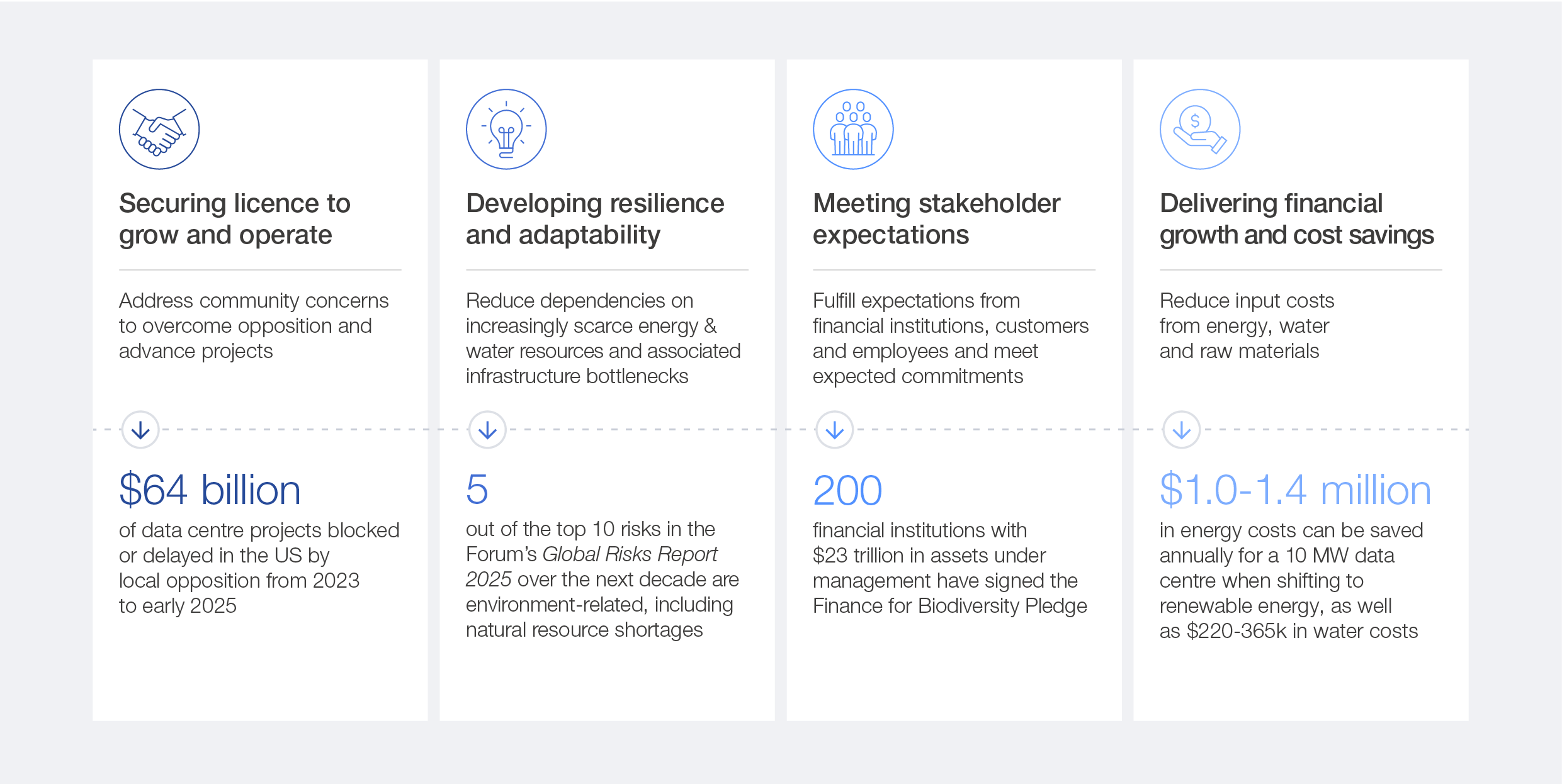
This convergence of resource intensity, risk and stakeholder and regulatory momentum means that the timing is opportune and the opportunity immense. The World Economic Forum estimates the tech sector can capture around $800 billion in cost savings and revenue upside for businesses operating across the sector’s value chain.
Tech sector priorities in the nature-positive transition
We have identified seven key actions for the tech sector to both reduce harm to nature and generate nature benefits across the entire value chain. These actions ensure alignment with the mitigation hierarchy – avoid, reduce, restore and compensate – to prioritize preventing negative impacts from occurring initially.
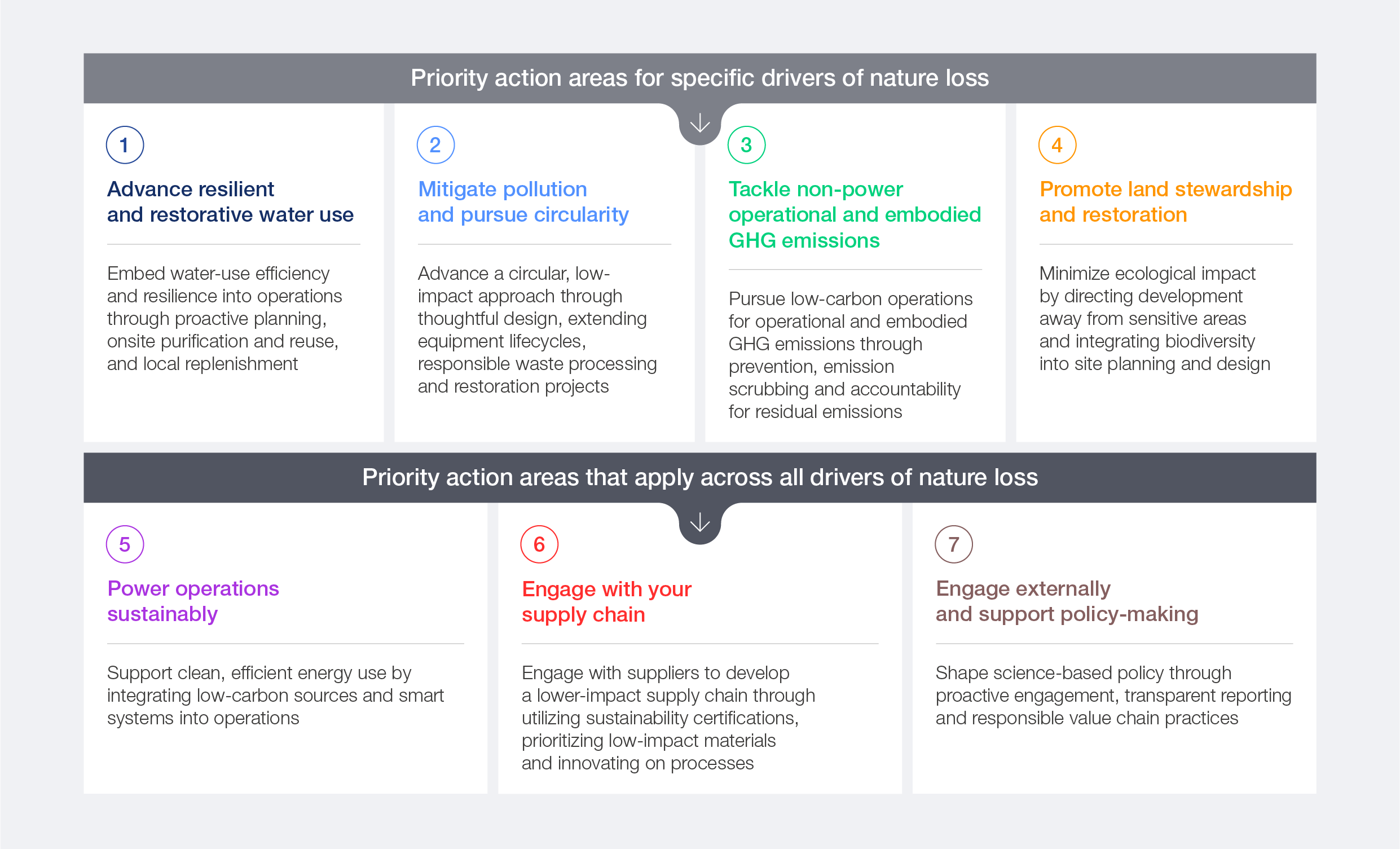
Many companies are already taking simple, cost-effective steps towards these actions, which are becoming industry standard. Others are leading through ambitious moves that also yield greater nature and commercial benefits. Lastly, some companies are pioneering transformative but complex actions that require time, commitment and innovation.
1. Advance resilient and restorative water use
Many companies are already assessing potential sites for water stress and improving operational water efficiency. Leading players extend this into their supply chains (such as in power generation) and adopt closed-loop systems.
For example, Taiwanese semiconductor fabricators recycle on average 85% of wastewater. Companies including Salesforce are focused on replenishing watersheds and combating the water strain projected to affect half of the global population by 2030.
2. Mitigate pollution and pursue circularity
Companies should take care to avoid releasing pollutants into the environment and to extend product lifespans to reduce e-waste. Leading companies go further: optimizing hardware design for circularity and developing collection programmes for their customers’ e-waste.
Aspirational actions require cross-company collaboration – for example, Australia’s MobileMuster programme, a collaboration between government and companies such as HTC, Google and Samsung, enables nearly 100% of its population to recycle mobile phones.
3. Tackle non-power greenhouse gas emissions
Certain tech processes, especially in semiconductor manufacturing, generate direct emissions. It is becoming an industry standard to monitor and prevent leaks of high global warming potential gases used in semiconductor manufacturing.
Leading companies are also deploying gas scrubbers and other technologies to capture waste gases. Across the tech sector, leaders are investing in high-integrity carbon credit and carbon removal programmes to address residual emissions.
In the longer term, companies can redesign products and processes to reduce embodied emissions and the use of high global warming potential gases; IBM’s decades-long product design for the environment programme has incorporated emissions considerations into material selection and product design.
4. Promote land stewardship and restoration
Though land impacts are less prominent in tech, leading companies actively avoid development on high-value ecosystems or even better, favour previously developed brownfield land. When they build, they plant native vegetation, install green roofs and minimize irrigation requirements.
The aspiration is to consider biodiversity similarly to carbon, with upfront and ongoing assessment and reduction of impacts alongside investments into high-integrity biodiversity offsets or ecosystem restoration, as seen in HP’s partnerships with the Arbor Day Foundation, the World Wildlife Fund and Conservation International.
Beyond considering land and biodiversity impacts when siting, leading companies also thoughtfully engage local community stakeholders to ensure shared value.
5. Power operations sustainably
Tech’s reliance on power slows growth.
“A new data centre can be built in 18 months,” says IEA Executive Director Fatih Birol, “but building new [power] transmission lines can take four to eight years.”
Given the direct impact on business, companies commonly incorporate energy efficiency into site design and upgrades. Leading companies commit to renewable, low-carbon power and in some cases, go beyond Power Purchase Agreements to directly sponsor new generation, transmission and distribution infrastructure.
AI-driven process management and innovative cooling reduce both energy and water use.
6. Engage with your supply chain
Given a reliance on energy, water and mineral inputs, engaging with suppliers is critical. It is now common practice to request environmental certifications from suppliers (including ISO 14001, Initiative for Responsible Mining Assurance, and others).
Delta Electronics’ supplier code of conduct includes metrics on energy conservation, carbon and waste reduction, and sustainable material procurement. Leading companies set commitments related to their supply chains and collaborate with suppliers on lower-impact alternatives.
Where alternatives are especially limited, aspirational players partner even more closely on research and development, such as Micron working with Merck KGaA to develop lower global warming potential gases for semiconductor manufacturing.
7. Engage externally and support policymaking
Increasingly, companies are reporting on nature-related risks, following frameworks like the Taskforce on Nature-related Financial Disclosures. Leading companies proactively shape policy to drive the nature-positive transition – for example, a joint US-government, tech industry board (including IBM, Microsoft, Alphabet, AWS, and AMD) advises on responsible AI infrastructure.
Similar partnerships can create sector-wide platforms for nature metrics, such as the European Green Digital Coalition’s development of methods to estimate tech-enabled emissions reductions.
A call to action for the tech industry
A nature-positive tech sector is both a necessity and an immense opportunity. As natural resources and ecosystems become increasingly critical to sector resilience and growth, tech companies can lead by integrating nature with their strategies, product design and procurement.
By enabling its own sustainable growth, the sector will be better positioned to enable the nature-positive transition in other industries as well. If you are interested in learning more, take a read through our latest report, Nature Positive: Role of the Technology Sector.
Don't miss any update on this topic
Create a free account and access your personalized content collection with our latest publications and analyses.
License and Republishing
World Economic Forum articles may be republished in accordance with the Creative Commons Attribution-NonCommercial-NoDerivatives 4.0 International Public License, and in accordance with our Terms of Use.
The views expressed in this article are those of the author alone and not the World Economic Forum.
Stay up to date:
Future of the Environment


Forum Stories newsletter
Bringing you weekly curated insights and analysis on the global issues that matter.
More on Nature and BiodiversitySee all

Forum Stories
February 25, 2026


