Why linear policymaking no longer fits complex challenges

Is it time to rethink the policymaking process? Image: Photo by Rafael Rex Felisilda on Unsplash
- Traditional forecasting extrapolates past trends into the future – an approach that is quickly becoming insufficient.
- Experimentation and foresight can strengthen policymaking, but they must be effectively integrated into organizations' processes.
- To do this, governments, businesses and civil society must institutionalize anticipation, train their personnel in relevant tools and build effective coalitions.
Climate change, technological disruption, demographic shifts and cascading crises are rewriting the operating environment for governments. The policy systems tasked with addressing them, however, remain overwhelmingly short-term, linear and reactive.
The classic 'textbook' or Lasswellian model of policymaking (identifying problems, setting the agenda, choosing policies, implementing and evaluating) was designed for stable conditions. In practice, policymaking is shaped by interest groups, path dependence and limited rationality. Kingdon's 'multi-stream' model highlights that problems and solutions rarely align; they meet only briefly in the 'policy windows', which often close before transformative action can take hold. That leaves governments vulnerable to the cycle of euphoria, implementation and disappointment.
As highlighted in the OECD's Foresight Toolkit and the UNDP's foresight manual, this cycle is dangerous in an era of systemic shocks, such as climate change and pandemics. ECLAC Latin America has noted that failing to escape short-termism perpetuates inequality and fragility.
From foresight to policy
Traditional forecasting extrapolates past trends into the future. But when faced with 'super-wicked' problems — those with multiple causes and feedback loops, prediction alone is inadequate. Strategic foresight is not intended to predict; it equips leaders to think about plausible futures, bring hidden assumptions to light and design policies that are sound across all scenarios, avoiding a 'used futures' lockout.
The OECD's anticipatory governance guidelines note that while experimentation and foresight can strengthen policymaking, their impact remains limited unless they are integrated into government processes. Only a few countries - Finland is often cited - have deeply incorporated forecasting into planning. Most governments use it sporadically, leaving a gap between recognizing its value and effectively institutionalizing it.
Here, foresight is most effective when seen not as a standalone exercise, but as part of anticipatory governance, a 'system of systems' combining strategic foresight with policy integration, continuous feedback and institutional continuity. Examples, such as Policy Horizons Canada and the Government of Finland's Report on the Future, demonstrate how foresight can be institutionalized. At the same time, the OECD and UNDP highlight their transformative role in complex environments.
A framework from foresight to policy
One proposed mechanism for institutionalizing foresight in government is a practical forward-to-policy framework, developed by James Balzer and Aditi Chugh through the Next Generation Foresight Practitioners network. It offers an approach to anticipating the future as a central feature of the policymaking process. It enables civil society and government stakeholders to:
• Diagnose historical and present barriers to achieving their political agenda.
• Identify ways to overcome those barriers.
• Develop a policy mix that enables long-term, sustainable, transformative change.
According to the World Economic Forum's Global Foresight Network and the OECD's Public Sector Innovation Observatory, these frameworks are essential for integrating future thinking into real-world government processes. They also demonstrate that foresight is insufficient unless effective governance systems back it.
Step 1: Diagnosing current (in)capacity
The process begins with a sobering analysis of the horizon of an organization's ability to achieve its political agenda amid uncertainty. Using a 2×2 matrix with two broad variables — namely, magnitude of social impact and uncertainty of long-term direction — policymakers map internal strengths and weaknesses against external opportunities and threats. This allows horizon scanning to reveal trends and signals.
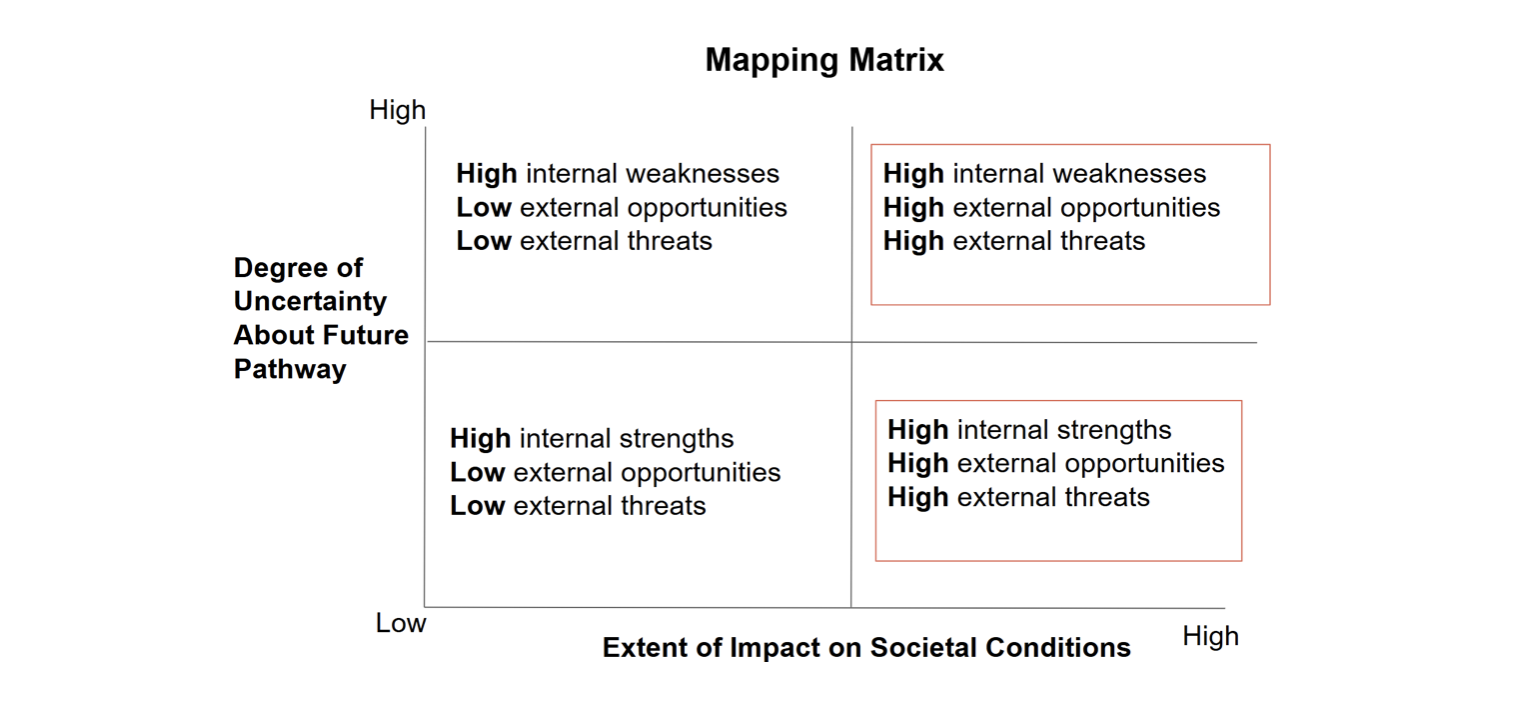
Cases such as that of the Centre for the Strategic Future in Singapore and the European Commission illustrate how horizon scanning can be institutionalized to support decision-making at scale.
Step 2: Identify the deepest drivers of inaction
To determine how the government might navigate uncertain futures identified in the horizon scan, it is essential to consider the problems and the underlying structures, worldviews and metaphors that turn the preferred policy on or off in the future. The proposal, from prospective to policy, is part of of Sohail Inayatullah's 'Futures Triangle' that maps the "pull of the future", "the pull of the present" and the "weight of the past" and causal layered analysis to unravel the deepest policy layers inaction, which must be overcome to achieve a transformative, lasting policy mix.
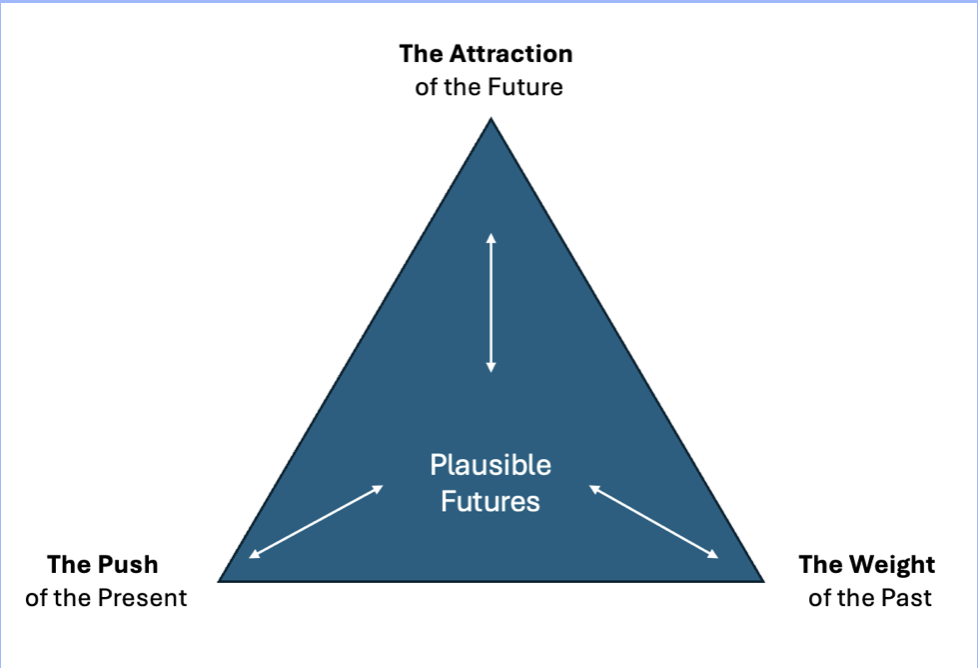
Futures Triangle and causal layered analysis have been successfully applied in contexts as diverse as UNESCO's Futures Literacy Labs and Millennium Project's Foresight Initiatives. These methods reveal that cultural and institutional narratives hinder reform, a prominent need in UNDP's foresight programmes for Latin America.
Step 3: Overcome path dependency
Once the drivers of inaction (weights of the past) are clearly understood, the framework helps leaders design interventions that break free from business as usual. Using path dependency analysis and the 'Three Horizons Model', policymakers can plan:
• Horizon 1 (stickiness): Create a short-term 'blockage' (that exceeds the weight of the past).
• Horizon 2 (entrenchment): Build coalitions and co-benefits (that run from the push of the present).
• Horizon 3 (expansion): Changing norms, values and perceptions (that pursue the attraction of the future).
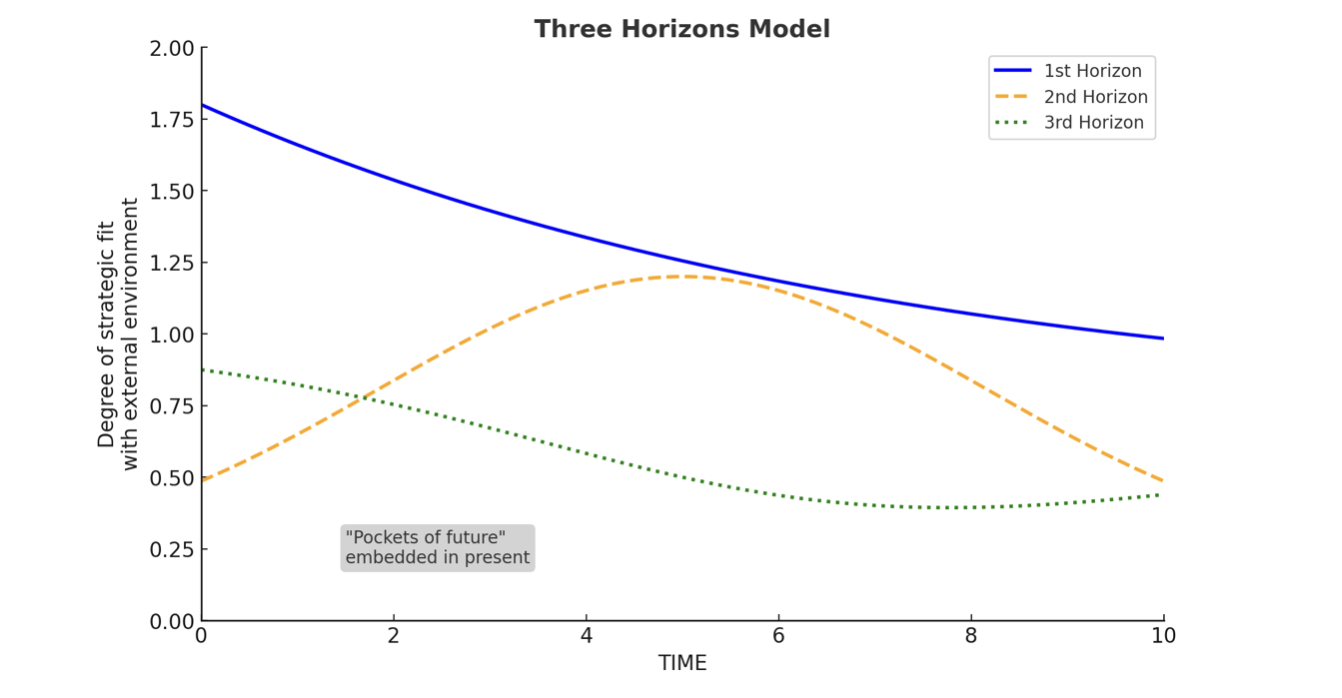
The UK Government's Office of Science and South Korea's long-range planning system demonstrate how trajectory dependency can be changed through phased strategies. The OECD's review of Finland shows that the 'Three Horizons' model can be adapted to parliamentary and budgetary processes.
Step 4: Develop a policy mix
As shown in the OECD's Framework for Anticipatory Governance of Emerging Technologies, strong policy mixes must be adaptable to ensure resilience and legitimacy in rapidly changing environments.
The payoff: resilient and people-centred policies.
When governments systematically integrate foresight into policymaking, three benefits emerge: durability, innovation and legitimacy.
Durability, however, also depends on institutional design: foresight tools must be combined with technical, operational, political and foresight (TOPP) capacities developed by ECLAC and the United Nations. As ECLAC's 2025 guidance and OECD early governance reviews confirm, resilience requires tools and capabilities.
A call to action
Foresight is a public good. To move beyond short-termism, governments, businesses and civil society must institutionalize anticipation, train their personnel in relevant tools and build effective coalitions. This shift enables resilient, people-centred futures. The choice is clear: temporary fixes or tomorrow’s institutions.
Don't miss any update on this topic
Create a free account and access your personalized content collection with our latest publications and analyses.
License and Republishing
World Economic Forum articles may be republished in accordance with the Creative Commons Attribution-NonCommercial-NoDerivatives 4.0 International Public License, and in accordance with our Terms of Use.
The views expressed in this article are those of the author alone and not the World Economic Forum.
Stay up to date:
Strategic Foresight
Related topics:


Forum Stories newsletter
Bringing you weekly curated insights and analysis on the global issues that matter.
More on Global RisksSee all

Saia Ma’u Piukala
April 5, 2026


