How a fatal accident led this man to dedicate his career to protecting migrant workers in India
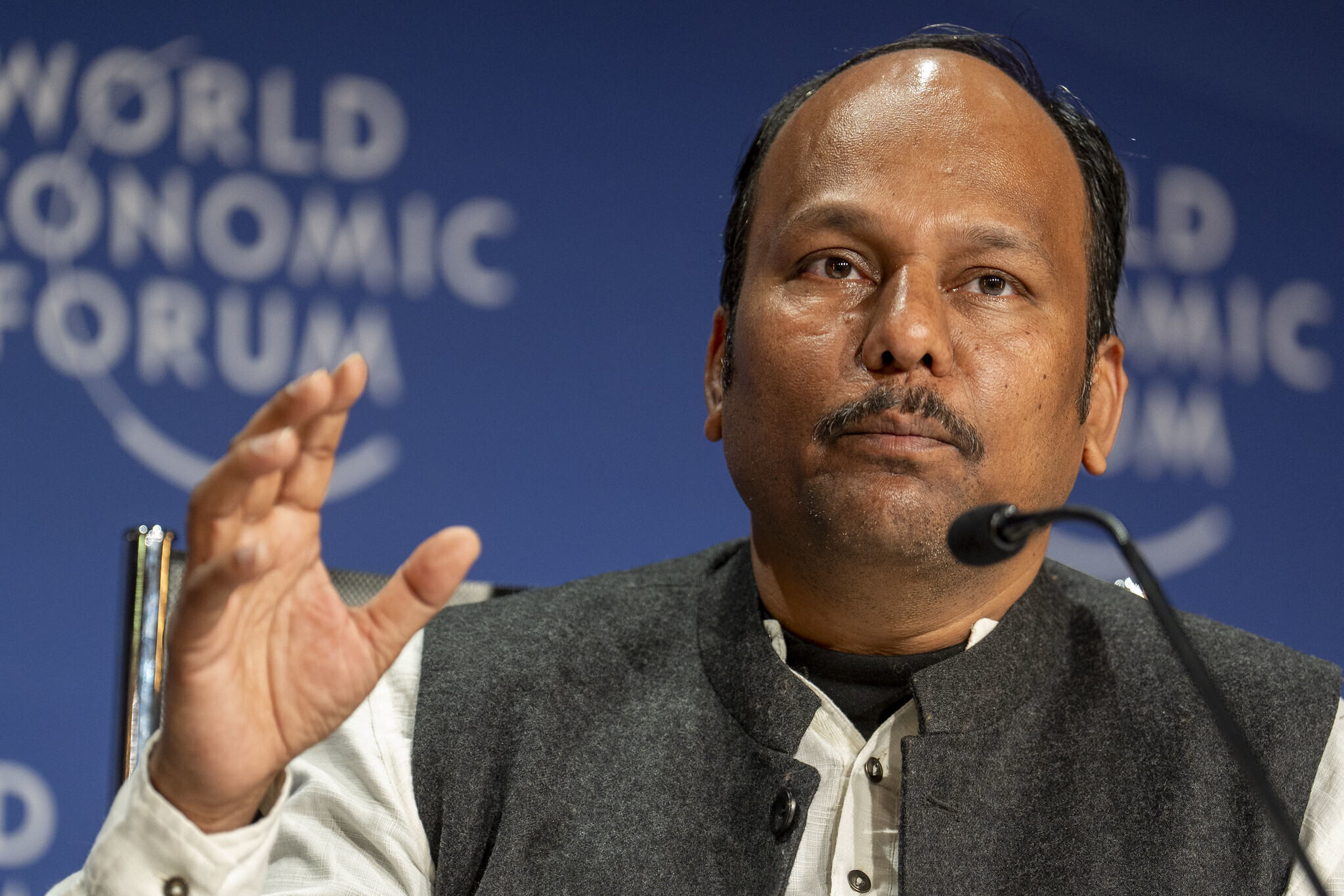
Inspired by his own "lived experience", Ashif Shaikh has dedicated his work to being a voice for the vulnerable and excluded.
- Ashif Shaikh set up People's Courage International to protect migrant and informal sector workers across South Asia and Southeast Asia.
- In the past five years, PCI has scaled its operations and now protects and supports more than seven million households through its Migrants Resilience Collaborative.
- The collaborative's work is showcased in the World Economic Forum's report, Building Economic Resilience to the Health Impacts of Climate Change.
When Ashif Shaikh was 17, an accident at a firecracker factory in the district where he lived in India changed the course of his life.
Three migrant workers, including children, lost their lives.
"I realized that although children are not allowed to work in hazardous industries, there were still children working there. Migrants are the most vulnerable and they are the most excluded. Most of the time, they are not able to raise their voice."
So Shaikh became the voice of the excluded.
He founded People's Courage International (PCI) in 2020 to support migrant and informal sector workers across South Asia and Southeast Asia.
Shaikh's personal journey deeply informs his work. Growing up in an excluded community, he understood the vulnerability faced by those on the margins.
"I know that pain. I have a lived experience," he says.
In the past five years, PCI has scaled its operations to protect and support more than seven million households through its Migrants Resilience Collaborative (MRC), which brings together not-for-profits, businesses, government and the communities to improve the situation for migrants.
Its work is highlighted in the World Economic Forum's Building Economic Resilience to the Health Impacts of Climate Change report, in collaboration with Boston Consulting Group.
The report finds that by 2050, there could be 14.5 million excess deaths from climate change, concentrated in the world's most disadvantaged regions and populations.
Climate change and migrant workers
Globally, there are around 1 billion migrants – one in eight people – with approximately 75% of people migrating within their countries, and 25% migrating from one country to another for work opportunities.
The latest data from the International Labour Organization shows that in 2024, the international migrant labour force exceeded 167 million people – an increase of 30 million since 2013.
"Most of the time, these people are not able to get social security or protection," says Shaikh. "But each and every worker is contributing – and society, the state and businesses should recognize their contribution."
Compounding the lack of social protection is the escalating impact of climate change.
"In the last couple of years, climate change has contributed a lot to increasing challenges for the rural community or vulnerable communities. And migration is increasing at an unprecedented scale because of climate change," Shaikh says.
"We did a study with 24,000 migrant workers across South Asia and Southeast Asia and 90% said they are facing challenges in their day-to-day life because of climate change. And 10% of workers said they migrated because of climate change."
By 2030, the World Bank estimates that climate change will drive between 68 million and 135 million people into poverty. Meanwhile, estimates of the number of people who will migrate due to the growing impacts of climate change vary wildly, but Shaikh says it could be "another 120 million people" over the next couple of years.
"Climate change and migration are interlinked – and we try to work at this intersection," says Shaikh.
Protecting vulnerable migrant workers
PCI has identified six critical challenges faced by migrant communities due to climate change: heatwaves, poor air quality, drought, floods, unseasonal rain, and cyclones.
"These six things are forcing people to move from one place to another place without a safety net," says Shaikh. "In that kind of situation, each and every stakeholder – the state, philanthropy, businesses, investors – everybody needs to work together to protect these workers."
The Forum's report highlights an example from Delhi, India, where winter air pollution often halts construction. This costs roughly 1.5 million daily-wage workers – many of whom are migrants – nearly two-thirds of their income.
To protect these workers' livelihoods, the MRC partnered with a reinsurance broker to create a parametric insurance scheme. It pays up to ₹6,000 (about $70) whenever the Air Quality Index exceeds 400 for three out of five consecutive days.
Across India, Bangladesh, Nepal, Indonesia and the Philippines, PCI advocates for social protection access and long-term climate resilience for informal workers facing cascading impacts like income loss, forced migration and food insecurity.
Part of its work is using technology to create a social registry of migrants and an eligibility engine to enable the distribution of benefits: "The system generates a report of what this particular household is eligible for ... And we facilitate that benefit to the worker."
Shaikh says PCI recognizes the importance of both systemic and individual-level change: "If you are only focusing on system-level change, it's very difficult to transform the life of individuals."
This necessitates applying a "gender lens" to focus particularly on women-headed households and single women, who are often more vulnerable to exploitation. PCI also operates a helpline to assist women who fall into trafficking or forced labour during migration.
"This collaboration helps us to rescue these women from that kind of situation and rehabilitate them to a different kind of livelihood."
License and Republishing
World Economic Forum articles may be republished in accordance with the Creative Commons Attribution-NonCommercial-NoDerivatives 4.0 International Public License, and in accordance with our Terms of Use.
The views expressed in this article are those of the author alone and not the World Economic Forum.

Forum Stories newsletter
Bringing you weekly curated insights and analysis on the global issues that matter.
More on Climate Action and Waste Reduction See all

Laetitia Gardé and Marc Delobelle
February 26, 2026


