The leadership compass: 8 ways for leaders to find their bearings in a changing world

Leaders must read their compass in new ways. Image: Getty Images/iStockphoto
- Against a global backdrop buffeted by shocks, providing an agile framework for leadership is a more urgent priority than ever.
- Young Global Leaders recently convened in Geneva and created an eight-point Transformation Map for modern leadership.
- Foresight, sustainability and adaptability were among the key principles that emerged.
Leaders in the public and private sector find themselves increasingly on a back foot, reacting to a multitude of crises in an ever more turbulent world. In a time marked by technological disruption, shifting societal expectations and climate urgency, what is clear is that those steering government and business can no longer rely on static maps of the past. At the 2025 Young Global Leaders’ Summit in Geneva, over 370 emerging leaders from the Young Global Leaders (YGL) community came together to debate and discuss the critical question of leadership preparedness in a new era. The central question of the summit was: What does the future of leadership look like?
What leaders need is an orienting tool to help them make sense of rapidly shifting landscapes. During the summit, the Young Global Leaders did just this by co-curating a Transformation Map on the Future of Leadership using the World Economic Forum’s Strategic Intelligence platform. The discussion outlined eight key themes that, rather than prescribing a single path, suggest multiple, interconnected avenues leaders must consider to navigate complexity in a changing world.
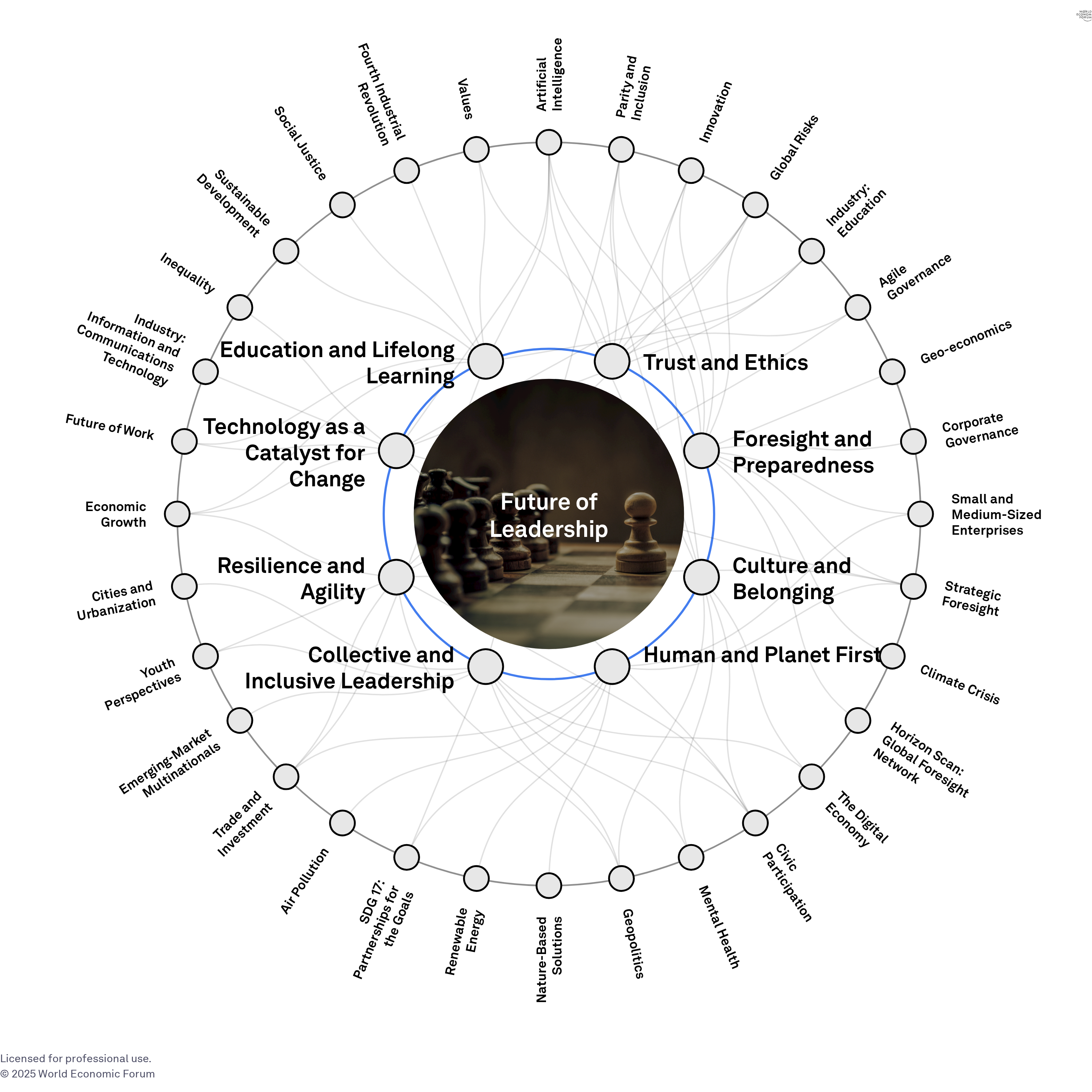
1. Foresight and preparedness
At a time when the world feels increasingly unpredictable, leaders are being asked to guide teams and individuals through what can often seem like disorienting darkness. While traditional training may prepare them to manage complexity, the pressure of the moment can all too easily push even seasoned leaders back into short-term thinking.
So how do the Young Global Leaders suggest navigating this uncertainty? Anulika Malomo (2021 YGL cohort), Non-Executive Director of HarbourVest Partners, offers a compelling perspective: "Strong leadership is about staying true to convictions, cutting through the noise, and keeping the long-term in focus." This means leaders must question whether their “clarity of purpose” is truly future-proof, or a familiar yet dated model.
2. Collective and inclusive leadership
Conventional top-down authority crumbles under the pressure of today’s poly-crises, while the Young Global Leaders emphasized that inclusion multiplies impact. The discussions during the summit were a reminder that true leadership is defined by its ability to centre the needs of the many, not the few.
Gaurav Mehta (2018 YGL cohort), CEO of Dharmalife Foundation, captures this: "In my work, I've seen that the future of leadership lies in turning inclusion into innovation, balancing exponential technology with exponential empathy."
3. Technology as a catalyst for change
One of the biggest conversations at the summit centred around the transformative power of AI and what it means for leadership in the 21st century. Rapid progress in AI, automation and digital transformation is infinitely complex, offering equal parts opportunity and ethical challenge.
Fadel Adib (2024 YGL cohort), Associate Professor from the Massachusetts Institute of Technology, shared a sharp insight, noting that: “The future of leadership lies in how fast leaders can cut through the noise, decide what to embrace, and what to set aside without getting distracted.” This points to the idea of purposeful change that hinges on leaders who set boundaries, engage in active listening and ensure deployment is both values-driven and inclusive.
4. Human- and planet-first
Sustainability was also high on the agenda at the summit, with YGLs issuing a unique call to action. If increasing natural disasters, forced displacement and the threat of sea-level rise are not enough to drive change, the YGLs urged policy-makers to rethink climate action through a different lens: "The solutions of today cannot be the problems of tomorrow."
This perspective emphasizes that if leaders truly wish to solve their challenges, they must ensure that the measures they adopt do not create future crises or lock them into a perpetual cycle of problem-solving. As a result, they need to prioritize eco-centric leadership to design and implement solutions that are solving problems, not creating new ones.
5. Education and lifelong learning
With more than half of all workplace skills projected to shift in the next five years, upskilling, reskilling and modular learning pathways – specifically around AI – all demand attention. The educational mindset shift is critical for leaders to broker this divide between tech advancements and curriculum improvements.
Yet at the summit, there was this sense that educational institutions often lag behind the speed of change. Carlos Emilio Larreátegui (2025 YGL cohort), Vice-Chancellor of Universidad de las Americas, identifies this friction: "Higher education faces real challenges in embracing AI. Students are eager to adopt these tools, but resistance from faculty and administrators is common. The key is helping skeptics see the value of technology. When people feel threatened, it's our role as leaders to provide reassurance."
6. Trust and ethics
Trust is the foundation upon which all other leadership competencies rest. Yet global confidence in institutions remains fragile, with OECD data showing only 39% of citizens trust their national governments.
As technology-driven decision-making accelerates, new governance systems are required. Sana Mir (2025 YGL cohort), sports analyst and commentator, adds: "True leadership requires resilience and vulnerability. While we often chase big solutions, it's the smaller acts – dialogue, open conversations and truly listening – that build trust and strengthen our ability to lead through challenges."
7. Resilience and agility
According to the Global Risks Report 2025, consensus is increasingly fractured across geopolitical, environmental, societal, economic and technological domains. Unpredictability is the new normal, and leaders must replace linear planning with agile and more experimental approaches to tackle these uncertainties.
Maria Eugenia del Castillo Cabrera (2024 YGL cohort), Special Adviser to the Vice-Presidency of the Dominican Republic, articulates this imperative: "Leadership today demands agile decision-making, moving forward with the information we have, not waiting for perfect certainty. It's about uniting around what works, resisting fragmentation and keeping our focus on addressing humanity's most urgent challenges across the globe."
8. Culture and belonging
The YGLs noted that fostering belonging is both an ethical imperative and a strategic edge. When people feel seen, heard and valued, across gender, ethnicity,and age, teams solve tougher problems and innovate faster.
“Sometimes the most powerful tools are the simplest: dialogue, open conversations and truly listening. That’s the groundwork for trust and for belonging that travels across cultures,” highlighted Ann Dumaliang (2025 YGL cohort) of Masungi Georeserve.
The insights from the 2025 Young Global Leaders' Summit reveal that leadership in the new era requires more than technical expertise or strategic acumen. It demands a fundamental reorientation toward preparedness over prediction, collective wisdom over individual authority, and planetary stewardship over short-term gains.
The future of leadership, as envisioned by the Young Global Leaders, is not about having all the answers; it's about asking better questions, engaging diverse perspectives and having the courage to lead through uncertainty with both clarity and care.
Don't miss any update on this topic
Create a free account and access your personalized content collection with our latest publications and analyses.
License and Republishing
World Economic Forum articles may be republished in accordance with the Creative Commons Attribution-NonCommercial-NoDerivatives 4.0 International Public License, and in accordance with our Terms of Use.
The views expressed in this article are those of the author alone and not the World Economic Forum.
Stay up to date:
Future of Leadership


Forum Stories newsletter
Bringing you weekly curated insights and analysis on the global issues that matter.
More on LeadershipSee all

Aiman Ezzat and Bart Valkhof
September 15, 2026


