Why cyber resilience in space is essential for economic security
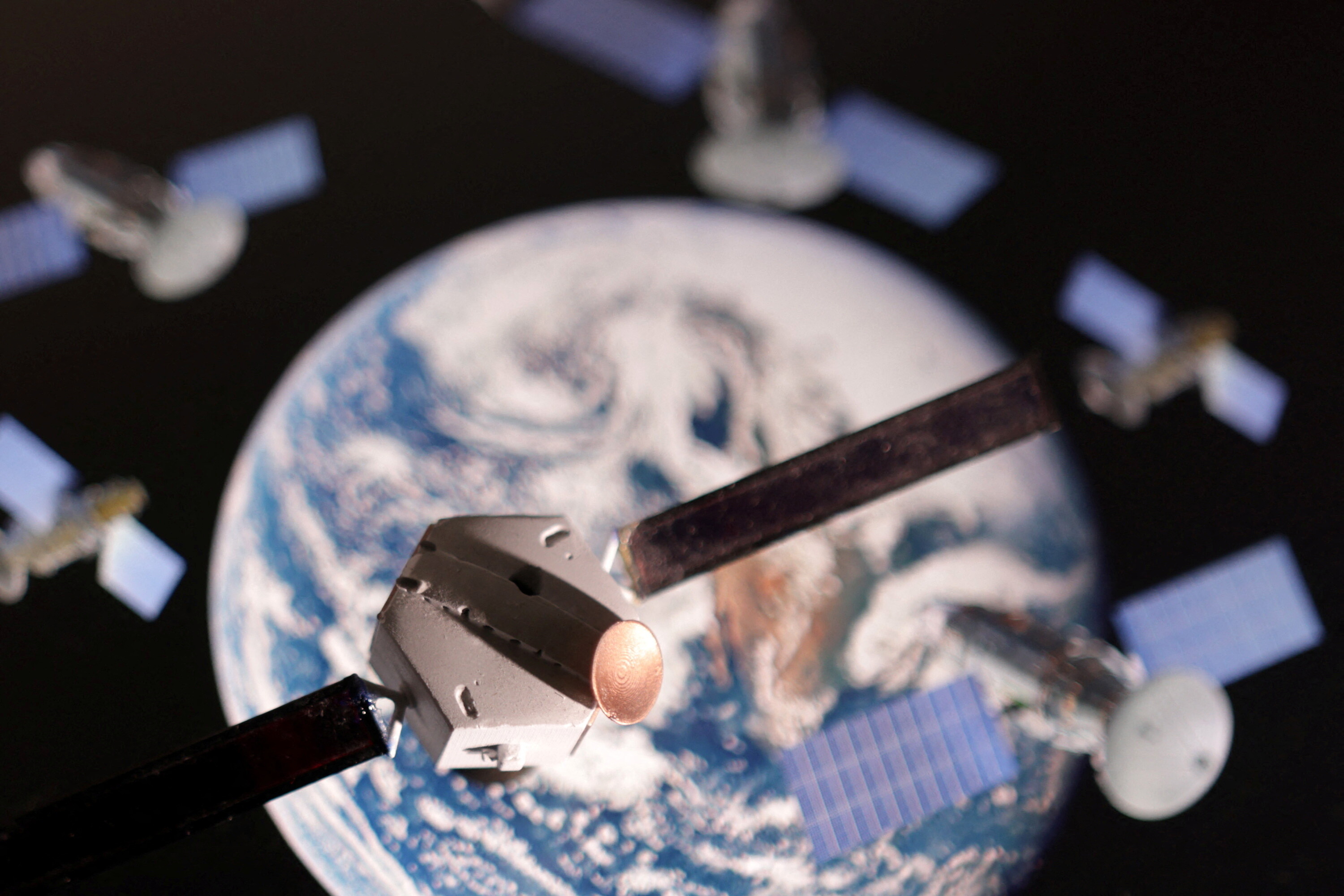
Increased democratization in access makes building cyber resilience in space essential. Image: REUTERS/Dado Ruvic/Illustration
Hoda Al Khzaimi
Associate Vice-Provost for Research Translation and Entrepreneurship, New York University Abu Dhabi- Space has become critical but fragile infrastructure, being susceptible to vulnerabilities such as cyberattacks, which could cascade across economies and societies.
- Commercial growth is expanding the attack surface as democratized access to space also introduces systemic cybersecurity risks and risk of targeted attacks in conflict.
- Stronger global governance and cyber resilience in space are essential as current space treaties and regulations lag behind technological and commercial realities.
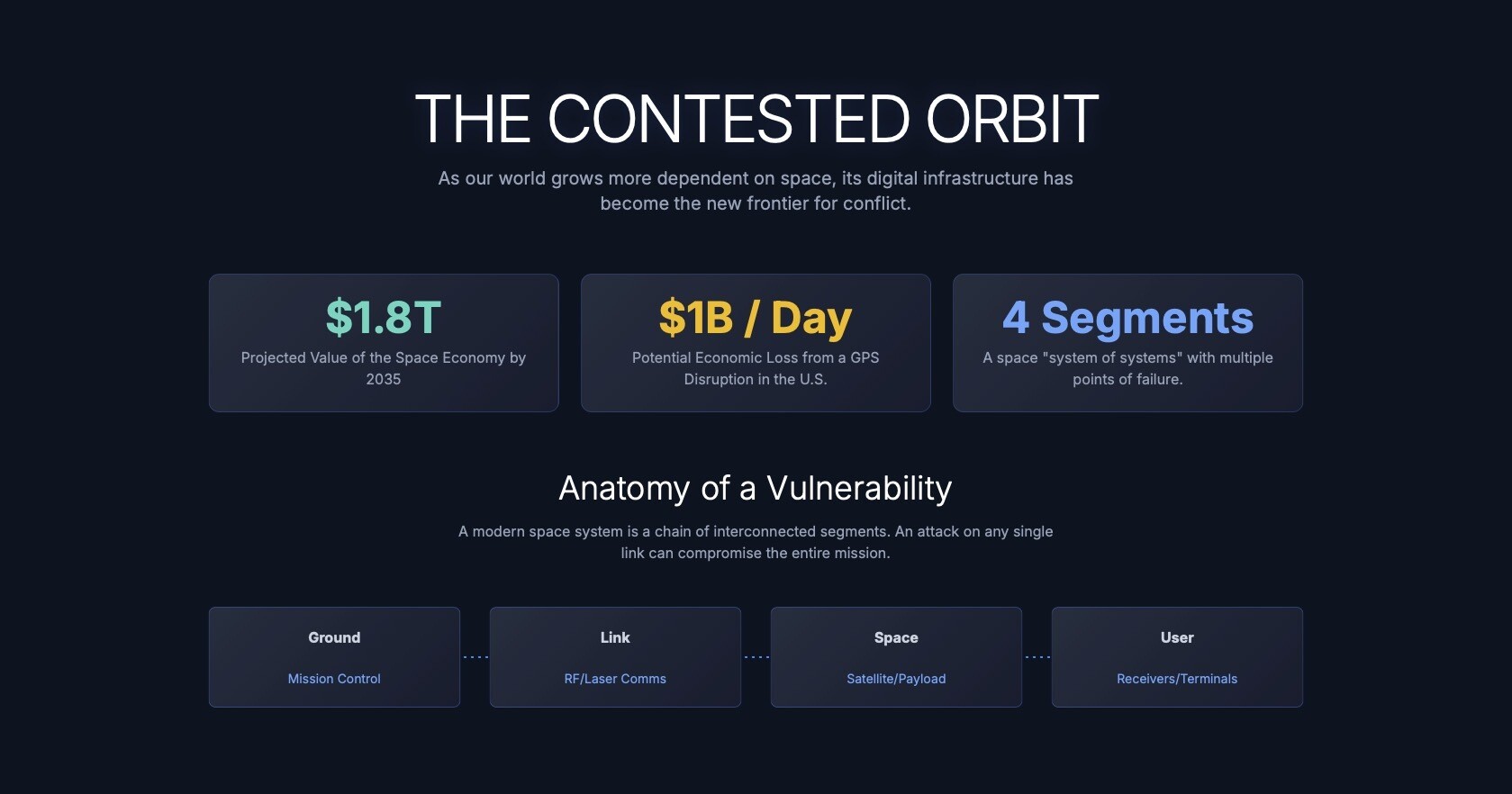
From international finance and climate monitoring to navigation and humanitarian assistance, satellite services from space are now woven into the fabric of modern life. Valued at over $630 billion in 2023, with projections exceeding $1.8 trillion by 2035, space has shifted from frontier to foundational infrastructure.
Yet as space becomes indispensable, it is increasingly contested. Cyber disruptions, jamming attacks and geopolitical manoeuvres highlight a fragility that coexists with rapid innovation.
The expanding footprint of new space systems and businesses, with hundreds of new start-ups and 10s of billions in investment in recent years, has created unprecedented opportunity and also multiplied vulnerability. These pressures are converging and securing our global space infrastructure has become imperative for innovation and stability.
Why our space infrastructure is at risk
Space systems operate as a “system of systems”: satellites in orbit, ground control stations, communication links and user devices. Each represents a potential point of failure and a breach in one can ripple across others.
The ground segment, often built on conventional IT systems, is especially vulnerable. In 2022, the KA-SAT cyberattack disrupted over 40,000 terminals across Europe, impairing military and emergency communications.
In July 2025, a Starlink software failure caused a global outage affecting millions of users. Both events demonstrate how software vulnerabilities can cascade into space and terrestrial disruptions.
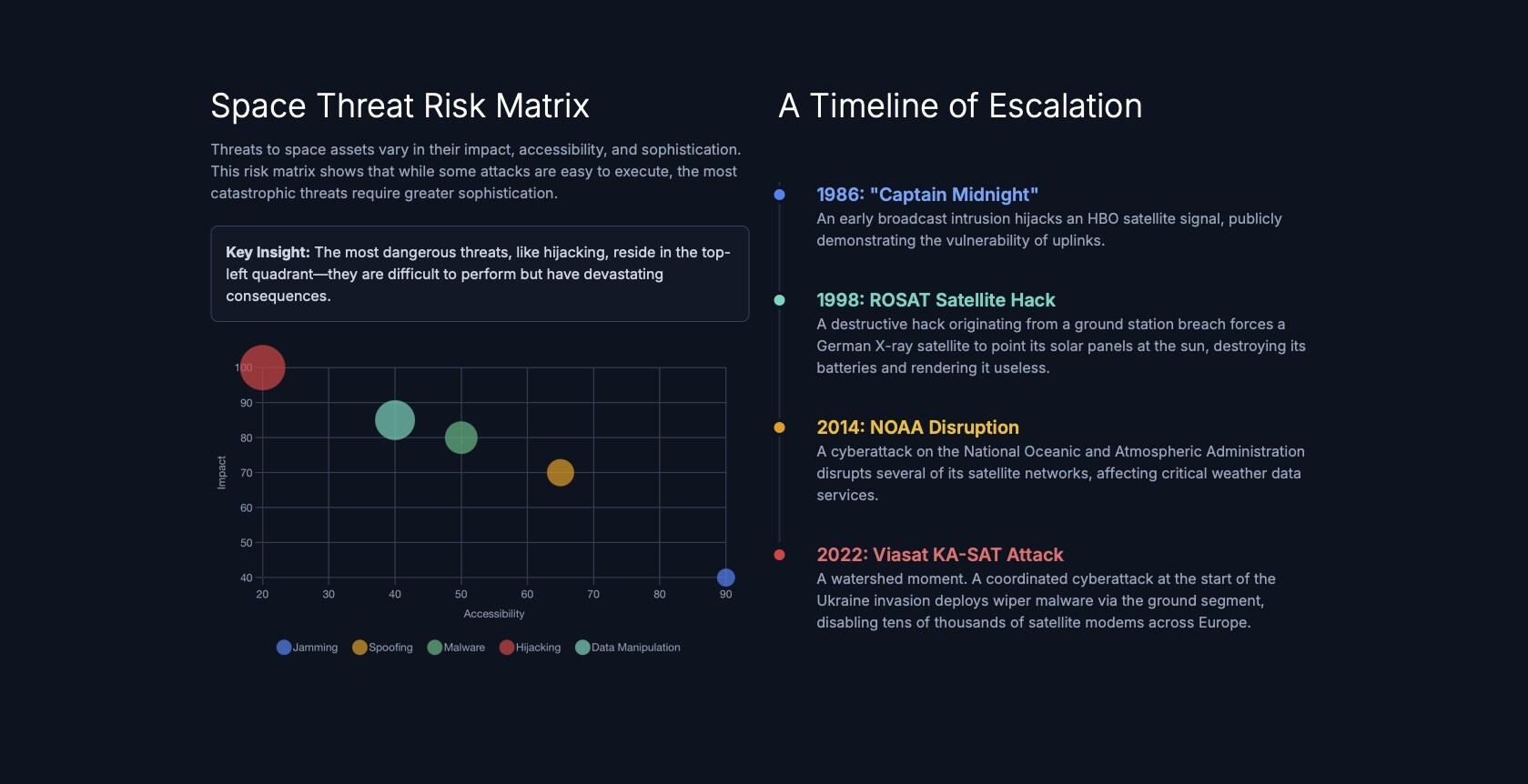
The link segment is also exposed. Global positioning system (GPS) jamming and spoofing have disrupted aviation across Europe, affecting thousands of flights and highlighting the fragility of navigation services.
Commercial satellite operators daily fight off attacks; despite the use of varying levels of encryption and other secure design approaches, management of supply chains and application of standards, satellites and space platforms are often inadequately protected as threats evolve.
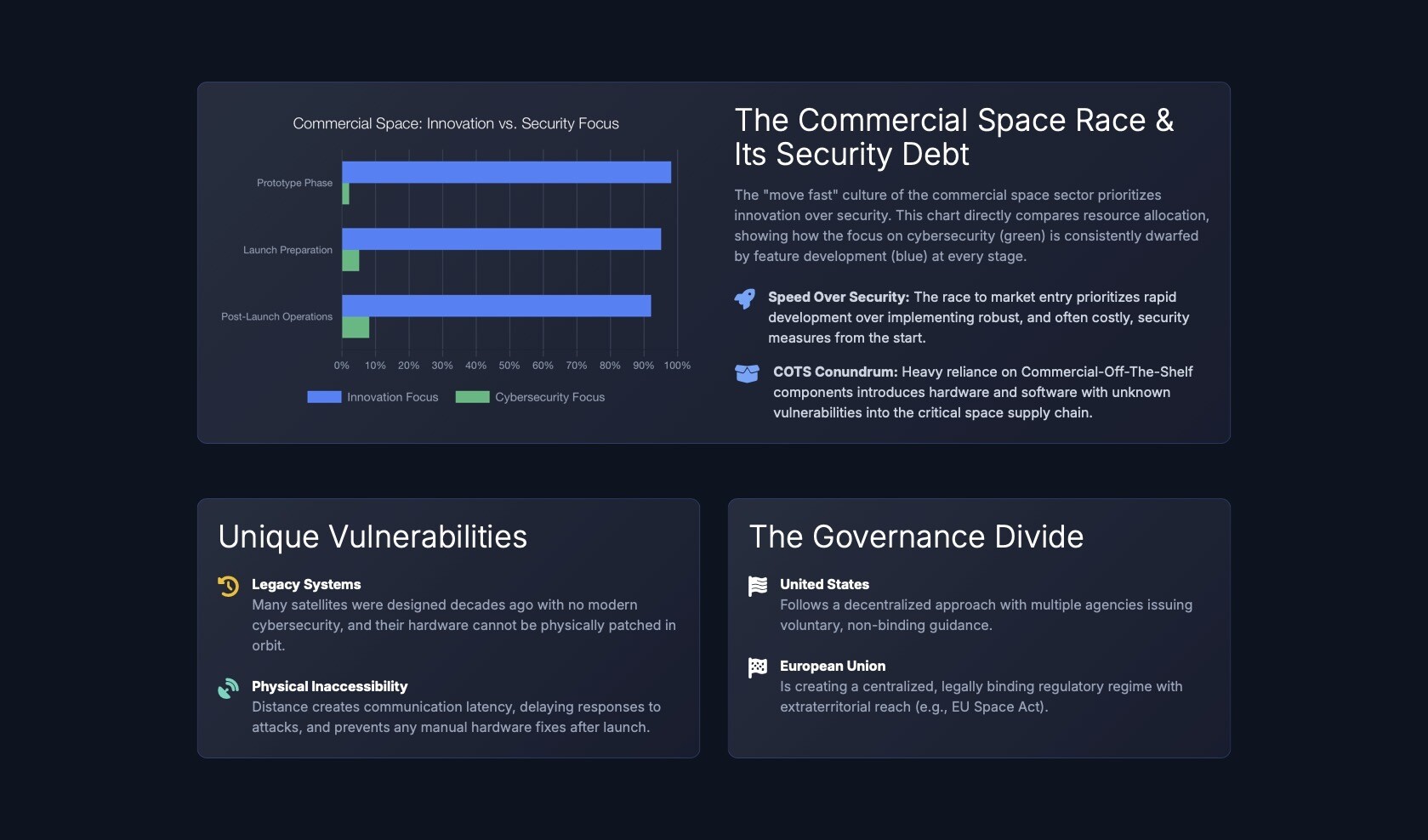
In addition, legacy satellites, often designed decades ago without cybersecurity considerations, can remain active for 15 years or longer. More than 1,700 satellites launched before 2000 are still operational, many of them critical and costly to replace but impossible to patch or retrofit. Their very longevity now makes them fragile assets.
The new gold rush and security deficit
Access to space is increasingly democratizing. From start-ups to governments, space actors are launching mega-constellations at record speed. By 2024, more than 11,500 active satellites orbited Earth, with 80% operated by commercial entities. These constellations fuel economic opportunity but also create a vastly expanded cyberattack surface.
Cost pressures exacerbate vulnerabilities: commercial providers often rely on off-the-shelf components and open-source code, efficient but not necessarily designed for a highly contested cyber environment.
The blurred boundary between commercial and military space raises further risks. Commercial satellites have been used to support military operations for decades.
Today, constellations such as Starlink have been leveraged in conflict zones, potentially becoming military targets. Governments increasingly depend on these systems, which may not meet desired software and operating standards, as cyber-attacks on space systems become more common.
Emerging technologies add both promise and complexity. Quantum communication satellites (e.g. China’s Quantum Experiments at Space Scale mission), space-based solar power demonstrators in Europe and Japan, and artificial intelligence (AI) driven satellite constellations for Earth observation represent potentially transformative advances but each adds new dependencies and potential vulnerabilities.
Space is no longer peripheral to our economy or security. It is embedded in everything we do.
—Carissa Christensen, CEO, BryceTech
”Governance and regulatory gaps
The pace of commercialization has outstripped cyber governance in space, as it has terrestrially. The Outer Space Treaty (1967) provides broad principles of peaceful use but is silent on cybersecurity or digital resilience.
Multiple United Nations bodies and other organizations have sought to develop space cyber frameworks and standards but today, no international framework fully covers the cyber integrity of space systems.
International agreement is particularly important regarding command and control of space systems, to prevent interference with operations and risks such as collisions, which can cause debris fragments that can harm many other satellites, with long periods of risk.
Instead, regulations remain fragmented across jurisdictions, producing uneven standards and exposing shared assets to systemic risk. These gaps are particularly concerning in light of the importance of sustainability and operational safety in space, which the Global Future Council on Space Technologies has highlighted.
Cybersecurity is not peripheral to these goals; it is foundational. Without cohesive global standards, space infrastructure risks becoming a “patchwork domain” where safety, sustainability and digital resilience are undermined simultaneously.
Building resilience through collaboration
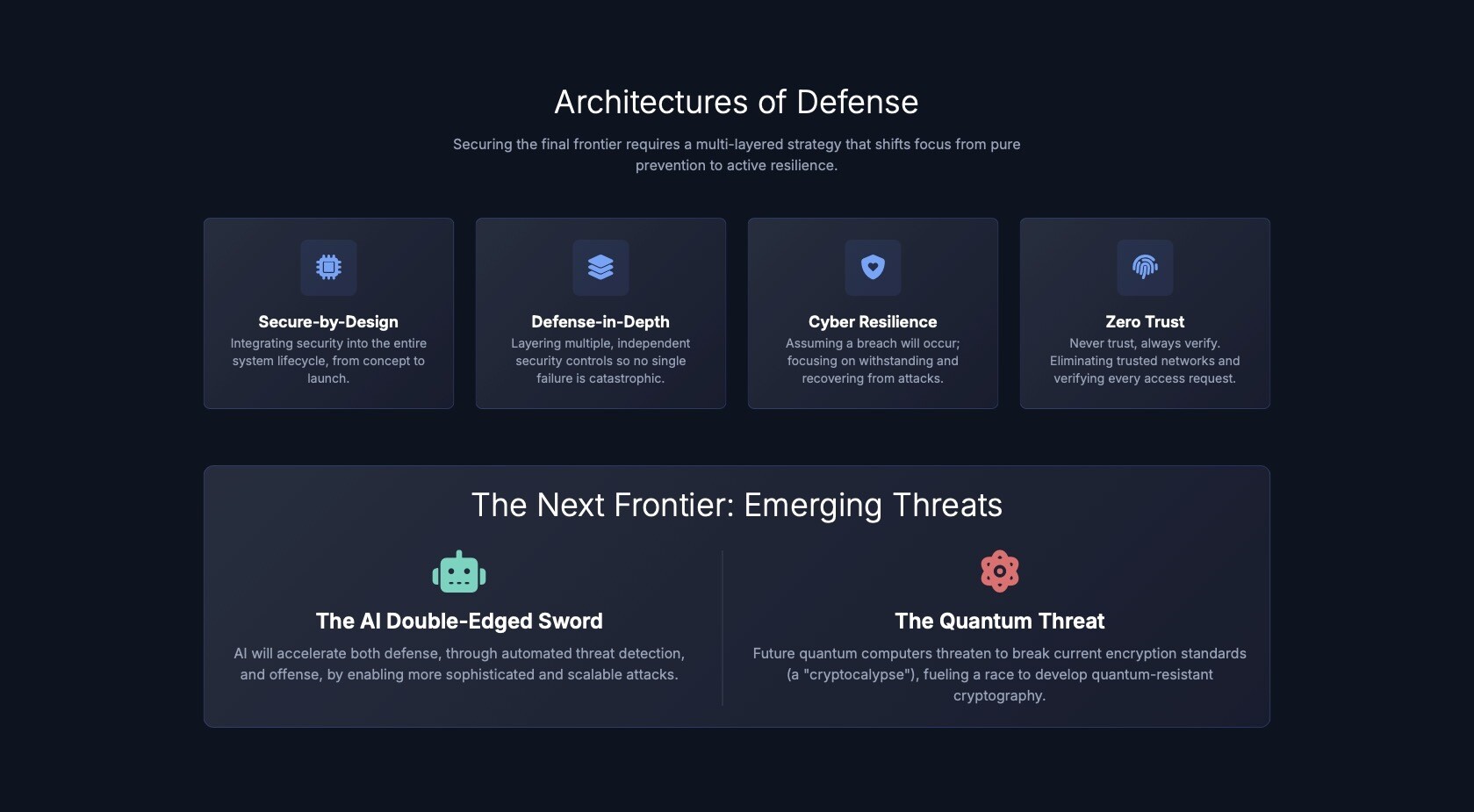
Securing orbital systems requires an integrated approach that combines technology, governance and international coordination. This requires a systematic consideration of critical pillars, such as security by design, where cyber resilience must be built into satellites and other space assets from the first line of code to deployment.
Additionally, systems should include zero-trust architecture where every user, device and connection is continuously verified. Supply chain security is vital, where compromised hardware or firmware during manufacturing can endanger billion-dollar constellations.
Finally, placing digital resilience over prevention dictates that we assume breaches will occur; hence, systems must be designed to withstand, adapt and recover. Governments hold leverage through procurement and regulation, while industry agility remains vital.
National government actors will remain chiefly responsible for enforcement and will benefit from international benchmarks they can draw on and incorporate into regulation and policy.
Models such as the Space Information Sharing and Analysis Center provide platforms for industry and government to collaborate on real-time threat intelligence sharing. On the global stage, adapting norms from cyber diplomacy, such as those developed in the UN Group of Government Experts and Open-Ended Working Group, can foster common standards for responsible behaviour.
Securing cyber resilience in space
Space has become a contested environment. It is a domain where failure would reverberate across economies, societies and security systems worldwide. Its protection cannot be treated as optional or secondary.
As Carissa Christensen, CEO of BryceTech and member of the World Economic Forum’s Global Future Council on Space Technologies, emphasizes:
“Space is no longer peripheral to our economy or security. It is embedded in everything we do. With enhanced cybersecurity, transparency and trust in space systems, space can remain a driver of prosperity and stability.”
The vulnerabilities are clear, and so is an important path forward: embed security at the DNA level of designing the space paradigm, enforce accountability across supply chains and build governance architectures that treat space assets as critical infrastructure.
These measures are not luxuries. They are prerequisites for stability.
Governments, industry and the global community must act now to ensure that space remains a trusted enabler for cooperation, innovation and resilience. The alternatives are fragmentation and systemic fragility that would compromise not just the orbits above us but the world below.
Don't miss any update on this topic
Create a free account and access your personalized content collection with our latest publications and analyses.
License and Republishing
World Economic Forum articles may be republished in accordance with the Creative Commons Attribution-NonCommercial-NoDerivatives 4.0 International Public License, and in accordance with our Terms of Use.
The views expressed in this article are those of the author alone and not the World Economic Forum.
Stay up to date:
Cybersecurity
Related topics:


Forum Stories newsletter
Bringing you weekly curated insights and analysis on the global issues that matter.
More on CybersecuritySee all
Spencer Feingold
March 25, 2026


