AI for sustainable development: how Bahrain is driving public-sector transformation through tech

A cutting-edge, ethical digital economy … Bahrain. Image: Unsplash/Andrej Bocek
Noor Ali Alkhulaif
Minister of Sustainable Development of Bahrain, Chief Executive, Bahrain Economic Development Board- AI can unlock up to $370 billion in sustainable investment across the MENA region by 2030.
- Governments must play a pivotal leadership role in ambition-setting, deployment and measurement to best use the technology to drive the digital economy.
- Bahrain's SME SMART is an AI-powered sustainability maturity tool that helps SMEs unlock new value.
Artificial intelligence (AI) is a transformational force with tremendous economic and societal value. By some estimates, generative AI could lift global GDP by 7% over the next decade, largely driven by its ability to analyse vast amounts of data, identify complex patterns and generate insights at unprecedented speed.
The public sector stands to gain significantly from AI’s transformative potential across nearly every dimension of its operations, including in advancing sustainable development. The technology will facilitate designing and testing evidence-based policies, strengthen institutional capacity, improve access to investments, catalyse partnerships and track impact in real time.
When effectively developed and utilized, AI can greatly accelerate the delivery of national development priorities, such as net zero or the Sustainable Development Goals.
To validate AI’s potential in the public sector, Bahrain’s Ministry of Sustainable Development (MOS) partnered with Bain & Company and the World Economic Forum under the Leaders for a Sustainable Middle East and North Africa platform. As a first step, a workshop was held, bringing together more than 30 representatives from across 16 government entities in Bahrain to explore AI applications for sustainability in the public sector. The workshop served as a key building block towards validating the development of an AI prototype to accelerate sustainability efforts across industries in Bahrain. The collaboration identified four high-impact use cases for AI, ranging from national sustainability target-setting and tracking to policy intelligence and impact estimation.
Reflecting this strategic vision for AI in public sector development, Bahrain's commitment to building a cutting-edge, ethical digital economy is clearly demonstrated by several national initiatives. The kingdom has established a National Policy for the Use of Artificial Intelligence, launched in July 2025, and adopted the GCC’s Guiding Manual on the Ethics of Artificial Intelligence Use, creating a robust framework that mandates responsible, secure and human-centric AI deployment across all sectors.
In April 2025, the Labour Fund (Tamkeen) announced a massive upskilling effort by launching a package to train 50,000 Bahrainis in AI by 2030. This ambitious programme underscores the country’s proactive investment in its human capital, ensuring that the local workforce possesses the essential skills to drive innovation and maintain Bahrain's competitiveness in the global technology landscape.
Given the role of small and medium-sized enterprises (SMEs) in driving national economic growth, one specific use case was prioritized for prototyping as part of the partnership: SME SMART (Sustainability Maturity Assessment and Readiness Tool). This is a testament to the critical role SMEs play in Bahrain’s economy, society and sustainable development.
SMEs make up over 93% of the kingdom’s company registrations, employ 75% of the private sector workforce and contribute a third of GDP. Bahraini SMEs aspire to operate more sustainably, and crave practical guidance and resources to do so effectively.
SME SMART is presented to SMEs as a streamlined questionnaire. On the back end, an AI-powered tool evaluates their sustainability performance against Bain’s Link, Engage, Activate and Drive (LEAD) framework, which provides organizations with a structured approach to embed sustainability into their core strategy and operations. The tool helps SMEs gauge their current state through a maturity score and generates a customized sustainability readiness report with practical recommendations to help them prioritize initiatives in their sustainability journey.
This tool is applicable across sectors and easy to deploy. By acting on its recommendations, Bahrain’s SMEs could see a cumulative valuation lift of up to $17 million by 2030 (proprietary calculation on the basis of the number of SMEs in Bahrain, adoption rate assumptions, etc.). The ROI analysis showed that for every $1 invested in the tool, $3 would be mobilized in turn.
With this substantial boost, SMEs could expand their operations and gain access to new sources of financing. For Bahrain, this could open new opportunities for financial institutions and foreign investors, support economic diversification, and enhance overall economy and competitiveness. Tools such as SME SMART take the potential of AI in the public sector beyond operational efficiencies to value-creation niches where governments can play a key strategic role.
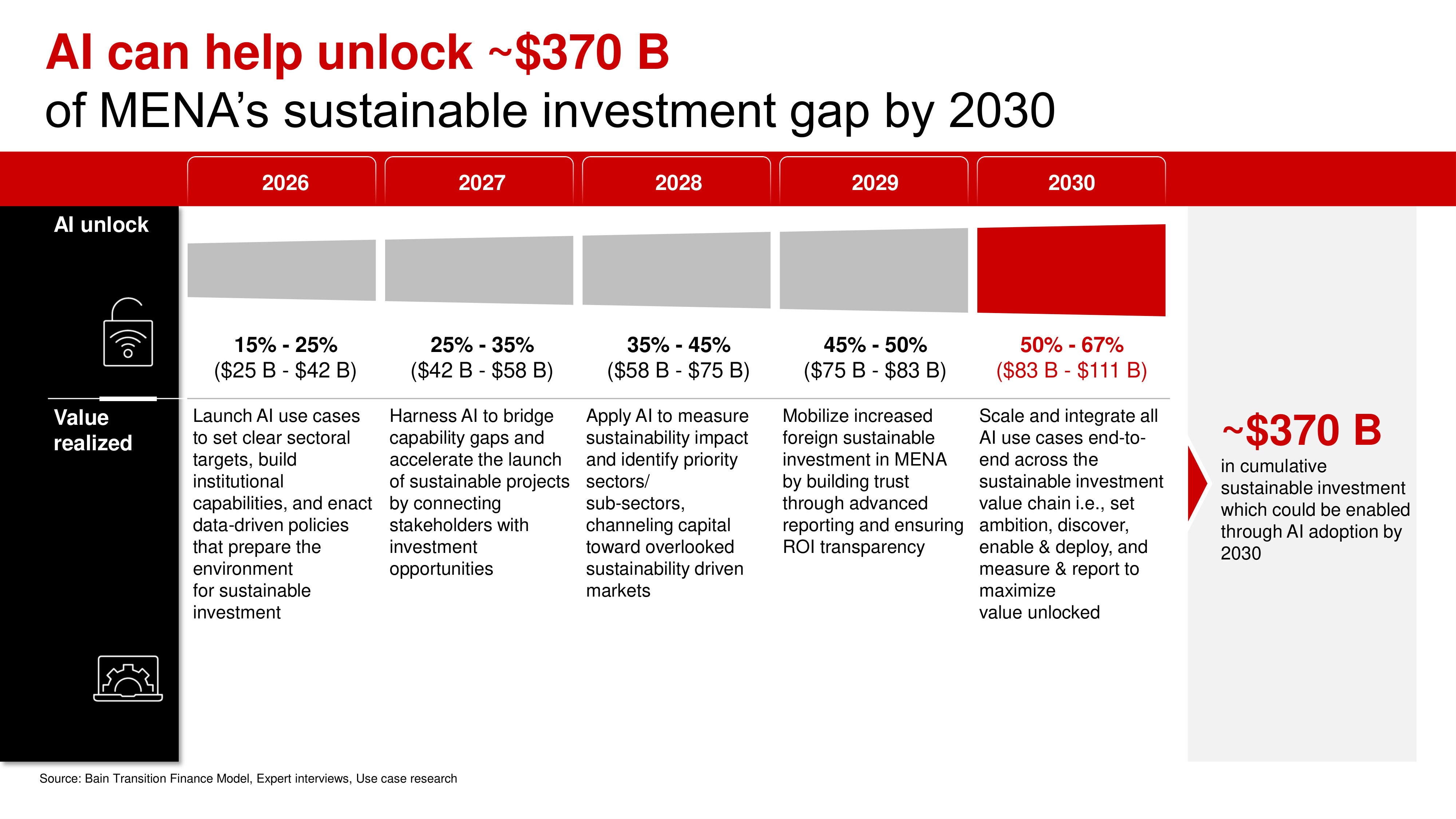
On a regional level for the Middle East and Africa (MENA), such AI-powered tools could play an important role in the broader sustainable investment value chain, with the potential to mobilize approximately $370 billion by 2030, representing around 45% of the region’s net-zero financing gap. This would help close MENA’s current gap of $830 billion in additional cumulative investments to finance its net-zero path by 2030 (an estimate derived through Bain’s transition finance model, across all investment instruments, including share of financing by banks).
AI-enabled tools have the potential to create value across every step of the sustainable investment value chain:
- Step 1: Ambition-setting (medium AI impact). AI can surface data-driven national and sectoral targets, quantify investment needs, and launch impactful policies.
- Step 2: Discovery (medium AI impact). Organizations can use AI to understand current R&D technology gaps, predict investment feasibility and impact, and identify potential public-private-partnership structures.
- Step 3: Enablement and deployment (high AI impact). AI agents can streamline procurement and circumvent bottlenecks, forecast supply chain risks, map workforce upskilling needs, enable investor-investee matching and suggest incentives to motivate lagging sectors.
- Step 4: Measurement and reporting (high AI impact). Automation tools can track progress (e.g. emission reduction), generate audit-ready disclosures, and facilitate dialogue between local and foreign stakeholders.
Positive sustainability impact is within reach, but it won’t be realized with technology alone. Public sector leadership is equally important. To fully harness AI’s transformative potential and accelerate sustainable progress, regional governments must articulate a bold vision, convene diverse partners and cultivate an environment that enables responsible innovation.
When effectively deployed, AI can strengthen institutional capabilities, align national priorities through data-driven insights, instil investor confidence via transparent governance and streamline access to finance.Realizing this vision requires strategic intent. By treating AI as a vital component of public infrastructure, governments can transform it into a resilient engine for inclusive and enduring prosperity.
Don't miss any update on this topic
Create a free account and access your personalized content collection with our latest publications and analyses.
License and Republishing
World Economic Forum articles may be republished in accordance with the Creative Commons Attribution-NonCommercial-NoDerivatives 4.0 International Public License, and in accordance with our Terms of Use.
The views expressed in this article are those of the author alone and not the World Economic Forum.
Stay up to date:
Artificial Intelligence
Related topics:


Forum Stories newsletter
Bringing you weekly curated insights and analysis on the global issues that matter.
More on Artificial IntelligenceSee all

Jovan Jovanovic
March 11, 2026


