How business leaders can adapt and thrive when uncertainty is a certainty
Uncertainty is a defining feature of today’s business landscape. Image: Unsplash/Anne Nygård
- In an economic landscape defined by uncertainty, resilience is now an imperative for business success.
- Organizations that build and embed resilience will be better positioned to grow, innovate and create value.
- Leaders at the World Economic Forum’s 56th Annual Meeting, which takes place from 19 to 23 January 2026 in Davos, will be tackling these and other issues to move the world forward together.
In today’s global environment, uncertainty is no longer a periodic headwind, but a defining feature of the business landscape. The question is no longer how to withstand disruption and respond by building resilience, but rather how to build systems that adapt and thrive because of it. Resilience is now an imperative for business success, not a defensive shield to help weather a one-off storm.
In recent years alone, business leaders have navigated financial crises, the accelerating impact of climate change, a global pandemic, geopolitical instability, supply chain shocks and rapid technological advancements. As an investor in, and owner of, a wide range of businesses across global markets reflecting over $250 billion in net assets, we have seen this firsthand, and have meaningfully deepened efforts to anticipate, mitigate and find opportunities amid incessant change.
One thing has remained constant: organizations that build and embed resilience are better positioned to grow, innovate and create value, even when the world becomes harder to understand and operate in.
Everything, everywhere, all at once
The global operating environment is being redefined by multiple forces at once. Capital is becoming more discerning as investors reassess risk through a long-term lens rather than short-term reaction. The global trading system is fragmenting. Supply chains are being rearranged. Technology cycles are compressing.
The landscape has become more dominated by geopolitics. Growing political polarization and generational shifts are altering long-term policy direction. Country relationships that have historically served as predictable anchors are being tested. This is driving nations around the world to diversify their partners and move to protect their own interests. We can no longer rely on the same familiar markets to provide the stability we seek.
We must be able to operate across multiple political, economic and technological scenarios, not only in the quickly unfolding present, but also in the hard-to-predict future. Leaders must be prepared to make difficult decisions and move beyond the way things have previously been done – it is no longer a reliable predictor of future risk.
From defensive resilience to strategic resilience
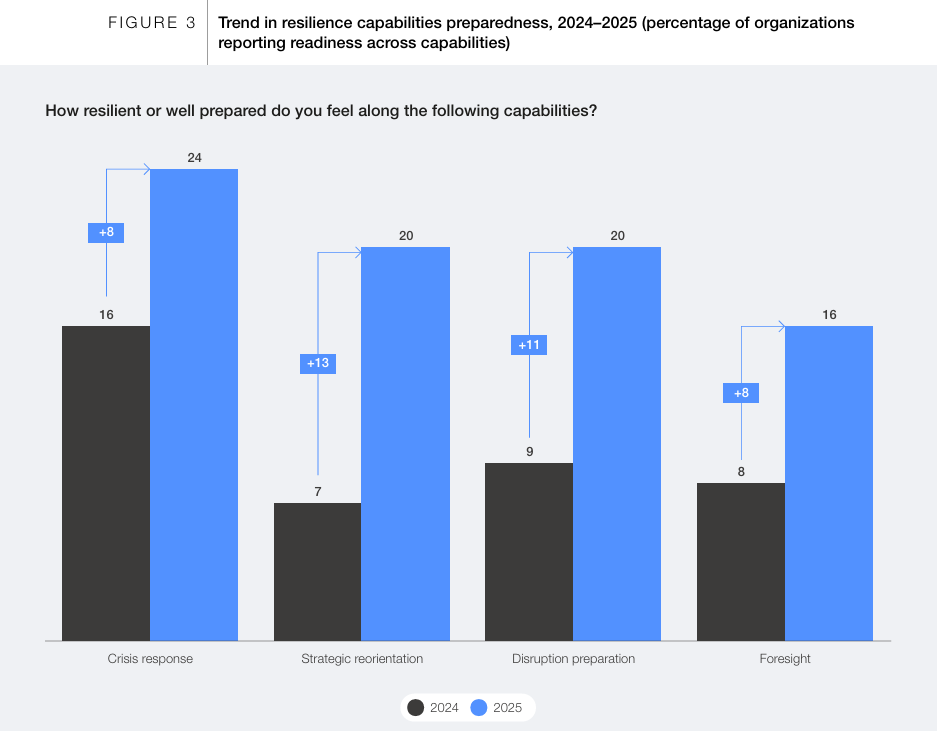
Resilience once was synonymous with defense and largely involved building contingencies to test an organization’s ability to withstand disruption. Today, it must become an active mindset, bringing disciplined probabilistic thinking and the willingness to update beliefs as conditions change. Teams must be empowered to test, adapt and iterate, so ambiguity becomes ripe for opportunity, not paralysis.
Preparing for the future means embedding resilience across the organization and constantly scanning the environment for what is changing.
This includes:
- Conducting scenario analyses that address emerging conditions, not rehashing historical patterns.
- Building systems and data capabilities that generate insights needed to act decisively.
- Proactively engaging with stakeholders to build intelligence and conviction so decisions can be made swiftly when conditions change.
- Stress testing correlations under different assumptions to evaluate potential outcomes in tangible terms rather than purely theoretical probabilities.
Together, these practices can help leaders make informed, disciplined decisions that preserve performance and help turn uncertainty into a source of strategic advantage.
AI: A transformative accelerant of competitiveness
As we look ahead, one force rapidly accelerating is technology. Artificial intelligence is advancing at an unprecedented pace. While largely recognized as transformative, it is still unclear who will win and what gains beyond efficiency will be made. The opportunity lies not in adopting AI solely as a technology enhancement, but by embedding it into strategy – i.e. the core capabilities that drive growth and build resilience, efficiency and innovation. With that comes the need to ensure the necessary technological foundations and proper guardrails are in place.
Organizations that integrate AI strategically into decision making, operations and customer engagement will be positioned to unlock tangible value and sustain a competitive advantage. For investors, we can support companies with the capacity to adopt AI in building the skills and processes to convert technology into value creation, innovation and resilience. Recent data we gathered from the global investment community shows that 86% now view technological change as a tailwind, with 98% embedding AI into their own businesses.
Resilience by design
In a world where uncertainty is the only certainty, resilience must be intentionally designed into organizations, cultures and investment strategies. It will require investment in talent development, in particular to build agility to adapt to change.
Businesses need the right capital structure for this environment and should be fast adopters of, rather than first movers in, technology. Finally, assessing potential areas of weakness in your own organization or supply chain will remain important but, identifying future areas of growth and your right to win, will help uncover opportunities where others may only see risk.
Don't miss any update on this topic
Create a free account and access your personalized content collection with our latest publications and analyses.
License and Republishing
World Economic Forum articles may be republished in accordance with the Creative Commons Attribution-NonCommercial-NoDerivatives 4.0 International Public License, and in accordance with our Terms of Use.
The views expressed in this article are those of the author alone and not the World Economic Forum.
Stay up to date:
The Digital Transformation of Business
Related topics:


Forum Stories newsletter
Bringing you weekly curated insights and analysis on the global issues that matter.
More on BusinessSee all

Francisco Betti, Hernan J.F. Saenz, III and Karen Harris
March 14, 2026


