The new economy will not be 'back to normal'. Here is why

Geoeconomics and technology trends are poised to shape business strategies in the next five years. Image: Unsplash
- Geoeconomics and technology trends are poised to shape business strategies in the next five years, according to chief strategy officers.
- The new World Economic Forum report Four Futures for the New Economy: Geoeconomics and Technology in 2030 explores plausible scenarios for the global economy at the intersection of these trends, and their strategic implications for businesses.
- This is the first output of the Forum’s Scenarios for the Global Economy Dialogue Series, which provides leaders with a space for dialogue on key economic developments, interconnected risks and their implications for strategy and investment decisions.
For decades, businesses benefited from a relatively benign global economic landscape. Today, the assumptions that guided corporate strategies in the past are being challenged.
The convergence of transformative forces – like geoeconomic fragmentation, fast-changing technologies, growing debt, demographic shifts, and the green transition – are reshaping the global economy and business environment, creating both new opportunities and risks.
The combined effect is a new economy shaped by volatility and difficult trade-offs.
Navigating this evolving landscape requires businesses to anticipate, adapt quickly and make decisions amid uncertainty.
Looking at the key trends that might shape business strategies over the next five years, the results of the Forum’s latest survey of chief strategy officers highlighted commercialization of AI and emerging technologies (72%) and geoeconomic fragmentation (52%) as among the most impactful trends.
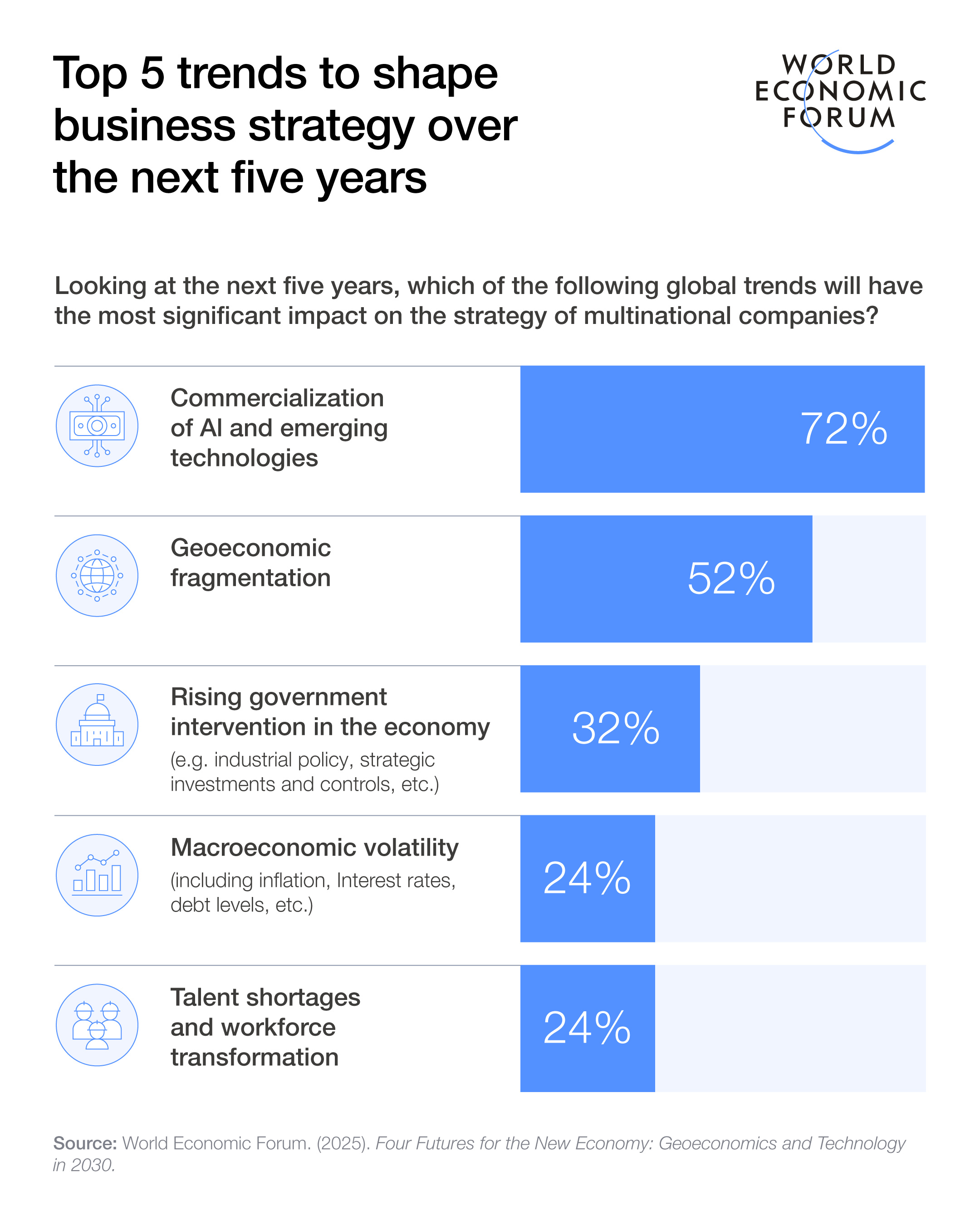
Understanding how these trends may shape the new economy and business strategies is the focus of the report Four Futures for the New Economy: Geoeconomics and Technology in 2030, the first edition in the World Economic Forum‘s new Scenarios for the Global Economy Dialogue Series – which uses scenario analysis and cross-sectoral dialogue to help decision-makers navigate global trends and understand their implications for strategic and investment decisions.
Four futures for the new economy in 2030
The report zeroes in on four plausible scenarios for the new economy at the intersection of two critical forces – geoeconomics and technology.
Each of these scenarios has the potential to reshape sectors and individual businesses, with different implications for corporate strategies, business models and investment decisions. The purpose of these scenarios is not to predict where the world will be in 2030, but to provide a framework for analysing risks, opportunities and strategies across alternative futures.
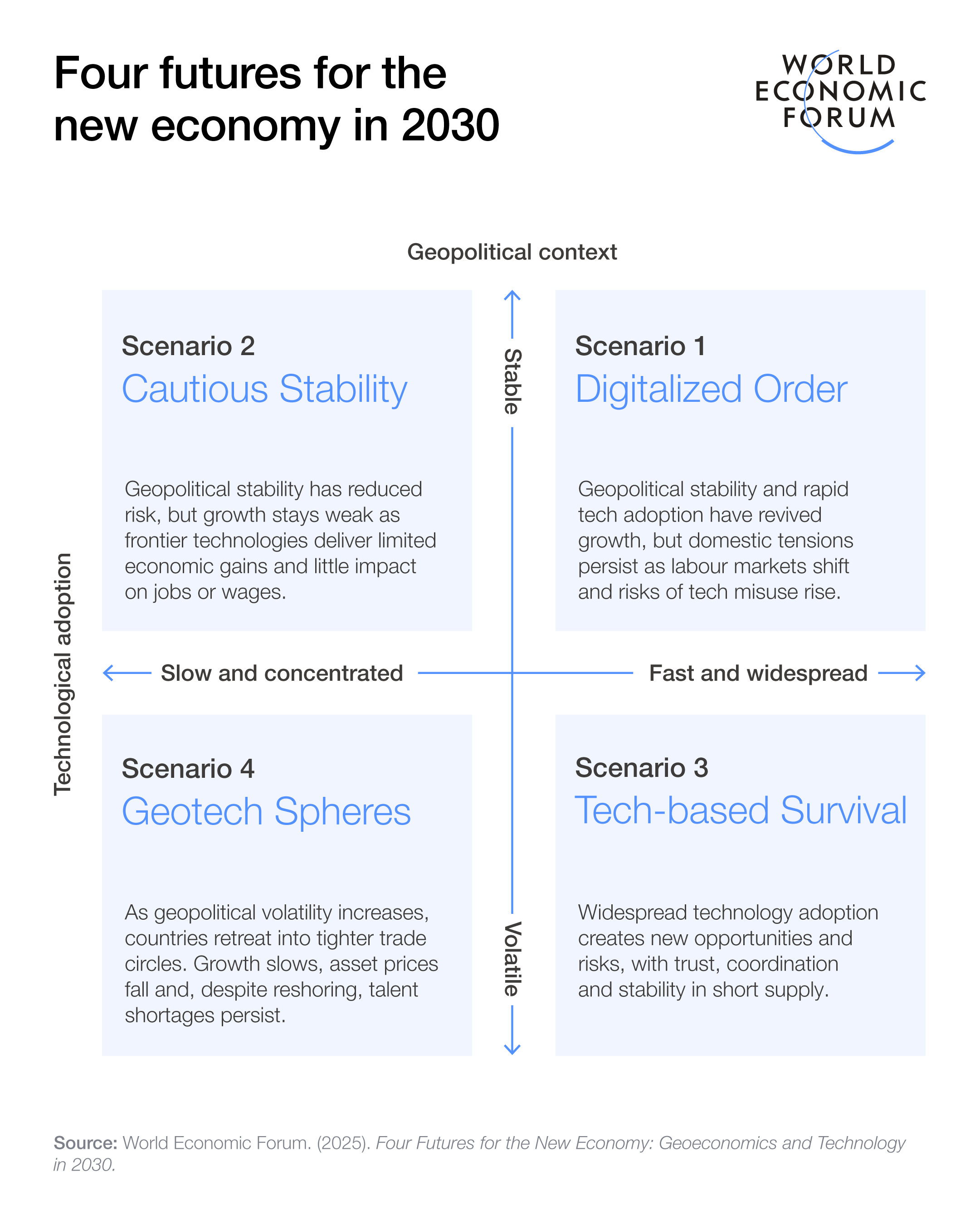
The first scenario is Digitalized Order, where geopolitical stabilization and rapid technological adoption accelerate growth across sectors and geographies. On the upside, lower adoption costs, digital interoperability, talent and infrastructure investments may help modernize digital ecosystems and accelerate technology diffusion beyond frontier firms and economies. However, strategic competition and concerns over inequality and algorithmic governance deepen. While some of the trade and investment flows recover, domestic tensions persist in many countries as labour market disruptions and risks of technology misuse increase.
The next scenario is Cautious Stability, where geopolitical normalization lowers risk premiums and reduces price shocks. While the stabilization of global trade and energy markets creates a more predictable business environment, growth remains stagnant in this scenario. Furthermore, technological advances are confined to a few sectors and industry leaders, falling short of delivering expected economic benefits and further deepening digital divide.
Have you read?
Why don’t we see bad things coming? Real foresight isn’t as simple as that
The future of global competitiveness: 4 decision-makers reveal their strategies for surviving uncertainty
Gauging the global economic future: can productivity revive by 2030?
Four Futures for the New Economy: Geoeconomics and Technology in 2030
In a third scenario, Tech-based Survival, widespread technology adoption and heightened geopolitical volatility create a high-risk world. Opportunities arise from accelerated technology adoption within countries and alliances. However, deepening geoeconomic fragmentation and diverging regulatory systems increase operational complexity and compliance costs. Persistent trade wars and resource competition stifle broader growth spillovers. Cyber risks and attacks on critical infrastructure are on the rise. Businesses use digitalization to offset the impact of geopolitical disruption, creating new opportunities as well as risks.
In the last scenario, Geotech Spheres, there is a sharp rise in geopolitical volatility and a slowdown in technology adoption. Isolationism and protectionist measures constrain trade flows even between allied countries. Tech hype fades, leading to disappointment over its promised transformational impact. Asset prices slump and growth rates stall or plummet. Domestic labour markets become less polarized, as businesses look to reshore jobs and create local technology champions but face significant talent shortages. Opportunities are largely confined to strategic sectors, which benefit from government support.
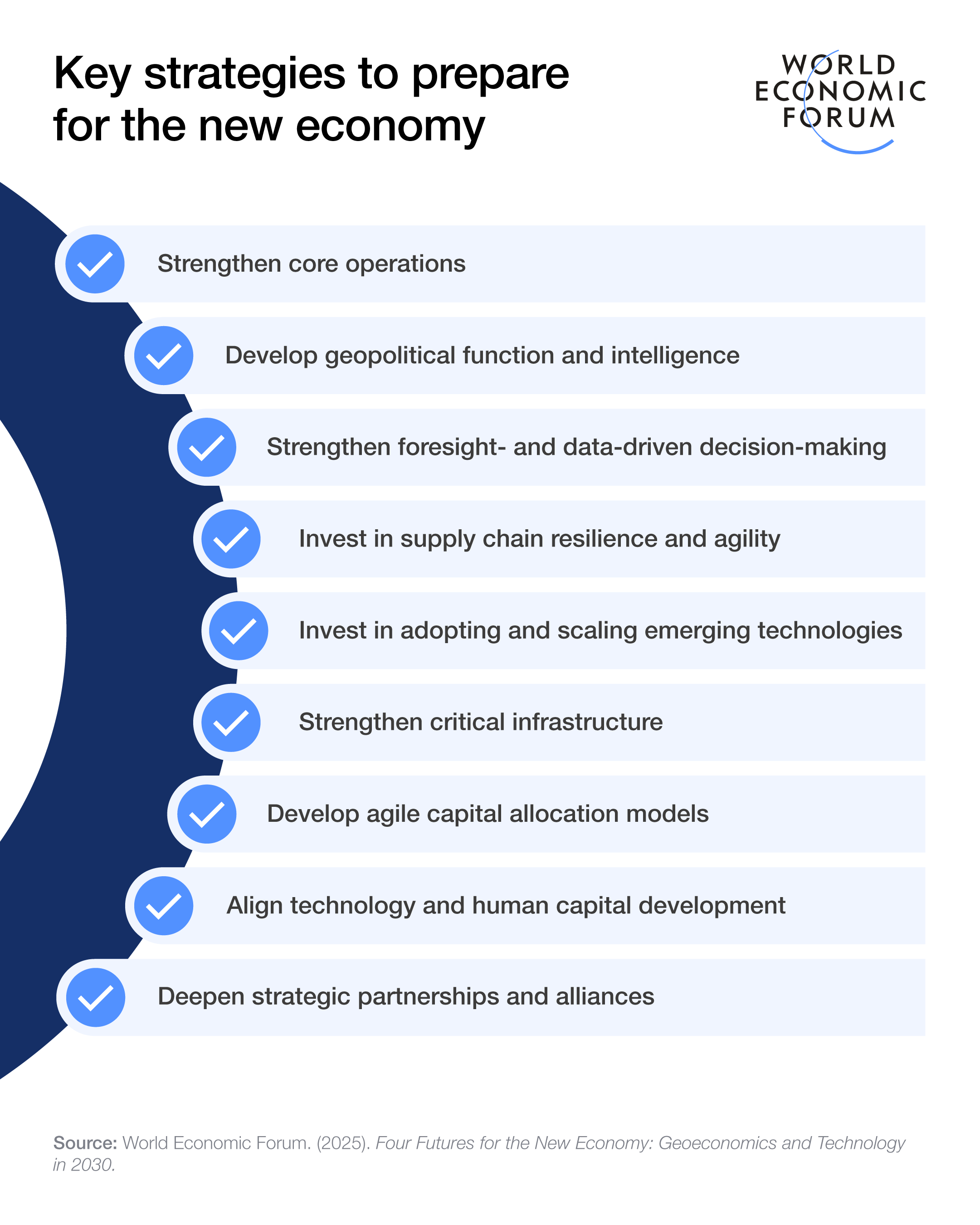
'No-regret' strategies to prepare for the new economy
These scenarios are not projections. They present stylized storylines for a complex and evolving outlook. Informed, agile and creative strategies can help businesses not only adapt to these futures, but also shape them.
Building on a series of dialogues with chief strategy officers and senior experts, the new report identifies a set of “no-regret” strategies that could help businesses mitigate risks and leverage geopolitical and technology trends – regardless of which future emerges.
Developing geopolitical intelligence and strengthening the foresight function will better position businesses to decipher early signals and adjust to shifting geopolitical faultlines. Strengthening core operations, building resilient infrastructure, agile capital allocation and integrated technology-talent strategies may help businesses create operational and financial bandwidth to navigate emerging risks and seize new opportunities.
Deepening strategic partnerships and alliances – across industries and with the public sector – can also help spread risk, scale innovation and address shared challenges.
Real advantages will result from preparing for multiple futures – and being ready to act.
Don't miss any update on this topic
Create a free account and access your personalized content collection with our latest publications and analyses.
License and Republishing
World Economic Forum articles may be republished in accordance with the Creative Commons Attribution-NonCommercial-NoDerivatives 4.0 International Public License, and in accordance with our Terms of Use.
The views expressed in this article are those of the author alone and not the World Economic Forum.

Forum Stories newsletter
Bringing you weekly curated insights and analysis on the global issues that matter.
More on Economic GrowthSee all

Mihir Shukla
March 16, 2026


