Why AI without humanity is incomplete
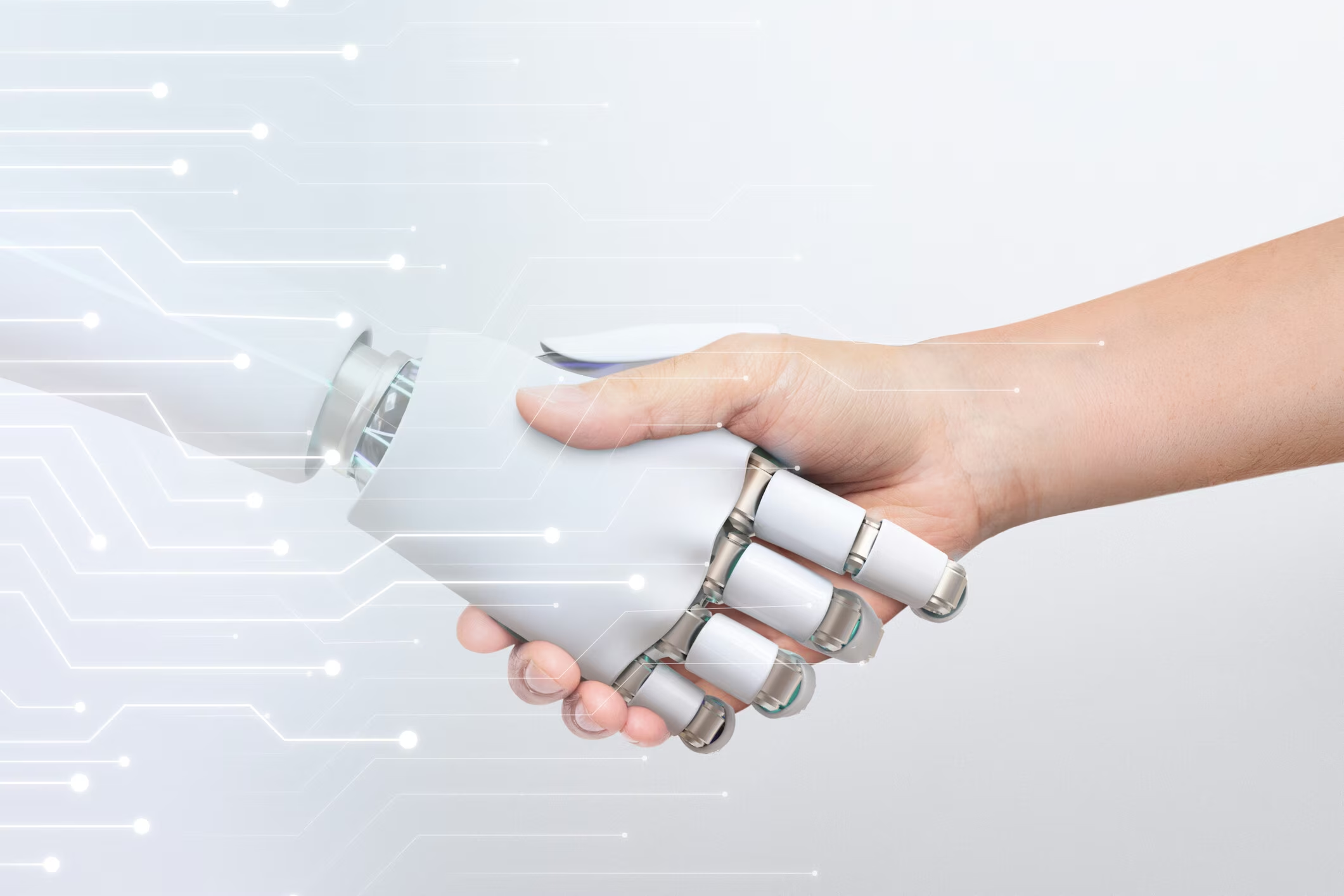
The real opportunity lies in combining human and AI across creative and analytical domains. Image: Getty Images
- Leaders are gathering at the World Economic Forum Annual Meeting 2026 to explore how the ethical use of AI and other emerging technologies will translate into solutions for real-world challenges.
- The future will not be human versus AI, despite this still-dominant narrative.
- The real opportunity lies in combining human and AI across creative and analytical domains, applying the right competencies in the right context.
Artificial intelligence (AI) has moved far beyond experimentation. It is already reshaping how industries operate, how economies evolve and how people experience work. Recent McKinsey research shows that almost all organizations now use AI in some form – yet most are still at the beginning of scaling it responsibly and effectively. At the same time, there is no question that technological change continues to happen at a remarkable pace, and it demands careful guidance through constant organizational transformation, strong leadership, and the key ability to learn and unlearn.
I am convinced that the future will not be human versus AI, despite this still-dominant narrative. It will be determined by how effectively human insight, judgement and expertise shape AI’s integration into work and society. The real opportunity lies in combining human and AI across creative and analytical domains, applying the right competencies in the right context.
Built on trust and ethical intent, AI can amplify human potential, while inevitably transforming certain roles and tasks. The Intelligent Age is not about technological dominance, but about purposeful progress through human-AI collaboration.
The rise of human-AI power couples
Imagine working with a new colleague who has not been trained in a classroom but by algorithms processing vast datasets. Simply put, this AI teammate delivers speed, scale and precision – while you bring judgement, context and creativity. Together, you achieve outcomes neither could deliver alone.
This is already happening across industries. The real differentiator is how well humans and intelligent systems complement each other’s strengths – mainly combining AI’s capacity for data-driven execution with human adaptability and vision. These human–AI power couples are becoming a new source of competitive advantage, able to solve problems faster, spot opportunities earlier and innovate more boldly.
Yet this potential only materializes when people trust the AI tools they use – trust built not just on transparency, but on daily experience of systems that help them succeed.
Designing the new architecture of work
To set these human-AI power couples up for success, organizations must rethink the very architecture of work. Trust and collaboration are not enough if the underlying structures remain rigid. Traditional roles and hierarchies cannot keep pace with continuous technological change. Work will become increasingly fluid, shaped by skills, collaboration and shared intelligence. Our time demands adaptive organizations that continuously learn and enable their teams to take on new challenges, as they arise.
Consequently, this shift also places new expectations on leaders. As AI progresses, human leadership becomes increasingly important – not less. Leaders must design environments where human and artificial intelligence reinforce each other, and they must actively drive the effective use of AI to deliver business outcomes. This requires adopting a new model, in which leaders fluently manage integrated systems of people and AI agents. They are accountable not only for their human teams’ performance, but also for the limitations of the AI models they deploy. This means creating a working environment where experimentation is encouraged and where people feel supported as their roles evolve.
As shown in SAP’s own Future of Work research, employees express growing openness toward AI-enabled coaching and support. When AI takes on parts of the coaching role, leaders must focus on what only humans can provide: context, empathy and the ability to inspire. AI can track progress, but it cannot build trust or shape culture.
The human skills that will shape the Intelligent Age
As humans and intelligent systems collaborate more closely, the skills people need will also continue to evolve. Research from the OECD and the World Economic Forum shows that skills have a shorter lifespan than ever before. Traditional job profiles no longer keep pace. The real differentiator is how quickly people can learn and keep up as technology advances.
A skills-led organization takes a holistic view of employees’ skills across the entire employee lifecycle – from recruiting and learning to talent development and succession management. Its defining capability is the ability to adapt with speed to external changes and disruptions. A company can adjust required skills almost in real time. This is a prerequisite to staying competitive and responding quickly to customer and market needs.
AI is the catalyst for this adaptability: it identifies skill gaps in real time, personalizes learning journeys and enables talent to move fluidly to where it is most needed. This turns skills management from a static process into a dynamic system – preparing a workforce that evolves alongside technology rather than being overtaken by it.
Culture as the true algorithm
At the same time, culture becomes equally decisive. Technology may accelerate change, but culture determines its impact. Responsible AI adoption depends on strong cultural foundations. A culture of trust enables people to take ownership and try new approaches without fear of failure. The goal is to have a workforce with a true growth mindset. A mindset that is defined by the inner drive to grow turns change from uncertainty into progress. It is the ability to learn and unlearn, to let go of outdated approaches and embrace new ones.
In fast-moving industries like technology, the pace of transformation is beyond any single person’s control; what can be shaped is how we respond to it. When curiosity and adaptation become a constant core element of organizational agility, change is met with confidence.
Building inclusive and forward-looking societies
When such strong organizational cultures guide responsible AI adoption, their influence naturally extends beyond the workplace – shaping how technology transforms societies, economies, labour markets and education systems. Whether this shift leads to broader opportunity or deeper inequality depends on the decisions we make now.
AI is already widening access to learning, democratizing coaching, creating more opportunities and enabling people to focus on meaningful, uniquely human work. The challenge now is to scale these gains, so the Intelligent Age drives shared progress – not deeper inequality – under a responsible, human-centric approach.
What matters now
In the Intelligent Age, technological progress will not wait – nor should it – but it does require leaders to redesign how work and organizations function so that human and artificial intelligence advance together. This demands a radical rethinking of structures, skills and leadership models to match the pace of innovation. Three imperatives stand out.
- Design for trust: Ensure transparent governance and explicit human accountability, embedded in every stage of AI design; this is essential to building trust in human-AI collaboration.
- Build human capability: Make continuous learning, upskilling and mobility the default, powered by AI insights that connect talent to opportunity in real time.
- Lead with humanity: Anchor empathy, purpose and ethical judgment in every decision.
Technology can amplify performance and even inspire to think out of the box, but only when guided by clear intent and values. The future will favour organizations that reimagine work at the speed of technology – and keep humanity at its core. AI will accelerate our potential, and while technology’s advance is largely unstoppable, it is our values and leadership that will determine how we respond to and guide its impact. AI without humanity is simply incomplete.
Don't miss any update on this topic
Create a free account and access your personalized content collection with our latest publications and analyses.
License and Republishing
World Economic Forum articles may be republished in accordance with the Creative Commons Attribution-NonCommercial-NoDerivatives 4.0 International Public License, and in accordance with our Terms of Use.
The views expressed in this article are those of the author alone and not the World Economic Forum.
Stay up to date:
Artificial Intelligence


Forum Stories newsletter
Bringing you weekly curated insights and analysis on the global issues that matter.