Swapping spreadsheets for solutions: Building smarter climate reporting for SMEs

Climate reporting needs to be simplified to help SMEs support the green transition. Image: Unsplash/Microsoft 365
Xiaoming Zhong
Initiatives and Community Lead, Advanced Manufacturing and Supply Chains, World Economic Forum- As environmental sustainability becomes central to the global agenda, the role of SMEs in the green transition is essential.
- The World Economic Forum's Global Chief Operating, Supply Chain & Procurement Officers Community is working to harmonize the environmental sustainability data request forms SMEs receive from larger companies.
- The World Economic Forum's Annual Meeting 2026 is looking to advance climate action and ensure that protecting the environment and driving economic growth go hand in hand.
Small and medium-sized enterprises (SMEs) are the backbone of the global economy. They represent 90% of all businesses and nearly 70% of global employment and also contribute roughly 40% of industrial pollution across OECD countries.
As environmental sustainability becomes central to the global agenda, the role of SMEs in the sustainability transition is essential. Without their participation, progress towards net-zero objectives would be limited and companies would face significant challenges in addressing Scope 3 emissions targets, which depend largely on upstream and downstream value chain activities, where SMEs play a critical role.
Yet, despite this importance, SMEs are at risk of falling behind in the sustainability transition. This is not due to a lack of potential, but because current strategies often fail to reflect their specific needs and operational realities. Compared with large corporations, SMEs face tighter financial constraints, limited resources and a lack of knowledge to undertake effective abatement actions.
The growing demands around measurement and reporting compound these barriers. As regulations evolve and customers demand greater transparency, SMEs often carry a reporting burden that is disproportionately high relative to the resources available to them.
An overview of global carbon accounting standards
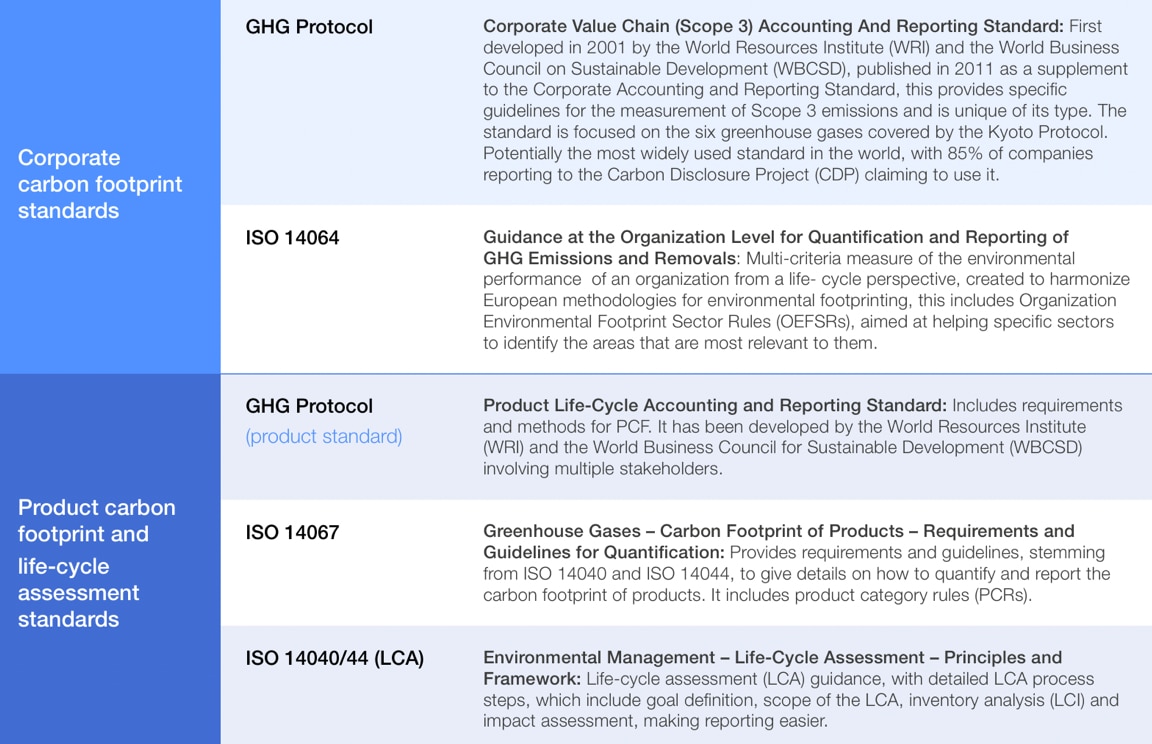
Carbon accounting standards form the foundation for measuring and reporting greenhouse gas emissions and for evaluating how well organizations are progressing toward their emissions-reduction goals and strategies. These standards generally fall into two categories:
1. Corporate carbon footprint
This represents all greenhouse gas emissions a company produces, directly and indirectly, over a defined period.
2. Product carbon footprint and lifecycle assessment
Product carbon footprint captures the total emissions associated with a product from raw material extraction through to end-of-life. Lifecycle assessment provides a broader evaluation of environmental impacts across every stage of a product’s life cycle, including production, use and disposal.
Given the wide range of existing standards, organizations often struggle to choose the most appropriate framework and to ensure their results are comparable across companies and at sectoral, national and cross-border levels. The table below shows the most common global standards used to evaluate corporate carbon footprint and product carbon footprint.
SMEs face a fragmented, costly and increasingly complex climate reporting landscape
Improving access to accurate, real-time sustainability data is critical for businesses to set meaningful targets, track progress and respond to growing regulatory and customer expectations. A survey by the World Economic Forum’s SME Sustainability Accelerator showed that 60% of SME respondents cited customers and market demand as the primary drivers of sustainability initiatives, while 23% cited regulatory requirements.
Despite the drivers, SMEs face two key challenges in systematically gathering and reporting data on their environmental impact.
Like larger players, the first challenge SMEs face is a patchwork of reporting requirements derived from frameworks, such as the Greenhouse Gas Protocol and the Carbon Disclosure Project, as well as customer-specific data requests from multinational buyers. Meanwhile, large corporations' sustainability reporting is accelerating, increasing the volume of different data requests cascading down to SMEs.
The second key challenge is the cost, which stems from several factors: establishing measurement baselines, such as gathering emissions data from Scope 1, 2 and 3 categories; investing in new digital systems for energy and resource monitoring and data capture; developing in-house talent or hiring external consultants or auditors; and completing multiple questionnaires for different customers.
These challenges are not merely operational. They reflect structural barriers to reporting faced by SMEs. According to the International Chamber of Commerce, 73% of SMEs are concerned about the upfront costs of reporting, and 65% describe the current reporting standards as complex.
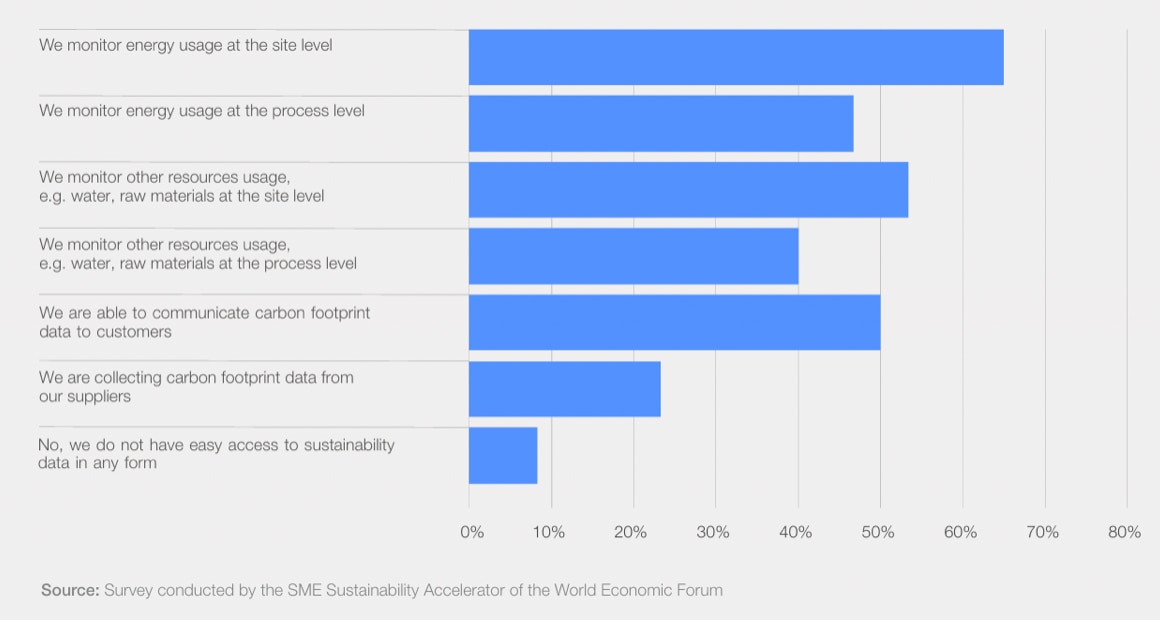
Most SMEs lack dedicated sustainability staff or carbon-accounting expertise. Many have not yet adopted mechanisms for collecting high-quality data. As the data below shows, while some SMEs monitor energy or water use, only 50% are communicating carbon footprint data to customers and less than 30% collecting emissions data from their own suppliers.
Taking the example of reporting under the European Sustainability Reporting Standards, the European Financial Reporting Advisory Group estimates that the annual reporting costs are €10.3 billion ($12.1 billion) in total for 11,700 large EU corporates, €8.8 billion ($10.34 billion) for 10,000 large non-EU corporates (assuming similar costs) and €4.2 billion ($4.93 billion) for 38,000 SMEs (assuming one-eighth the cost of large companies).
Unless the data requests are harmonized and simplified, these reporting expectations risk diverting limited resources that SMEs have away from practical decarbonization measures and innovation — an outcome that runs counter to the aims of the transition.
The key is to enable SMEs to enhance the visibility of their carbon footprint without incurring substantial costs that could undermine their competitiveness. This underscores the need for practical support and collaboration across the industrial ecosystem, involving the private and public sectors.
Harmonizing climate data requests to reduce the burden on SME suppliers
The World Economic Forum’s Global Chief Operating, Supply Chain & Procurement Officers Community recognizes that climate reporting for SMEs needs to shift from being a burden to becoming an enabler of resilience and competitiveness.
To support this transition, the community — through a dedicated taskforce — is working to harmonize the sustainability data request forms that SME suppliers receive from larger companies.
This task force will focus on defining a common, interoperable set of core sustainability data fields aligned with existing leading global standards and designed to be practical and scalable for SMEs. Beyond harmonization, it will act as an accelerator for capability-building across supply chains and provide actionable guidance for smaller manufacturers. Through structured knowledge transfer, peer learning, and the dissemination of best practices, the initiative will empower SME suppliers to build sustainability capabilities — enabling them to understand and meet reporting requirements, embed sustainability into their growth strategies, strengthen resilience, and enhance their competitiveness in global markets.
Stakeholders are invited to join this initiative to harmonize the approach to climate data, share best practices, incubate new partnerships and disseminate insights. The goal is to support SMEs in building capabilities and enabling a journey towards sustainability for companies of all sizes.
For further information or to participate in this SME Sustainability Accelerator, please contact xiaoming.zhong@weforum.org.
Don't miss any update on this topic
Create a free account and access your personalized content collection with our latest publications and analyses.
License and Republishing
World Economic Forum articles may be republished in accordance with the Creative Commons Attribution-NonCommercial-NoDerivatives 4.0 International Public License, and in accordance with our Terms of Use.
The views expressed in this article are those of the author alone and not the World Economic Forum.
Stay up to date:
Small and Medium-Sized Enterprises


Forum Stories newsletter
Bringing you weekly curated insights and analysis on the global issues that matter.
More on Climate Action and Waste Reduction See all

Shantanu Srivastava and Tanya Rana
March 5, 2026


