Opinion
China at Davos 2026: Scale, stability, and structural questions
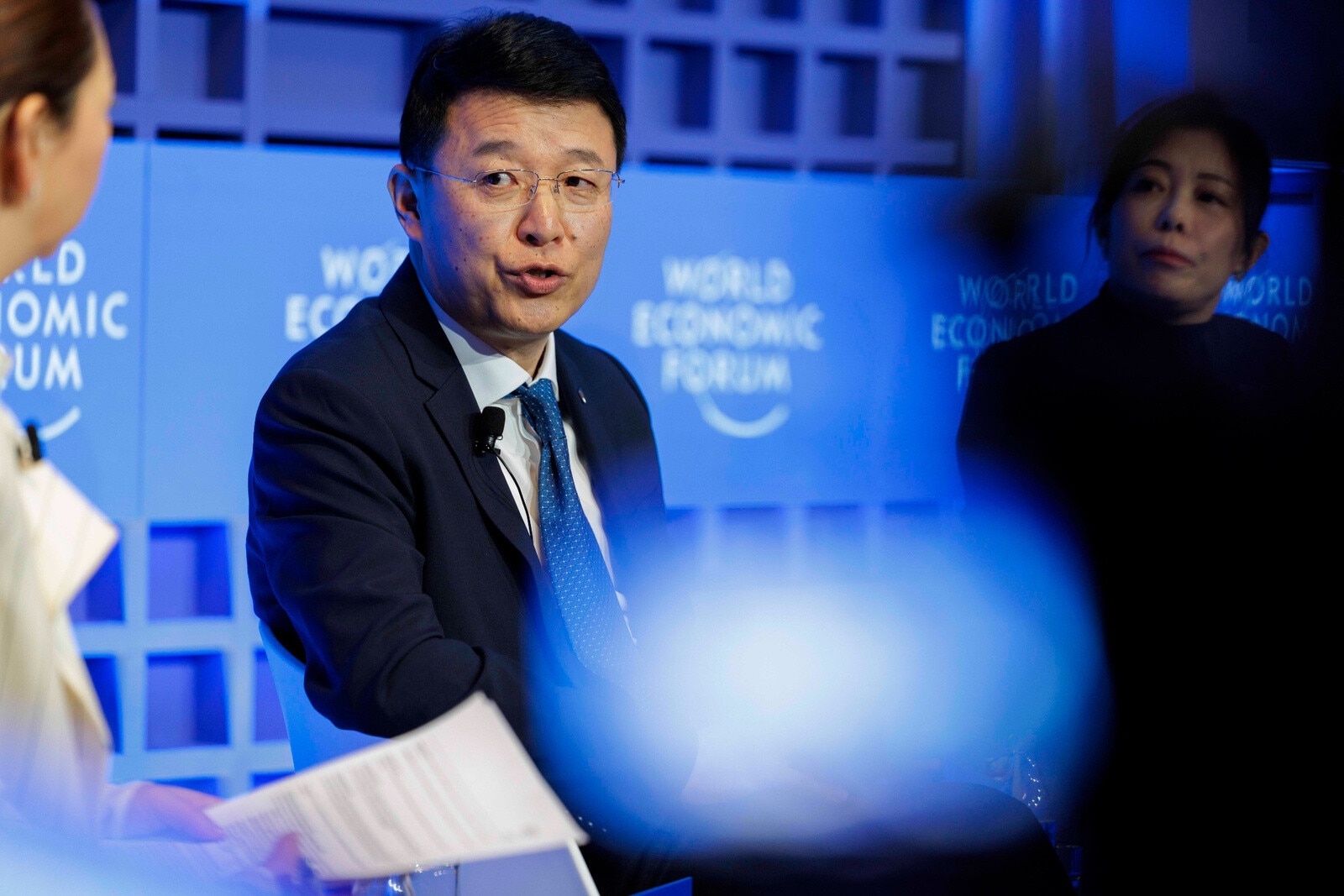
Participants discussed China's future at the World Economic Forum Annual Meeting in Davos 2026 Image: Jason Alden/World Economic Forum
- China's entrenched role as a system-shaping manufacturing and technology power now defines global adjustment, rather than expectations of its future rise.
- The combination of formidable export strength and relatively weak consumer demand is the subject of debate and closely tied to trade politics.
- China's development trajectory has broadened the perceived range of viable development models, even as it reshapes the practical conditions under which others pursue industrial upgrading.
China arrived in Davos this year with a familiar but sharpened message: in a world of tariff shocks, geopolitical fragmentation, and policy volatility, it presents itself as a source of continuity̦: a country committed to globalization, anchored in industrial strength, and increasingly confident in the durability of its development path. Yet beneath that steady exterior sat a set of tensions that Davos regulars now recognize as structural rather than cyclical: high savings rate alongside formidable export performance; deep anxiety abroad about Chinese overcapacity alongside quiet admiration for its manufacturing prowess; and a development model that has expanded global possibilities.
He Lifeng: stability as strategy
Those themes were clearly articulated in the special address by Vice Premier He Lifeng, who framed China as a defender of multilateralism at a moment when it sees the global economic order under strain. His remarks at the Annual Meeting emphasized openness, opposition to protectionism, and the importance of maintaining global supply chains.
Less conspicuous, but no less important, was what went unsaid: China is no longer arguing for patience while it rises or “catches up.” It is arguing for accommodation to a reality in which it already occupies a central position in global manufacturing, trade, and increasingly, technological diffusion.
He Lifeng’s message was not triumphalist, but managerial: China not as a system challenger but as economic ballast in a world of accelerating volatility. That posture resonated in Davos corridors precisely because it contrasted so sharply with the more adversarial tone emanating from Washington.
The domestic drag, the external engine
The paradox at the heart of China’s economy remains unresolved. The property market slump continues to cast a long shadow over household balance sheets and confidence. Consumer demand, while no longer collapsing, remains hesitant and uneven. Beijing’s efforts to stabilize expectationș – incremental support for housing, targeted fiscal tools, and consumption incentiveș – have prevented a hard landing, but they have not yet produced a decisive rebound in household sentiment.
At the same time, China’s export machine remains extraordinarily robust, and for some of its trade partners, threatening. The country closed the year with a record global trade surplus of nearly $1.2 trillion, driven by competitiveness across an increasingly sophisticated range of manufactured goods. This is not simply a story of price undercutting; it is a story of scale, integration, automation, and learning curves that continue to steepen. For many Davos participants, this divergence̦ – soft domestic demand paired with relentless export strength̦ – has become the defining feature of China’s current phase.
China is clearly not suffering from a lack of productive capacity; instead, it is grappling with how to rebalance an economy whose institutional incentives still favor production over consumption. That imbalance is the legacy of a development strategy that has delivered formidable capabilities but now generates difficult trade-offs.
As Zhu Min, former deputy managing director of the IMF, put it in a Davos discussion, the real test will be whether incentives change: “Income growth will be higher than GDP growth – that’s the KPI.” Until that metric governs official performance, he suggested, boosting consumption will remain more an aspiration than an operational priority.
Made in China 2025, judged by outcomes
A decade after “Made in China 2025” was first promulgated, then quietly disappeared from official slogans, its results are impossible to miss. China now dominateș – or is deeply competitive acrosș – nearly all of the advanced manufacturing sectors it originally targeted: electric vehicles, batteries, solar and wind components, power electronics, industrial machinery, and segments of robotics and automation.
What impressed Davos audiences was not any single technology, but the coherence of the industrial ecosystem. China’s advantage lies less in isolated breakthroughs than in its ability to move from design to scale, from pilot to deployment, faster and more comprehensively than peers. Manufacturing depth, supplier density, and tight feedback loops between producers and users have turned industrial upgrading into a cumulative process.
This matters politically as much as economically. It is increasingly difficult to describe China’s industrial rise as speculative or fragile. It has become embedded.
Renewables: scale as power
Nowhere is this clearer than in renewable energy. China’s position in solar modules, wind turbines, batteries, grid infrastructure, and EV supply chains is not merely dominant; it is system-shaping. Costs have fallen rapidly, deployment has accelerated, and Chinese firms increasingly set global benchmarks for price and performance.
For climate discussions at Davos, this created an uncomfortable duality. On the one hand, China’s renewable scale is indispensable to any plausible global decarbonization pathway. On the other, that same scale fuels accusations of overcapacity and distorts trade relations. China, for its part, frames this as a contribution to global public goods. Its critics see strategic leverage. Both views can be true simultaneously.
A related theme surfaced repeatedly in Davos discussions: a growing willingness to court Chinese investment. Faced with persistent trade imbalances and the sheer scale of China’s manufacturing capacity̦ – especially in clean-energy technologieș – policymakers in Europe and elsewhere are increasingly exploring conditional openness to Chinese foreign direct investment as an alternative channel of engagement. The emphasis is not on openness for its own sake, but on how investment is structured: local production, local employment, integration into domestic value chains, and governance under host-country rules. In this framing, encouraging embedded investment is seen as one way to absorb China’s industrial strength without relying solely on tariffs or import restrictions. More broadly, it reflects a shift from managing flows of goods to managing the embedding of capability within domestic systems – a distinction that becomes even more salient when the discussion turns from hardware to software.
AI and the industrial flywheel
That same logic underpins discussions of artificial intelligence. A year after the “DeepSeek Moment” that rocked Silicon Valley and Wall Street, China’s recent AI advances surprised some observers, but they should not have. The country has spent years building the institutional, infrastructural, and human foundations for AI deployment—particularly in manufacturing and logistics.
In this sense, AI reinforces rather than replaces China’s industrial advantage. It tightens the flywheel between digital systems and physical output, making manufacturing not less central, but more intelligent.
The new Five-Year Plan: locking in advantage
Unambiguous signals from the new Five-Year Plan suggest continuity with adaptation. The emphasis remains on building a “modern industrial system,” advancing technological self-reliance, upgrading traditional industries, and accelerating the green transition. Lackluster consumption is acknowledged as a constraint, but the remedies on offer remain cautiouș – designed to stabilize rather than radically rewire the political economy.
The plan appears less concerned with chasing headline growth than with ensuring that China’s core capabilities remain resilient under external pressure. In that sense, it is a plan shaped by experience: Beijing no longer assumes a benign global environment.
A widening menu̦ – and a narrowing ladder
This brings us to a deeper, less often articulated paradox that hovered over Davos discussions. China’s rise has, by example rather than evangelism, challenged the Washington Consensus. It has demonstrated that development need not follow a single, liberalizing script. For many countries in the Global South, this has widened the perceived menu of viable development strategies.
Yet China’s success has also disrupted the traditional “Flying Geese” model of industrial upgrading. The expectation that China would steadily shed lower-value manufacturing as it moved up the value chain has only partially materialized. Instead, China has retained, automated, and integrated much of that manufacturing into higher-value systemș – using robotics, AI, and scale to compress margins and neutralize labor-cost advantages elsewhere.
The result is an uncomfortable truth: China has expanded the conceptual space for development while, in some sectors, narrowing the practical pathways available to its less-developed neighbors. This is not the product of deliberate exclusion so much as the emergent consequence of scale, automation, and institutional coordination.
Geopolitics in the background: Canada and the United States
Against this backdrop, the sudden thaw in Sino-Canadian relations under Prime Minister Mark Carney stood out. The warming̦ – marked by selective tariff easing, renewed market access, and cooperation in clean energy̦ – was widely read in Davos as pragmatic hedging rather than alignment. It underscored the reality that middle powers are increasingly seeking room for maneuver amid U.S.–China rivalry.
By contrast, the shadow of Donald Trump loomed large. Tariffs remain the baseline assumption of U.S. policy toward China, even after the temporary truce that emerged from Busan. For Davos participants, the lesson was clear: pauses are tactical, but friction is structural. China’s export performance in this environment has only reinforced Beijing’s confidence in its capacity to adapt.
The reckoning, quietly underway
Taken together, the Davos 2026 China story was not about crisis or resurgence. It was about consolidation under constraint. China is no longer asking the world to believe in its future potential; it is asking the world to adjust to what it has already become̦ – a manufacturing superpower with growing technological depth, unresolved domestic imbalances, and a development trajectory that complicates established economic narratives.
That, perhaps, is the deeper reckoning now unfolding: not whether China will succeed, but how global systemș – economic, political, and intellectual̦ – will respond to a country that has redefined what development can look like, and in doing so, altered the terrain for everyone else.
Don't miss any update on this topic
Create a free account and access your personalized content collection with our latest publications and analyses.
License and Republishing
World Economic Forum articles may be republished in accordance with the Creative Commons Attribution-NonCommercial-NoDerivatives 4.0 International Public License, and in accordance with our Terms of Use.
The views expressed in this article are those of the author alone and not the World Economic Forum.
Stay up to date:
China


Forum Stories newsletter
Bringing you weekly curated insights and analysis on the global issues that matter.