Davos 2026: Special address by Abdel Fattah El-Sisi, President of Egypt
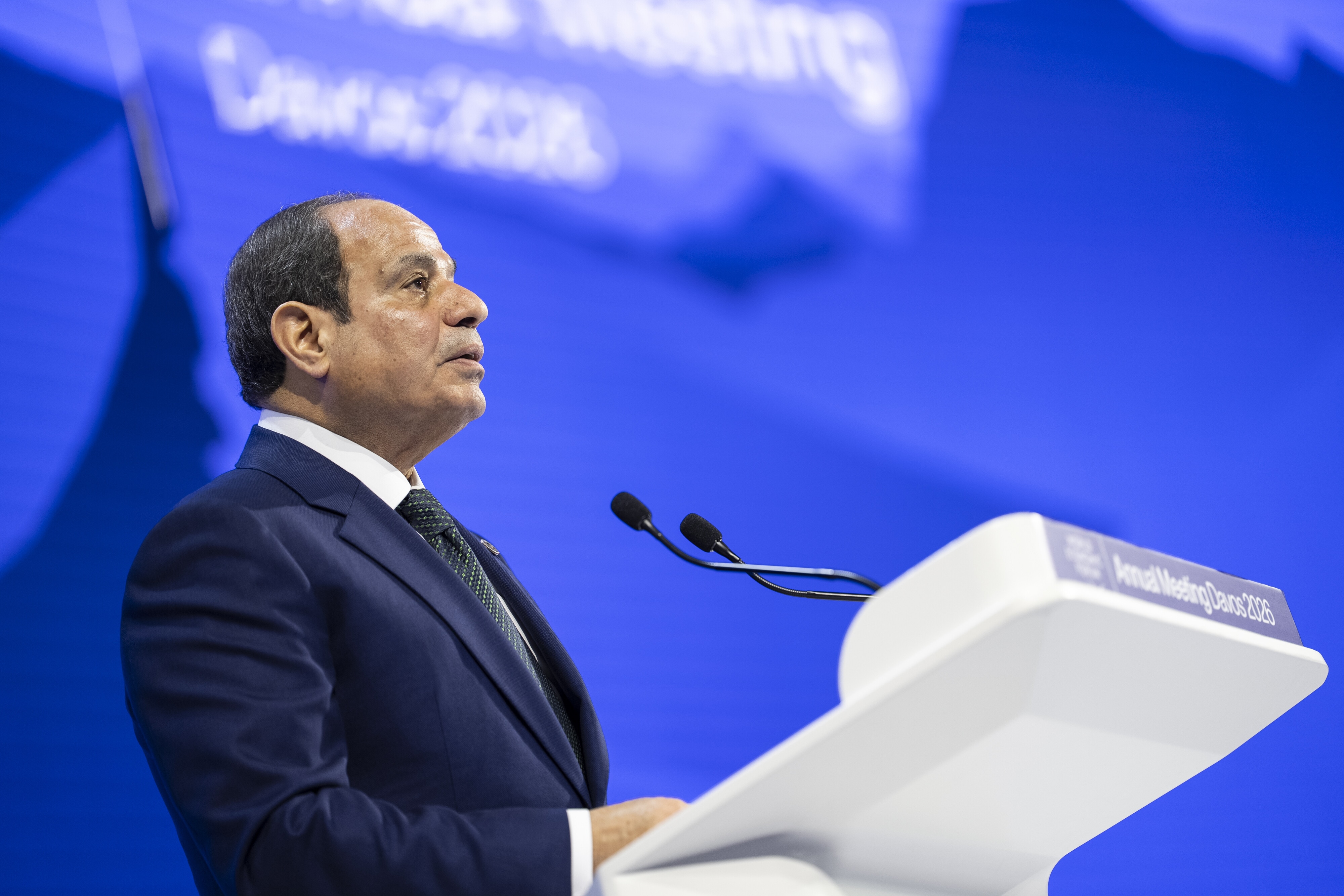
'The Palestinian issue is still at the forefront' … Abdel Fattah El-Sisi, President of Egypt, in session at the 2026 Annual Meeting. Image: World Economic Forum/Faruk Pinjo
- Supporting the Annual Meeting's theme of A Spirit of Dialogue, Egyptian President El-Sisi reiterated his commitment to international cooperation.
- On the Palestinian question, Egypt continues to back the two-state solution and is ready to back phase two of the Gaza ceasefire.
- The country's ambitious economic reforms aim at boosting private sector opportunities in a host of cutting-edge industries.
This transcript was produced using AI and subsequently edited for style and clarity. The edits do not alter the substance of the speaker’s remarks.
In the name of Allah, as I begin, I'd like to extend a sincere thanks and appreciation to Mr. Børge Brende, Chairman and CEO of the World Economic Forum for his generous invitation to join the Annual Meeting.
This outstanding gathering offers a precious opportunity to address international issues and current challenges, while being geared to achieve our common goal: to build a more prosperous and a just future for everyone.
Our world today faces monumental challenges on the development path. It witnesses profound transformations in the patterns of international cooperation, in addition to the rising role of innovative tools of technological progress, digital transformation and AI applications. This matter requires us all to consolidate efforts and to promote cooperation and joint action to enable ourselves to cope with those changes and seize the opportunities for the good and mutual benefit of our nations.
As we believe in the importance of cooperation, Egypt continues to build solid regional and international partnerships to ensure mutual benefit and sustainable development. Egypt is also investing in creating a private sector-conducive environment and being an essential partner on the road to development progress and prosperity. However, such efforts face unprecedented challenges both regionally and internationally, given the escalating geopolitical tensions and violations of international legitimacy by some parties; a matter that undermines endeavours of economic growth, weakens efforts to preserve international peace and security, and limits joint actions between countries.
Therefore, Egypt stresses that the only way to achieve peace, stability and development in a sustainable fashion requires the following. First, international dialogue and cooperation should be adhered to. The principles of mutual respect and peaceful coexistence should be upheld, and international law and the UN charter should be respected. Second, disputes should be settled peacefully, escalations should be averted, and an environment for durable solutions of various crises should be created. Third, interstate integration should be sought. Eradicating poverty and hunger should be our priority, and shared prosperity among countries should be achieved. Fourth, national, regional and world business institutions should be enhanced; the private sector should be enabled to carry out the key role of achieving inclusivity.
Ladies and gentlemen, the Palestinian issue is still at the forefront of the Middle East area. It forms the essence of regional stability and the main anchor of a just and comprehensive peace. Along these lines, I'd like to express my appreciation of President Donald Trump's efforts and commitment to the work to stop the war in Gaza, and his sincere endeavours to alleviate the human suffering of our brotherly Palestinian people for over two years now.
The Sharm el-Sheikh conference on 13 October 2025 was the crowning of Egypt's efforts in coordination with its partners to bring a ceasefire and enshrine peace, open up new horizons of hope and regional stability, and launch a serious political path towards a just and comprehensive settlement of the Palestinian issue, where legitimate Palestinian rights are ensured, and security and prosperity in the entire region can be promoted. Accordingly, I emphasize the necessity to build on the Sharm el-Sheikh summit: The ceasefire should endure, the flow of humanitarian assistance to Gaza should not be interrupted, while the process of early recovery and reconstruction should be accelerated. I also welcome the United States' announcement of the beginning of phase two of the ceasefire agreement. This is a key step towards the implementation of the peace plan and de-escalation in the region. Thus, the chances of stability are even bigger.
And I would like to re-emphasize that Egypt, because of its historical role in supporting the Palestinian cause, will spare no pains to continue engaging with all parties concerned to reach a just, comprehensive and permanent solution on the Palestinian issue, based on the two-state solution and the international legitimacy resolutions that provide the establishment of an independent Palestinian state on the lines of 4 June 1967, with East Jerusalem as its capital.
Despite multiple regional and international crises, Egypt continues its ambitious economic reform, with an integrated package of actions to control financial and monetary policies, to restore investors' confidence in the Egyptian market, upgrade the investment legislative environment and provide attractive incentives to investors. Egypt has given special priority to strengthening the private sector as a major indispensable partner in economic growth and development, and set a cap for government investment. There are plans for the state's exit from certain public investments, giving the private sector more room to enlarge its contribution to the economy.
The dividends of such efforts are a remarkable improvement in economic performance indexes, high rates of growth, an increase in private investment flow, a broad commendation of the world financial institutions, notably the IMF, in addition to a better credit rating by world institutions. I assure you that Egypt will continue the process of economic reform and advance in its development trajectory, along with implementing the state-owned enterprises document, which specifies the work of government and state-owned companies. It is carrying out the monetization programme and state exit in order to broaden the participation of the private sector and multiply its contribution to propelling the wheel of the economy.
Ladies and gentlemen, the Egyptian market today provides countless investment opportunities in various sectors. In its turn, the government is keen to offer necessary incentives and facilitations, especially in the automotive industry, including EVs, pharmaceuticals, logistics, ITC and AI applications. I invite you to make hay and benefit from the well-resourced infrastructure established in recent years; the highways, communications, logistics, transport, free zones, particularly the economic zone of the Suez Canal, which stands as a strategic platform for trade and investment. I assure you that the investor that chooses to work in Egypt will not only benefit from the promising local market, but will open up to broader markets linked with Egypt by FTAs in both the Arab world and Africa.
Distinguished audience, in conclusion, I re-emphasize Egypt will continue to establish pillars of stability and security worldwide and advance development and economic growth. Egypt looks forward to a stronger cooperation with world partners to reach these desirable goals. I'm also pleased to welcome our announcement to organize a business summit in Egypt during this year. I look forward to keeping up our coordination in the time we have, and I seize this opportunity to wish you all the best with the rest of the World Economic Forum activities. Thank you.
Børge Brende: Mr. President, thank you so much for your speech. My interpretation is that geopolitics are challenging, but the economy is going a lot better than geopolitics. If you look at the region of Middle East and North Africa, how do you interpret what is now unfolding from the Egyptian side? And how do you think we can move more decisively towards peace and reconciliation?
Abdel Fattah El-Sisi: Thank you very much for this question. On the geopolitical level that I mentioned during my speech, Egypt has tried, not only in the last few years in the Gaza Strip but for the last 10 years when I have been in charge, to be pivotal; a stabilizing force in the region that suffers from some shocks in the last few years. And we have not forgotten our role because we have to work very hard to be a stabilizing force, so that our country is ready to be the launching pad for the Sustainable Development Goals that we have set for our countries until 2050.
In my speech, I have said that we are taking measures that aim at attracting and incentivizing the private sector, and to better our infrastructure in Egypt. This is absolutely necessary to attract the proper investment and proper infrastructure. The infrastructure per se is in itself a stabilizing factor, because businessmen and institutions are more inclined to come to Egypt to contribute. Egypt has got a policy based on boosting stabilization in the region, not only within the country, but even in the regional and international environment as well. We have always made a positive contribution, not only to keep or serve our own interests, but also because our overall goal is to provide stability in the region, which has been prone to conflict in the last 10 years.
Egypt has always had a positive role in this stability. Once again, in October 2024, through the Sharm el-Sheikh summit, we dealt with very thorny issues, especially the war in Gaza that lasted about two years. We are hopeful that our positive role will be pivotal in crystallizing phase two of the peace process in the region.
Talking about a different point regarding the proper environment and investment atmosphere in Egypt, I would like to respond by saying that we have done a lot of things, but we still have a lot to do in order to have a proper incentivizing atmosphere to attract foreign investments. We've not left a single stone unturned in order to get all these projects up and running: We've connected the Red Sea and Mediterranean ports, we have advanced and well-developed road and rail networks. This applies to the airports, to the energy sector, even the education sector, which has part and parcel of the overall reform of our country. We have boosted the infrastructure for Egyptian universities to make sure we have graduates that are fit for the positions open in the labour market. And the same efforts have been extended in the legislature, in the reforms agenda.
The last review with the IMF, held last month, reiterated the fact that we are on the right track: the growth rate in the first quarter was over 5%, and this is an opportunity for the Egyptian government to continue striving and to have better reforms. I may have spoken a little too much in response to your question, but I wanted to show the overall picture of a very attractive business environment. We have the free trade agreement that has been signed with Africa, with the Arab region, and we also have free economic zones in addition to the development underway in the Suez Canal, to have smoother movement in these different waterways. If you have projects in hydrogen, logistics, communication, data centres, pharmaceuticals, even in education and health, we are fully ready to contribute in making these investments a success.
Børge Brende: This gave an excellent overview of the region, but also the reforms. We have a few minutes left, so I would like to touch on two things. Let me start with the easiest. It is how about about Egypt is now, also with the reforms you mentioned, adjusting to the new economic reality. Because since last time you were here, a decade ago, no one spoke about artificial intelligence, there there are almost no electric vehicles. But things are changing. And the growth in the years to come will be strongest in digital trade and in these new technologies. How do you prepare Egypt for that? I think you already touched on some of the reforms there that will apply; but with such a young population, I guess you also have a big opportunity, because this young generation is very tech-savvy.
Abdel Fattah El-Sisi: Very true. We have an overarching programme planned to make sure the state is ready, not only to attract investors but also to overcome any upcoming challenges. You mentioned electric vehicles, and there are other sectors we can dwell on. We are ready to make the utmost effort in order to make sure we have the right capabilities, so that we incentivize investors in these specific sectors that are going to be supported by the state. We need to make sure we are the engine for growth. And with regard to electric power, that is absolutely necessary.
But education is also pivotal. I spoke about universities: Different sectors, like digitalization and AI, are part and parcel of the preparation of the younger generation at universities. We have over 30 million young people in education, including 4.5 million at university; we have a huge opportunity because we need to make sure that our human capital is ready to meet the challenges, by providing graduates that are knowledgeable and able to meet the new era. So we need to have youth that are capable and fully fitted with the right skills. Egypt is a promising market, and we are eager to make better efforts so that we make headway in all the different sectors we've mentioned.
Børge Brende: The last question is about the Middle East region. As you underline, we all know that Egypt is an anchor between Europe, Africa and Asia. If you look at the regional developments of the last year, Lebanon and Syria are moving in a new direction. You have the problematic situation in Sudan and Yemen. Libya, I don't want to characterize – I leave that to you, Mr. President, to find the right words. But if you look at the regional overall, do you think this is going to be a calmer year? Or are we still going to have challenges? And tomorrow, as you know, President Trump is also launching the Board of Peace there. So, even in Davos, there will be some developments.
Abdel Fattah El-Sisi: If I may, as I said in the introduction, I wanted to give a broader overview of the region. In the last 10 years, Egyptian policy has been stable and in continuation of what we have always done. We have always believed in non-interference in the domestic affairs of other states. We also support international institutions to settle disputes support in the region; for example, if there are militia or factions that are rampant in some countries and that have a negative impact. I don't want to name countries per se, because I don't want to raise issues with the state, but they know themselves.
If you look at Lebanon, for example, it's on the right path. And I really hope that Lebanon, in the coming weeks and days, will find the way out and help the region to stabilize and grow. We've always had an excellent relationship with its government, because it has been the lighthouse of education in the region. In Syria, there are developments, and we're hopeful that the trend will be encompassing and all-inclusive for all the components that make up Syria; they should all be represented in the government, and there should be no exclusion. And therefore, we call upon all our friends in Sudan, in Somalia, in Libya, in Yemen, to work on stability. And to make sure that the principle of non-interference in domestic affairs is highlighted.
So our aim, which we have been working on since 2014, is to return statehood to Libya, Sudan, Somalia and Syria; that a fully functioning state government should be a stabilizing force in all these countries. And we are still working on being positive and having a constructive role as Egyptians. The war in Gaza over the last two years has severely impacted the Suez Canal; we in Egypt are paying the price, we have lost billions of dollars. Therefore we have been very positive in de-escalation and in softening the tone. We have had a very positive role because we wanted to put an end to to the war. We have always encouraged humanitarian aid for those affected. Our policy has consistently argued for stabilization in our country, in the region and in the world.
Don't miss any update on this topic
Create a free account and access your personalized content collection with our latest publications and analyses.
License and Republishing
World Economic Forum articles may be republished in accordance with the Creative Commons Attribution-NonCommercial-NoDerivatives 4.0 International Public License, and in accordance with our Terms of Use.
The views expressed in this article are those of the author alone and not the World Economic Forum.
Stay up to date:
Egypt


Forum Stories newsletter
Bringing you weekly curated insights and analysis on the global issues that matter.
More on Forum in FocusSee all

Kaya Bülbül and Kate Whiting
January 30, 2026


