Davos 2026: Special address by Javier Milei, President of Argentina
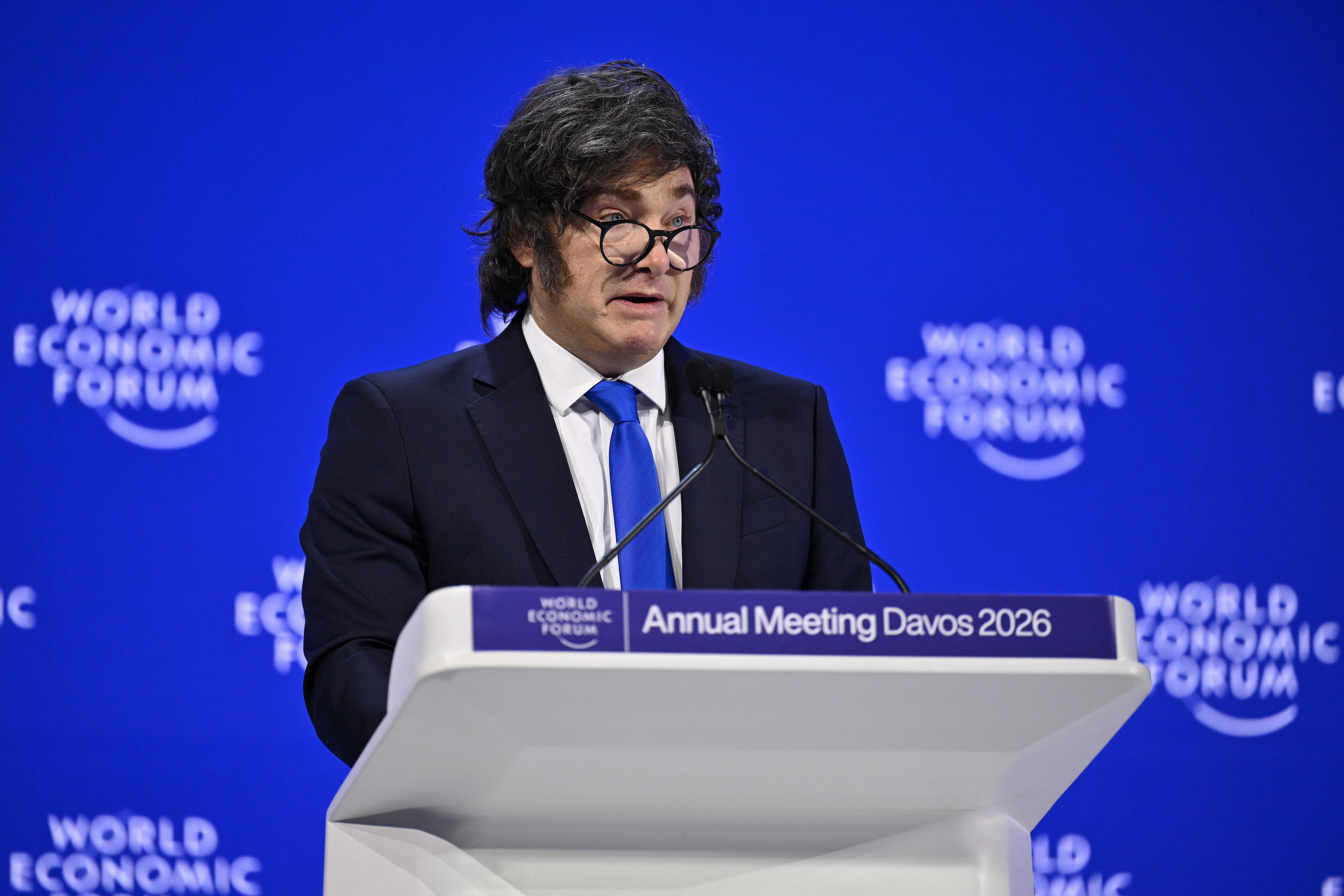
Argentine President Javier Milei spoke on ethics, markets and economic freedom in his special address at Davos 2026. Image: ©World Economic Forum/Harold Cunningham
- This blog contains the full transcript of a special address by Javier Milei, President of Argentina, delivered at the World Economic Forum's Annual Meeting 2026 in Davos.
- Milei discussed the relationship between economic efficiency, ethics and public policy, drawing on economic and philosophical traditions to argue that justice and efficiency are interconnected.
- He outlined his views on free enterprise, institutional frameworks and the role of values in shaping economic growth, referencing Argentina’s recent policy reforms and global economic challenges.
[The following is translated from Spanish. This transcript was produced using AI and subsequently edited for style and clarity. The edits do not alter the substance of the speaker’s remarks.]
Good afternoon, everyone.
I stand here before you to state categorically that Machiavelli is dead.
For years, our thinking was distorted by the presentation of a false dilemma in the design of public policies, one in which we were supposedly faced with a choice between political efficiency on the one hand and respect for the ethical and moral values of the West on the other.
As Professor Jesús Huerta de Soto points out in his work on dynamic efficiency, from that perspective, efficiency is not compatible with various schemes of equity or justice, but rather arises solely and exclusively from one of them, the one based on respect for private property and the entrepreneurial function.
Therefore, the opposition between the dimensions of efficiency and justice is false and erroneous. That is to say, what is just can't be inefficient, nor can what is efficient be unjust. Actually, from the standpoint of dynamic analysis, justice and efficiency are two sides of the same coin.
Without a doubt, the thinker who purviewed this most clearly was M. Rothbard when he articulated the connection between the dynamic conception of economic efficiency and the realm of ethics. Rothbard considered it essential to establish in advance an adequate ethical framework to foster dynamic efficiency, given our lack of knowledge regarding the ends, means and utility functions that exist in reality.
According to Rothbard, and I subscribe to this view, even in my role as President of the great Argentine nation, only the ethical principles underlying Western culture can serve as efficiency criteria when it comes to making public policy decisions.
Put bluntly, when public policies are designed, it is unacceptable from the standpoint of ethics and morality to sacrifice justice on the altar of efficiency. This commitment to values not only stands above economic efficiency, but even stands far above political utilitarianism.
Thus, by setting aside ethical and moral values, we end up with policies that are not only unjust but also lead to collapse, not only economically but also socially, to such an extent that they could ultimately bring about the downfall of Western civilization itself.
This is why, in 2024, at this forum, I stated that the West was in danger. In turn, in my 2025 address, I showed that the agendas and policies being promoted by various international organizations and fora were nothing more than a whole set of socialist policies elegantly packaged to deceive people of noble spirit, who were full of good intentions. But this always led to the same catastrophic results.
That is why we must never forget the words of Thomas Sowell on socialism, of which he acknowledged the merit that it sounds very appealing, but whose flip side is that it always ends badly, appallingly badly.
In fact, and beyond the continuous disasters caused by socialism throughout the 20th century, we can see the terrible damage done in Venezuela. Not only an 80% collapse in GDP, but something far worse still, namely the establishment of a bloody narco dictatorship whose terrorist tentacles spread across our entire continent in the Americas.
Therefore, today more than ever, in the face of the ethical and moral degradation afflicting the West as a result of embracing the new socialist agenda, it is necessary to once again promote the ideas of freedom.
However, unlike the way this was approached in the past based on a utilitarian framework, today, the defence of the free enterprise capitalist system must be grounded in its ethical and moral virtue.
As Israel Kirzner points out, today's socialists do not deny capitalism’s superiority in terms of productivity; they challenge capitalism on the grounds that it's unjust. Therefore, it's not enough for the system to be more productive, because if its roots were unjust, capitalism should not be defended.
Today, I will demonstrate that free enterprise capitalism is not only more productive, but also that it's the only just system.
I will also demonstrate that there is no dilemma between political utilitarianism and policy-making based on values, because if the two were in conflict, that would imply that the foundations of political utilitarianism should be discarded as unjust.
Therefore, this will mean that if we wish to emerge from our dark present, we must once again draw inspiration from Greek philosophy, embrace Roman law and return to Judeo-Christian values, thereby enabling us to save the West.
A large share of human conflicts arise from a failed interaction between natural law and positive law.
Natural law is the law that ought to govern human beings because it accords with their nature, and it is therefore just in a universal sense. It is a law common to all men because it is intrinsic to their essence and therefore unchangeable and immutable.
By contrast, positive law is the law written by human beings to govern according to their convenience. Thus, when positive law is in harmony with natural law, there will be justice. Otherwise, the law may be legal but not legitimate.
Accordingly, two fundamental rights are recognized: the right to life and the right to liberty. Man is born alive and free and has the right to preserve these attributes of nature. He also has the right to demand that others respect them in order to pursue his own happiness, which is the end towards which every human being tends.
Alongside these, we have acquired rights, which are neither natural nor inherent to human beings, but are instead earned through merit or obtained as a gift.
Thus, from the fundamental right to liberty derives the acquired right to private property, which is manifested in our ability to freely acquire goods with the fruits of our labour or to receive assets that are freely donated or inherited.
In turn, the right to property, especially because of its dynamic consequences, is linked to Locke's principle of appropriation. Property may not only derive from donation, gifts, inheritance and/or exchange, but also from appropriation through discovery and creation.
Finally, these rights are complemented by the non-aggression principle, which establishes that no human being has the right to inflict aggression of any kind on another human being. This includes not only physical aggression, but also all forms of coercion, compulsion and/or imposition under the threat of force.
Hence, we define libertarian liberalism, in line with Alberto Benegas Lynch Junior, as unrestricted respect for the life project of others based on the principle of non-aggression and in defence of the right to life, liberty and property, whose institutions are private property, markets free of state intervention, competition understood as free entry and exit, the division of labour and social cooperation.
Naturally, associated with this social order, the question arises as to whether it is just.
Therefore, in order to determine whether the system is just, the necessary reference is Ulpian, whose basic premise constitutes a foundation of Roman law and is undoubtedly one of the pillars of Western civilization.
Thus, justice is a constant and perpetual will to give to each his due, that is, the intention to give to each their own what belongs to them. However, Ulpian’s statement did not end there; he went on to add that the principles of law consist in living honourably, harming no one and giving to each their own.
Therefore, from all of this, it follows that one of the defining characteristics of free enterprise capitalism is that it is a just doctrine.
Given the emergent institutional framework, which we have also shown to be just, it is now time to demonstrate that it is also efficient.
The first formulation in this regard was put forward by Adam Smith, who, by using the argument of the invisible hand, posited that each individual, in pursuing their own interests, maximize social welfare.
Later, the neoclassicals, guided by an idea of the invisible hand based on the Pareto optimum, derived the first fundamental theorem of welfare economics, namely that every competitive equilibrium is Pareto optimal.
However, this required embracing a mathematical structure that left the door open to state intervention under the well-intentioned goal of correcting market failures, which, from my perspective, do not really exist.
To address this, the proof developed by Hans-Hermann Hoppe, based on property rights in line with Locke's principle of original appropriation together with the non-aggression principle, not only proves satisfactory in establishing optimality, but also leaves no room for intervention.
In this regard, Hoppe states, "Any deviation from this set of rules implies, by definition, a redistribution of property titles, and thus of income, from producer-users and contracting parties to non-producer-users and non-contracting parties. Consequently, any such deviation implies that there will be relatively less original appropriation of resources, whose scarcity is known, and therefore, there will be less production of new goods, less maintenance of existing goods and fewer contracts and trades that are mutually beneficial. This naturally implies a lower standard of living with respect to goods and services that change hands. Moreover, the postulate that only the first user of an asset acquires property rights over it, not the last one, ensures that productive efforts will be as high as possible at all times."
Likewise, the notion that only the physical integrity of property and not its value must be protected, guarantees that every owner will undertake the greatest possible value-producing efforts, that is to say, efforts to promote favourable changes in the value of property and to prevent or counteract any unfavourable change in its value.
Therefore, any deviation from these rules entails a reduction in productive efforts at all times.
Note that by relying on private property rather than on excess demand functions derived from optimization exercises. This approach allows an optimum to be reached without the need to use esoteric assumptions that later serve as justification for state intervention.
This also avoids falling into the empirical absurdity of the second theorem of welfare economics, which posits independence between production and distribution, as if choosing between capitalism and communism were neutral in terms of outcomes.
So, having demonstrated that the institutions of free enterprise capitalism, supported by natural rights, Locke's principle of original appropriation and the non-aggression principle are not only just but also efficient, at least in static terms. It is now time to show that free enterprise capitalism displays the same properties in dynamic terms as well.
As early as 380 BC, Xenophon pointed out that economics is a form of knowledge that enables men to increase their wealth while arguing that private property is the most beneficial vehicle for the life of individuals.
Xenophon then went on to address the concept of efficiency from two perspectives. On the one hand, from a static viewpoint, he defined efficiency as the management of available resources aimed at avoiding waste, while highlighting the benefit of private property by stating that the master's eye is the best way to fatten his cattle.
On the other hand, in his second definition of efficiency, Xenophon delved into the dynamic realm, noting that efficiency also entails increasing wealth, that is, increasing the available quantity of goods through entrepreneurial creativity, namely through trade and speculation.
This latter criterion of efficiency is of fundamental importance for the study of economic growth, because, unlike a static model that considers only what Robert Lucas Junior defined as deep parameters, that is, preferences, technology and initial endowments of resources, in the dynamic sphere, both technology and initial endowments can vary. And in fact, they do so continuously as a result of entrepreneurial creativity.
Moreover, the institution of private property deserves a separate chapter. By pivoting on it, the Austrian School of Economics from Mises, Hayek, Rothbard, Kirzner and Hoppe to Huerta de Soto has demonstrated the impossibility of socialism, thereby dismantling the ghostly idea of John Stuart Mill that postulated independence between production and distribution; a form of academic deafness that led to socialism and cost the world the lives of 150 million human beings, while those who managed to survive the terror, did so in absurd poverty.
In line with their previous remarks and consistent with Xenophon's second line of analysis, economic theory has identified four sources of economic progress.
First, there's the division of labour, which was illustrated by Adam Smith through the pin factory example. At its core, this is a mechanism that generates productivity gains, manifested as increasing returns. Although its limit is determined by market size, the size of the market is positively affected by this process. However, it is also worth noting that this virtuous process is not infinite and that its ultimate limit lies in the endowment of initial resources.
Second, there is the accumulation of capital, both physical and human. With regard to physical capital, the interaction between saving and investment is crucial, highlighting the fundamental role of capital markets and of the financial system in carrying out such intermediation. On the human capital side, the focus should not be limited to education alone, but should also include the development of cognitive capacities from birth, as well as nutrition and health, basic elements for gaining access to education and the labour market.
Third, there is technological progress, which consists in being able to produce a greater quantity of goods with the same amount of resources, or to produce the same output using a smaller quantity of inputs.
Finally, there is entrepreneurial spirit, or rather the entrepreneurial function, which, according to Professor Huerta De Soto constitutes the main driver of the economic growth process. Because, although the three factors mentioned are important, without entrepreneurs, there can be no production, and living standards would be extremely precarious.
In fact, the entrepreneurial function is not so much focused on short-term efficiency, but rather on increasing the quality of goods and services, which, in turn, leads to higher standards of living. On this basis, what truly matters is to expand the frontier of production possibilities to the maximum extent possible.
Thus, dynamic efficiency can be understood as an economy's capacity to foster entrepreneurial creativity and coordination.
In turn, the criterion of dynamic efficiency is inseparably linked to the concept of the entrepreneurial function, which is that typically human capacity to perceive profit opportunities that arise in the environment and to act accordingly to take advantage of them. This makes the task of discovering and creating new ends and means fundamental, driving spontaneous coordination to resolve market imbalances.
Moreover, this definition of dynamic efficiency proposed by Huerta de Soto coherently and appropriately combines Schumpeter’s idea of creative destruction with North's concept of adaptive efficiency.
Naturally, given the role of the entrepreneurial function, the institutions under which it develops are of vital importance. In this regard, both Douglass North and Jesús Huerta de Soto consider one of the key functions of institutions to be that of reducing uncertainty.
So, while North presents them as a set of humanly devised constraints that structure social interaction in a repetitive manner, Huerta de Soto considers that these institutions, conceived by human beings, emerge spontaneously from a process of social interaction without being designed by any single individual, and that they reduce uncertainty in the market process.
As Roy Cordato points out, the appropriate institutional framework is one that favours entrepreneurial discovery and coordination. Accordingly, within this framework, economic policy should aim to identify and remove all artificial barriers that hinder the entrepreneurial process and voluntary exchanges.
Given the decisive influence of institutions on economic progress, this directs our attention to the importance of ethics, as societies that adhere to stronger moral values and ethical principles in support of institutions will be dynamically more efficient and will therefore enjoy greater prosperity.
Accordingly, the fundamental ethical problem is a search for the best way to foster entrepreneurial coordination and creation.
Therefore, in the field of social ethics, we conclude that conceiving human beings as creative and coordinating actors entails accepting axiomatically the principle that every human being has the right to appropriate the results of their entrepreneurial creativity.
So the private appropriation of the fruits of what entrepreneurs create and discover is a principle of natural law because if an author were unable to appropriate what they create or discover, their capacity to detect profit opportunities would be blocked, and the incentive to carry out their actions would disappear. Ultimately, the ethical principle just stated is the fundamental ethical foundation of the entire market economy.
So, what we've just demonstrated is that free enterprise capitalism is not only just but also efficient and also that it is the one that maximizes growth.
Given the conceptual framework of dynamic efficiency and the absence of a dilemma between efficiency and ethical values when designing public policies, it is of interest to consider their implementation in real life.
Beyond the enormous achievements we have exhibited during these years in office, having eradicated a fiscal deficit of 15% of GDP, reducing inflation from 300% to 30% lowering country risk by 2,500 basis points and restoring economic growth, with poverty falling from 57% to 27%, pursuing public policies guided by ethical and moral values, I would like to focus on the case of the Ministry of Deregulation, or, as we call it back home, the Ministry of Increasing Returns.
This ministry is inspired by the evolution of per capita GDP since the beginning of the Christian era, and it is in the shape of a hockey stick. This figure arises from the fact that until the year 1800, per capita GDP remained almost constant and from that point onwards, it increased 15-fold in a context in which the size of the population increased tenfold. In parallel, as GDP grew, extreme poverty fell from levels of 95% to 10%.
However, this marvel implies the existence of increasing returns, which in economics are associated with concentrated market structures, and this is where the public policy dilemma between Pareto efficiency and justice arises.
In Pareto analysis, increasing returns entail the existence of non-convexities in the production set that prevent the derivation of a profit function with a maximum. As a result, neither supply of goods nor the demand for imports is optimal.
In response, regulation of firms is proposed in order to assimilate them to a perfectly competitive case, that is, to kill increasing returns and with them, economic growth.
Consider the effects caused by regulation around the world.
The values-based view of capitalism holds that if such a position has been achieved through discovery, voluntary exchange and without violating the non-aggression principle, there is no justification for intervention. Indeed, intervention constitutes a violation of property rights, and by punishing profits, the economy's potential growth declines, so intervention and regulation are dynamically inefficient because they are violent and therefore unjust.
This is why, since we took office in 2023, we have carried out, thanks to the Cyclopean effort of Federico Sturzenegger, 13,500 structural reforms, which today allow us to have a dynamically more efficient economy and will enable us to grow once again. That is to make Argentina great again.
Thus, the Pareto optimal is clearly called into question, and for that reason, many consider that it authorizes the regulation of concentrated structures by assimilating them to a competitive model. But, as I said, this means killing increasing returns, with the unintended collateral effect of killing growth.
Note that along the same lines, we can also address the issue of artificial intelligence, a tool that can be seen as the 21st-century version of Adam Smith's pin factory. That is a catalyst for increasing returns and, thereby, a catalyst for greater growth and well-being.
Therefore, the most responsible thing states can do regarding this issue is to stop pestering those who are creating a better world.
Let me say it in a straightforward way. The most responsible thing politicians can do is to stop pestering those who are creating a better world.
At the same time, I wish to point out that all fears associated with dystopian scenarios are nonsense. The answer is Adam Smith; the limit to increasing returns is determined by the size of the market.
We must finally not forget that the implementation of these projects requires real inputs and financial resources, so expansion will be constrained by initial endowments.
Lastly, linked to this phenomenal future that lies ahead, the role of human capital is of vital importance. And in this regard, in Argentina, thanks to the work of Minister Sandra Pettovello with respect to vulnerable sectors, we have stopped giving people fish and have started to teach them how to catch fish, and if possible, hoping to encourage them to create their own fishing company.
Finally, despite popular criticism, free enterprise capitalism does not undermine moral values. After all, economic progress through the mechanism of the invisible hand emerged from Adam Smith's moral sentiments, and the modern era owes its existence to what McCloskey calls the bourgeois virtues.
In turn, thanks to the great work of Huerta de Soto in developing the concept of dynamic efficiency and its application in Argentina, we can be confident that the alleged dilemma between efficiency and justice is false. That is to say, markets are not only superior and productive terms, but they are also just.
Therefore, public policies should be guided by ethics rather than by economic and/or political utilitarianism, which invariably leads to unjust, populist and impoverishing solutions.
So I reaffirm what I stated at the beginning of this address. Machiavelli is dead. Therefore, it is time to bury him.
Moreover, given the deep link between morality and free markets, the latter makes us better people.
Thanks to dynamically efficient markets, we can simultaneously achieve economic progress, defend private property, maintain peace, attain social harmony and strengthen the social virtues that are indispensable for a prosperous society.
Finally, I would like to leave you with a reflection on this week's Torah portion, Parashat Bo describes the moment when Moses confronts Pharaoh, the symbol of the oppressive power of the state, to warn him that if he didn't free the Hebrew people, the final three plays would fall upon Egypt.
When Pharaoh refused, the plague of locusts came, which meant famine. Then came the plague of darkness, meaning the loss of clarity in decision-making. And finally, the plague of the death of the firstborn, which illustrates the fate of a society that denies liberty.
The analogy with what is happening in the West today is crystal clear.
For some time now, and for some strange reason, the West began to turn its back on the ideas of liberty. That is why, in this same place in 2024, I stated that the West was in danger, as a result of having embraced increasing doses of socialism in its most hypocritical form, which is wokeism.
In turn, in 2025, I explained the mental parasites sown by the left in humanity.
However, 2026 is the year in which I bring you good news. The world has begun to awaken.
The best proof of this is what is happening in the Americas with the rebirth of the ideas of liberty.
Therefore, the Americas will be the beacon of light that will once again illuminate the entire West, thereby repaying the civilizational debt with expressions of gratitude towards the foundations in Greek philosophy, Roman law and Judeo-Christian values.
We have a better future ahead, but that better future exists only if we return to the roots of the West, which means returning to the ideas of liberty.
May God bless the West. May the forces of heaven be with us, and long live freedom, damn it.
Thank you very much.
Don't miss any update on this topic
Create a free account and access your personalized content collection with our latest publications and analyses.
License and Republishing
World Economic Forum articles may be republished in accordance with the Creative Commons Attribution-NonCommercial-NoDerivatives 4.0 International Public License, and in accordance with our Terms of Use.
The views expressed in this article are those of the author alone and not the World Economic Forum.
Stay up to date:
Justice and Law


Forum Stories newsletter
Bringing you weekly curated insights and analysis on the global issues that matter.
More on Forum in FocusSee all

Kaya Bülbül and Kate Whiting
January 30, 2026


