Davos 2026: Special address by He Lifeng, Vice-Premier of the People's Republic of China
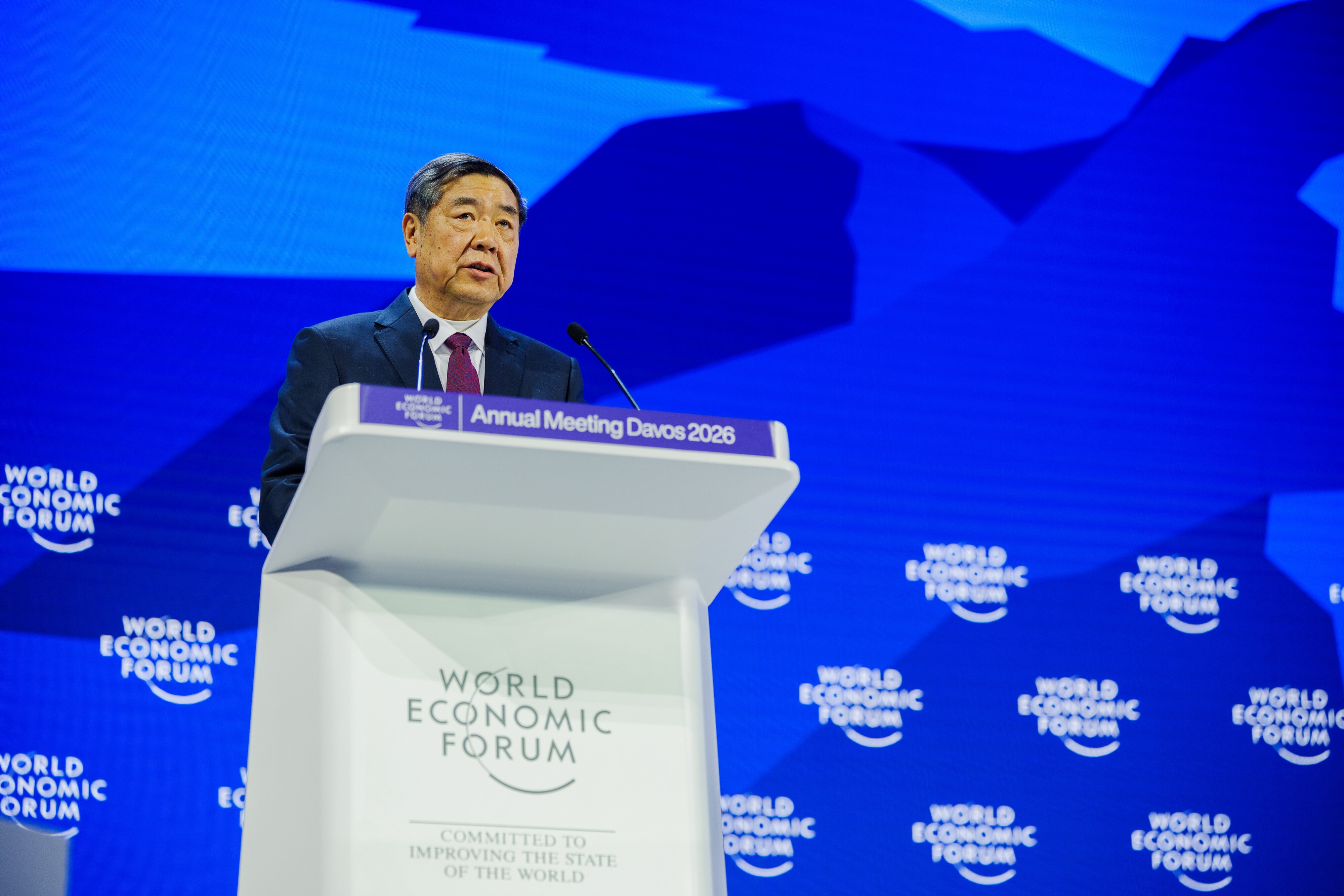
This blog contains the full transcript of a Special Address by He Lifeng, Vice-Premier of the People’s Republic of China, delivered at the World Economic Forum Annual Meeting 2026 in Davos. Image: World Economic Forum/Boris Bal
- This blog contains the full transcript of a Special Address by He Lifeng, Vice-Premier of the People’s Republic of China, delivered at the World Economic Forum Annual Meeting 2026 in Davos.
- He Lifeng cautioned against rising unilateralism and protectionism, urging countries to board the “giant ship” of globalization.
- Economic development is not a zero-sum game, he emphasized, even as progress toward the SDGs slows.
This transcript was produced using AI and subsequently edited for style and clarity. The edits do not alter the substance of the speaker’s remarks.
It gives me great pleasure to join you in beautiful Davos for the World Economic Forum Annual Meeting under the theme A Spirit of Dialogue. It is timely that we listen to each other, learn from each other and build stronger trust with each other.
In 2017, facing backlash against globalization, President Xi Jinping gave an incisive answer to the questions: What has gone wrong with the world, and what should we do about it here in Davos? As he pointed out, any attempt to channel the waters in the ocean back into isolated lakes and creeks is simply not possible. It runs counter to the historical trend.
His important speech offered much enlightenment, and brought the world some sunshine, as the World Economic Forum described it. In 2021, President Xi proposed that we should let the torch of multilateralism light up humanity's way forward. One year later, on the major question of how to rebuild from COVID, President Xi underscored that amidst the raging torrents of a global crisis, countries are not riding separately in some 190 small boats, but are rather in a giant ship on which our shared destiny hinges.
Over nine years, guided by President Xi's important remarks, China has consistently acted on the vision of a community with a shared future and remained steadfast in supporting multilateralism and free trade. Today, President Xi's insights continue to resonate and remain as inspiring as ever.
As we speak, a transformation not seen in a century is accelerating across the world. Rising unilateralism and protectionism compounded by the impacts of regional conflicts and geopolitics are bringing new changes to the global economic and trade order. In particular, since last year, tariff and trade wars have inflicted significant shocks on the world economy, most seriously to multilateralism and free trade.
In response to world changes and the dynamics of the times, President Xi has put forward a global development initiative, a global security initiative, a global civilization initiative and, last year, the global governance initiative. We're upholding consensus and solidarity, and cooperation over division and confrontation, and providing China's solutions to the common problems of the world.
In light of the current situation, I wish to share a few observations. We should firmly support free trade and jointly promote a universally beneficial and inclusive economic globalization. Economic globalization – driven by international specialization, collaboration, complementary strength and the pursuit of win-win – is a prevailing trend of history. It has benefited many countries, including China, and enabled them to achieve fast development. On the contrary, tariff and trade wars have no winners. Beyond driving up costs for production and trade, they fragment the world economy forward and disrupt the global distribution of resources.
WTO data shows that the share of global trade under most-favoured-nation terms has dropped from 80% at the beginning of last year to 72%. The IMF estimates that economic fragmentation can reduce global economic output by about 7%. That is in no country's interest.
While economic globalization is not perfect and may cause some problems, we cannot completely reject it and retreat to self-imposed isolation. The right approach should be, and can only be, to find solutions together through dialogue and steer economic globalization in the correct direction.
China advocates a universally beneficial and inclusive economic globalization. We are committed to building bridges, not walls. We will firmly support trade and investment, liberalization and facilitation, and continue to share development opportunities with the world. We will work with all parties to create a bright future of prosperity and development, where every country and every community shares the dividends of development.
Second, we should firmly safeguard multilateralism and make the international economic and trade order more just and equitable. The multilateral trading system now faces the most serious challenges in years. The unilateral acts and trade deals of certain countries clearly violate the fundamental principles and principles of the WTO, and severely impact the global economic and trade order.
As President Xi Jinping noted, at difficult times, we must uphold our original commitment to peaceful co-existence and strengthen our confidence in win-win cooperation. Multilateralism is the right way to keep the international order stable and promote humanity's development and progress. The rules must apply equally to everyone. A handful of countries should not enjoy privileges based on their strength, and the world must not return to the law of the jungle, where the strong will eat the weak. Every country is entitled to defend its legitimate rights and interests.
Since joining the WTO, China has strictly followed the organization's rules, earnestly fulfilled its commitments and taken voluntary steps to contribute more. Last year, it solemnly announced that it will not seek new, special and differential treatment in current and future negotiations at the WTO.
China will continue to firmly uphold the WTO-centred, rules-based multilateral trading system and firmly supports the reform of multilateral institutions, including the WTO and the IMF, with a view to enhancing the authority, effectiveness and inclusiveness of the multilateral trading system and increasing the representation of the Global South and developing countries. China is glad to see countries reach trade agreements that are mutually beneficial. But these agreements should comply with WTO rules and not undermine the interests of third parties. We should pursue win-win cooperation, work together to make the pie bigger and jointly resolve development issues.
Currently, world economic growth is lacking momentum. The IMF forecasts global growth at 3.1% for 2026, which is below the pre-COVID average of 3.7%. What is more worrying is that unfairness continues to grow, and sustainable development is facing severe challenges. According to a UN report, two-thirds of Sustainable Development Goals will not be met by 2030.
The pursuit of development should not be you-lose, I-win, zero-sum game. Rather, every party should play its part and get its fair share. Making the pie bigger together is more important than fighting for the pie. And solving problems together is more effective than blaming each other. China is committed to fostering common prosperity with its trading partners through its own development, and making the pie bigger for the global economy and trade. We never seek trade surplus; on top of being the world's factory, we hope to be the world's market too. However, in many cases, when China wants to buy, others don't want to sell. Trade issues often become security hurdles.
On the other hand, services now account for two-thirds of global GDP. China has recorded a large deficit in its services trade over the long term. But it never feels taken advantage of. We will give full play to our super-sized market, step up our efforts to expand imports and strengthen industrial cooperation so that countries can better share in China's opportunities.
Fourth, we should uphold mutual respect and equal-footed consultation, and manage differences and solve problems through dialogue. Last year, economic and trade relations between China and the United States went through some ups and downs. Guided by the common understandings of the two presidents, from their meeting in Busan and four phone calls, Chinese and US teams had five rounds of consultation and economic trade issues. Following the principles of mutual respect, peaceful coexistence and win-win cooperation, they properly handled some outstanding issues and kept the economic and trade relationship generally stable.
Facts have demonstrated once again that China and the United States will gain from cooperation and lose from confrontation. And that they should and can help each other succeed and prosper together. The trade talks also show that as long as the two sides engage in equal, free consultation and work in the same direction, there will always be more solutions than problems.
To be frank, it's normal for countries with different social systems, status development, histories and cultures to encounter divergences and frictions as they develop and interact. At times, these are just misunderstandings. The key is to uphold the spirit of equality, respect mutual benefits, build trust through dialogue, and to resolve disputes through consultation.
Instead of looking for answers through confrontation or antagonism, we must find a way out through communication and consultation, and explore the path of win-win and all-win. China is a trading partner, not a rival, for other countries. China's development presents an opportunity, not threat, to the world economy. When it comes to differences and misunderstandings in international economic and trade cooperation, China calls for equal consultation to enhance mutual trust, bridge differences and solve problems.
Ladies and gentlemen, friends, over the past five years, the Chinese economy has made steady progress. We have deepened reform in opening up, continued to expand the consumer market, made solid headway in developing new quality productive forces, and accelerated the green and low-carbon tradition. With average annual growth rates of around 5.4%, China's economy has expanded to over CNY140 trillion, contributing approximately 30% to global economic growth.
Over the past five years, China has imported more than $15 trillion of goods and services. Its overseas investment has generated over $300 million of tax revenue, created numerous jobs and boosted local economies. The Chinese economy is on solid foundations, demonstrating advantages in many areas, strong resilience and great potential. China's development has been achieved mainly through reform, opening up and innovation, rather than so-called government subsidy.
Admittedly, we do face some old and new problems and challenges. They are predominantly the growing pains of our development and transition, and we are working hard on them. We are fully confident and capable of tackling all kinds of risks and challenges. Last October, the 20th Central Committee of the Communist Party of China held its fourth plenary session and adopted the recommendations for the 15th Five-Year Plan, laying out the top-level design and strategic blueprint for China's economic and social development in the next five years.
China will further apply the new development philosophy of innovative, coordinated, green, open and shared development preferred by President Xi Jinping, work faster to provide a new development paradigm with domestic circulation as the mainstay, and the domestic and international circulation reinforcing each other. To fully tap into the potential of our super-sized market,with 1.4 billion people, and strive for new progress in high-quality development.
We will improve our market rules and institutional safeguards, and provide more opportunities for all other countries. China will actively expand domestic demand and share with the world the opportunities in its vast market. Currently, China is the world's second largest consumer market, and in many segments, such as automobiles, mobile phones and home appliances, it is already the largest one. But its capital consumer spending is still below that of developed economies. As China's middle-income group continues to grow, there will be more diverse needs for higher quality of life, which means immense potential for consumption.
China has put domestic demand on top of its economic agenda this year, and is working faster on a income-growth goal for both urban and rural residents, to vigorously boost consumption and make itself a consumption powerhouse on top of a manufacturing powerhouse. China will continuously promote investment in both physical assets and in human capital, actively expand investment and consumption in such areas as education, medical services and elderly care, to create more space for consumption. We will continue to host events such as the China International Import Expo, further expand import, and encourage more quality products from across the globe to enter the Chinese market.
We encourage business from around the world to seize the opportunities presented by our expanding domestic demand to provide more and better products and services, and further explore China's consumer market, so as to gain a headstart in the fierce international competition. China will steadfastly expand, open up and share with the world the opportunities from its high-standard opening-up.
Reform and opening-up is China's fundamental state policy. China will open its doors still wider to the world. It will actively expand and voluntarily open up, align with the high-standard international economic and trade rules, expand market access and open more areas, particularly in the service sector, and step up our efforts to attract and utilize foreign investment. China will continue to foster a market-orientated and world-class business environment, provide equal treatment for both domestic and foreign enterprises and make the demand list of businesses a service list of the government. Should foreign enterprises encounter any problems in China, please do not hesitate to inform us – and we will actively address them.
China is committed to deepening international industrial specialization and collaboration, keeping global industrial supply chains secure and stable, and building a global market of shared benefits. We welcome foreign enterprises to invest in China and share in China's opportunities. We also hope governments of other countries can provide a fair, non-discriminatory, transparent and predictable investment environment for Chinese enterprises.
China will accelerate sci-tech innovation and share with the world opportunities from its innovation-driven development. The latest round of technological revolution and industrial transformation is unfolding at a faster pace, creating new historical opportunities. Innovation is an essential engine for China's high-quality economic development and Chinese modernization, mostly underpinned by modernization in science and technology. Currently, China has the biggest number of researchers and international patent applications. There are diverse scenarios for application, and a sound environment for innovation.
And now AI is powering various sectors. China will continue to promote full integration between technological and industrial innovation, strengthen the protection and application of intellectual property rights, and stimulate the mentality of all innovators. Scientific and technology progress cannot be achieved without international cooperation, and innovation brings both opportunities and risks. China is ready to work with all other countries in a spirit of openness and cooperation to advance sci-tech innovation, empower the world economy and address global challenges in such areas as AI governance.
China's innovation journey not only serves itself but also benefits the world. We welcome companies from around the world to deepen cooperation with China on innovation and share in the opportunities presented by innovation-driven development. China will pursue green development and share with the world the opportunities from green and low-carbon transition.
At a UN climate summit last September, President Xi Jinping solemnly announced China's nationally determined contributions for 2035. This is the first time that China has put forward an absolute emissions reduction, which is a testament to China's firm resolve and maximum effort. China has put in place the world's largest renewable energy system and the most complete new-energy industrial chain. We will control both the total amount and intensity of carbon emissions across the board and strive to achieve carbon peaking before 2030 and carbon neutrality before 2060.
China will work with all other parties to fully and effectively implement the UNFCCC and Paris Agreement, uphold the multilateral process on climate change, and actively promote global green and low-carbon development. China will work with all parties to foster closer partnerships for green development, address the shortfall in green production capacity, and ensure the free flow of quality green products globally. We invite entreprises from all over the world to embrace the opportunities from the green and low-carbon transition, and work closely with China in such areas as green infrastructure, green energy, green minerals and green finance, and jointly create a green and prosperous future.
Ladies and gentlemen, friends, the wisdom of Davos lies in dialogue, and the future of the world hinges on cooperation. As President Xi noted, for us to break through the mist and embrace a bright futur, the biggest strength comes from cooperation and the most effective way is through solidarity. Let us uphold the vision of a community with a shared future for humanity, carry forward a spirit of dialogue, enhance openness and cooperation, and steer the giant ship of the world economy steadily forward on the vast blue ocean, breaking all winds and waves. Let's build a better future for all – I wish this Annual Meeting a full success. Thank you.
Don't miss any update on this topic
Create a free account and access your personalized content collection with our latest publications and analyses.
License and Republishing
World Economic Forum articles may be republished in accordance with the Creative Commons Attribution-NonCommercial-NoDerivatives 4.0 International Public License, and in accordance with our Terms of Use.
The views expressed in this article are those of the author alone and not the World Economic Forum.
Stay up to date:
China


Forum Stories newsletter
Bringing you weekly curated insights and analysis on the global issues that matter.
More on Forum in FocusSee all

Kaya Bülbül and Kate Whiting
January 30, 2026


