Davos 2026: Special address by Prabowo Subianto, President of Indonesia
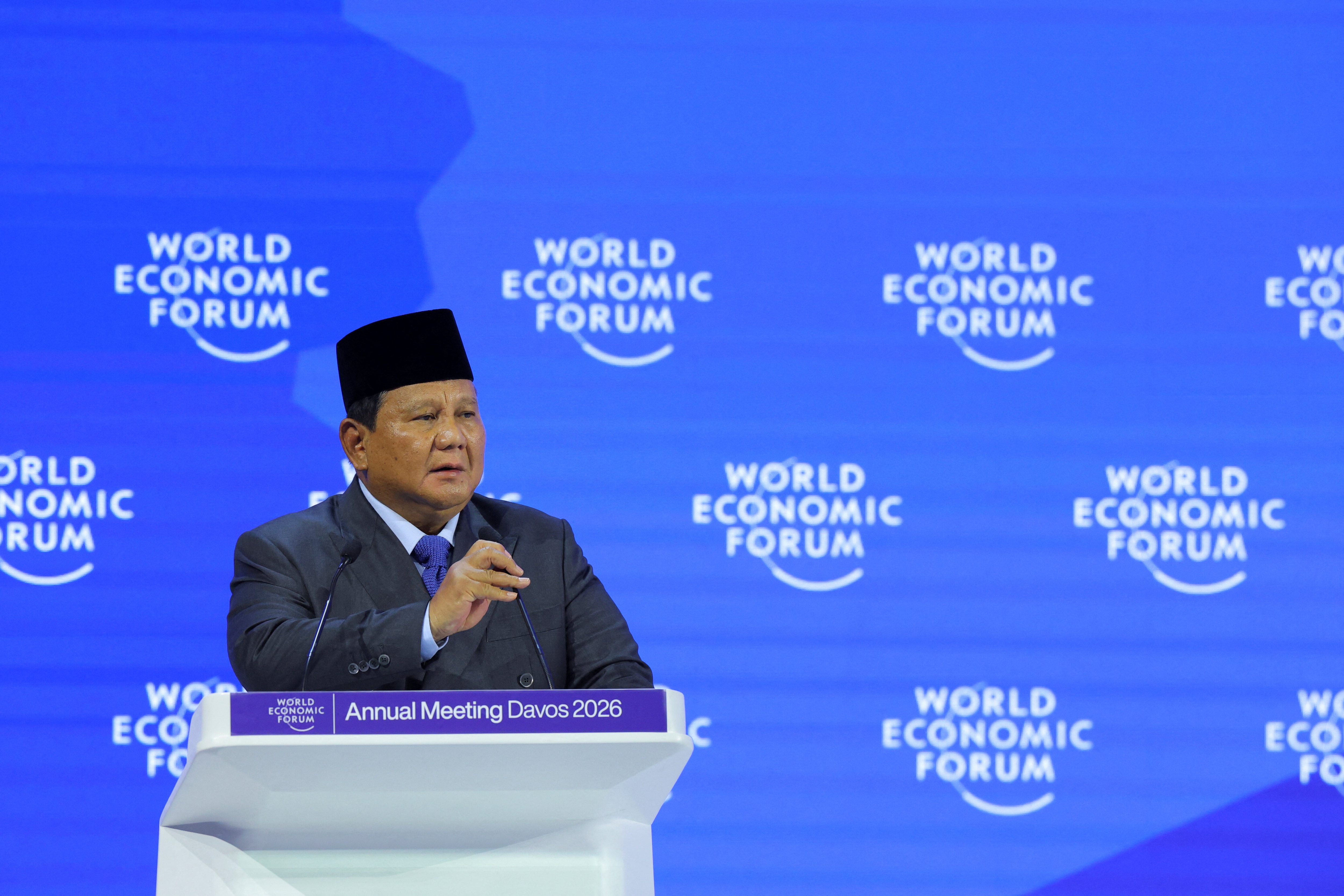
'I want to cut the chain of poverty' … Indonesia's President Prabowo Subianto addresses the 56th annual World Economic Forum (WEF) meeting in Davos. Image: Reuters/Denis Balibouse
- This blog contains the full transcript of a special address by President Prabowo Subianto of Indonesia delivered at the World Economic Forum's Annual Meeting 2026 in Davos.
- He highlighted his social policies since taking office such as free medical checks, nutritious meals for mothers, infants and the elderly, and school-building programmes.
- He also spoke of the new "Danantara" sovereign wealth fund, Indonesia's fiscal credibility, his fight against corruption labelling it "greedonomics".
This transcript was produced using AI and subsequently edited for style and clarity. The edits do not alter the substance of the speaker’s remarks.
Distinguished president and CEO of the World Economic Forum, Børge Brende; ladies and gentlemen, we gather here in Davos at a time of great uncertainty, a time when wars continue to break out, a time when trust between nations, between institutions, between peoples is fragile. History teaches us peace and stability are most valuable assets. Peace and stability are the ultimate prerequisites for growth and prosperity. There will be no prosperity without peace.
Excellencies, distinguished delegates, the IMF recently described Indonesia as a "global bright spot with strong economic growth amid a challenging economic environment". While the world faces tightening financial conditions, trade tensions and political uncertainty, Indonesia continues to grow. Indonesia's economy has grown by more than 5% every year over the last decade, and I'm confident that this year our growth will be higher. Our inflation remains at around 2%, our government deficit is now cut below 3% of our GDP.
International institutions did not praise us because of unfounded optimism. They did so because of evidence. They recognized that Indonesia's economy is resilient. Our policies have been, and will always, well-calibrated. Peace and stability in Indonesia over the years did not happen by chance. Peace and stability in my country did not happen by luck. It happened because we, Indonesia, have and will always continue to choose unity over fragmentation, friendship and collaboration over confrontation. And, always, friendship over enmity.
Our credibility, hard-earned over many years, has been protected. Credibility, once lost, is very expensive to regain. Indonesia has never once in our history defaulted on payments of our debt. Not once. Succeeding regimes always pay the debts of the preceding regime. Successive presidents will always honour the debts of the previous administration.
Excellencies, distinguished friends, in addition to requiring peace and stability, growth requires statecraft and capital; in particular, the efficient allocation and reallocation of capital. That's why, last February, we established our sovereign wealth fund: Danantara Indonesia. Danantara means the energy to power the future of Indonesia. Danantara is a sovereign wealth fund with $1 trillion in assets under management. With Danantara, I can stand here in front of you as an equal partner. Indonesia is now not a land of peace and stability; Indonesia now is more and more the land of opportunity. Once again, I mentioned that I am convinced that our growth of our economy will be significantly surprising to many in the world.
With Danantara, Indonesia is now able to be your partner. We will co-invest and grow with you. Danantara is established to finance and co-finance the industries of the future. We are determine to industrialize our country in a significant way. The industries of the future must be executed well and wisely. That is why we built Danantara with strong oversight and institutional responsibility, and we tried to find the best executives to direct the leadership of Danantara. Danantara now manages 1,044 state-owned enterprises. We are going to bring this down to at most 300. We will rationalize, we will get rid of inefficiency, we want the best governance and the best management under international standards. I have allowed Danantara to recruit expatriates, foreign citizens, to be able to lead these companies. We want the best brains and the best minds in the world.
This is, in fact, how we run Indonesia now, from our social programmes to our efforts to downstream our natural resources, to our efforts to reach self-sufficiency in food and energy. All are now accompanied by strong oversight and capable leaders. In the first two months of my administration, we carried out a vigorous, efficiency programme. We saved $18 billion by stopping inefficient and dubious programmes from our budget, and redirected these funds to projects that directly improve livelihoods and impact all of society.
As a result, on 6 January 2025, we started our free nutritious meals programme for pregnant and lactating mothers, infants and all Indonesian children. On our first day, we started with 190 kitchens serving 570,000 meals per day. Today, in one year, we have achieved 21,102 kitchens serving nationwide. As of last night, we are producing 59.8 million meals for 59.8 million children, mothers and elderly living alone. They receive these meals every day.
To put this into context, in about a month's time, we will surpass McDonald's: 68 million meals a day. We started in January of last year; this year, we aim to serve 82.9 million meals a day. All Indonesian children, from their mothers' wombs up until 18 years of age, benefit from this programme. For pregnant and lactating mothers, we deliver the meal daily to their home, as well as for the elderly living alone. To put this into the context I mentioned, I think McDonald's started their first kitchen in 1940. To reach 68 million, it took them five decades more. We will reach 82.9 million, I hope, by the end of December 2026. But my people said: "no sir, we will reach 82.9 before December". So hopefully we will achieve this.
In addition to strengthening our children, our free meals strengthen our economy. More than 61,000 micro, small and medium-sized enterprises and cooperatives are now a part of this supply chain. We are creating more than 600,000 jobs, just at the kitchens. At its peak, we are optimistic it will reach 1.5 million direct jobs. With vendors, with suppliers, there will be another more than 1 million livelihoods embraced and improved. This is why I am convinced that our growth will reach impressive numbers.
Our social policies must expand productivity and produce growth. Today, 70 million Indonesians receive free medical checkups, and they will receive free medical checkups once a year for the rest of their lives. And this will increase to all the children and the adults of Indonesia. We are providing free medical checkups to all citizens of Indonesia. This is not a populist programme; this is a rational programme to save money. By detecting illness and disease at an early stage, we will save much more in the long-term in treatment. This actually is a productivity improvement programme that in the long run will save many billions of dollars.
Last year, for instance, we renovated 16,140 schools. We equipped 288,000 schools, each with one 75-inch interactive flat panel as part of our digitalization of our education programme. This year, we will add another 1 million of these interactive smart panels, so that every school will have at least three to four classrooms with them. And we hope that within three years, all Indonesian schools will have at least six classrooms with digital interactive panels.
That means that I, for instance, in Jakarta can drop in on any school, and can see the quality of teachers. I can see the reaction of the children. And in the next first weeks, we have seen the enthusiasm of the children and the teachers, of the villagers. Many of them cry when they see the panels coming in. We get messages: Mr President, in the entire history of this village, we have never felt that the central government knows about us. This is the first time we feel the central government cares about us and is now in our village, is now helping to teach our children. This is, for me, heartwarming because what we are doing is empowering the future generation of Indonesians.
Why does this matter to global investors gathering here at the World Economic Forum? Because I am of the conviction that human capital determines long-term growth, long-term returns. Human development, human resources are the key to thriving and successful nation. Lack of education is the path towards failed states. No country can hope to be stable and prosper if its people are illiterate, are not able to keep up with modern science and technology.
In addition, this year, we will increase the renovation and are determined to modernize and renovate 60,000 schools. I am also building 1,000 schools – what I call integrated, comprehensive schools with modern facilities, modern laboratories. I have built 160 boarding schools for the very poor, so this is maybe unique, because it is usually the children of the upper class and wealthy who go to boarding school. But I now make boarding schools for the very poor. Their only condition for entering the school is that they must come from the bottom deciles of our society.
I want to cut the chain of poverty. In countries such as mine, countries of the Global South, countries coming out of hundreds of years of colonialism, usually the son of a poor peasant will be a poor peasant. The son of a garbage collector will be a garbage collector. The son of a street hawker will be a street hawker. The son of a day labourer in the harbour will also be a day labourer in the harbour. In the Global South, this is what we call the circle of poverty.
I am determined to break the circle. I am determined that the son of the poorest should not be poor. They must be given equal opportunity. And that's why I built 166, and I will build a total of 500 of these boarding schools. And another 500 centres of excellence to boost bright children. Also, I've started 20 new boarding schools for the academically gifted, I'm also building 10 new universities, and I'm discussing and negotiating with the best universities of Europe, the United Kingdom and North America to twin them and produce universities and campuses of international standard. In addition, we are now in the process of building 83,000 cooperatives with 83,000 warehouses, 83,000 cold-storage units, 83,000 minimarkets, 83,000 village drugstores selling generic medicine and subsidized goods direct to the villagers, without intervention from too many middle men.
We're also going to modernize what we call the new fishing villages. We will be build at least 1,000 this year, but we actually want to allocate funds for 5,000 villages. Each village will have 2,000 fishermen; we hope to impact 10 million fishermen. With their wives and their children, this will impact at least 40 million Indonesians. We have started a pilot project in Biak, in Papua, and the result is very heartening. The average increase in their livelihood is a 60% annual increase. Why? Because before, to get ice was impossible for them. There was no ice-making factory near their villages. To get diesel, they had to go very far. We will build diesel stations in every village. They will have very easy access.
Ladies and gentlemen, let me say this clearly. There is no investment climate without the certainty of equitable rule of law. Nobody will come in to invest in a country that's lawless or of dubious legal tradition. I am determined, under my administration, to ensure the rule of law. The rule of law must prevail over any vested interests. In 2025, Indonesia, as I promised, confronted corruption directly, firmly and openly. As with any person dealing with an illness or disease, we must have the courage to acknowledge what we're suffering from. We are determined to directly fight against this corruption. It's challenging; not many people believe we can do it, but we have no choice.
I have no choice. I have been inaugurated, I have been sworn in to uphold the constitution and the rule of law. In my first weeks in government, we uncovered massive abuse in fuel and crude-oil governance. In all sectors of the economy, we found illegality, illegal practices. In the first year of my administration, we have already confiscated 4 million hectares of illegal plantations and mines. It is amazing: I don't call this free enterprise, or the free market.
I called it openly greedonomics. The economics of greed, the economics of rapacious practices. Maybe in many of your countries, there was a period like this; a period of the robber barons. I have confiscated 4 million hectares, but two days ago, I led a cabinet meeting by Zoom from London, and we decided to revoke the licenses of 28 corporations that had licences over 1.01 million hectares. Because we found them violating laws. They were building plantations on protected forests. This is a flagrant undermining of the rule of law. Perhaps these rapacious so-called entrepreneurs feel that they need not recognize the sovereignty of the Indonesian government. Or perhaps they feel they can buy all Indonesian government officials. I have reports that some of these people in their meeting say: it's OK, there is no government official that cannot be bought. Well, I challenge them to try and buy officials from my administration. They're in for a big surprise.
Combined with the 4 million hectares of plantations already confiscated, we have in fact enacted the boldest, the most daring forest law-enforcement effort in the history of Indonesia. Up to now, we have closed 1,000 illegal mines. But my staff, my people, report to me: Sir, there are at least another 1,000 or more. There could be as many as 666 corporations that violate the law. So I say: What can we do? We can only have the courage to enforce the law. There can be no compromise, there can be no turning back. My people demand this, and we are determined to serve our people honestly. I am determined to uphold my oath to defend the constitution of my country and enforce the law of the land.
You might not have heard our story, because we are not flamboyant people. We are low-key, we tend to be below-the-radar. But we are very determined in our effort to keep up with the rest of the world. You might not have heard this story, but extreme poverty in Indonesia fell to its lowest level in history. I am determined in the next four years to eradicate extreme poverty, and we will reduce poverty as a whole. That is my life's mission, for the remaining years of my life. There is nothing more honourable, there is nothing more satisfying than bringing down poverty and eradicating hunger.
There is a saying I learned from my elders. One of them, a very wise man, very honest political leader, told me: Prabowo, the duty of a leader is very simple. If you want to be leader of this country, you must work so that the poor and the weak can smile and can laugh. Very simple – but what does it mean that the poor and the weak can smile and can laugh? That means they have hope. That means they see a future. That means their livelihood is being improved. That's my mission now: to make the poorest and weakest of Indonesians smile. I think a part of this is we must combat corruption, manipulation, malfeasance.
Ladies and gentlemen, a few days ago I was surprised that Gallup poll and Harvard University found in a research study of hundreds of countries that the Indonesian people are the happiest. The most flourishing country, with the most optimistic people. This was heartening, but also for me a bit sad. I know my people. Many of them live in shacks. Many of them do not have clean water. Many of them do not have bathrooms. Many of them eat rice with salt. And yet, they smile. And yet, they have hope.
We also achieved self-sufficiency in rice. For the first time in many years, our rice production is the highest in the history of Indonesia. I gave a target to be self-sufficient in four years. I gave a target to my team; they did it within one year. I am convinced in the next four years we will be self-sufficient in the other food products: corn, sugar, protein.
Excellencies, distinguished delegates, Indonesia does not fear economic integration. We have been a trading nation for hundreds of years. We conclude trade agreements now; not because it is fashionable, but we consider it necessary. We believe in the concept of win-win. Last year, we signed free trade agreements and comprehensive economic partnership agreements with Europe, the EU, Canada, Peru, Eurasia. I have just visited the United Kingdom to sign a new strategic partnership, also an economic growth agreement. We hope next year, we can conclude a complete comprehensive economic partnership agreement.
This is part of our strategy to deepen productivity, reduce barriers, unlock private sector growth for Indonesia, ASEAN and the Global South. We believe the trade integration when done fairly is not a threat to sovereignty. We believe trade is a tool for prosperity. Indonesia has a clear vision. We are determined to become a modern country, integrated with the global economy, providing good quality of life for its citizens, living free of poverty and hunger.
But we understand very well this cannot be achieved by slogans alone. It requires determination, good governance, clean government, free of corruption and malfeasance. And in the end, we must have efficient public administration. We must also enact a new culture in our bureaucracy. Our government must serve the general good and must not entrench itself in collusion with greedy and rapacious economic players. Achieving our mission also requires smart investments in infrastructure, simplifying rules and regulations, getting rid of too much red tape, and of course significant investments in health and education.
Distinguished delegates, friends, economic growth requires a dynamic private sector. Indonesia is and will always be open for foreign and domestic investment. And we realize the prerequisite for investment is political and economic stability. Also, the certainty of equitable rule of law, guaranteed by a strong, clean and democratic government. Indonesia today offers sustainable growth with stability.
We may be very low-key, we may be below the radar, we don't like to be flamboyant, to be bragging. We believe in evidence-based action. In fact, I was invited to speak last year here, and I declined. Why? Because had I come last year, I would have only been leading my administration for only two months. So what would I be able to say? I would only be able to give platitudes.
Today, I stand before you with confidence, with pride in our achievements. We have in one year achieved tremendous gains, tremendous reforms. We have wiped away hundreds and hundreds of regulations that do not make sense. Regulations that hinder fairness, that create the culture of corruption; hundreds of regulations wiped out in one year.
Ladies and gentlemen, peace and stability is a long and arduous programme. But if you want to take something from my talk today, maybe it should be this. Indonesia chooses peace over chaos. We want to be a friend to all. An enemy to none. One thousand friends are too few for us; one enemy too many. We want to be a good neighbour. A good, responsible citizen of the world, protecting the environment. Protecting nature. We must not destroy nature; we must live with nature. We must maintain and be part a future full of hope. Hope grounded in credibility. Execution of sound public policy and continuous record of growth with equity.
Let us build the world we want to live in together. Let us continue the journey to improve the quality of life for all, to live in peace, freedom, friendship, tolerance. Coexistence and cooperation for all races, all ethnicity, all religions. Let us continue our pursuit of justice for all, security and freedom for all.
I look forward to seeing many of you here in this room in Indonesia. Because in Bali this June, we will host the first Ocean Impact Summit, together with the World Economic Forum, which Indonesia is sponsoring, together with the important participation of Mr. Ray Dalio and his research vessel, Ocean X. There is a Space X, I think, from Mr. Elon Musk, but I think Mr. Ray Dalio is one of the pioneers in ocean research. And in Indonesia, being three-quarters sea, we are very concerned about the future of our ocean.
Ladies and gentlemen, thank you very much for your attention. May you go in peace with the blessing of the Almighty God. Wassalamu'alaikum warahmatullahi wabarakatuh. Shalom, om shanti, shanti om. May peace be upon us all.
Don't miss any update on this topic
Create a free account and access your personalized content collection with our latest publications and analyses.
License and Republishing
World Economic Forum articles may be republished in accordance with the Creative Commons Attribution-NonCommercial-NoDerivatives 4.0 International Public License, and in accordance with our Terms of Use.
The views expressed in this article are those of the author alone and not the World Economic Forum.
Stay up to date:
Indonesia


Forum Stories newsletter
Bringing you weekly curated insights and analysis on the global issues that matter.
More on Forum in FocusSee all

Kaya Bülbül and Kate Whiting
January 30, 2026


