How partnerships can help decarbonize food value chains
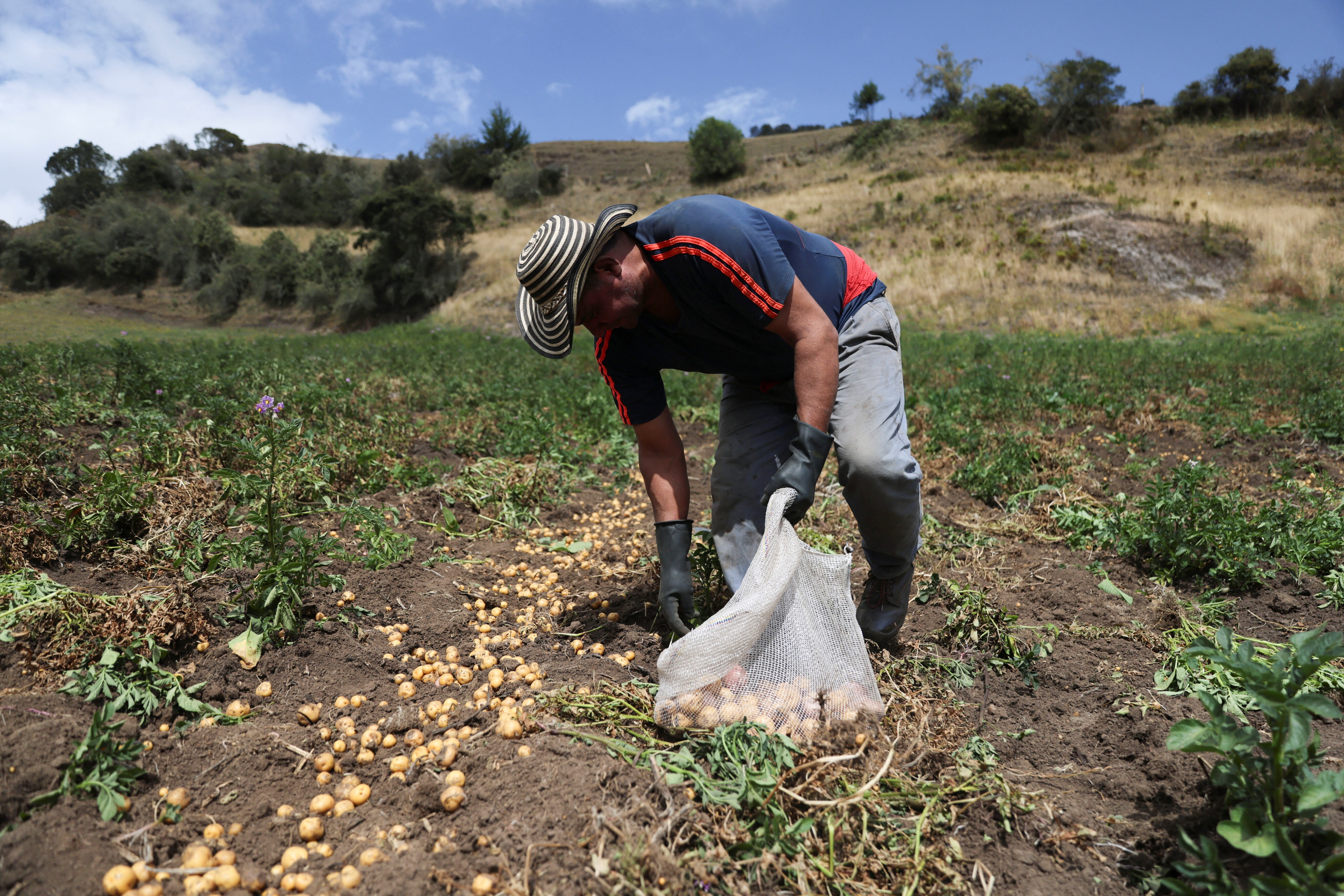
The food system contributes significantly to global greenhouse gas emissions. Image: Reuters/Luisa Gonzalez
- The world faces the dual challenge of meeting rising demand for nutrition while reducing the food system's impact on the environment.
- Addressing these challenges requires collaborative action, with targeted measures needed to accelerate emissions reductions in agriculture.
- One collaboration highlights how it is possible to reduce emissions in the food system, while maintaining yields and supply chain reliability.
The global food system faces an unprecedented challenge. Agriculture contributes significantly to global greenhouse gas (GHG) emissions, much of which is linked to upstream activities such as fertilizer production and on-farm nutrient use. Meanwhile, rising demand, climate pressures and geopolitical instability are straining the resilience of food supply chains.
Addressing these challenges requires collaborative action across industries and borders. Targeted partnerships are needed to help accelerate emissions reductions in some of the most challenging parts of the food value chain.
A partnership between Yara and PepsiCo demonstrates how collaboration can cut emissions in the food system while safeguarding yields and supply chain resilience.
The idea was straightforward: rather than simply replacing conventional fertilizers, the programme combines lower-carbon inputs – including lower-carbon fertilizers produced either from renewable or carbon capture and storage (CCS) ammonia, and nitrous oxide (N₂O) catalytic abatement technology – with soil diagnostics and data-driven nutrient management.
This helps ensure nutrients are used efficiently – reducing both upstream production emissions and in-field emissions – without undermining crop yields.
“Without collective action, the global food system is not going to change at the speed and scale needed. Our collaboration with Yara is a powerful example of what can help drive the necessary transformation. We have put farmers at the centre and are helping them scale regenerative practices, reduce emissions and build resilience across agricultural communities,” says Margaret Henry, Vice-President, Sustainable & Regenerative Agriculture at PepsiCo.
“By introducing low-emission fertilizer solutions and leveraging innovation, this collaboration helps accelerate progress toward a net-zero food system while supporting farmer livelihoods and strengthening food security. It’s collaborations like this and others that demonstrate how business, government and civil society can work together to deliver systemic change.”
On Yara’s side, the agreement reflects a broader ambition to supply food companies with lower-carbon fertilizer options, and to enable more sustainable agricultural practices.
"To transform our food system, we need to collaborate across the food value chain. We’re excited to work with first movers like PepsiCo to help make this a reality. Decarbonizing food production will be critical to delivering on the Paris Agreement, and farmers will play a key role in helping us get there,” says Benoit Lamaison, Senior Vice-President for Continental Europe and Product Strategy at Yara.
By mid-2025, PepsiCo and Yara extended this model to Mexico, Colombia, Chile and Argentina, initially focused on potato growers within PepsiCo’s supply chain.
The Latin American programme mirrors the European collaboration by offering lower-carbon fertilizers alongside agronomic support and digital farm monitoring. Early projects demonstrated potential 20-40% reductions in emissions per ton of potatoes, depending on crop system and fertilizer variant.
The geographic and climatic diversity of the rollout suggests a high level of replicability, which is a key requirement for global food system transformation.
Why fertilizer matters in helping to reduce emissions
Fertilizer is a major but often hidden contributor to emissions. Its production traditionally relies on fossil feedstocks and field-level nitrogen-use releases nitrous oxide, a potent greenhouse gas.
However, fertilizers are essential to food security, as nearly half the food produced in the world today depends on mineral fertilizers. Decarbonizing this segment of food production is therefore critical if the agri-food value chain is to help contribute to meeting the climate goals.
The Yara-PepsiCo model addresses emissions in two ways: by offering fertilizer manufactured with lower-carbon ammonia and N₂O catalytic abatement technology, while also encouraging efficient, data-driven nutrient management at farm level.
Clear demand signals help justify investments in lower carbon fertilizer production. Meanwhile, suppliers need customers willing to commit at scale to make those investments profitable. This buyer–supplier alignment is often missing in agricultural supply chains; it is however central to scaling decarbonization.
For farmers, the shift must make agronomic and economic sense: reduced carbon does not justify lower yields or higher costs. By pairing lower-carbon fertilizers with monitoring, advice, and existing supply-chain relationships, the approach limits risk for producers. The use of lower-carbon fertilizers does not require practice change.
A blueprint for change across the value chain
The experience so far generates clear takeaways for global food system actors:
- Procurement commitments can help accelerate upstream emissions reductions: Businesses with large agricultural footprints can play a role by working with suppliers and farmers to co-invest in lower carbon inputs, helping ensure that the transition is practical. This approach supports shared value creation rather than shifting the burden.
- Support matters, not just products: Offering fertilizers alone is not enough. Agronomic advice, soil diagnostics and digital tools are essential to help ensure adoption and effectiveness leading to improved nitrogen use efficiency (NUE) over time.
- Transparency and data underpin credibility: Well-designed digital crop and soil-monitoring systems enable reliable data and help assess real-world emissions reductions, which is critical for tracking progress toward climate goals.
- Scalability depends on replicability: The fact that the model moved quickly from Europe to Latin America, with different crops, climates and regulatory contexts, shows that with the right structure, it can be adapted widely.
Here’s what needs to go right for such an initiative to be successful:
- Farmer affordability: transition support and economic incentives remain essential.
- Clean ammonia production: requires investments in renewable hydrogen, CCS and enabling policies.
- Policy alignment across regions: divergent regulatory frameworks can slow global adoption.
- System-wide participation: systemic change requires multiple players, including business, government, and civil society, to work together to deliver systemic change.
- Market-based approach: drive scale and adoption through book and claim for production decarbonization.
A sustainable food system is key to reducing global emissions
The collaboration between PepsiCo and Yara International illustrates how decarbonization of food systems can move beyond pilot projects to structured, scalable collaborations.
By combining purchase commitments, lower-carbon inputs, agronomic support and data-driven monitoring, the collaboration addresses emissions where they are deeply embedded – not just in factories or logistics, but on the farm.
As climate constraints intensify and demand for food rises, approaches like this, which lower emissions without compromising productivity, will be increasingly central to a sustainable global food system.
If other actors follow suit, and if enabling conditions (policy, technology, economics) align, the collective impact on decarbonizing the global food system and reducing emissions could be substantial.
Don't miss any update on this topic
Create a free account and access your personalized content collection with our latest publications and analyses.
License and Republishing
World Economic Forum articles may be republished in accordance with the Creative Commons Attribution-NonCommercial-NoDerivatives 4.0 International Public License, and in accordance with our Terms of Use.
The views expressed in this article are those of the author alone and not the World Economic Forum.
Stay up to date:
SDG 17: Partnerships for the Goals
Related topics:


Forum Stories newsletter
Bringing you weekly curated insights and analysis on the global issues that matter.
More on Food, Water and Clean AirSee all

Michael Colarossi
April 7, 2026


