The Global Gender Parity Sprint to 2030: How we are scaling parity and opportunity for 1.5 million women

At the current rate, it will take 123 years to close the global gender gap. Image: Getty Images
- At the current pace, closing the global gender gap will take 123 years – roughly five generations – with disparities in workforce representation, pay and leadership hindering economic growth.
- Through collective public and private action, the Global Gender Parity Sprint has expanded opportunities for 1.5 million women, supporting access to skills, quality jobs, leadership pathways and inclusive work environments.
Gender parity: An economic imperative in a volatile world
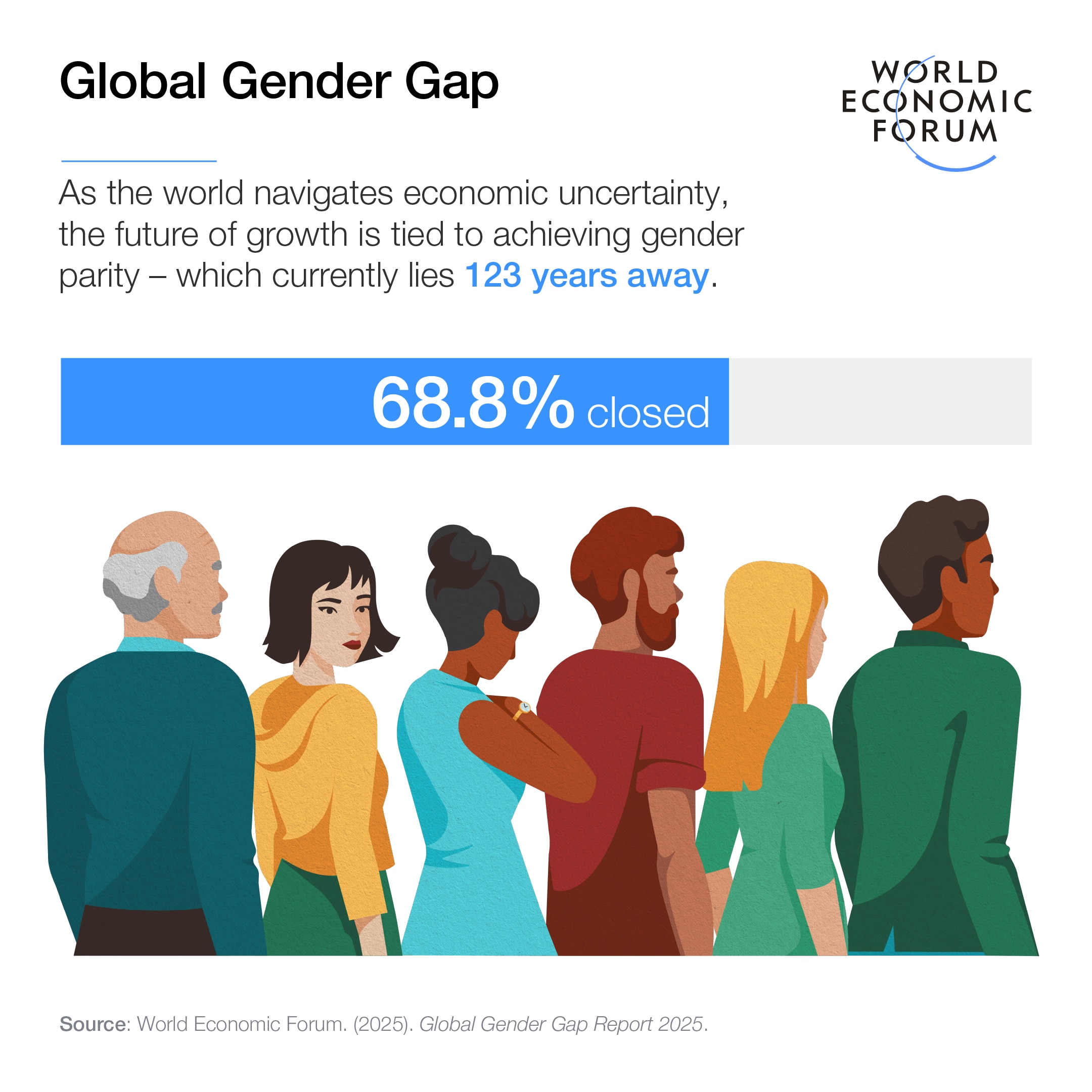
At the current pace, closing the global gender gap will take 123 years – roughly five generations – with disparities in workforce representation, pay and leadership hindering economic growth. Through collective public and private action, the Global Gender Parity Sprint has expanded opportunities for 1.5 million women, supporting access to skills, quality jobs, leadership pathways and inclusive work environments.
With heightened economic and geopolitical volatility, the global economy can’t afford to leave talent on the sidelines. Supporting women’s full economic participation has never been more important.
However, the 2025 Global Gender Gap Report highlighted that gender gaps persist across multiple economic dimensions, including labour force participation, pay and leadership in the public and private sectors.
At the current rate, it will take 123 years – approximately five generations – to close the global gender gap across education, health, economic participation and political empowerment.
Parity in economic participation and opportunity is projected to take even longer – 135 years – underscoring the urgent need for action. Without the full creativity, talent and innovation of half of the population, economic growth, business dynamism and societal resilience will remain suboptimal.
The World Economic Forum’s Global Gender Parity Sprint offers a platform for action, partnerships and innovation – uniting governments, businesses and civil society around a shared ambition: to reset the time to parity and deliver more inclusive economic growth.
Championing gender parity as a fundamental driver of inclusive economic growth
The Sprint is championed by a growing coalition of senior business, public sector and civil society leaders who recognize gender parity as a fundamental driver of inclusive economic growth and industry transformation. Representing diverse industries and regions, these champions help shape the Sprint’s strategic direction and mobilize collective momentum.
Supported by leading research and actionable insights, the Sprint is catalyzing a growing ecosystem of initiatives to close gender gaps in economic participation and opportunity. It surfaces, mobilizes and scales partner-led solutions that advance economic gender parity, while sparking new coalitions where action and investment are most needed.
Advancing public-private collaboration on gender parity
At the heart of the Sprint ecosystem, the Forum’s Gender Parity Accelerators have tackled challenges in 18 economies, including Argentina, Chile, Colombia, Costa Rica, Dominican Republic, Ecuador, Egypt, Guatemala, Honduras, Japan, Jordan, Kazakhstan, Kenya, Mexico and Panama.
In Latin America, the accelerators are implemented in collaboration with the Inter-American Development Bank and Agence Française de Développement (AFD). In 2025, new accelerators focused on the future of work and green transition were launched in Bahrain, Indonesia and Malaysia.
Through targeted action plans, accelerators have mobilized over $28 million to address systemic barriers to gender parity, working with 100 public sector organizations and 1,500 companies to advance workplace inclusion, future-ready skills for women and strengthen national care systems.
In Ecuador, the Crédito Violeta programme has enabled more than 4,000 women entrepreneurs to access loans from $500 to $3,000 from a $12 million annual fund. In Malaysia, the Accelerator is equipping 100,000 women with high-growth, future-ready skills and opportunities, particularly those returning to work after a career break.
Advancing gender parity through financial markets
Through the Global Future Council on Investing in Gender Parity, the Sprint is examining how innovations in capital markets can drive investments that create more gender equal economies. The council’s frontier white paper highlights the market opportunity as women become a major force in global wealth ownership.
Women will be central to a historic $83 trillion wealth transfer over the next two decades. Their investable wealth is projected to grow from $20.1 trillion in 2020 to $34.3 trillion in 2025, reaching $62.8 trillion by 2035.
This shift is expanding the investable frontier – unlocking new demand, surfacing new opportunities and strengthening returns through more diverse decision-making. Building on these insights, the Sprint is working with leading financial services providers to develop a new industry platform for action.
Advancing gender parity through AI transformation
The Forum’s Gender Parity in the Intelligent Age Insights Brief addresses the challenges and opportunities of an AI-driven economic transformation through a gender-parity lens.
Women remain underrepresented across the AI ecosystem, accounting for only 28.2% of STEM roles and 12.2% of STEM C-suite positions, and are disproportionately concentrated in roles vulnerable to automation. However, while limited diversity in AI design risks amplifying bias, inclusive and well-governed AI systems can help detect, mitigate and counteract it. The Sprint is engaging business and AI leaders to understand the current state of deployment of AI in the talent industry, common challenges and emerging best practices that support inclusive outcomes.
Building caring societies that enable economic participation
Care systems are critical for enabling women’s participation in the workforce. The Forum’s Global Future Council on the Care Economy has highlighted the policies, financing models and innovations needed to build more comprehensive and accessible national care systems.
On the ground, Gender Parity Accelerators are supporting policy reform and innovative public-private models for financing care.
In Colombia, research by the accelerator on the costs and benefits of expanding paternity leave led the government to introduce a two-week paternity leave allowance, one of the highest in the region.
As part of its action plan, Costa Rica introduced a national care policy that significantly expands its care system to cover pre-school children, the elderly and people with disabilities, so caregivers can better balance career and care responsibilities.
The accelerator also supported the piloting of a new care co-payment model in which companies, families and the government share the cost of childcare.
Get involved
With fewer than five years left to meet the Sustainable Development Goals of 2030, this is not a moment of retreat but of resolve. The opportunity before business and government leaders is not just to close the gap but to build an economy that is prosperous, resilient and fair.
Get involved and join a growing global community advancing gender parity through the Global Gender Parity Sprint.





Forum Stories newsletter
Bringing you weekly curated insights and analysis on the global issues that matter.