These are the top 10 risks in 2026: Geoeconomic confrontation ranks highest in 'age of competition'
Geoeconomic confrontation, mis- and disinformation and societal polarization make up the top three short-term risks, while environmental risks dominate in the long term. Image: Planet Volumes For Unsplash+
- The World Economic Forum’s Global Risks Report 2026 finds the world in an "age of competition", marked by fragmentation and confrontation.
- Both the short and long-term outlooks of leaders and risk experts predict "turbulent" to "stormy" times.
- Geoeconomic confrontation, mis- and disinformation and societal polarization make up the top three short-term risks, while environmental risks dominate in the long term.
- The report sets the agenda for discussions at the Forum's Annual Meeting in Davos (19–23 January 2026), which this year focuses on reestablishing 'A Spirit of Dialogue'.
After a year of geopolitical turbulence, technological transformation and challenges to multilateralism and its institutions, what can leaders expect in 2026?
The World Economic Forum’s Global Risks Report 2026, based on an annual survey of over 1,300 global leaders and consultations with risks experts, documents a distinct shift to an "age of competition".
While global risk momentum is continuing to spiral in speed, scale and scope, the report notes that "the future is not a single, fixed path but a range of decisions we make today as a global community." It describes a multipolar landscape emerging, marked by confrontation instead of cooperation and trust.
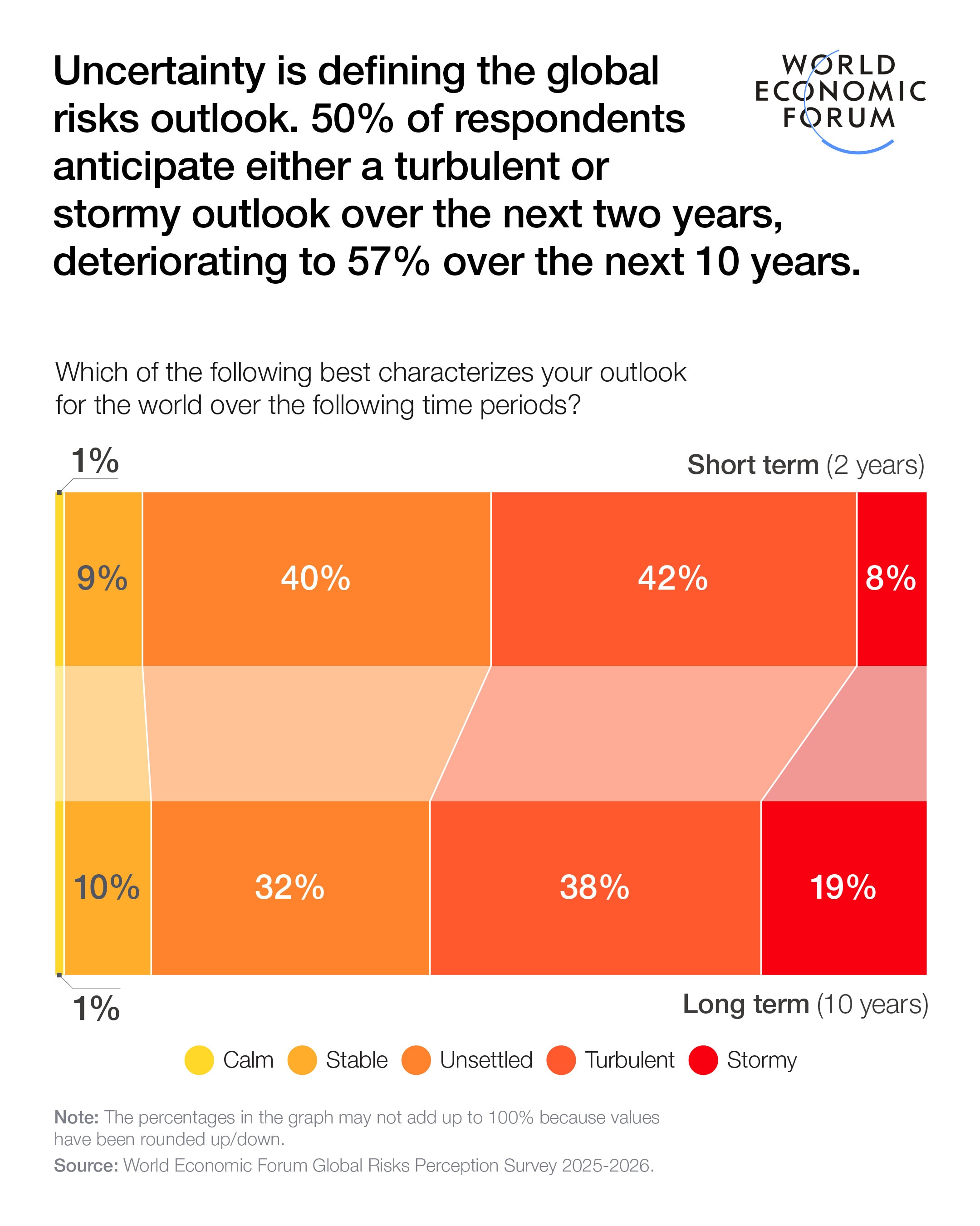
Uncertainty will remain the defining theme for the near future. Half of the respondents expect 2026 to be either “turbulent” or “stormy” in the next two years. Yet, as we take a 10-year risk perspective, this share expands to 57%, with nearly a fifth anticipating 'global catastrophic' risks in the offing.
Here are some of the key findings.
Geoeconomic confrontation threatens multilateralism
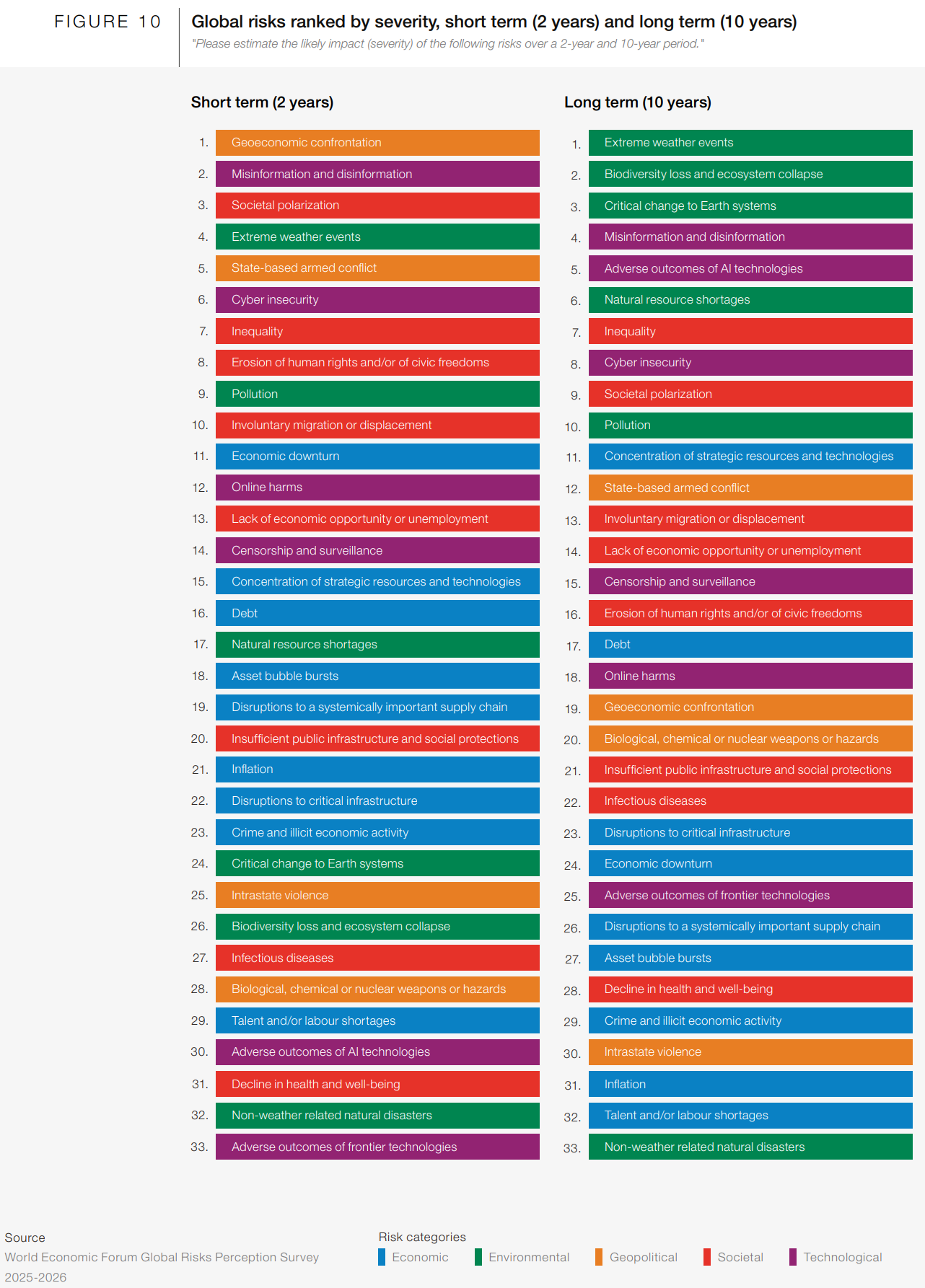
With the long-established multilateral global system under stress, geoeconomic confrontation is now top of mind for leaders and risk experts in 2026. This involves challenges to trade, investment, supply chains and access to natural resources. And it has pushed “state-based armed conflict” – last year’s highest-ranked risk – into second place.
While we may be getting used to tariffs, there is a risk for geoeconomic confrontation to turn into full-scale economic war with port blockades, export restrictions for key goods, cancelled contracts and capital controls, to name just a few.
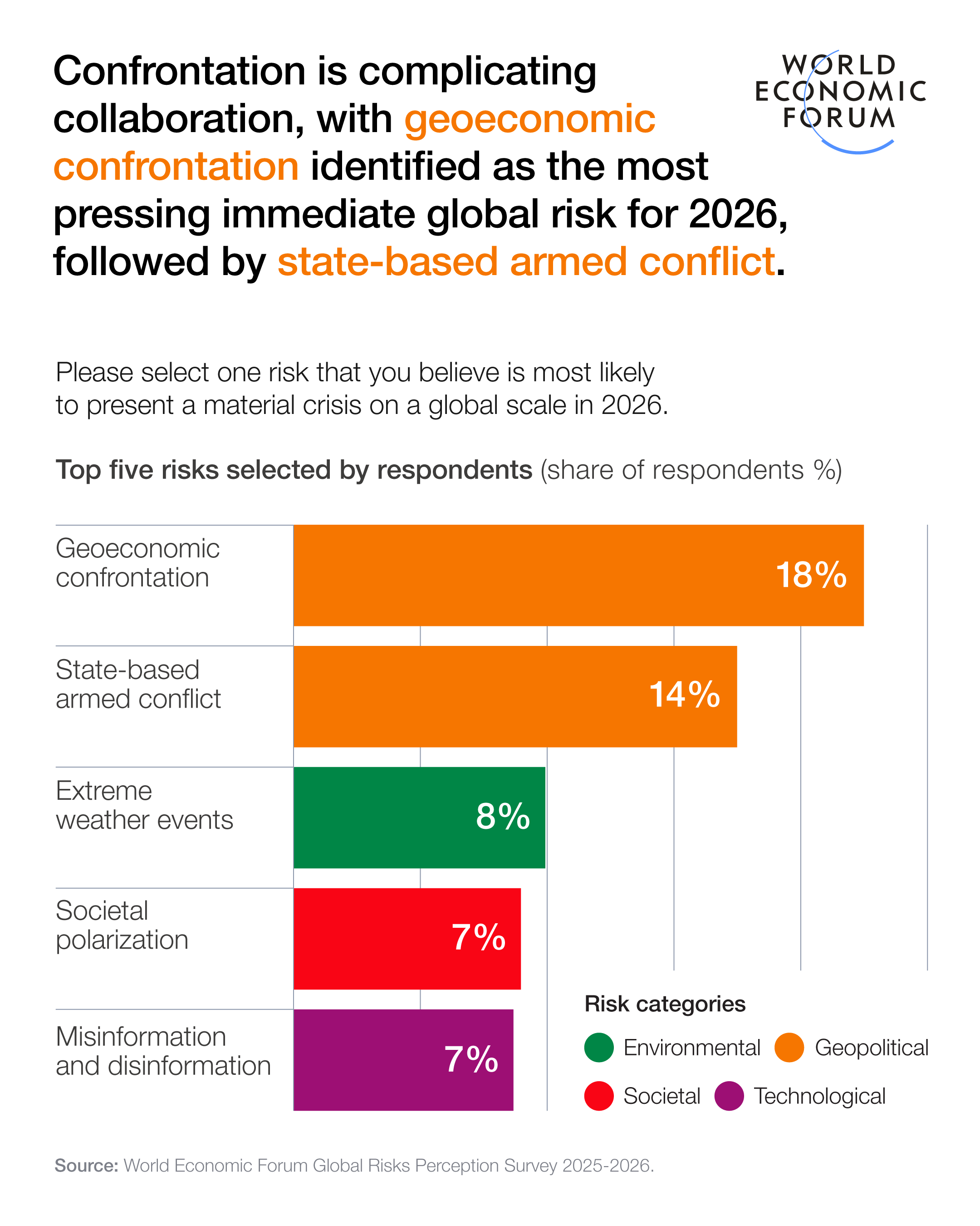
Extreme weather, societal polarization and mis- and disinformation complete the top five perceived risks for this year.
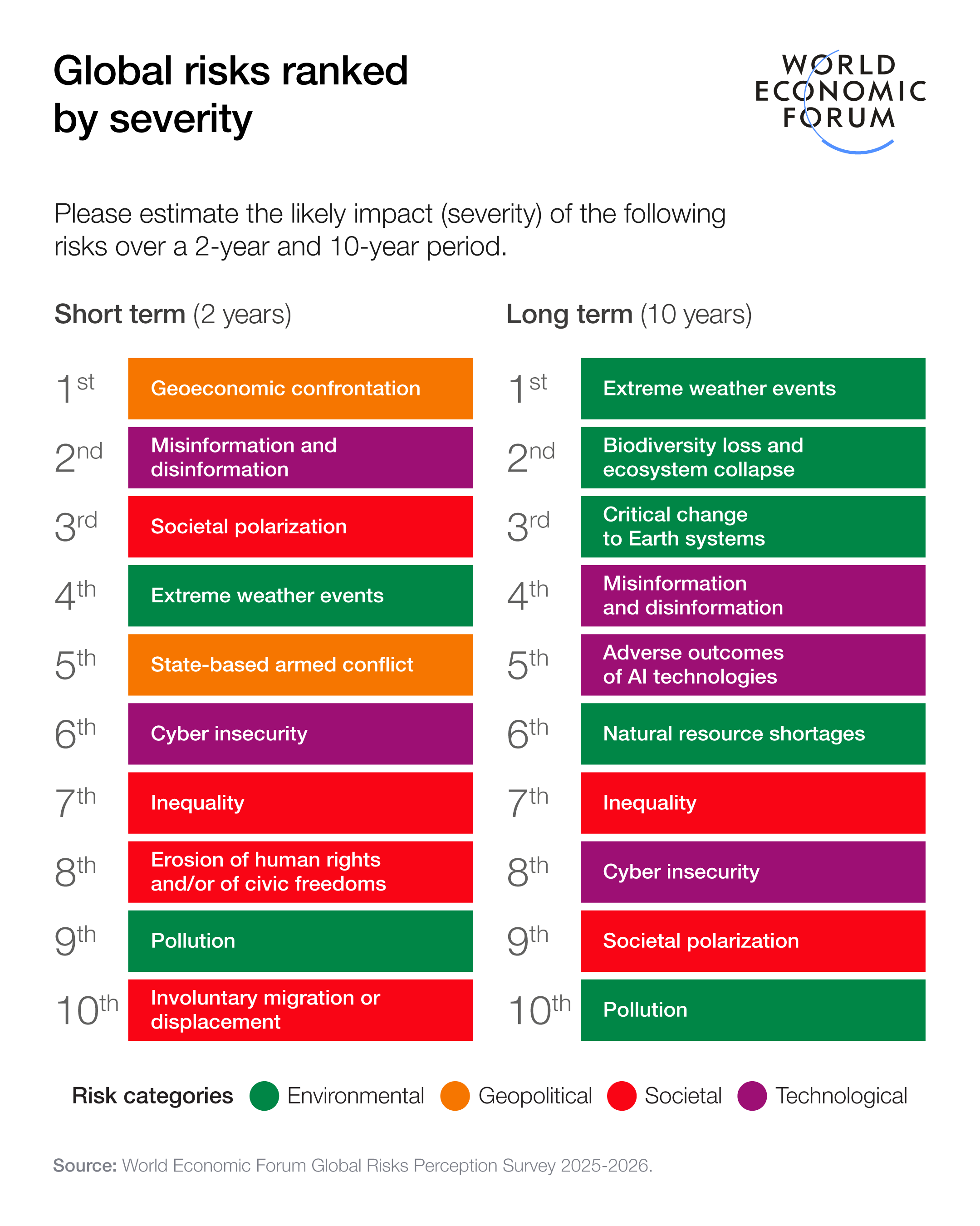
The mix is similar in respondents’ two-year outlook, which is led by geoeconomic confrontation, mis- and disinformation and societal polarization while state-based armed conflict has dropped down the rankings.
However, from a 10-year perspective, risk perceptions shift substantially. Here, the top concerns are the impacts of climate change, such as extreme weather, biodiversity loss and critical changes to Earth’s systems. Of the biggest concerns in the next two years, mis- and disinformation is another that is also perceived as a severe long-term risk, in fourth place, with the fear of adverse outcomes of AI rounding off the top five.
Intensifying economic risks
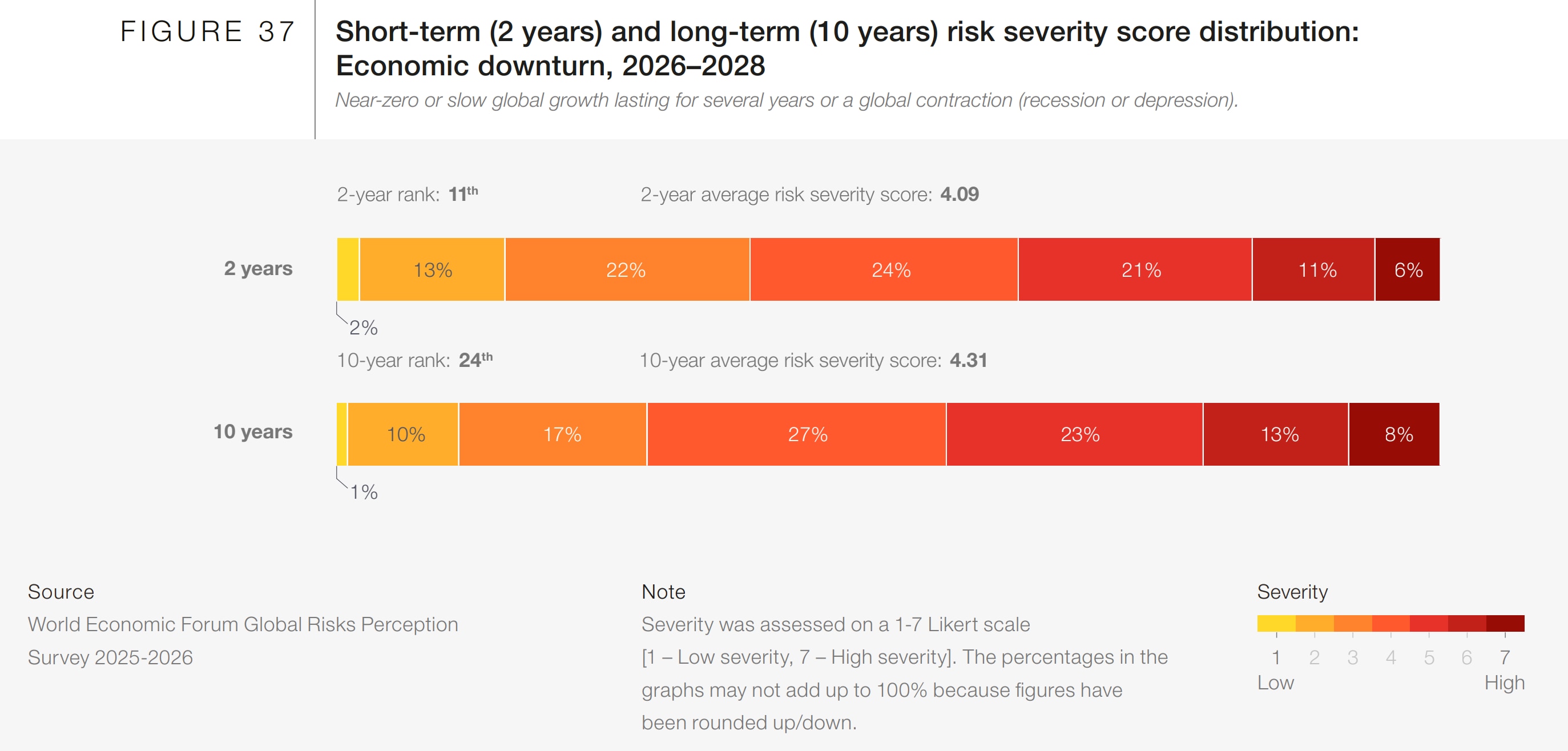
Compared to last year, economic risks show the largest increases in ranking over the next two years. Along with geoeconomic confrontation, the risks of an economic downturn and inflation saw the largest increases in severity and climbed eight positions.
Another fast riser was the risk of the asset bubble bursting, which jumped up seven places. This highlights the volatile combination that might result from the interplay between mounting debts, economic downturn, and uncertain returns on investments in frontier technologies (AI, quantum). Add geoeconomic confrontation into this mix, and the impact could destabilize not only businesses but entire societies, the report warns.
Unchecked technology risks
The rapid evolution of technologies such as AI and quantum computing creates fertile ground for growth, but also raises risk levels. These range from AI's impact on the job market and social stability as job profiles change fundamentally to questions about quantum’s threat to information integrity and the military risks posed by increasingly automated weapons systems.
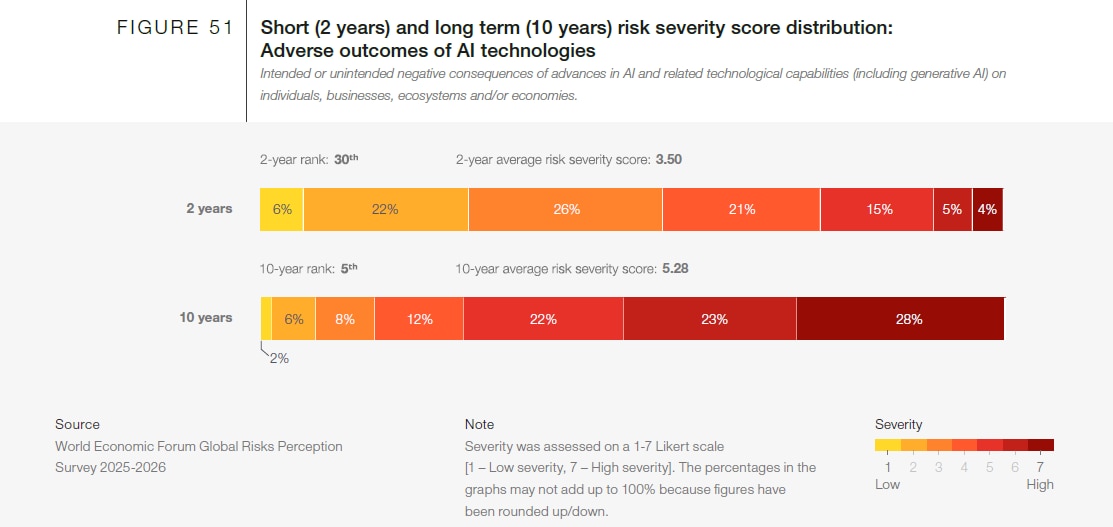
Mis- and disinformation and cyber insecurity rank second and sixth in the 2-year outlook, while adverse outcomes of AI shows the largest ranking jump over time - from 30th place in the short-term to fifth in the 10-year outlook. Adverse outcomes of frontier technologies moves from rank 33 to 25 between the two-year and 10-year outlook.
Awareness, education, reskilling and guardrails will be essential to mitigation strategies.
Social polarization remains a high-risk factor
Societal polarization risks have been a central and stable component of the global risks landscape over the last five editions of the Global Risks Report.
Societal risks are ranked third in the two-year outlook, dropping to ninth when respondents look 10 years ahead. It is the only risk that has remained in the top 10 list of risks for both the short-term and long-term outlook for the past five years.
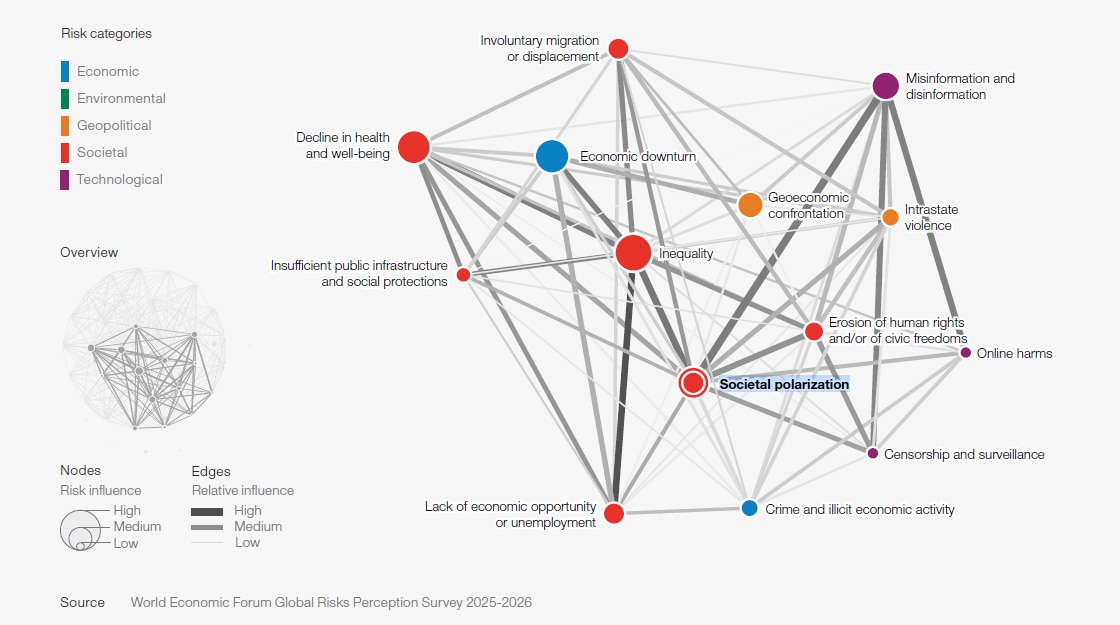
Inequality, decline in health and well-being and the economic downturn are closely interconnected to societal polarization. With aspects such as mis- and disinformation and geoeconomic confrontation also interconnected, societal and political polarization could deepen further in the next two years, the Forum suggests.
Environmental risks drop but remain high in the long term
Environmental risks have been among the most highly ranked in recent years. However, this year they are being reprioritized in the short term, relative to perceived more pressing non-environmental threats. While extreme weather events and pollution still rank within the top 10, with small drops in the outlook for the next two years, critical changes to Earth systems and biodiversity loss have had a marked decline into the lower half of the ranking compared to last year’s report.
However, this situation is different in the 10-year outlook, where environmental risks remain at the top of the ranking. Five environmental risks make it into the top 10: extreme weather events, biodiversity loss and ecosystem collapse, and critical change to Earth systems make up the top three. Natural resource shortages is in sixth place and pollution is in tenth, while the top-ranked short-term concern, geoeconomic confrontation, has dropped to 19th place.
The old global order is at an inflection point
As protectionism and strategic industrial policy are on the rise and governments take more active control of critical supply chains, the Global Risks Report 2026 paints a picture of a “more intensely competitive” world.
68% of respondents believe that over the next decade, the global political environment will become more fragmented and multipolar. Only 6% expect the post-war international order and its multilateral institutions to be revived as national interests are put ahead of collective action.
With uncertainty set to remain the only constant, this puts into relief the continued need for cooperation across emerging fault lines. Effective dialogue - the core theme of the forthcoming Annual Meeting of the World Economic Forum at Davos - will be vital for jointly shaping the path ahead.
License and Republishing
World Economic Forum articles may be republished in accordance with the Creative Commons Attribution-NonCommercial-NoDerivatives 4.0 International Public License, and in accordance with our Terms of Use.
The views expressed in this article are those of the author alone and not the World Economic Forum.
Related topics:

Forum Stories newsletter
Bringing you weekly curated insights and analysis on the global issues that matter.
More on Global RisksSee all

Eric Usher
February 24, 2026


