Global risks in 2026 and over the past 5 years: What’s changed and what hasn’t?

Emerging and converging technologies are undergoing rapid advancements - as are the global risks. Image: REUTERS/Tingshu Wang TPX IMAGES OF THE DAY SEARCH "2025 STORIES BEST" FOR THIS STORY. SEARCH "REUTERS YEAR-END" FOR ALL 202X YEAR END GALLERIES.
- The 'age of competition' is upon us, says the World Economic Forum's 2026 Global Risks Report.
- But how have risk perceptions changed over the last five years?
- Technology-related risks are freshly concerning, societal risks a constant, geoeconomic confrontation seen as more urgent, economic risks erratic, and environmental risks reprioritized.
This year's Global Risks Report warns that we have entered an ‘age of competition’, where global risks continue to spiral in scale, interconnectivity and velocity.
A contested multipolar landscape has emerged, where confrontation is complicating collaboration, and trust – the currency of cooperation – is losing its value.
Every year, key findings from the Global Risks Report are underpinned by the Global Risks Perception Survey (GPRS), which gathers perceptions of the global risks landscape over the next decade from more than 1,300 experts from government, academia, civil society, business and international organizations.
We’ve analysed the changing nature of these risk perceptions over the last five years, highlighting what’s new, what’s remained stable and what’s receded.
Societal concerns run deep
Social mobility is faltering. Technological change, geoeconomic shifts and tighter fiscal space are together weakening the pathways to social mobility and they are eroding trust. The result is that social cohesion and public distrust are at risk of deepening.
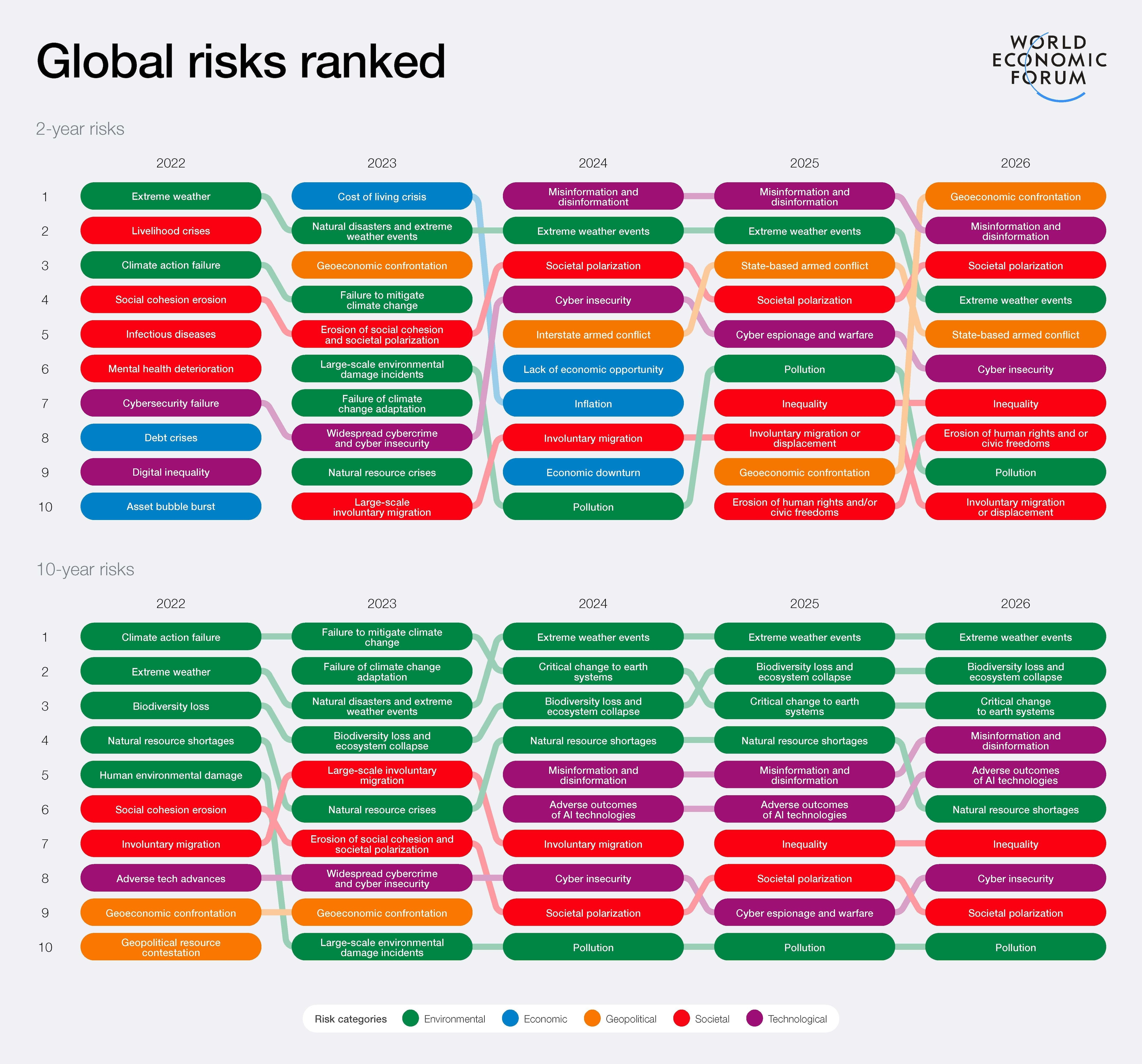
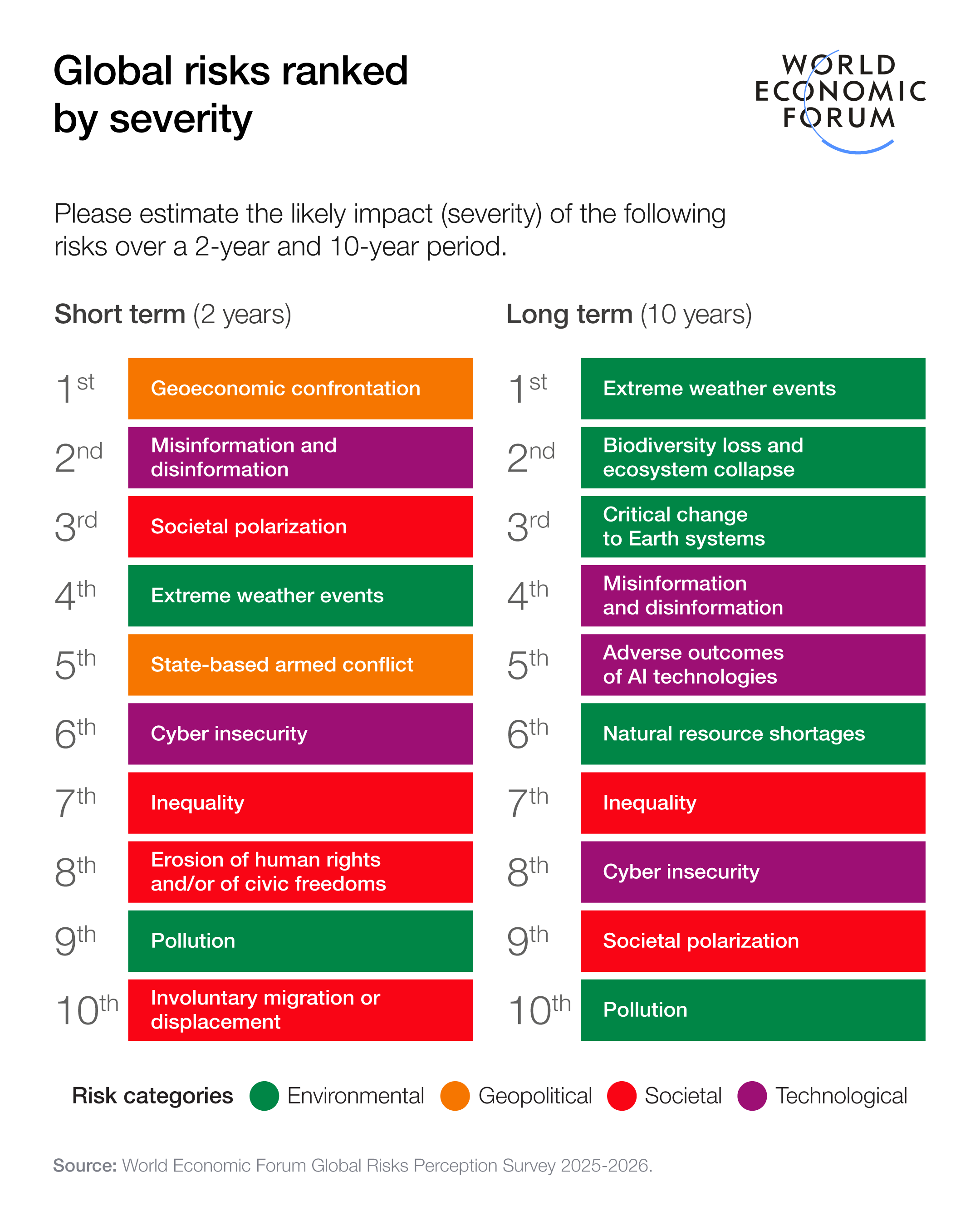
Societal risks are a central and stable component of the global risks landscape over the last five editions of the Global Risks Report. When comparing the two- and ten-year risk lists, societal risks remain a top concern amongst GRPS respondents, in particular Societal polarization which is ranked at #3 and #9 over the next two and ten years. This is the only risk that has remained a permanent top ten feature over both time horizons over the last five years, and consistently as a top five risk within the two-year list.
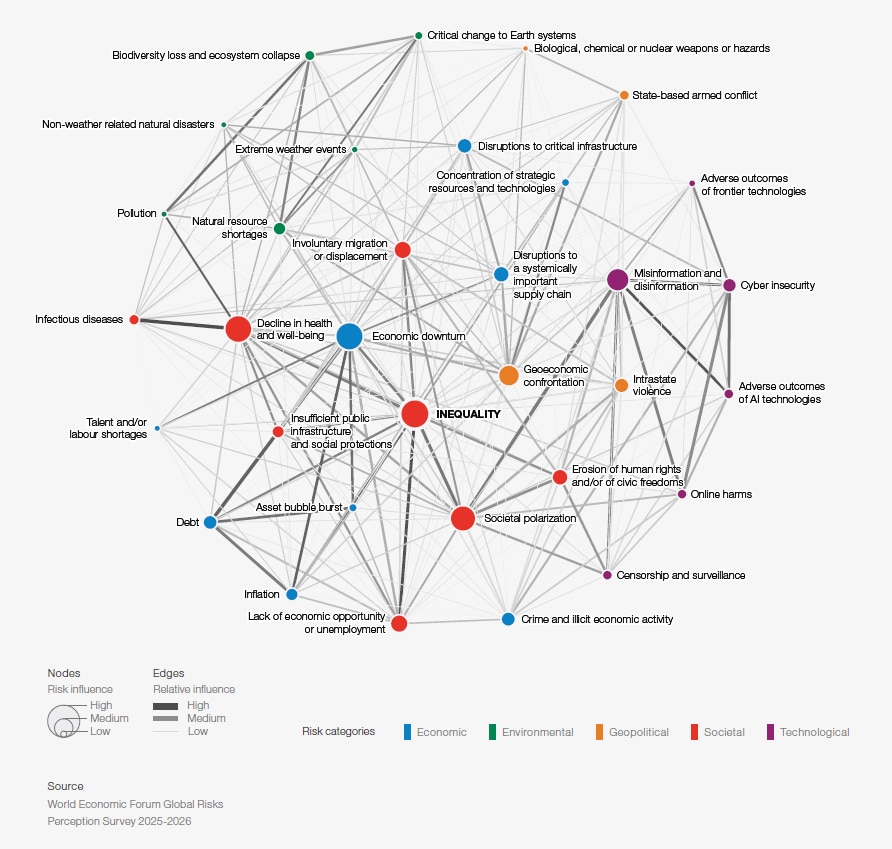
Polarization has not only manifested in terms of diverging wealth, but also in terms of societal values. The set of values that has underpinned decades of multilateral collaboration is itself now at stake. Across the world, there is a growing division between those who are trying to preserve that value system and the institutions built on it, and those who argue that the value system needs changing because many have not benefited from the prevailing political, societal and economic orders. At the heart of this division is Societal polarization, with no geography immune to the repercussions.
Geoeconomic confrontation: from a slow-burn to urgent
Recent years have shown a shift in the deliberate deployment of economic weapons for strategic advantage as societies continue to fragment. Rules and institutions that have long underpinned stability are under siege, ushering in a new era in which trade, finance, and technology are wielded as weapons of influence.
Confrontation is complicating collaboration, which can be reflected in shifting time perceptions of Geoeconomic confrontation over the last five years. In 2022 and 2023, Geoeconomic confrontation was identified as a top risk over the next decade at #9 respectively for both years. This is in contrast with current perception, with it now identified as the top risk over the next two years, demonstrating a shift in risk reprioritization by GRPS respondents from a long-term concern, to short term reality.
In highlighting Geoeconomic confrontation as a top concern over the next two years, respondents seem to be indicating a deepening and broadening of their concerns. After a year of heightened uncertainty over trade policy, there is now a growing recognition of an escalating use of other economic and political instruments, from sanctions and regulations to capital restrictions and weaponization of supply chains, as tools of geoeconomic strategy.
What about environmental risks?
Environmental risks remain stable on the ten-year time horizon, with Extreme weather events (#1), Biodiversity loss and ecosystem collapse (#2) and Critical change to earth systems (#3) topping the long-term risks. Findings also suggest a reprioritization of environmental issues over the short-term outlook compared to previous years.
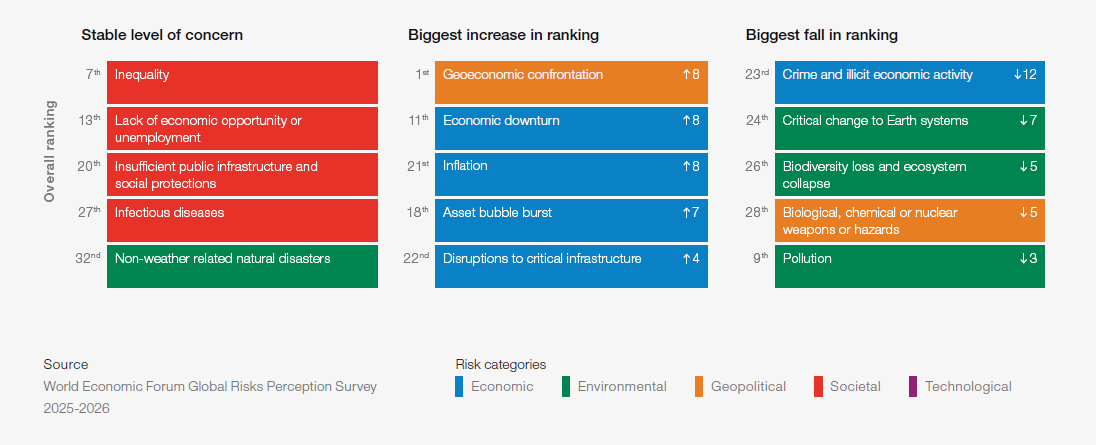
For the next two years, the majority of environmental risks experienced declines in ranking, with Extreme weather events moving from #2 to #4, Pollution from #6 to #9, and declines also in ranking for Critical change to earth systems and Biodiversity loss and ecosystem collapse by seven and five positions respectively, which are in the lower half of the risk list. This shift is further evident when comparing rankings with the Global Risks Report 2022, where Extreme weather events was selected as the top risk over the next two years, and Climate action failure at #3.
This reprioritization of environmental risks is unfolding in a geopolitical landscape shaped by growing multipolarity and protectionism, where competition for resources is intensifying, and national security - including energy security - is deemed by many governments to be the new leading driver of policymaking.
Erratic economic risks
Economic challenges following the pandemic were persistent in the Global Risks Report, with rising commodity prices, inflation and debt levels, stifling countries’ abilities to facilitate a sustained recovery. Cost of living crises were identified as the top global risk over the next two years in the 2023 edition. As outlined in a 20 year retrospective, economic risks have not featured as a top ten risk over the last two years over the short term, and not at all on the ten-year risk list over the last five years. The last economic risk in the top ten was in the Global Risks Report 2024 with Economic downturn in #9.
While not present in the top ten, the findings from the GRPS further indicate mounting economic concerns, with economic risks collectively showing the largest increases in ranking over the next two years, albeit from relatively low rankings last year. Economic downturn and Inflation are both up eight positions, to #11 and #21 respectively, with a similar uptick for Asset bubble burst, up seven positions to #18. Economic downturn has witnessed one of the largest increases in severity score compared with last year’s findings, behind only Geoeconomic confrontation. Are we approaching an economic reckoning?
New: Technological risks on the rise
Technological risks have increased in presence as top ten concerns over the last five years. In 2022, Cyber insecurity was perceived as #7 most severe risk over the next two years and Adverse tech advances at #8 over the next ten years - these being the only two technological risks selected as top risks.
New innovations and technological developments are driving transformations across domains - from labour markets to information integrity to autonomous weapons systems. Emerging and converging technologies are undergoing rapid advancements - as are the risks.
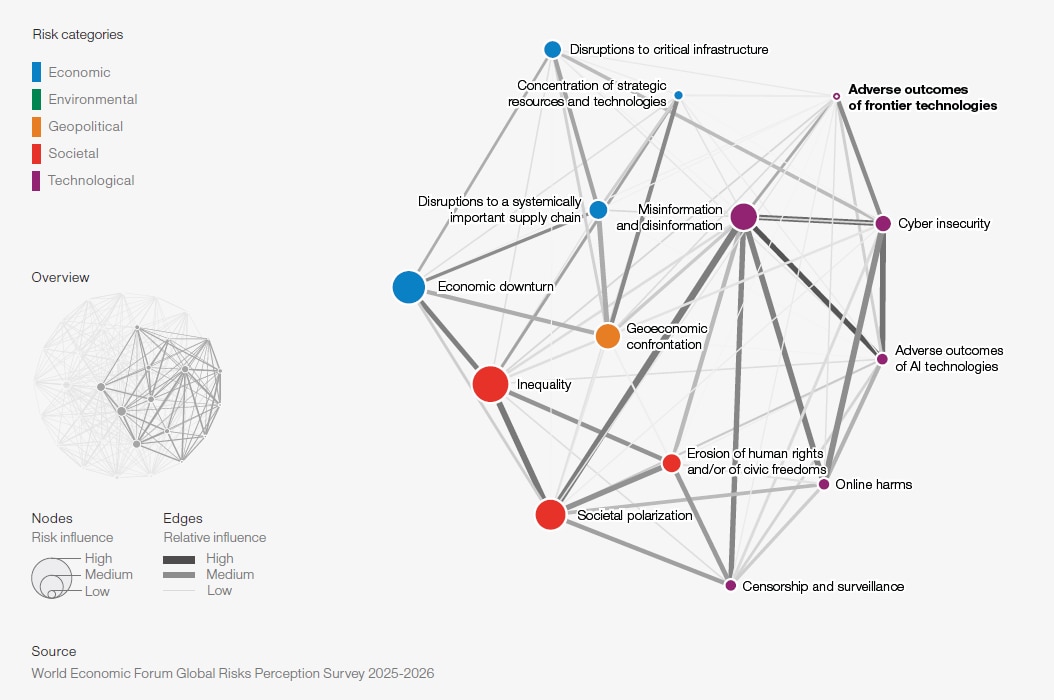
This can be reflected in the increased presence of technological risks over the next two years, with Misinformation and disinformation and Cyber insecurity ranked #2 and #6 respectively on the 2-year outlook and Misinformation and disinformation (#4), Adverse outcomes of AI technologies (#5) and Cyber insecurity (#8) over the next decade.
In this year's Global Risks Report, artificial intelligence and quantum computing are featured as technological risks of concern over the next decade. Progress in quantum is likely to accelerate over the next decade as AI fuels faster understanding of how to improve and scale the technology, with potentially serious risk impacts. While frontier technologies, including quantum, can offer significant opportunities to societies and economies, the risks of such advancements becoming another facet of strategic rivalry and domestic political polarization cannot be ignored.
What's next?
The future is not a single, fixed path but a range of possible trajectories, each dependent on the decisions we make today as a global community. The challenges highlighted in this year's report - spanning geopolitical shocks, rapid technological change, climate instability, and economic uncertainty - underscore both the scale of the risks we face and our shared responsibility to shape what comes next.
Have you read?
License and Republishing
World Economic Forum articles may be republished in accordance with the Creative Commons Attribution-NonCommercial-NoDerivatives 4.0 International Public License, and in accordance with our Terms of Use.
The views expressed in this article are those of the author alone and not the World Economic Forum.

Forum Stories newsletter
Bringing you weekly curated insights and analysis on the global issues that matter.
More on Global RisksSee all

Eric Usher
February 24, 2026


