Here are four ways AI and talent trends could reshape jobs by 2030

The pace of AI advancement has deepened uncertainty about its implications for businesses, workers and economies. Image: Unsplash
- More than two-thirds of chief strategy officers expect the commercialization of AI and emerging technologies to shape business strategies over the next five years.
- The pace and trajectory of AI advancement has deepened uncertainty about its implications for businesses, workers and the global economy.
- The second edition in the World Economic Forum’s Scenarios for the Global Economy Dialogue Series explores how AI and talent trends could shape the future of jobs, with varying implications for corporate strategies and investment decisions.
Fast-developing technologies such as artificial intelligence, robotics and autonomous systems are redefining how businesses operate, how tasks are performed and what skills are required to stay competitive.
As they move from experimentation to workflow integration – including the diffusion of agentic AI – their advancement creates both new growth opportunities and risks.
The potential economic gains could be significant, as the commercialization of AI and emerging technologies reshapes industries and unlocks systemic productivity advances. Yet, their rapid acceleration also raises critical questions about the future of business models, value chains, economic inclusion and resilience.
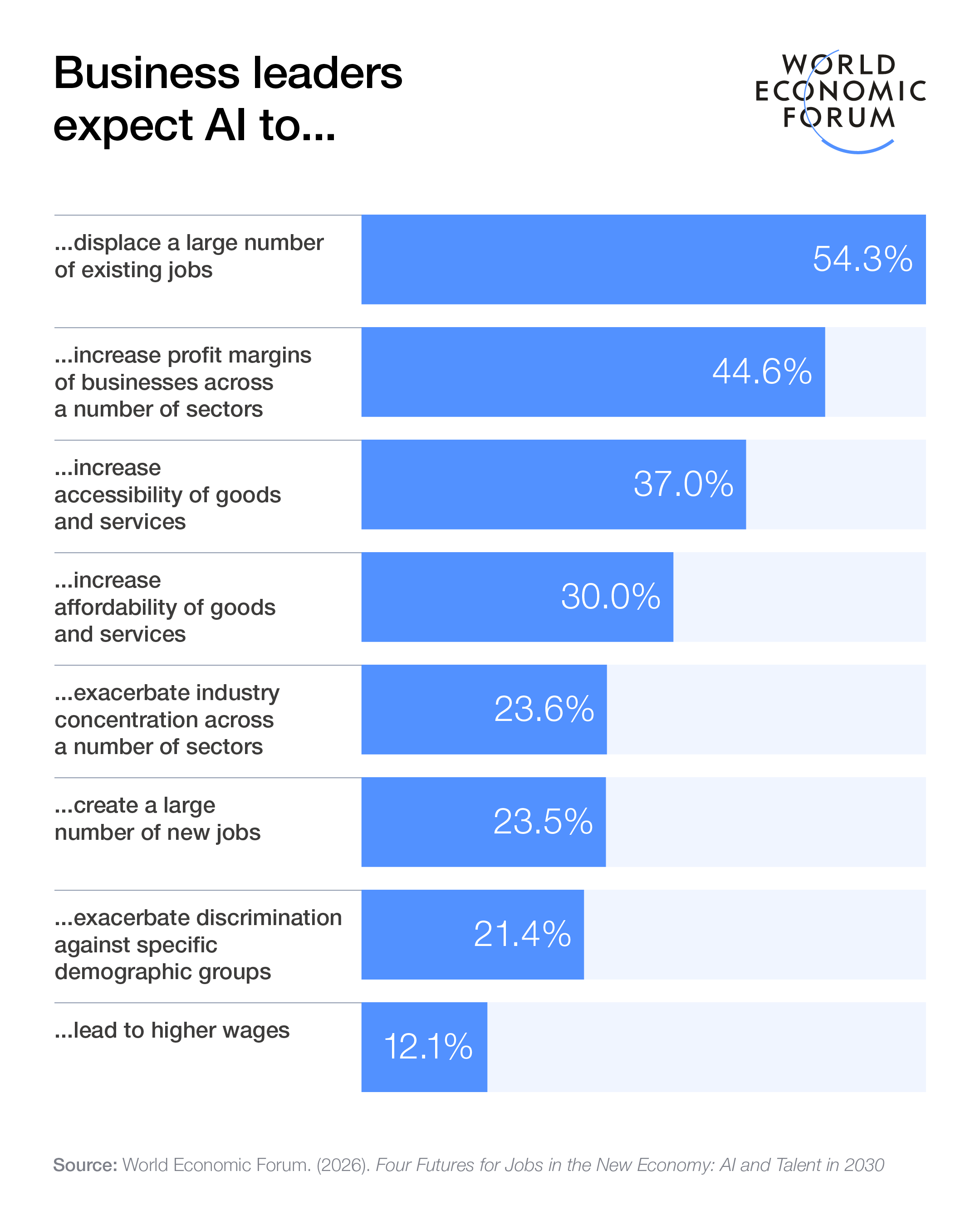
The business community is divided on the impact of AI. According to a World Economic Forum survey, more than half of business executives globally expect the technology to displace existing jobs, while 24% said AI will create new jobs. Nearly 45% also cited an increase in profit margins as a likely impact of AI; far fewer expect it to lead to higher wages.
In the meantime, demographic trends and the shortening longevity of skills may further strain labour markets and training systems in the coming years.
Taken together, these dynamics are deepening uncertainty for businesses and policymakers alike, and demand greater agility and foresight.
The Forum's new report Four Futures for Jobs in the New Economy: AI and Talent in 2030 can help leaders navigate and harness these transformative shifts. It explores how AI advances and talent trends could shape the future of jobs, with varying implications for corporate strategies and investment decisions.
Four futures for jobs in 2030
The report sets out four plausible scenarios for the future of jobs at the intersection of AI advancement and workforce readiness, and details potential trajectories for the year 2030.
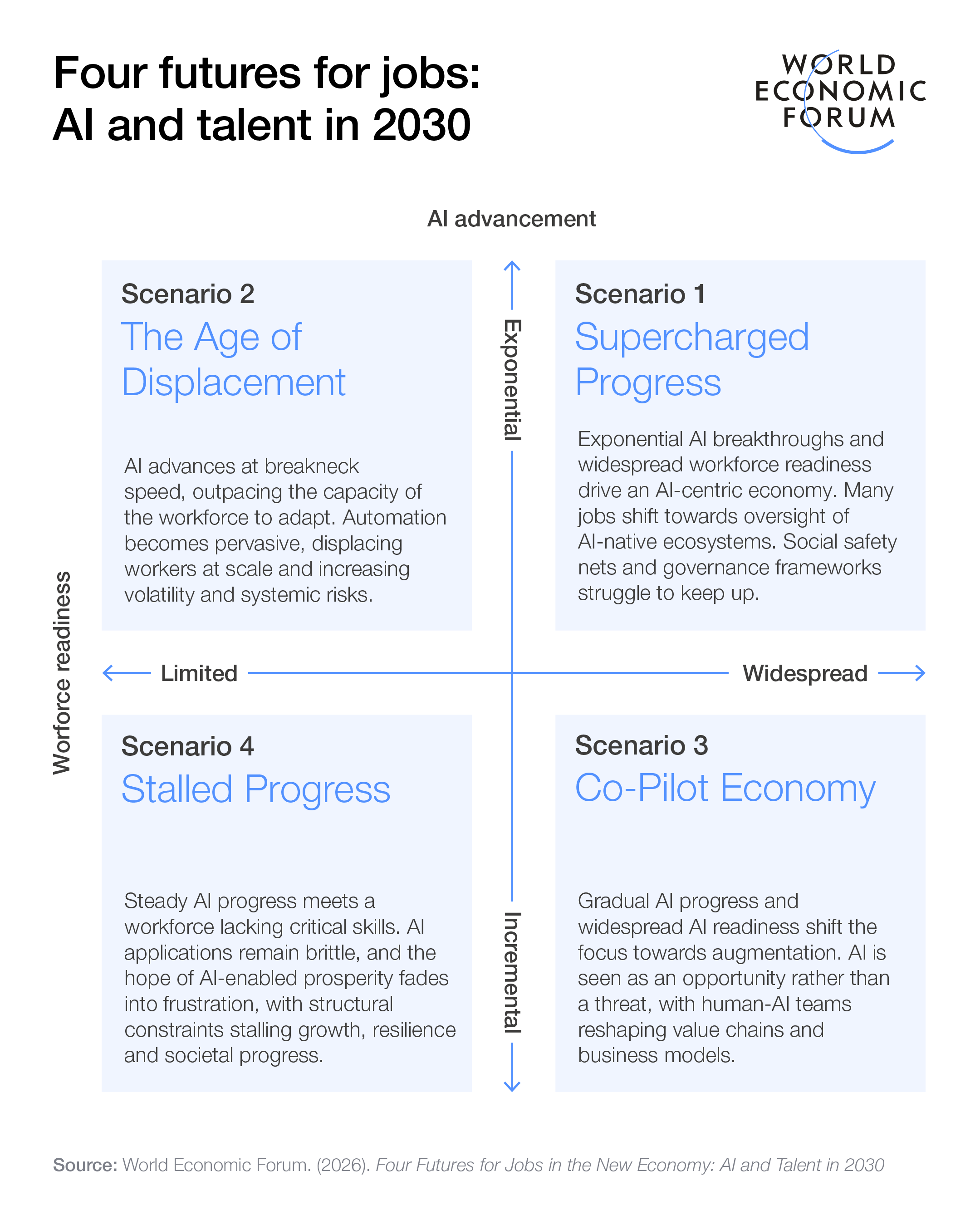
The first scenario is Supercharged Progress, where exponential AI advancement and widespread workforce readiness enable businesses to harness the “agentic leap”, driving a shift to an AI-centric economy and breakthroughs in productivity and innovation. Many jobs disappear, but new occupations emerge and scale up fast, in part with humans becoming agent orchestrators. On the upside, the blurring of physical and virtual networks minimizes the geographical boundaries limiting access to talent, markets and critical value chains. However, social safety nets, ethics and governance frameworks struggle to keep up with the pace and scale of change – intensifying many structural tensions related to labour displacement and governance gaps.
The second scenario is The Age of Displacement, where exponential AI advancement outpaces the capacity of the workforce to adapt. Businesses race to automate in lieu of scarce talent, displacing workers faster than education and reskilling systems can respond. Agentic AI takes over key processes, creating a productivity upsurge but also new risks. Economies race ahead technologically but fracture socially; unemployment spikes, consumer confidence erodes and governments face mounting societal risks and instability. The expansion of ultra-lean and AI-native business models creates new growth opportunities, but an over-reliance on agentic AI systems and a lack of oversight increases systemic risks and cognitive manipulation.
The next scenario is Co-Pilot Economy, where AI progress is more incremental and AI-ready skillsets are widespread. An “AI bubble” burst shifts focus to pragmatic integration and augmentation, rather than mass automation. Most industries see incremental transformation, shaped by tailored and task-specific AI integration rather than the structural redesign of workflows. Early investments in training, mobility, infrastructure and governance pay off, enabling countries and businesses to elevate human expertise and advance emerging technologies. Although displacement and job churn have risen, AI is increasingly seen as an opportunity rather than a threat, with human-AI teams reshaping global value chains. The growing economic importance of technology risks escalating strategic competition related to AI capability, talent and control of critical value chains.
The last scenario, Stalled Progress, combines gradual AI advancement and a workforce lacking critical skills. Cost pressures and a race for short-term returns entrench legacy processes. Technological progress is visible, but it is far from transformative; governments and businesses shift to selective and conservative AI deployment, prioritizing incremental efficiency gains within the existing workflows and offsetting talent shortages. New opportunities arise in domain-specific AI solutions, localized innovation and talent pipelines, but productivity gains remain uneven and concentrate among firms and regions with more AI expertise. Displacement primarily hits routine roles, while the value of skilled trades and manual occupations increases. The hope of AI-enabled prosperity fades into frustration, as adoption gaps fuel inequality, create a bifurcated economy and limit growth.
‘No-regret’ strategies to navigate AI and talent trends
These scenarios provide a lens through which leaders can explore critical uncertainties, and shape strategies to navigate and harness trends in AI and talent.
Drawing on discussions with chief strategy officers and subject matter experts, the Forum's new report also includes a set of “no-regret” strategies that could help businesses prepare for any scenario.
Starting small can help build fast, and understanding different technology use cases across industries can help scale up strategic AI integration. Aligning technology and talent strategies will be critical for ensuring that technology and talent evolve in tandem, in ways that increase productivity and trust. Businesses that invest in human-AI collaboration, agentic workflows, data governance and infrastructure will likely emerge relatively more resilient.
Most importantly, preparing for the implications of different scenarios – across roles, generations, career paths, workflows and technologies – while leveraging partnerships, can help dilute risk and navigate complexity.

The World Economic Forum's Future of Jobs Initiative and Reskilling Revolution provide businesses, governments, and civil society space to co-design, discuss and scale strategies to:
- Ensure individuals and organizations are equipped to thrive in the future of work
- Respond effectively to evolving labour market demands and challenges
- Create better education-industry pathways and support continued access to top talent and relevant skills
- Identify the greatest value opportunities to boost productivity via human-centric technology deployment
- Leverage AI to build future-ready education systems that enhance accessibility, improve equity and deliver impactful learning outcomes
Don't miss any update on this topic
Create a free account and access your personalized content collection with our latest publications and analyses.
License and Republishing
World Economic Forum articles may be republished in accordance with the Creative Commons Attribution-NonCommercial-NoDerivatives 4.0 International Public License, and in accordance with our Terms of Use.
The views expressed in this article are those of the author alone and not the World Economic Forum.
Related topics:

Forum Stories newsletter
Bringing you weekly curated insights and analysis on the global issues that matter.
More on Economic GrowthSee all

Larry Fitzgerald Jr and Kelvin Beachum Jr
April 6, 2026