How the power of AI can revolutionize the financial markets
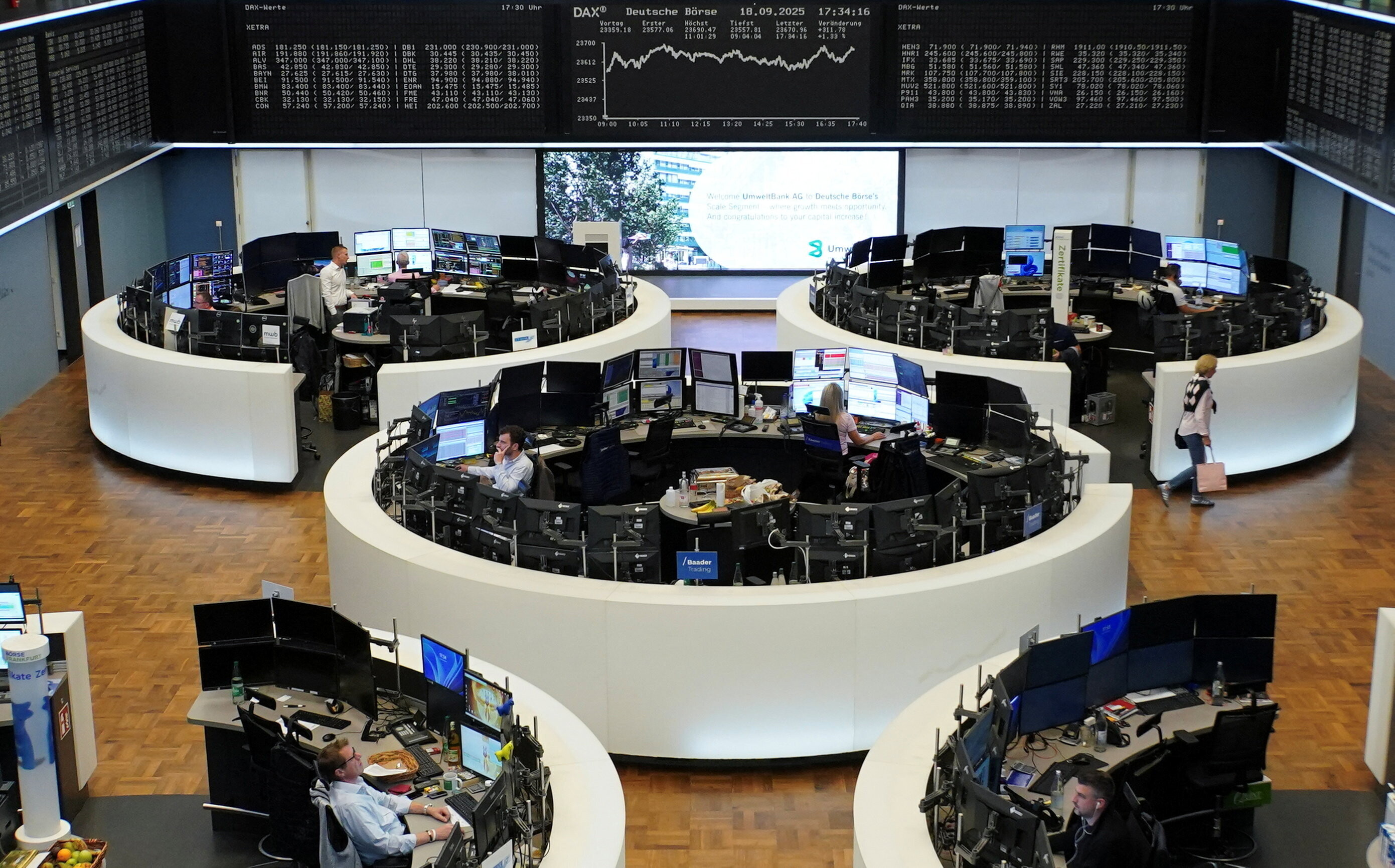
AI will fundamentally reshape all aspects of business and financial markets as companies use the technology to pilot intelligent, intuitive and flawless solutions. Image: REUTERS/staff
- AI will fundamentally reshape all aspects of business and financial markets as companies use the technology to pilot intelligent, intuitive and flawless solutions.
- While AI transformation will progress over time, its implementation must always be deliberate and responsible.
- Leaders are gathering at the World Economic Forum Annual Meeting 2026 to explore how the ethical use of AI and other emerging technologies will translate into solutions for real-world challenges.
Technology and the global markets have always shared a symbiotic relationship. The financial services industry continues to embrace and adopt innovation to improve investment and intermediation activities and make them more effective.
As our industry looks ahead to the future, innovation will continue to be a major differentiator and business accelerator as companies forge even deeper integration of technology across their organizations. One of the most powerful and transformational technologies that enterprises can adopt to achieve their strategic goals will be AI.
AI is a megatrend that will occur over a super-cycle; it's expected to last a decade or longer. While AI transformation will progress over time and at varying degrees of speed, it’s imperative that the implementation of this groundbreaking technology is always deliberate and responsible. AI will be a catalyst for fundamentally reshaping all aspects of business and economic activity as companies scale AI pilots to production and use it to develop intelligent, intuitive and flawless solutions.
How will AI transform financial markets?
In the realms of global securities trading and market infrastructure, AI will play a significant role as firms rely more heavily on algorithms for high-frequency trading. Systems that track and instantly process disparate datasets required for real-time trading will help traders anticipate market trends and make transaction decisions more accurately.
AI’s predictive models and analytics will also strengthen market surveillance and compliance monitoring, given the technology's ability to detect anomalies and potential fraud. The automation of trade execution activities, such as settlement and regulatory reporting, will help reduce manual errors and operational costs. By and large, AI will further de-risk the post-trade lifecycle, allowing my organization, the Depository Trust & Clearing Corporation (DTCC) and the industry to continue shifting from reactive to predictive responses, which in turn will improve resiliency.
At DTCC, our vision for the future is to leverage AI to solve some of the most complex capital markets issues. Like many in our industry, our use of AI is still in its early stages, but we’re already seeing the technology deliver results as we move beyond experimentation to production implementations. We’ve introduced AI tools, for example, to drive efficacy and deliver insights that enhance the client experience. Our Risk Calculator AI Assistant, DTCC’s first client-facing GenAI tool, has achieved approximately 97% accuracy with zero hallucinations post-launch, saving our clients considerable time in otherwise highly manual document reviews for Risk Calculator usage.
In addition, we’ve also created a new capability for our client-facing teams that unifies disconnected data into a single conversational interface. This GenAI-powered assistant enables our client-facing teams to instantly surface contextual insights to deliver faster, smarter and more personalized engagement with our clients at scale. It also compresses preparation for client meetings from one week to a day, shifting focus from data gathering to insights generation and increasing productivity by up to fourfold after the tool’s implementation.
Why is data AI’s most important asset?
The common thread connecting all efforts involving AI is data. At DTCC, we’re constructing a strong data foundation based on our unique position at the centre of global trading activity. Our goal is to develop new, impactful solutions that address the top operational challenges firms face today. For any AI initiative to be successful, it’s critical to have data that is highly available, discoverable, clean and clearly labelled. It must also be rich in metadata, rendering it optimal for analysis. Data security is paramount, with safe access only granted through proper entitlements.
To fully harness AI’s power, companies need to invest in data capabilities to ensure they own a modern tech stack replete with resilient data governance platforms and effective tools that ensure the best data quality. We can expect such efforts to yield transformational benefits, including scalability, flexibility, cost reduction, enhanced data protection, privacy and compliance.
How can we use AI to leverage knowledge?
From a human capital perspective, AI is envisioned as a force multiplier, potentially enabling employees to focus on more strategic, high-value work by up to 10 times. In this age of innovation, AI is not a proxy for people; rather, employees will need to continue learning and staying up to date on the latest AI trends to keep their skills and knowledge relevant in the workplace of the future.
Educating and enabling workforces with AI tools will give them a new capability and build company cultures where every employee is AI-literate and every role is AI-ready. At DTCC, we offer an array of AI upskilling and solutions, including specialized tools for building AI agents. We’re pleased to see high employee AI adoption rates, as well as active participation in our AI learning programmes. Indisputably, AI is a capital-light approach that will create substantial value and free up humans to do what they do best: create, connect and lead.
In the past year alone, AI’s momentum has been gaining as more companies start to use agentic AI to create their own digital agents and workflows to transform all aspects of how we work. The integration of AI into business models and end-to-end processes is expected to help companies ascend the value chain by enhancing client service, data, analytics and overall productivity.
Ultimately, companies across all industries will need to maintain robust AI governance and compliance frameworks to ensure that the technology’s benefits do not expose the financial markets, investors and consumers to new or greater risks, threats and vulnerabilities. Despite this, the vision for AI is clear: AI is going to be a massive technological enabler, helping companies and their employees to maximize their organizational output.
Don't miss any update on this topic
Create a free account and access your personalized content collection with our latest publications and analyses.
License and Republishing
World Economic Forum articles may be republished in accordance with the Creative Commons Attribution-NonCommercial-NoDerivatives 4.0 International Public License, and in accordance with our Terms of Use.
The views expressed in this article are those of the author alone and not the World Economic Forum.
Stay up to date:
Artificial Intelligence
Related topics:


Forum Stories newsletter
Bringing you weekly curated insights and analysis on the global issues that matter.
More on Artificial IntelligenceSee all

Navin Chaddha
April 10, 2026


