Why the race for tech sovereignty is a balancing act

Tech sovereignty isn’t a monolithic concept; it encompasses multiple dimensions of sovereignty. Image: Flickr/Graeme Maclean
- Tech sovereignty isn’t a monolithic concept; it encompasses multiple dimensions of sovereignty.
- These include data, operational, technical and even legal sovereignty. Decision-makers need to fully comprehend how these dimensions interact to navigate the trade-offs with full knowledge of their strategic implications.
- In addition, sovereignty must rest on unified, stable, forward-looking regulatory frameworks that support innovation and competitiveness.
As geopolitical tensions rise and digital interdependence deepens, tech sovereignty has become a cornerstone of economic resilience, national security and competitiveness. Yet, in a hyper-connected world, full autonomy is an illusion.
Organizations need to identify the potential risks they face and to design an affordable sovereignty strategy that will enable them to protect their businesses. Their challenge is to maintain strategic control over critical technologies, without falling into the illusion of self-sufficiency – ensuring sovereignty becomes a stimulus, not a constraint, for innovation and growth.
Tech sovereignty – the race is on
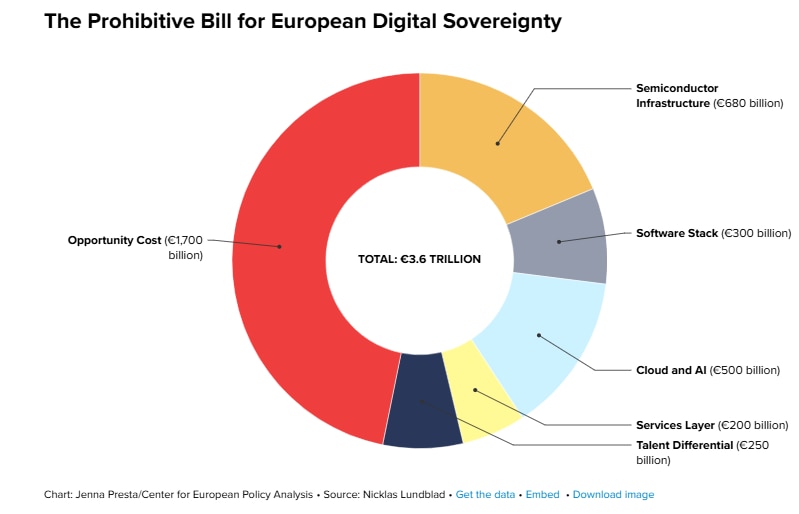
Geopolitical tensions, regulatory complexities and digital interdependencies have exposed critical vulnerabilities, notably in Europe, where more than 80% of digital products, services, infrastructure and intellectual property are imported.
In September 2025, Ursula von der Leyen called for Europe’s independence moment “to take control over the technologies that will fuel our economies.” Similar ambitions are evident in the US, with initiatives to secure semiconductor production, and in China, which continues to double down on self-reliance. A global investment race is, therefore, underway to safeguard sensitive data, ensure business continuity and control critical technologies.
Tech sovereignty is now at the top of political agendas and central to public debate, yet too often, this debate lacks nuance. The paradox is that in today’s globally hyper-connected digital world, no nation is truly sovereign. Digital architecture relies on rare earths, semiconductors, data centres, infrastructure, hardware, software and increasingly AI models – components which are sourced by their very nature across borders. No single country or company controls the entire value chain, and very few can afford to.
Owning and operating data centres alone isn’t the answer. In short, digital self-sufficiency does not exist; it is neither realistic nor desirable. The challenge for organizations is to decide how much they are willing to invest to gain strategic control over the critical technologies they need and mitigate risks. There is no single answer to that question.
How the Forum helps leaders make sense of AI and collaborate on responsible innovation
Tech sovereignty isn’t a monolithic concept; it encompasses multiple dimensions of sovereignty. These include data (control over data storage, access and governance); operational (autonomy and resilience in managing and executing digital operations safely); technical (development and control, including hardware and infrastructure); and even legal sovereignty (power to establish and enforce the regulations that govern digital infrastructures, technology actors, services and data within its territory). Decision-makers need to fully comprehend how these dimensions interact to navigate the trade-offs with full knowledge of their strategic implications.
From autonomy to resilient interdependence
Today, the focus is shifting from full autonomy to resilient interdependence. Sovereignty now means balancing strategic self-reliance with intelligent partnerships. Economic sovereignty does not equate to isolationism – closing borders isn’t the solution. Resilience and leadership will come from securing critical capabilities to reduce high-risk dependencies, while remaining open to collaboration at an affordable cost.
If it can’t compete on investment, Europe – in particular – must adopt a pragmatic approach and place its bets. Sovereignty strategies should be based on a clear assessment of urgency, identifying which sectors require strategic control and where partnerships can expedite progress.
Defence companies, for instance, must own and control technologies, cybersecurity and data. For many businesses in less sensitive sectors, the priority is mostly data sovereignty (for example, making sure data is accessible at all times, protected from any breaches and shielded from unwanted foreign access). For others, sovereignty means avoiding dependency on a single technology provider.
These varied needs can be met through pragmatic solutions, not ideological, one-size-fits-all approaches. Critical dependencies have to be identified and analysed in order to build the right sovereignty plan, taking into account one’s industry, customer base, country of operation, supply chain and IT architecture.
The role of regulation
Tech sovereignty has naturally become a political debate, layered on top of economic and technological concerns. It includes having the ability to shape the rules and values that govern digital systems through robust policy and regulatory frameworks covering energy, connectivity, semiconductors, AI or even talent. However, regulation must enable – not stifle – innovation.
Over-regulation, particularly in emerging technologies like AI, risks slowing adoption and undermining Europe’s leadership potential. A rigid pursuit of control can create a vicious circle: limiting competitiveness and delaying digital transformation.
Likewise, compliance with ever-changing rules is a challenge in the fast-paced, ever-evolving race for innovation. Sovereignty must rest on unified, stable, forward-looking regulatory frameworks that support innovation and competitiveness. Fragmented or overly restrictive policies will only weaken the very resilience they aim to build.
Ultimately, sovereignty is not just about control – it’s about resilience, performance, and competitiveness. It’s about ensuring regions can lead in the technologies that matter most, while remaining agile, open and innovative. In the digital age, we must ensure that strategic autonomy is designed not as a fortress, but as a launch pad for transformation.
Have you read?
Don't miss any update on this topic
Create a free account and access your personalized content collection with our latest publications and analyses.
License and Republishing
World Economic Forum articles may be republished in accordance with the Creative Commons Attribution-NonCommercial-NoDerivatives 4.0 International Public License, and in accordance with our Terms of Use.
The views expressed in this article are those of the author alone and not the World Economic Forum.
Stay up to date:
Innovation


Forum Stories newsletter
Bringing you weekly curated insights and analysis on the global issues that matter.
More on Technological InnovationSee all

Tejpreet S Chopra and Ayushi Sarna
February 27, 2026


