Chief economists have clear ideas about where AI will boost productivity, and when

The World Economic Forum’s latest Chief Economists’ Outlook reflects bullish sentiment on artificial intelligence-related productivity gains. Image: REUTERS/Ramiro Gomez
- The World Economic Forum’s latest Chief Economists’ Outlook reflects bullish sentiment on artificial intelligence-related productivity gains.
- We asked chief economists to detail where they see those gains taking shape within particular industries – and when.
The latest Chief Economists’ Outlook paints a picture of a resilient global economy.
Slightly more than half of the experts surveyed foresee weakened conditions in the year ahead, but that still marks a serious improvement from the last edition of the report.
The AI-related findings in the new outlook are a mixed bag, however.
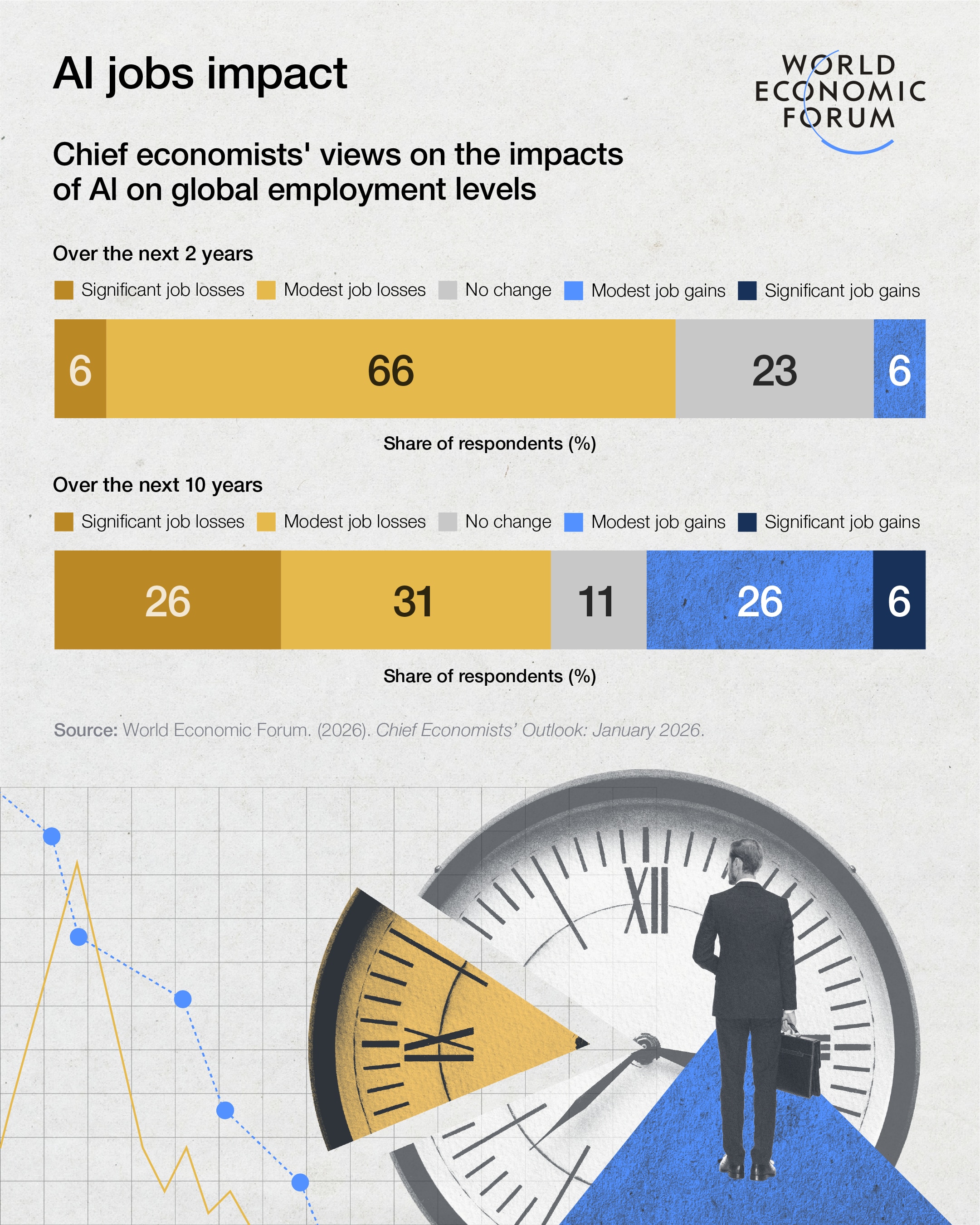
There’s broad anticipation of a puncturing of AI-related stock prices in the US, and AI-related job losses are seen stretching out over the coming decade. But at the same time, meaningful AI-related productivity gains in the biggest economies are predicted already within the next year or two.
We asked a select group of chief economists to expand on this productivity aspect. Where do they expect the biggest productivity gains within their respective industries, and when?
Gregory Daco, Chief Economist, EY
Financial, professional and real estate services
“The largest productivity gains from AI adoption are likely to materialize faster than previously expected, particularly in financial and professional services where work is highly knowledge-intensive and process-driven. In these sectors, AI is already compressing research, analysis, compliance, drafting, and workflow cycles. At the aggregate level, EY-Parthenon estimates that AI could lift economy-wide labour productivity by 1.5% to 3% over the next decade, with the largest contributions coming from tech, finance, consulting, legal, and accounting.
“Crucially, these gains are not being harvested passively. EY’s Fourth US AI Pulse Survey shows that most organizations are reinvesting AI-driven productivity gains into innovation, data infrastructure, and workforce upskilling – accelerating diffusion rather than locking in one-off cost savings.
“Recent evidence from the Federal Reserve Bank of St. Louis reinforces this acceleration. Its survey-based research suggests that generative AI is already saving workers time equivalent to around 1.6% of total work hours. When translated into a standard production framework, these self-reported time savings imply an early boost to aggregate labour productivity of roughly 1.3%, assuming the saved time is redeployed productively. These early gains are most visible in sectors with high AI exposure, driven by task reallocation and faster knowledge diffusion.
“Real estate gains are more incremental but still meaningful. Overall, while adoption will continue to evolve, the bulk of productivity gains now appears likely to arrive within the next three to five years, conditional on execution, skills, and organizational change.”
Michael Schwarz, Chief Economist, Microsoft
IT and digital communications
“Three years ago, if someone had asked me which industries would experience the greatest productivity gains from AI, I would have guessed sales and customer service. These fields often involve handling similar scenarios with minor variations – a setup seemingly ideal for AI automation.
“Today, however, it’s clear that the software industry has been the most visibly transformed by AI. Developer productivity has surged. I co-authored (with Sida Peng) what is, to my knowledge, the very first study showing the impact of AI on developer productivity as double-digit improvements, and in some cases nearly doubling output. The studies from academia that followed are broadly consistent with that.
“One does not need a PhD in economics to notice the impact of AI on developer productivity. Anybody with social ties to software engineers is likely to hear stories. A colleague recently shared that using GitHub Copilot for unit tests allowed him to complete a month’s work in just a few days. A former report (now a senior developer) described building a prototype in a week that would have previously taken months. While some developers remain hesitant and not all programming tasks benefit from AI, the overall effect is both noticeable and substantial.
“Why has AI had a greater impact on coding than on sales or customer service? There are three main reasons. The first is instant feedback. In software development, AI receives immediate feedback – if code doesn’t compile or fails a test, it’s instantly clear. In sales and customer service, feedback loops are slower and often require human involvement. Then there’s tech adoption and culture. Software engineers are accustomed to learning and adopting new technologies as part of their job. In contrast, sales and customer support roles often attract individuals less inclined to experiment with new tech. The third reason is tool creators’ expertise. AI tools are built by developers who have deep understanding of developer workflow and needs. On the other hand, developers have little experience with or understanding of the workflow of sales people or customer service agents – though I continue to believe that sales and customer service will be among the industries most transformed by AI in the future.”
Máximo Torero Cullen, Chief Economist, Food and Agriculture Organization of the United Nations (FAO)
Agriculture, forestry and fishing
“The largest productivity gains from AI adoption are likely to occur where information constraints, weak coordination, and transaction costs are highest – particularly among smallholders and along post-harvest value chains.
“FAO analysis shows that AI can use satellite, weather, and soil data to turn complex information into practical advice for precision farming. For smallholders, this improves the timing and targeting of water, fertilizer, and pest control to increase yields and overall production efficiency while reducing environmental pressures.
“Beyond the farm, AI tools that match supply and demand, predict prices and volumes, and improve routing and aggregation can help cut food loss by reducing spoilage, unnecessary transport, and transaction costs, especially in countries with weak transport infrastructure. At the consumer end, improved demand forecasting and inventory management can cut food waste.
“Realizing these benefits requires protecting data privacy, respecting ethical standards, and designing AI systems as global public goods. Open, interoperable data and governance frameworks are essential to ensure that smallholders and small and medium enterprises can participate. With these safeguards in place, results can appear within two to five years, with broader transformation over five to 10 years.”



License and Republishing
World Economic Forum articles may be republished in accordance with the Creative Commons Attribution-NonCommercial-NoDerivatives 4.0 International Public License, and in accordance with our Terms of Use.
The views expressed in this article are those of the author alone and not the World Economic Forum.
Related topics:

Forum Stories newsletter
Bringing you weekly curated insights and analysis on the global issues that matter.
More on Economic GrowthSee all

Pooja Chhabria
February 27, 2026


