Thermal storage is a cheap, scalable way to quickly power AI and industrial growth
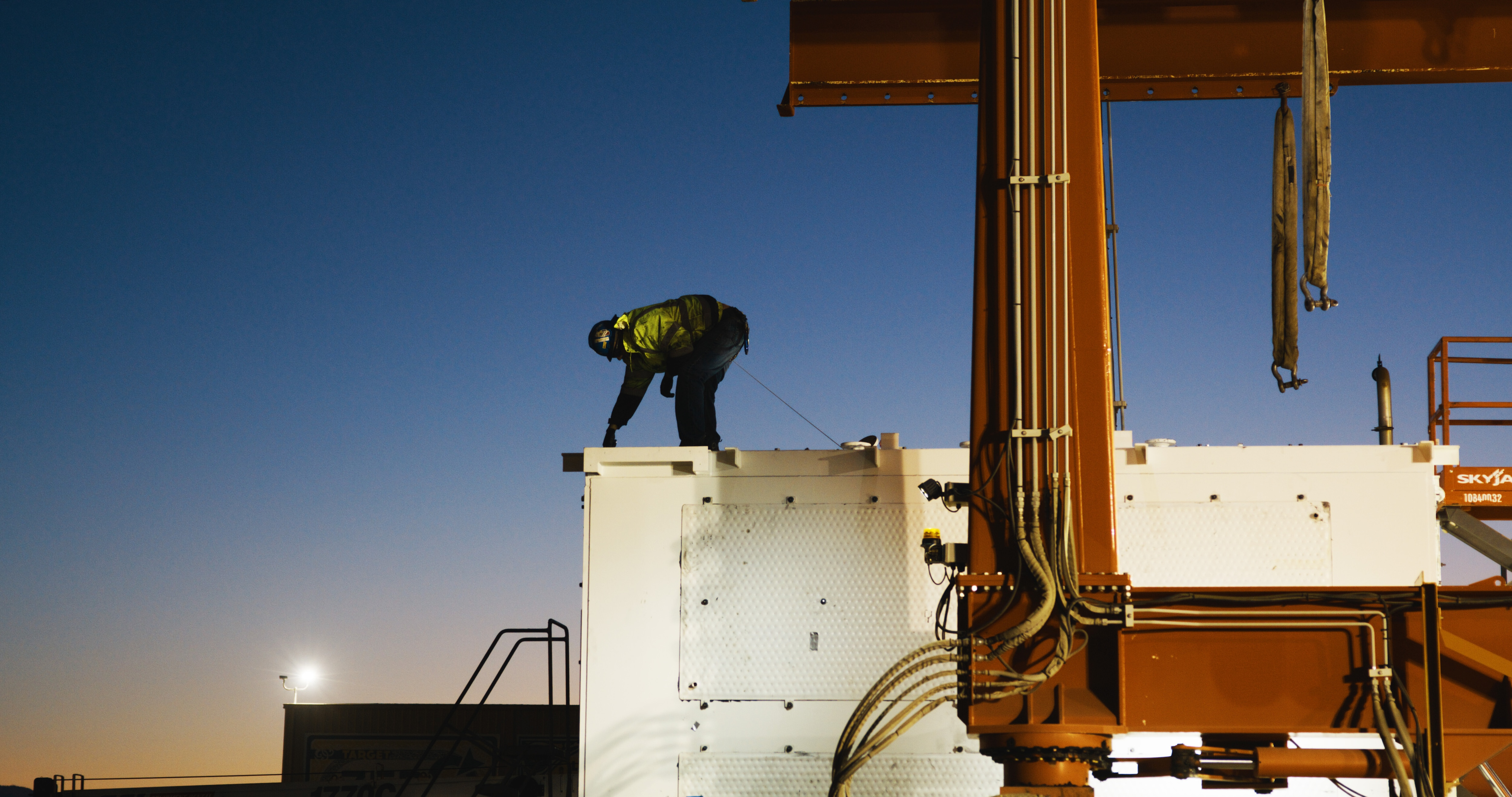
A worker inspects an Antora thermal battery at an industrial site. Thermal storage could be used alongside renewables to meet growing global power demand. Image: Antora
- Electricity demand is expected to continue to grow, but speed is a limiting factor as building traditional power supply can require long lead times.
- While tech giants explore nuclear fusion, thermal storage is ready today and can be deployed in months to provide cost-effective, reliable clean energy.
- Participants at the World Economic Forum Annual Meeting 2026 will discuss how such innovations can help build prosperity within planetary boundaries.
In recent decades, energy demand across the US and Europe was largely stagnant. With stalling industrial growth and meaningful gains in energy efficiency, energy consumption in the industrialized world hardly budged over the years, even as populations steadily increased.
Today, the energy landscape has flipped and demand is surging where it was once dormant, as detailed in the International Energy Agency’s Electricity Mid-Year Update 2025. In many parts of the world, huge factories and data centres are being built, some using as much power as entire cities.
In the US, electricity demand is expected to grow 16% by 2029, according to power sector consultancy Grid Strategies, driven largely by the explosion of data centres powering the artificial intelligence (AI) boom. By 2030, data centres could account for 5% of US and 8% of European electricity consumption, a tripling of today’s share.
For tech giants racing to win the AI arms race, speed is paramount. But powering this extraordinary demand is not as simple as turning on a switch. Cheap, scalable power has become the limiting factor for AI and industrial growth. Interconnection queues now stretch to half a decade in the US, for example. New combined cycle gas turbines face wait times of up to seven years, alongside rapidly rising costs.
In response, large AI and data centre companies, also known as hyperscalers, are investing billions in solutions like fusion and advanced nuclear fission. But these technologies remain at least a decade away from large-scale commercial deployment.
The search for a silver bullet is also obscuring the simple fact that the challenge is no longer generating cheap, clean energy – it's accessing this energy quickly and around the clock.
The fastest, cheapest energy
Over the past decade, massive amounts of low-cost clean electricity generation have been deployed around the world. These resources are now routinely producing some of the lowest-cost energy in human history. But that cheap power is often produced in the wrong place at the wrong time.
The resulting mismatch can be seen in power prices, which can change hourly and even sometimes by the minute. When the sun floods the grid at midday or demand drops overnight, electricity prices frequently drop towards zero. In places like Spain and the US Midwest, calculations by Antora using figures from market data providers show that power prices dropped below a dirt-cheap 1 cent per kilowatt-hour for a quarter of all hours in recent years.
In many markets, clean electricity is so abundant that entire power plants shut down for hours at a time. In 2024, there was enough of this so-called curtailed energy in the US to power virtually all of the country’s AI data centres, according to analysis of market data providers and trade press figures by Antora.
Clean electricity isn't just cheap, it’s also quick to deploy. Solar projects, for instance, can be commissioned and built in just one to two years, offering the quickest path to affordable power across most of the globe.
But such intermittent energy has been largely written off when it comes to powering 24/7 industrial loads. Most storage technologies excel at storing energy for a few hours, but remain too expensive to bridge multi-day gaps in generation and provide the baseload energy that these facilities require.
Soaking up this affordable power for delivery around the clock will require rethinking how energy is stored.
Thermal storage is quick and cheap to build
When my co-founders and I started Antora, an industrial energy storage provider, we studied every type of battery technology—from advanced chemistries based on lithium and sodium to approaches using molten salt and iron. What we found surprised us: The cheapest, most scalable way to store huge amounts of energy is to heat up some of the most abundant materials on earth.
Thermal batteries use surplus electricity to heat up low-cost storage blocks such as solid carbon, storing massive amounts of energy as heat. This heat is then delivered directly to industrial users or converted back into electricity. Using widely available materials, thermal batteries store energy at a fraction of the cost of conventional batteries and for durations long enough to deliver round-the-clock energy.
Just as important, thermal storage is fast and ready today. Built in factories, these batteries can be deployed in months. Instead of waiting years to access energy resources, data centres and manufacturing facilities can tap into nearby, intermittent electricity, or deploy new clean energy assets in tandem with thermal energy storage.
In just a few years, thermal storage has gone from a relatively unknown technology to a potential cornerstone of our energy future. Multi-day, multi-gigawatt-hour deployments are already turning on and existing thermal battery factories can provide enough storage capacity to get entire data centres up and running in a matter of months. Even Tesla predicts that more thermal energy storage will be deployed than lithium-ion batteries in the coming decades.
It's not an energy problem, it's a timing problem
Energy has always been the ultimate constraint on industrial growth. As AI turns electrons into intelligence, this fact is clearer than ever.
Today, hyperscalers and manufacturers are trying to power the future with the infrastructure of the past, waiting years for grid upgrades or chasing solutions that are years away. They’re overlooking the fact that, with the rise of cheap intermittent energy, we have solved the generation problem. We just have a timing problem.
Thermal storage is a solution to this problem. By capturing this fleeting energy and making it available 24/7, this technology can deliver the speed and reliability needed to unleash a new era of industrial growth.
Don't miss any update on this topic
Create a free account and access your personalized content collection with our latest publications and analyses.
License and Republishing
World Economic Forum articles may be republished in accordance with the Creative Commons Attribution-NonCommercial-NoDerivatives 4.0 International Public License, and in accordance with our Terms of Use.
The views expressed in this article are those of the author alone and not the World Economic Forum.
Stay up to date:
Energy Transition
Related topics:


Forum Stories newsletter
Bringing you weekly curated insights and analysis on the global issues that matter.
More on Energy TransitionSee all

Renée van Heusden
April 6, 2026


