What is intelligent infrastructure and how is it redefining industrial competitiveness?

Digital infrastructure connects; but intelligent infrastructure understands and acts. Image: Getty Images/iStockphoto
- Just as physical infrastructure, like roads, enabled the movement of goods in the industrial age, intelligent infrastructure enables the movement of data and intelligence in the intelligent age.
- Intelligent infrastructure goes beyond traditional digital infrastructure, while digital systems connect physical assets, intelligent infrastructure makes them cognitive and adaptive.
- Examples of intelligent infrastructure are emerging in China, from 5G and industrial internet platforms to integrated national computing networks, it has accelerated industrial transformation and strengthened its global competitiveness.
The $16.8 trillion global manufacturing landscape is reaching an inflexion point. The next generation of industrial growth won't be defined by who builds the most, but by who builds the smartest. This requires a new strategic asset: intelligent infrastructure. This is central to how countries and industries will gain a competitive advantage amid the reconfiguration of global value chains.
A historic parallel helps clarify its significance. In the 1950s, the standardization of shipping containers transformed global logistics by allowing ships, ports and trucks to work together seamlessly. This shared approach, based on common rules between governments, ports and logistics firms, opened the door to decades of trade and growth.
Similarly, in today’s intelligent age, shared standards, interoperability and cross-sector collaboration are essential for unlocking the full value of intelligent infrastructure.
What is intelligent infrastructure?
Intelligent infrastructure is the digital backbone that complements traditional physical infrastructure. It's made up of interconnected layers that integrate sensors, connectivity, data and platforms, embedding AI-driven intelligence directly into physical assets. By learning, adapting and optimizing in real time, these assets function as a cognitive, 'living' ecosystem.
In this way, infrastructure shifts from being a passive conduit to an active participant in value creation. The shift is analogous to the electrification of the early 20th century. Before the modern electric grid, every factory had to generate its own power, capping scale and innovation. Intelligent infrastructure creates a 'utility of intelligence,' enabling every company to plug into a shared national industrial internet network and access AI, data, and digital twins, unleashing industrial innovation across the board.
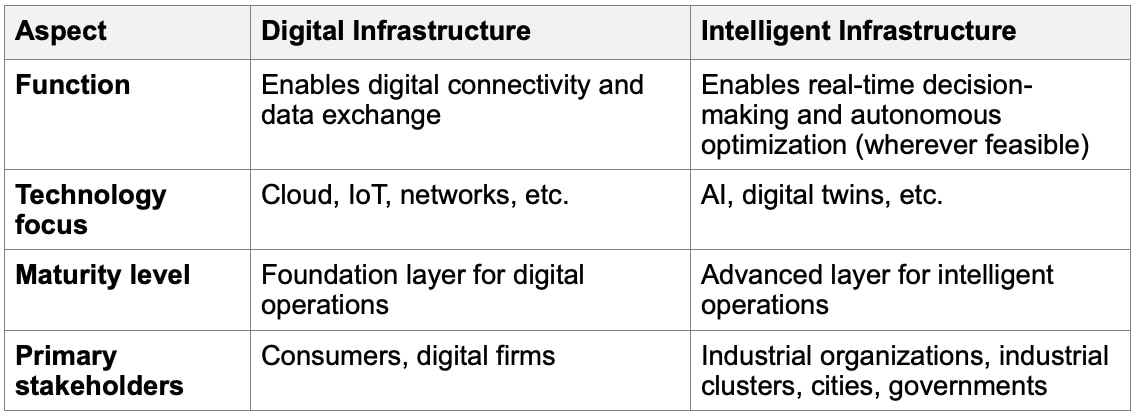
Intelligent infrastructure differs fundamentally from digital infrastructure. While digital infrastructure provides the connectivity that allows systems to communicate, intelligent infrastructure adds cognitive capabilities that enable systems to learn, decide and adapt. Put simply: digital infrastructure connects; intelligent infrastructure understands and acts.
A human-body analogy makes the distinction clear. Digital infrastructure functions like the nervous system, transmitting signals throughout the body. Intelligent infrastructure is the brain and reflex pathways — interpreting those signals and coordinating the response. One moves information, the other turns it into action.
The 3C (country, company and cluster) ecosystem
Intelligent infrastructure is emerging as a foundation for productivity, industrial transformation and national competitiveness. As highlighted in the World Economic Forum’s Beyond Cost: Country Readiness for the Future of Manufacturing and Supply Chains report, infrastructure – inclusive of intelligent infrastructure – is one of the seven readiness factors that enhance a country’s attractiveness for foreign industrial investments. Real impact, however, comes when the 3C ecosystem – country, company and cluster – advances together to deploy intelligent infrastructure and unlock ecosystem-wide transformation.
At the country level, intelligent infrastructure strengthens national competitiveness, for instance, through the development of connected logistics corridors, smart cities and resilient energy grids. It also creates the foundation for innovation-led growth by enabling secure data flows and supporting new industrial models.
At the company level, intelligent infrastructure powers smarter factories, connected supply chains and data-driven operations. Companies can use predictive analytics, digital twins and real-time optimization to improve performance and enhance resilience.
At the cluster level, shared infrastructure and data platforms enable industrial parks, ports, logistics hubs and energy systems to operate as integrated ecosystems, supporting resource efficiency and shared value creation.
Together, these form the 'invisible architecture of competitiveness', linking them into a single, intelligent economy.
China’s experience: Becoming a global manufacturing powerhouse
China’s rise as a manufacturing fast mover reflects a decade of coordinated progress in intelligent infrastructure. Its Manufacturing Value Added (MVA) increased from 25% of the global total in 2014 to 31% in 2024. The country advanced through three phases:
1. Envision: Government-led, top-level design anchors direction
China's 14th Five-Year Plan for the Deep Integration of Informatization and Industrialization (2021) positioned intelligent infrastructure as the 'foundation' for industrial upgrading. Complementary policies, such as the East-West Computing Network Project and the Action Plan for High-Quality Development of Computing Infrastructure (jointly released by six ministries, including the Ministry of Industry and Information Technology), set a clear target: to exceed 300 EFLOPS in computing power by 2025 and to form a national integrated computing network.
2. Execute: Government-enterprise synergy unlocks market vitality
Guided by national policies, China has built the world's largest 5G and industrial internet infrastructure. As of September 2025, the country boasts nearly 5 million 5G base stations, covering all prefecture-level cities. Its industrial internet platform ecosystem includes around 50 cross-industry, cross-domain platforms that connect nearly 100 million devices. Coordination with research institutions led the Industrial Internet Research Institute to release 11 standards in 2023 to simplify data integration and quality, laying the foundations for a unified data system.
Local governments have aligned with national efforts – for example, Hubei Province added 44 provincial-level industrial internet platforms in 2025. At the enterprise level, leaders, like BYD, have actively deployed '5G + Industrial Internet' projects, driving the construction of over 4,000 5G-enabled smart factories spanning 41 major industrial sectors. And, the impact extended beyond single enterprises – platforms such as Haier's COSMOPlat connect thousands of manufacturers and suppliers, enabling shared data, collaborative production planning and mass customization across entire industrial ecosystems.
3. Achieve: Interoperability-driven global value creation
The combined impact of coordinated policy, infrastructure deployment and enterprise adoption has enabled China to build systemic advantages reflected in three core capabilities:
- Smart industrial optimization: Dense sensor networks, 5G connectivity and edge–cloud computing architectures enable factories, logistics networks and energy systems to monitor conditions continuously and optimize operations leading to lower operating costs.
- Interoperable industrial ecosystems: Cross-industry platforms connect millions of devices and thousands of enterprises, allowing shared data models, digital twins and common standards to support end-to-end visibility across supply chains and industrial clusters.
- Digital and security enablement: 5G and computing infrastructure support a robot density of 470 units per 10,000 people, while a robust data security system strengthens national sovereignty.
While China’s context is unique, its experience underscores a critical insight: collaboration in intelligent infrastructure is ultimately a contest for systemic leadership. Through the closed-loop implementation of 'envision-execute-achieve,' China has advanced its industrial transformation and provided a reference point for countries seeking to advance their manufacturing digitalization.
Intelligent infrastructure is a strategic national asset
Intelligent infrastructure is emerging, not just as a technology upgrade, but as a strategic national asset. Countries that invest early — and collaborate across borders — will capture compounding gains in productivity, innovation and inclusion. Real progress, however, depends on collaboration, often transcending national borders. The development of global logistics standards in the 1950s shows that shared governance accelerates system-wide change. The next decade’s industrial leaders will not be those who build the fastest from the ground up, but those who collaborate the smartest. At the same time, the speed of deployment will have to be balanced with cybersecurity and sustainability considerations.
The leaders of the next industrial era will be those who recognize that governing data and interoperability is the new ownership of ports and rail.
The World Economic Forum’s newly launched Intelligent Infrastructure initiative, led jointly by the Centre for Advanced Manufacturing & Supply Chains, Centre for Energy & Materials and Centre for Cybersecurity, aims to provide a blueprint for countries to support this transition. We invite our partners to engage as we work to unlock the next wave of industrial competitiveness.
Read the Global Value Chains Outlook 2026 here
Don't miss any update on this topic
Create a free account and access your personalized content collection with our latest publications and analyses.
License and Republishing
World Economic Forum articles may be republished in accordance with the Creative Commons Attribution-NonCommercial-NoDerivatives 4.0 International Public License, and in accordance with our Terms of Use.
The views expressed in this article are those of the author alone and not the World Economic Forum.
Stay up to date:
The Digital Economy


Forum Stories newsletter
Bringing you weekly curated insights and analysis on the global issues that matter.
More on Manufacturing and Value ChainsSee all

Samaila Zubairu
March 3, 2026


