Creative destruction: Why technological convergence should be your growth strategy
Creative destruction is more about technological convergence Image: Getty Images
Connie Kuang
Initiatives Lead, Technology Convergence, Centre for AI Excellence, World Economic Forum- Creative destruction today is powered less by isolated breakthroughs and more by the combination, convergence and compounding of multiple technologies, which underpin economic growth.
- The World Economic Forum's maturity index tracks the development of technologies, helping organizations identify emerging capabilities and anticipate market shifts in converging technologies.
- Unlocking growth today requires the responsible adoption of innovation. By harnessing emerging technologies, leaders can create long-term value.
The 2025 Nobel Prize for Economics, jointly awarded to Joel Mokyr, Philippe Aghion and Peter Howitt for explaining how new technology can drive sustained growth, didn’t just celebrate innovation. It spotlighted the theory of sustained growth through creative destruction.
Creative destruction is a term coined by economist Joseph Schumpeter describing a recurring cycle in which technological advances displace existing industries and practices, shifting capital and labour toward more productive activities. While this transition supports long-term growth, it often brings short-term disruption for workers and incumbent firms.
Today, creative destruction is increasingly driven by convergence. Growth comes from combining maturing technologies across systems, shifting the competitive challenge from defending incumbency to integrating change early.
How creative disruption is occurring through convergence
Once driven by isolated breakthroughs, such as the steam engine or electrification, creative destruction can now be defined by the integration of previously separate technologies to create new possibilities.
Multiple foundational technologies are now maturing and accelerating in parallel. As evidenced by the inaugural Technology Convergence report in June 2025, the real engine of transformation today is the fusion of technologies that combine, converge and compound.
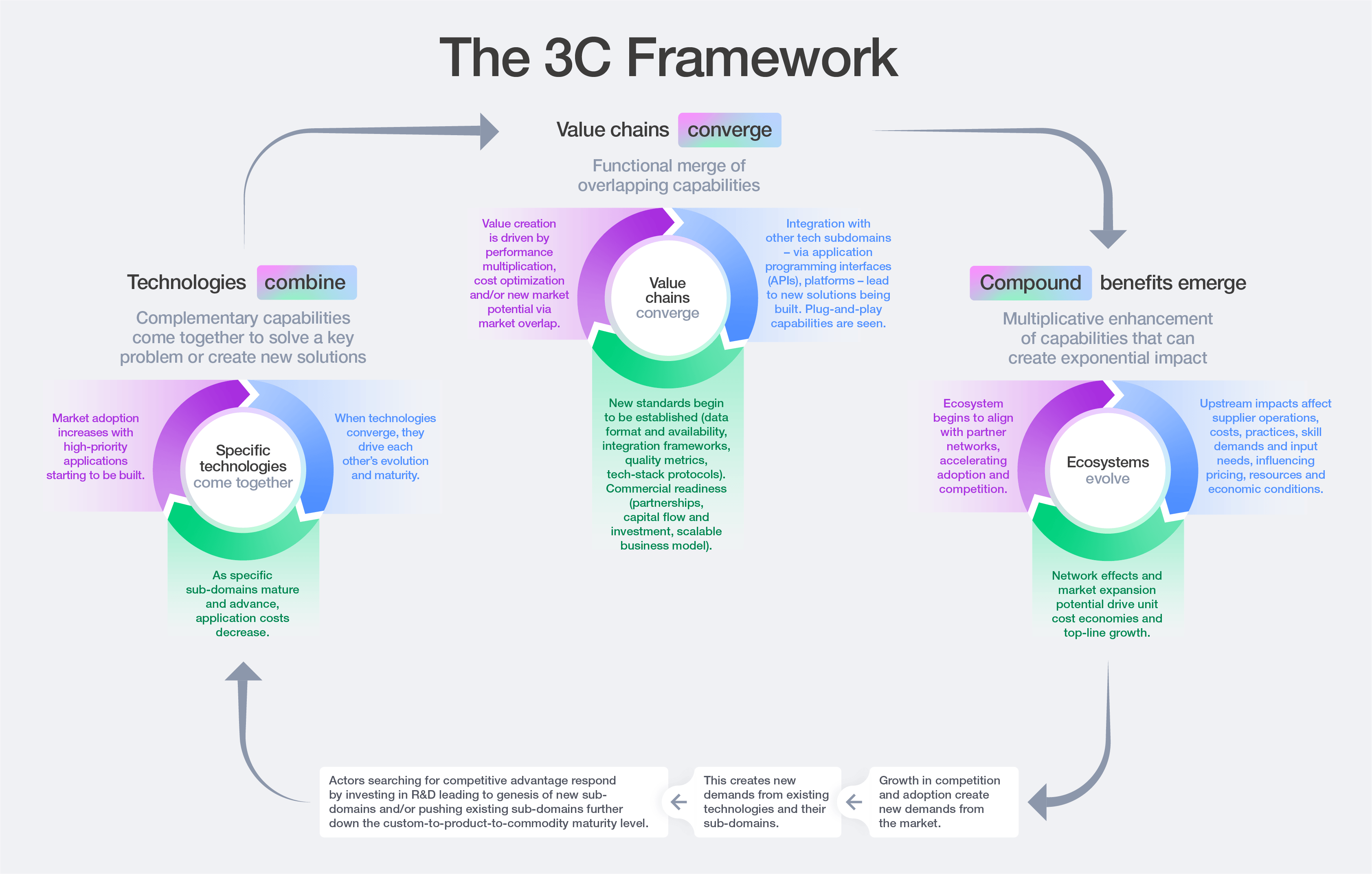
The 3C framework – combine, converge and compound – describes how innovation increasingly unfolds through systems rather than isolated breakthroughs.
- Combine: The integration of existing technologies, capabilities and data in new configurations. Innovation often begins by bringing together elements that already exist but have not been linked before.
- Converge: The blurring of boundaries between technologies, industries and value chains as these combinations mature. Distinctions between sectors erode, enabling new markets and business models to emerge.
- Compound: As combinations scale and converge, their impacts reinforce one another, accelerating productivity gains, market shifts and competitive disruption over time.
What is driving the next wave of technological convergence?
Convergence often follows a pattern: commoditized technologies combine with novel, genesis-stage components to create new capabilities.
Our maturity index tracks 246 technologies across eight domains, mapping their maturity from genesis to commodity solutions.
It maps how technologies mature and propel one another, revealing emerging capabilities, highlighting those nearing commercialization, explaining why maturity is accelerating and identifying who is leading.
Technological maturity is accelerating quickly in two notable areas: robotics and wearables.
Case study 1: Robotics – From factories to human spaces
Robots are moving from factories into dynamic real-world settings, driven by surging investment and innovation. Advances demonstrated in humanoid robotics are important markers of progress in sensing, mobility and human-robot collaboration, even though these capabilities are most often deployed in task‑specific forms.
This shift to dynamic environments is being driven by the evolving maturity of underlying technologies.
AI as foundation for robotic intelligence
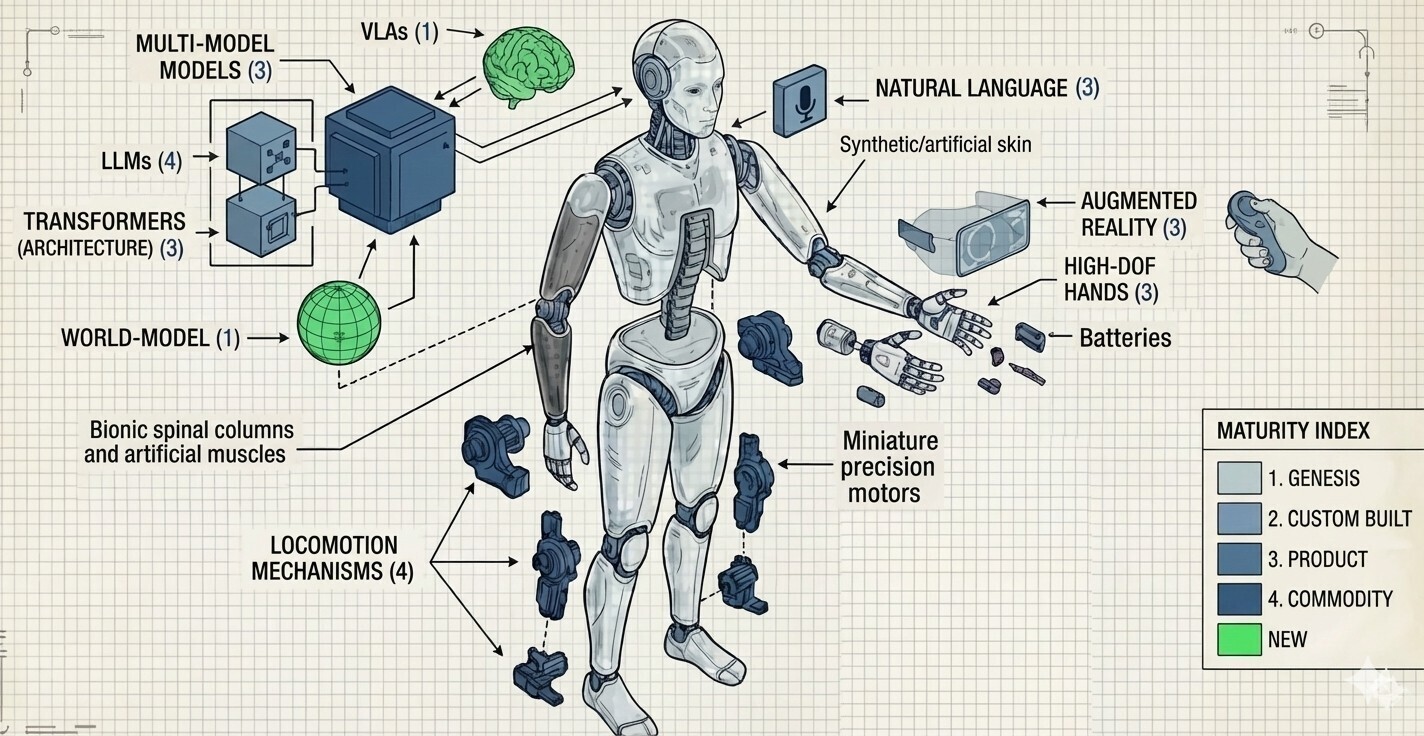
Large language models (LLMs), built on transformer architectures, defined the first wave of artificial intelligence (AI). But LLMs are becoming commoditized, driving down costs and enabling widespread adoption. This opened the door to multimodal models (MMMs), which integrate voice and images as well as text for richer perception.
Vision-language-action (VLA) models – a new tracked component this year that bridges the gap between robot interpretation and execution – go further. VLAs are critical for robots operating in unpredictable environments because they offer adaptive action.
These models can now run on the edge (on the device itself), enabling them to be deployed across a range of new devices.
Applied Intuition exemplifies how physical AI is being used in a range of industries by harnessing all of the above (LLMs, multimodal models and VLAs) to develop and validate autonomous machines, including next-generation tractors, submersible platforms, trucks and more.
Balancing autonomy and human intervention
MMMs enable natural human-robot interaction through speech and images. While introducing robots can bring enhanced capabilities, full autonomy carries risk.
Therefore, in critical domains, humans must retain the ability to guide, correct or override robot actions through a range of techniques, from teleoperation to physical controls in the robot.
From limited domains to broad deployments
Robots already deliver value in high-stakes, precise domains but two trends are expanding their reach.
First, hardware is becoming cheaper as more parts are mass-produced, reducing expenses for movement systems such as locomotion, where actuators and motors make up 40-60% of a robot's total cost.
Second, the rise of world models is transforming robotics. These AI systems simulate future states, allowing robots to plan and learn virtually instead of through costly physical iterations, making world models a new sub-component on our index this year.
How the Forum helps leaders make sense of AI and collaborate on responsible innovation
Case study 2: Wearables – From data collection to intelligent decisions
Wearables have moved beyond step counters and heart-rate trackers to become holistic monitoring systems. Today’s devices blend into daily life, from smart patches that track glucose levels to augmented reality (AR) glasses that transform how people experience and interact with the physical world.
Adoption is rising; recent surveys in the United States and Europe found approximately 50% of respondents used fitness wearables, with younger generations increasingly prioritizing wellness in their spending.
These changes make wearables smarter and more user-centric than ever, thanks to the maturity of the encompassing technologies.
Passive tracking to real-time interpretation
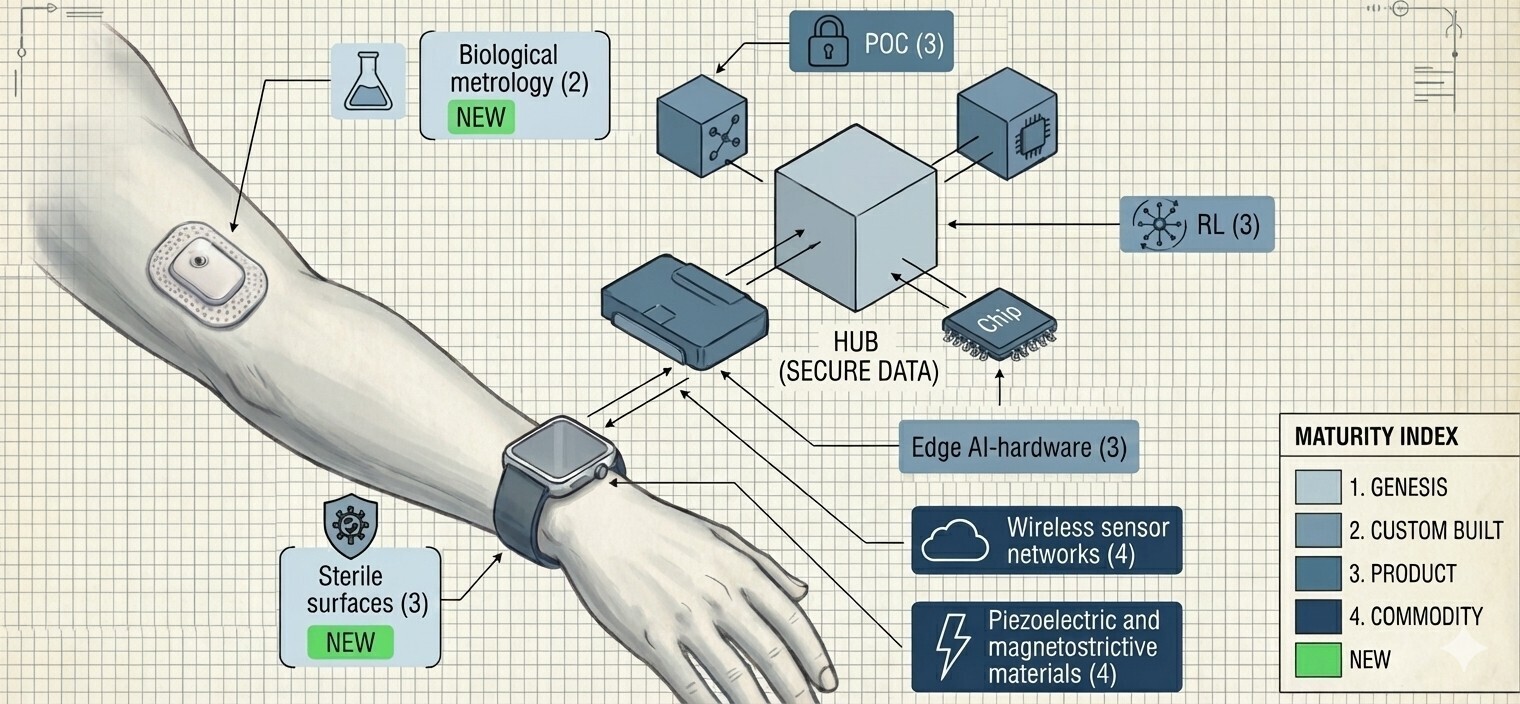
Health monitoring is becoming faster, smarter and more reliable. For instance, instant arrhythmia detection requires ultra-low-latency signal processing and real-time interpretation. Wearables now deliver this by shifting from being passive trackers to intelligent systems.
Advances in biological metrology provide accurate, long-term readings, making them “always-on.” Edge AI hardware and reinforcement learning enable on-device analysis without reliance on the cloud, while wireless sensor networks create seamless data-sharing ecosystems. These advances transform wearables into real-time interpreters of internal and external environments.
Comfort meets capability
Wearables succeed when they align with human needs. Skin-native, flexible patches enable continuous glucose monitoring with high comfort. Antimicrobial coatings eliminate the need for cleaning.
Motion-powered sensors with magnetoelectric wireless power remove the need to constantly recharge devices. These same principles apply to assistive innovation. Wearable designer Cognixion uses non-invasive brain sensors combined with AR to help people with speech impairments communicate, delivering capability without the discomfort and barriers associated with invasive tech.
Trust at scale
The ecosystem beyond wearables is just as critical. Adjacent technologies, such as post-quantum cryptography, ensure future-proof security for sensitive health data by resisting attacks from quantum computers, a non-negotiable in connected health.
The road ahead
Creative destruction is no longer a gamble but a necessity. As the examples of robotics and wearables demonstrate, the future belongs to those who master the 3Cs: combine, converge and compound.
The question isn’t whether these technologies will reshape industries but how organizations will scale the opportunities that convergence creates. To discover the broader shifts underway, visit our updated maturity index, highlighting emerging technologies, key changes and the forces driving them.
Don't miss any update on this topic
Create a free account and access your personalized content collection with our latest publications and analyses.
License and Republishing
World Economic Forum articles may be republished in accordance with the Creative Commons Attribution-NonCommercial-NoDerivatives 4.0 International Public License, and in accordance with our Terms of Use.
The views expressed in this article are those of the author alone and not the World Economic Forum.
Stay up to date:
Technological Revolutions
Related topics:


Forum Stories newsletter
Bringing you weekly curated insights and analysis on the global issues that matter.
More on Emerging TechnologiesSee all

Olumide Durotoluwa
March 6, 2026


